Turn 20 APS into a funded course in South Africa and match privately
Use a private APS calculator to find higher certificates, diplomas and ECPs you qualify for at South African institutions.

With an APS of 20 you qualify for many higher certificates, several entry-level diplomas and some extended curriculum programmes at institutions such as Tshwane University of Technology, UNISA and the University of Johannesburg. TVET colleges add further options in vocational fields. The catch: subject minimums in English, Mathematics or Mathematical Literacy still decide whether any specific programme accepts you, so run your actual marks through an APS calculator before you assume anything is off the table.
TL;DR:
- Many institutions accept APS of 20 mainly for higher certificates, entry-level diplomas, and extended programmes, but subject minimums must meet individual course requirements.
- Higher certificates at NQF level 5 are the most common qualification for APS 20 students, often leading to credit transfer into related diplomas or degree pathways.
- Subject-specific minimum passes in English and Mathematics or Mathematical Literacy are often more decisive than the total APS score in course eligibility.
- TVET colleges offer vocational courses and NATED trade programmes that accept lower APS scores, providing a practical route into various technical fields.
- Funding options like NSFAS, sector bursaries, and provincial schemes can support students with APS 20, especially if household income thresholds are met and deadlines are respected.
Table of Contents
- Which South African universities accept 20 APS courses?
- What kinds of qualifications does 20 APS actually open?
- TVET colleges: a vocational route that works at APS 20
- Why your subject marks matter more than your APS total
- Turning 20 APS into an actual application
- Paying for it: funding options at the APS 20 level
- Getting support once you’re enrolled
- Not every 20 APS course is equally competitive
- How AskSmarty was built for exactly this situation
- Your next move: check what you qualify for today
- Sources
- FAQ
Which South African universities accept 20 APS courses?
Not every university publishes programmes at this level, but several list higher certificates, foundation options, and select diplomas within reach for an APS 20 applicant. Here’s what to expect from each.
- University of Johannesburg (UJ) offers diplomas and bridging routes in select faculties where the APS bar sits closer to 20, particularly in extended programmes designed to build up underprepared students.
- UNISA runs a distance-learning model with many higher certificates and undergraduate qualifications that admit lower APS scores, since part-time and distance delivery carries different entry logic than full-time campus study.
- North-West University (NWU) lists extended bachelor’s and extended curriculum programmes at some campuses, aimed at foundation-track entry rather than mainstream degrees.
- Vaal University of Technology (VUT), Durban University of Technology (DUT) and Cape Peninsula University of Technology (CPUT) each carry a handful of higher certificates and technical diplomas with lower thresholds, usually in engineering support, business, or hospitality streams.
- University of Mpumalanga (UMP) advertises a higher certificate in ICT user support that has historically sat around the APS 20 mark, according to compiled programme examples.
- University of the Free State (UFS), University of KwaZulu-Natal (UKZN) and Walter Sisulu University (WSU) each run foundation or extended access programmes in specific faculties, though availability shifts year to year.
Treat every name above as a starting point, not a guarantee. Thresholds move between intake years, and the only reliable confirmation comes from the university’s own prospectus or admissions office.
What kinds of qualifications does 20 APS actually open?
An APS of 20 sits at the lower end of the university admission scale, which is why it maps almost entirely onto entry-level and access qualifications rather than standard three-year bachelor’s degrees. Understanding the qualification types helps you judge what you’re actually signing up for.
- Higher certificates run for one year at NQF Level 5. They’re the most common entry point at APS 20, covering fields like business administration, ICT user support, and education assistance.
- Entry-level diplomas span two to three years at NQF Level 6, typically in technical or applied fields such as hospitality management, policing, or public affairs.
- Extended curriculum programmes (ECPs) add a foundation year onto a standard degree, stretching a three-year qualification to four years so students can catch up on academic gaps before mainstream coursework begins.
- Bridging and foundation courses aren’t full qualifications on their own. They exist to lift a student’s academic readiness (and sometimes their effective APS) before re-applying to a mainstream programme the following year.
Representative subject areas at this level include business studies, tourism, creative arts, and public administration, alongside the ICT and hospitality streams already mentioned. The real value of a higher certificate or ECP isn’t the qualification itself; it’s the articulation route it opens. Most higher certificates allow direct credit transfer into a related diploma, and many ECPs feed straight into the mainstream version of the same degree once foundation requirements are cleared. Aggregated APS guidance confirms this banding pattern: scores around 20 to 22 typically unlock higher certificates and foundation routes, while diplomas open up closer to 25 and full bachelor’s programmes usually need 28 or higher.
TVET colleges: a vocational route that works at APS 20
TVET colleges run two main programme types. The National Certificate Vocational (NCV) is studied over three years at Levels 2 to 4 and blends theory with workplace skills. NATED (Report 191) programmes are shorter, more trade-focused courses often paired with practical work experience. Both accept students well below the APS thresholds universities require, since entry criteria are built around subject passes rather than an aggregate score.
- Engineering trades (fitting, turning, electrical) remain the most in-demand NCV and NATED streams.
- Hospitality, tourism and business administration are widely available and generally have lower entry barriers than engineering.
- IT support and office administration NATED courses accept a broad range of matric outcomes.
Several colleges also run credit articulation agreements that let NATED or NCV graduates move into a related higher certificate or diploma at a university of technology.
Pro Tip: If your APS of 20 comes with a weak Mathematics or English mark, a NATED N-course can sometimes get you into the same career field faster than waiting a year to rewrite matric subjects.
Why your subject marks matter more than your APS total
An APS of 20 opens doors on paper, but individual subject minimums close plenty of them right back up. Most higher certificates and diplomas require at least a Level 3 or 4 pass in English, and many technical programmes specify Mathematics rather than Mathematical Literacy, even at this entry level. Admissions analysts are consistent on this point: your total score gets you through the first filter, but departmental subject rules decide the rest.
Some programmes add selection layers that have nothing to do with APS at all: portfolios for design and creative arts courses, auditions for performing arts, and departmental tests for programmes like policing or nursing-adjacent fields. These rules live in the faculty-specific section of a prospectus, not the general admissions page, so skimming the wrong document is the single most common mistake applicants make.
Before you commit to a shortlist, run this check:
- Confirm the published APS and the minimum subject levels for each course, not just the total.
- Check whether Mathematics is compulsory or whether Mathematical Literacy is accepted.
- Look for portfolio, audition, or test requirements buried in faculty-specific pages.
- If you fall short on one subject, ask about bridging courses or NATED alternatives before writing off the field entirely.
Turning 20 APS into an actual application
Getting from “I have 20 APS” to “I’m enrolled” takes a handful of concrete steps, and doing them in order saves you from wasted applications.
- Calculate your exact APS and your subject-level breakdown using a tool like the APS calculator guide, since a rough mental estimate is where most mismatches start.
- Search for programmes that match both your total and your subject marks through a national programme database rather than relying on one university’s site alone.
- Pull the current prospectus for each shortlisted course and check the faculty-specific subject rules directly.
- Note every application deadline, since universities of technology often close earlier than traditional universities.
- Gather documents early: certified ID copy, final matric results or statement of results, and proof of payment for any application fee.
If direct entry isn’t realistic this year, an extended curriculum programme or a TVET bridging route keeps you moving instead of forcing a gap year.
- Extended programmes add one foundation year but end in the same qualification as the mainstream degree.
- NATED and NCV courses can articulate into a related higher certificate later, so a “lower” starting point isn’t a dead end.
Paying for it: funding options at the APS 20 level
Money is often the bigger obstacle than the APS score itself, and the good news is that funding at this qualification level isn’t limited to one source. NSFAS remains the primary funding mechanism for higher certificates and diplomas at public universities and TVET colleges, and it applies the same household income threshold regardless of whether you’re entering a bachelor’s degree or a one-year higher certificate.
Beyond NSFAS, look at three other channels. University-specific bursaries often exist specifically for access and foundation programmes, since institutions have an incentive to support students who need an extra year to catch up academically. Sector-specific bursaries, particularly in engineering trades, hospitality, and public sector fields like policing, frequently target TVET and higher-certificate students rather than only degree candidates. Provincial government bursary schemes, run through departments of education or economic development, also tend to fund vocational and entry-level qualifications more generously than they fund mainstream degrees, since the intent is to grow the technical workforce.
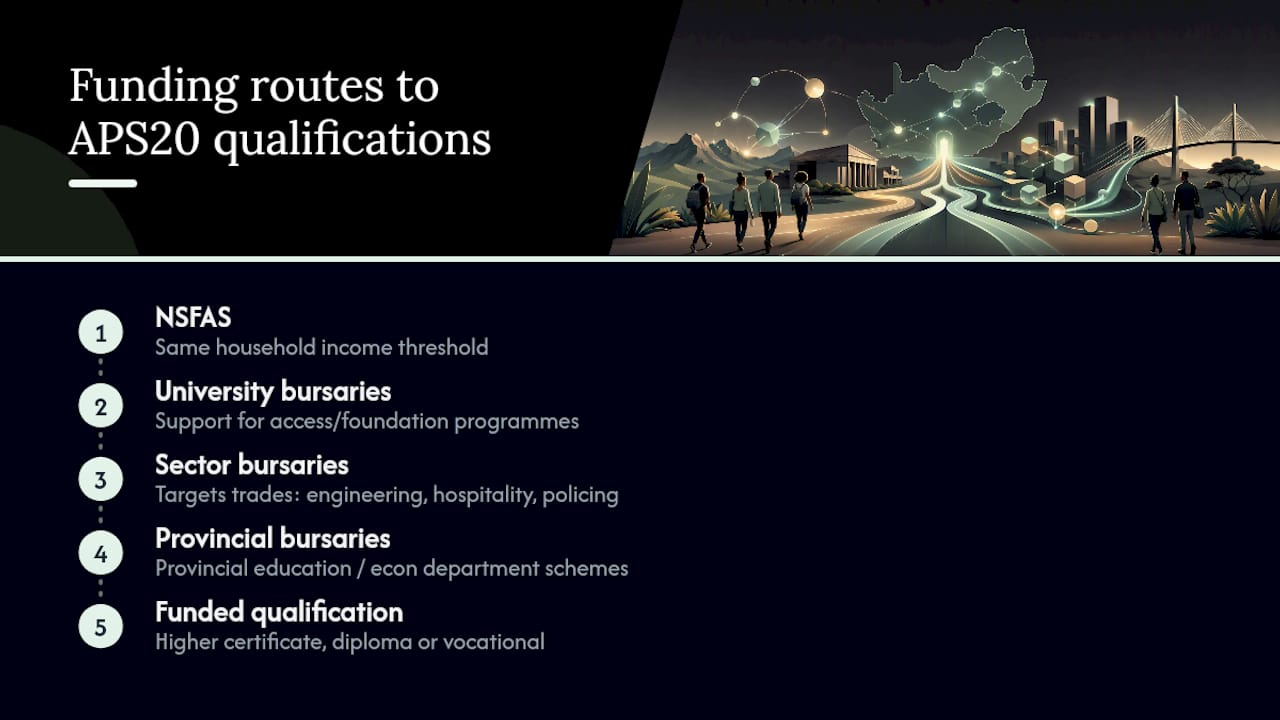
The mistake many APS 20 applicants make is assuming funding only exists for “real” degrees. In practice, a higher certificate or NATED qualification is just as fundable through NSFAS as a bachelor’s programme, provided your household falls within the income bracket and you apply before the closing date. Missing the NSFAS deadline is far more common than missing an academic deadline, so check the application fee structures for every institution on your shortlist and confirm funding timelines alongside academic ones, not after.
Getting support once you’re enrolled
Starting a higher certificate or extended programme with an APS of 20 usually means starting from a slightly weaker academic base than students who entered mainstream degrees directly. Universities know this, and most build support structures specifically for this cohort rather than expecting students to sink or swim.
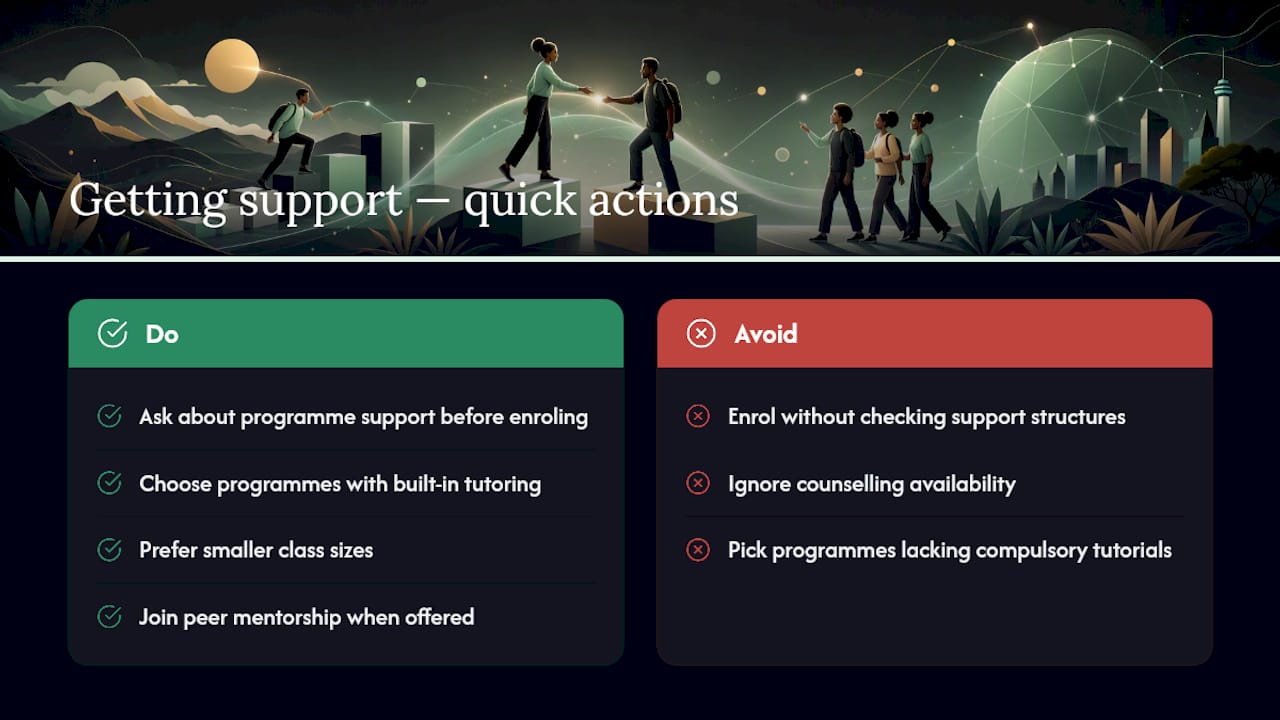
Academic tutoring is typically bundled into extended curriculum programmes by design. These programmes exist precisely because the institution expects students to need additional contact time, so tutorial sessions in core subjects like Mathematics, academic literacy, and foundational sciences are usually compulsory rather than optional. Higher certificates at universities of technology often run smaller class sizes than mainstream degree cohorts, which gives lecturers more room to flag struggling students early.
Mentorship programmes, often peer-led, pair first-year students with senior students in the same faculty. These tend to be strongest at institutions with large extended programme intakes, since the university has a direct interest in improving throughput rates for exactly this group. Counselling services, covering both academic planning and personal wellbeing, are standard across public universities and TVET colleges, though the depth of the service varies by campus size.
The practical lesson here: if you’re entering on an APS of 20, ask about the specific support structure attached to your programme before you enrol, not after you’re struggling. A foundation programme with strong built-in tutoring gives you a real shot at articulating into the mainstream degree; one without it leaves you more exposed.
Not every 20 APS course is equally competitive
Two programmes can both list an APS of 20 and still have wildly different odds of getting you in, because APS is a floor, not a queue position. Popular higher certificates in business administration or ICT user support at well-known universities of technology often receive far more applications than available seats, which means the university quietly raises the effective bar through subject marks, application order, or first-come allocation, even though the published APS stays at 20.
Less competitive options tend to be niche technical diplomas, TVET NATED courses in trades with lower application volume, and extended programmes at campuses outside the major metros. These aren’t lesser qualifications; they’re simply less oversubscribed, which means your APS of 20 carries more actual weight in the decision.
The practical implication: don’t anchor your entire application strategy on one popular course. Apply to a spread that includes at least one programme where demand is lower relative to available seats, alongside your first choice. A searchable programme database that shows you the full range of options at your APS band, rather than just the well-known names, makes it far easier to spot where your odds are genuinely better.
How AskSmarty was built for exactly this situation
I built AskSmarty’s calculator around a simple frustration: too many matriculants with borderline scores give up on university altogether because they only ever hear about the mainstream degree they didn’t qualify for. If your APS is 20, punch your actual marks into the APS calculator, and it filters our database of over 1,700 programmes down to what you genuinely qualify for right now, without your marks ever leaving your device.
Picture a student with 20 APS, a Level 4 in English and a Level 3 in Maths Literacy. Running those marks through the tool surfaces higher certificates and extended programmes they’d never have found by guessing university websites one at a time. Test your own marks, pull the matching prospectuses, and apply with a clear shortlist instead of a hopeful guess.
— Nkosi
Your next move: check what you qualify for today
Reading about APS bands only gets you so far. The programmes and institutions listed here shift slightly every intake, and the only way to know exactly what your 20 APS opens right now is to check your actual marks against live entry requirements.
That’s what AskSmarty’s tools exist for. The APS calculator takes your subject marks and shows matching programmes instantly, without sending your results anywhere. The programme search lets you filter by qualification type, APS band, and subject requirements across the full national database. And the admission requirements guide breaks down exactly how APS, NSC passes, and NQF levels interact, so you’re not relying on a general prospectus to figure out whether you qualify.
Try the APS calculator now, or search programmes you qualify for and build a shortlist worth applying to.
Sources
- UNISA undergraduate qualifications and admission information
- APS score requirements for South African universities (EduFunds)
- What and where you can study with 20 points (Varsity Wise)
FAQ
What can I study with 20 APS points?
You typically qualify for higher certificates, some entry-level diplomas, and extended curriculum programmes at institutions like TUT, UNISA, and UJ, plus NCV or NATED courses at TVET colleges, provided your subject marks meet each programme’s specific minimums.
Does UJ accept 20 APS?
UJ accepts APS 20 for select diplomas and bridging or extended programmes in specific faculties, though mainstream bachelor’s degrees generally require a higher score, so check the current UJ prospectus for the exact programme.
Which courses require 20 APS at TUT?
TUT lists several higher certificates and select diplomas with APS thresholds around 18 to 20, though the exact list changes by intake, so confirm through TUT’s official admissions page before applying.
What is a 20 APS score?
A 20 APS score is a mid-to-low aggregate calculated from your best six matric subjects (excluding Life Orientation), and it sits toward the lower end of the range South African universities use for admission, opening access-level qualifications rather than full bachelor’s degrees.
What can I study with 22 or 24 APS?
An APS in the low twenties opens a similar mix of higher certificates and diplomas, with slightly more diploma options and a few extended bachelor’s programmes becoming reachable as the score climbs toward 25.
Recommended
Published 2026-09-01 · AskSmarty is an independent guide. Confirm anything time-sensitive on the official source.