APS requirements UCT: FPS, NBT deadlines and checklist for 2027
Discover the essential APS requirements for UCT, including Faculty Points Score details and important deadlines for 2027 admissions.

APS requirements UCT: what most guides skip is that the University of Cape Town doesn’t use a standard 7-point APS scale at all. UCT ranks applicants with a Faculty Points Score (FPS) built from your six best NSC percentage marks, and Life Orientation never counts. For most faculties, FPS simply equals your APS, the sum of six raw percentages. Science and Health Sciences change that formula.
Before you calculate anything, know the non-negotiables. You need English among your six subjects, along with any subject your target programme specifies. Life Orientation and AP subjects never count toward your six, and any subject mark under 40% scores a flat zero. You also need a bachelor’s endorsement, an achievement rating of 4 or better in four subjects, though meeting that minimum doesn’t guarantee a seat.
- Confirm your six best contributing subjects (English plus programme requirements)
- Check that no subject you’re counting scored below 40%
- Register for the National Benchmark Tests before you apply
- Health Sciences applicants: write NBTs by 31 July 2026 for conditional-offer consideration
- All other applicants: write NBTs by 3 October 2026
Key Takeaways
UCT ranks applicants using raw NSC percentage sums (FPS), with Science doubling key subjects and Health Sciences adding NBT scores, and meeting minimums never guarantees a spot.
| Point | Details |
|---|---|
| APS uses raw percentages | A percentage mark translates directly to points at UCT, unlike 7-point APS scales elsewhere. |
| Six subjects, no Life Orientation | Include English plus programme-required subjects; exclude Life Orientation and AP subjects. |
| Faculty rules change the maximum | Science doubles Maths and Physical Sciences (out of 800); Health Sciences adds NBT scores (out of 900). |
| NBT deadlines are fixed | Health Sciences applicants write by 31 July 2026; other applicants by 3 October 2026. |
| Use a calculator to check eligibility | AskSmarty’s free APS calculator matches your NSC marks to qualifying programmes across universities. |
Table of Contents
- How is the APS requirement for UCT calculated?
- What should applicants actually prioritize first?
- How AskSmarty turns this into a plan you can act on
- Where to verify these rules before you apply
- Sources
- FAQ
How is the APS requirement for UCT calculated?
The math itself is simple. The faculty adjustments are where students trip up.
Step 1: Pick your six subjects. English is compulsory, and you add any subject your intended programme requires (Mathematics for Commerce, Physical Sciences for Engineering, and so on). Life Orientation is excluded automatically, and so are Additional/AP subjects that don’t count toward the NSC’s core seven.
Step 2: Convert marks to points. This is the part that surprises people coming from other university systems. Add your six percentages together and you get an APS out of 600.
Step 3: Apply faculty-specific rules. For Commerce, Engineering & the Built Environment, Humanities, and Law, your FPS is your APS, unchanged, out of 600. Applying for Science flips that: UCT doubles your Mathematics and Physical Sciences marks, pushing the maximum to 800. Health Sciences goes further still, adding your three NBT percentage scores (Academic Literacy, Quantitative Literacy, and Mathematics where relevant) to your APS for an FPS out of 900.
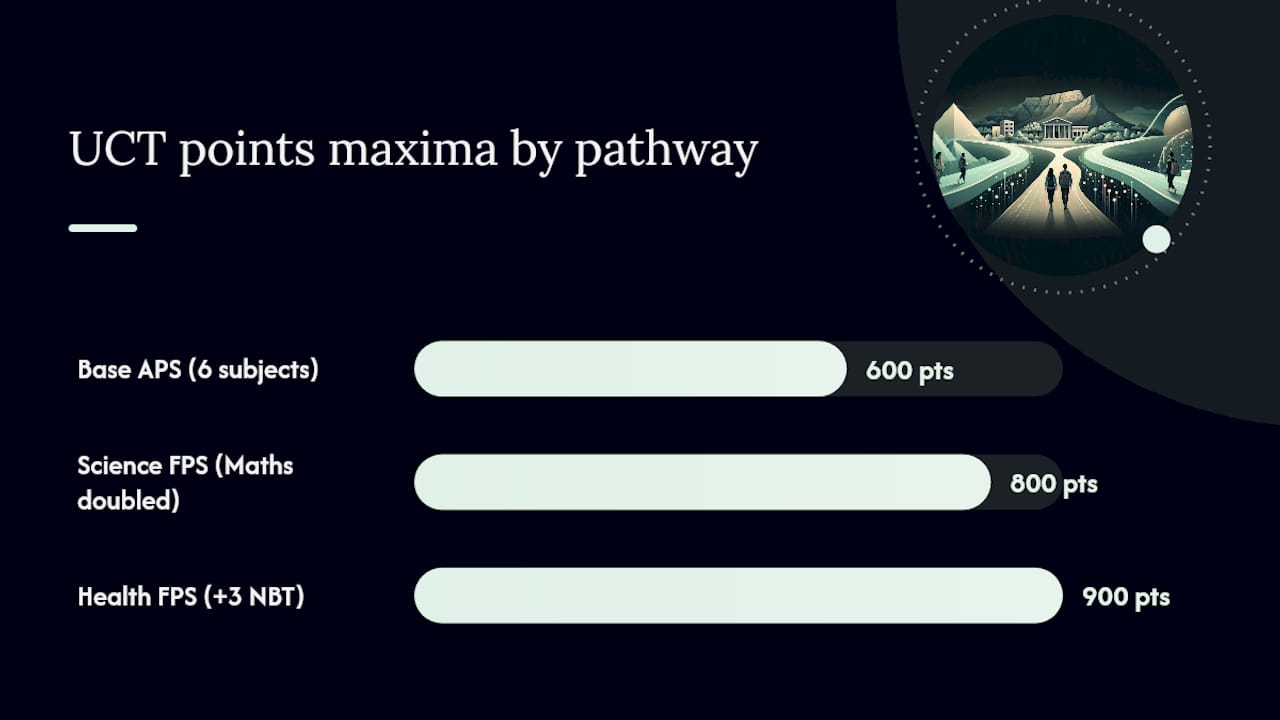
Here’s a worked example. That’s an APS of 393 out of 600, enough for many Humanities or Commerce programmes. Apply to Science, though, and Maths and Physical Sciences each get counted twice: 393 plus an extra 72 plus an extra 70 gives an FPS of 535 out of 800. Apply to Health Sciences instead, and the student’s three NBT percentages (say 65, 70, and 60) get added to the base APS of 393, producing an FPS of 588 out of 900.
South African applicants may also qualify for a disadvantage factor, applied as a percentage uplift to FPS (typically 0 to 10%, up to 20% for Health Sciences), producing a Weighted Points Score that can shift where you rank against other applicants.
- Select your six subjects, English plus programme requirements
- Sum the raw percentages for your base APS
- Double Maths and Physical Sciences if applying to Science
- Add your three NBT scores if applying to Health Sciences
- Check whether a disadvantage factor applies to your WPS
Before submitting anything, check that the marks on your school transcript match your official NSC certificate exactly, and confirm your NBT registration number is entered correctly in your UCT application.
Pro Tip: If Science or Health Sciences is your target, every percentage point in Maths and Physical Sciences counts double in your final FPS. Spend your last matric terms shoring up those two subjects specifically, and register for an NBT sitting as early as possible so a conditional offer stays on the table.
What should applicants actually prioritize first?
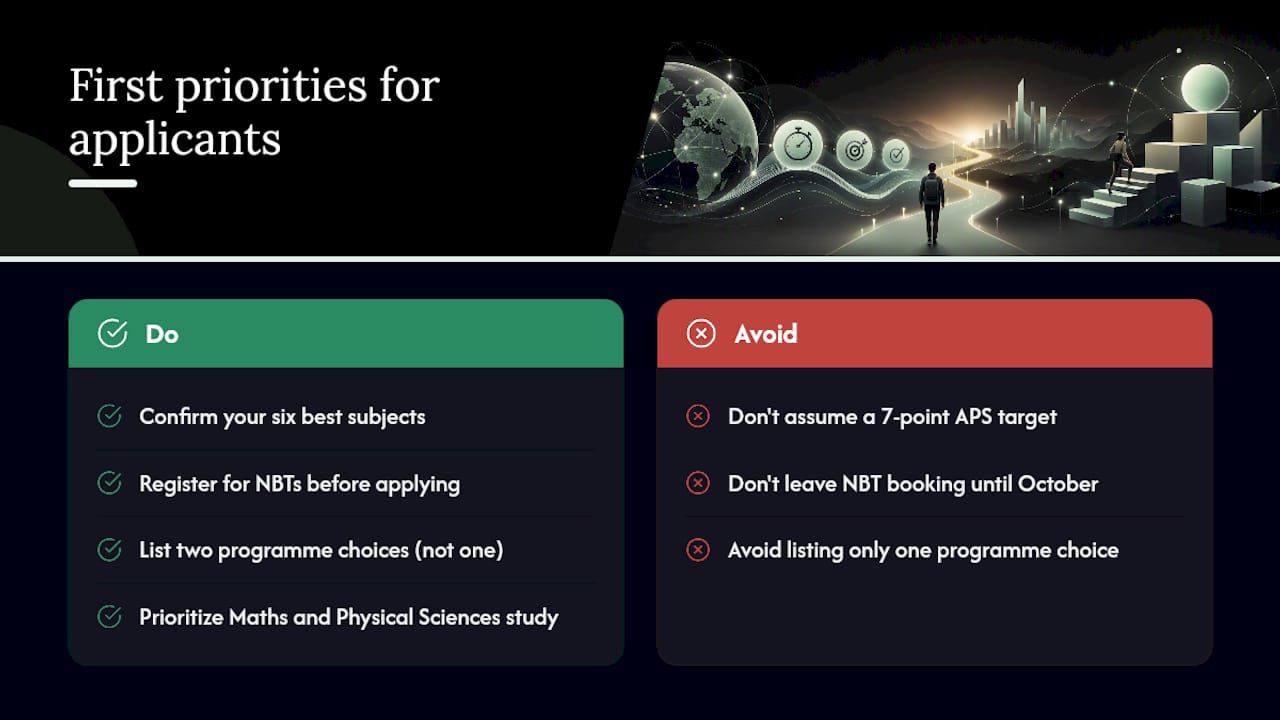
Confirm your six best subjects, register for the NBTs before you even open the application, and list two programme choices rather than one. That last point gets overlooked constantly.
The biggest misconception I see repeated in parent WhatsApp groups is treating UCT like a generic 7-point APS university. It isn’t. Students who assume a “30 points” target from another university’s scale often misjudge their real competitiveness at UCT entirely.
If Science or Health Sciences is on your list, protect study time for Maths and Physical Sciences above everything else, and don’t leave your NBT booking until October.
How AskSmarty turns this into a plan you can act on
Working through six-subject APS sums, faculty doublings, NBT additions, and a possible disadvantage factor by hand is where most families lose confidence, not because the math is hard, but because it’s easy to mismatch a rule to the wrong faculty. AskSmarty’s APS calculator does that conversion for you: enter your NSC marks once, and it shows which programmes you actually qualify for across UCT and other South African institutions, without asking for an email address or sending your marks anywhere.
Beyond the calculator, AskSmarty’s university guides link out to prospectus downloads, deadline trackers, and application fee details for institutions nationwide, so you’re not toggling between a dozen browser tabs during application season. If you’re still narrowing down programme choices, the programme finder lets you compare a second or third option alongside UCT, which matters given how competitive FPS-based selection actually is.
Run your marks through the calculator now, and keep your NBT registration number saved somewhere you won’t lose it before application day.
Where to verify these rules before you apply
- UCT eligibility and admissions page for current FPS rules
- 2027 UCT undergraduate prospectus for worked calculation examples
- Directions for undergraduate applicants for NBT registration steps
- nbt.ac.za for NBT test dates and formats
- AskSmarty’s UCT guide and APS calculator
Sources
- Eligibility for admission | Applicants & Students
- Directions for undergraduate applicants (2027)
- 2027 UCT undergraduate prospectus (1 April 2026)
FAQ
What is the minimum APS for UCT?
There’s no single minimum APS across UCT, since requirements vary by faculty and programme, but every applicant needs a bachelor’s endorsement (an achievement rating of 4 or better in four subjects) as a baseline.
Does UCT use a 7-point APS system?
No.
What happens if I miss the NBT deadline?
Missing the 3 October 2026 deadline (or 31 July 2026 for Health Sciences) removes you from conditional-offer consideration and pushes your assessment back until final NSC results are released.
How can I check which programmes I qualify for?
AskSmarty’s APS calculator lets you enter your NSC marks directly and see matching programmes across UCT and other South African universities without sharing your data.
Does a disadvantage factor affect every applicant?
Recommended
Published 2026-08-21 · AskSmarty is an independent guide. Confirm anything time-sensitive on the official source.