APS Requirements UJ: Aim for a 1–2 Point Buffer in South Africa
Calculate your UJ APS, check required subjects, and learn why a 1–2 point buffer helps. Match your score privately with a free APS calculator.

UJ calculates your Admission Point Score from your best six NSC or IEB subjects, and Life Orientation never counts toward that total. Each subject percentage converts to a point on a 1 to 7 band, so the maximum possible APS is 42. Baseline cut-offs run roughly from 20 to 22 for extended diplomas, up to the high 20s and beyond for competitive bachelor’s degrees. Calculate your own APS first, then check the specific programme’s subject minimums before you apply.
TL;DR:
- Most successful applicants with UJ’s APS scores land between 24 and 36, depending on the program’s competitiveness and demand.
- A minimum APS of 20 to 22 generally qualifies applicants for extended diploma programs, while high-demand faculties often require above 34 points.
- APS conversion is based on a 1 to 7 band aligned with subject percentages, with 80-100% achieving 7 points and 0-29% earning 1 point.
- Subject-specific minimums, such as a certain symbol in Mathematics or a language requirement, are crucial and can disqualify applicants despite meeting the overall APS.
- Building a buffer of one to two points above the published minimum APS improves chances in competitive years and prevents rejection due to demand-driven cut-offs.
Table of Contents
- How UJ calculates your APS
- What APS you need for different UJ qualifications
- Subject requirements and programme-specific rules
- Selection, buffers and timing: what your APS does and doesn’t guarantee
- How to calculate your UJ APS step-by-step
- How to check which UJ courses you qualify for
- Perspective: pragmatic advice from an admissions-guide viewpoint
- Try Asksmarty’s free APS calculator and course matching
- Sources
- FAQ
How UJ calculates your APS
UJ’s method is straightforward once you see the mechanics. You take your six best subject percentages from Grade 12, exclude Life Orientation entirely, and convert each one into a points value using a fixed band. Add those six numbers and you have your APS.
The University of Johannesburg’s academic regulations set out the exact conversion table:
- 80–100% = 7 points
- 70–79% = 6 points
- 60–69% = 5 points
- 50–59% = 4 points
- 40–49% = 3 points
- 30–39% = 2 points
- 0–29% = 1 point
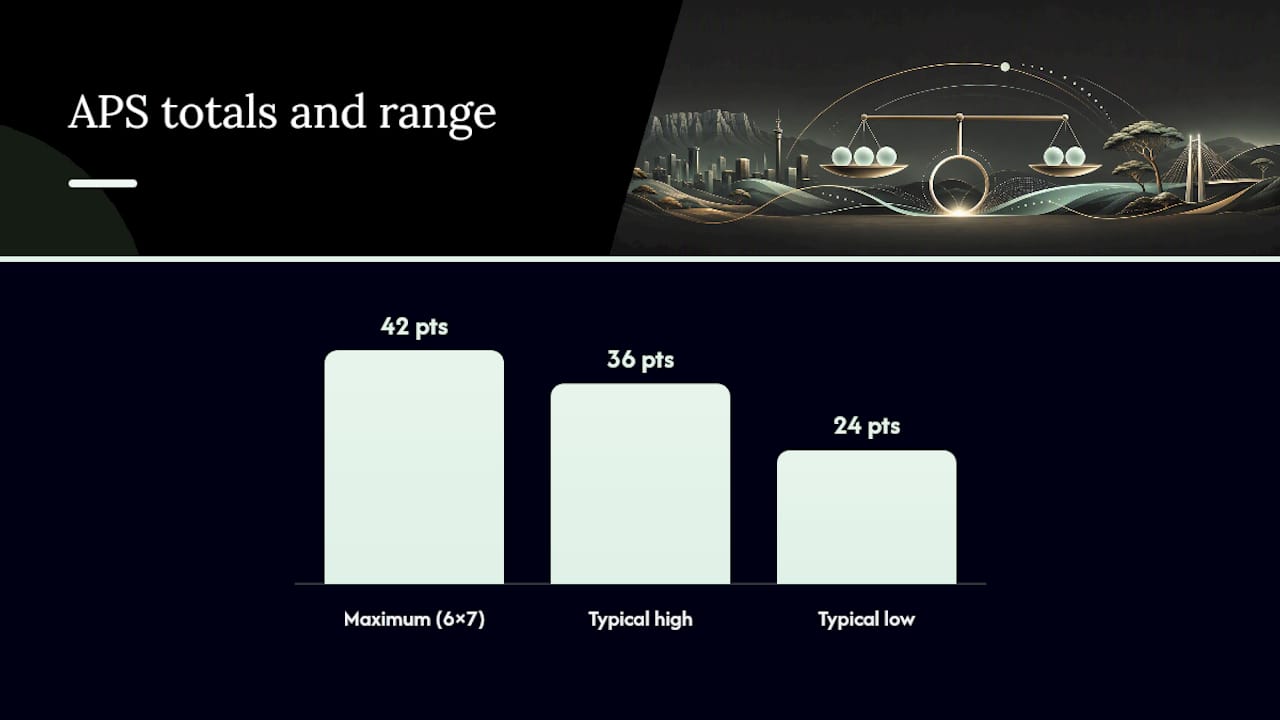
Six subjects at a maximum of 7 points each gives you the ceiling of 42. In practice, almost nobody hits that. Most successful applicants land somewhere between 24 and 36, depending on the programme.
Which six subjects count matters as much as the maths itself. Your home language or language of learning and teaching counts, along with an additional recognised language, plus whatever subjects a given programme lists as compulsory. Life Orientation sits outside all of this no matter how well you did in it.
If you’re not coming from a standard NSC or IEB background, the rules shift. UJ maps international qualifications to equivalent point values, but there’s one hard line worth knowing: the university does not accept the American GED for undergraduate curricular entry. Applicants need an NSC, an IEB certificate, or another qualification UJ formally recognises as equivalent. If you’re unsure where your certificate stands, that’s worth confirming with UJ directly before you build your application around an assumed APS.
What APS you need for different UJ qualifications
Numbers on their own don’t tell you much until you attach them to actual programmes. UJ’s prospectus groups minimum APS requirements by qualification type, and the spread is wide enough that a five-point difference in your score can shift you between entirely different categories of study.
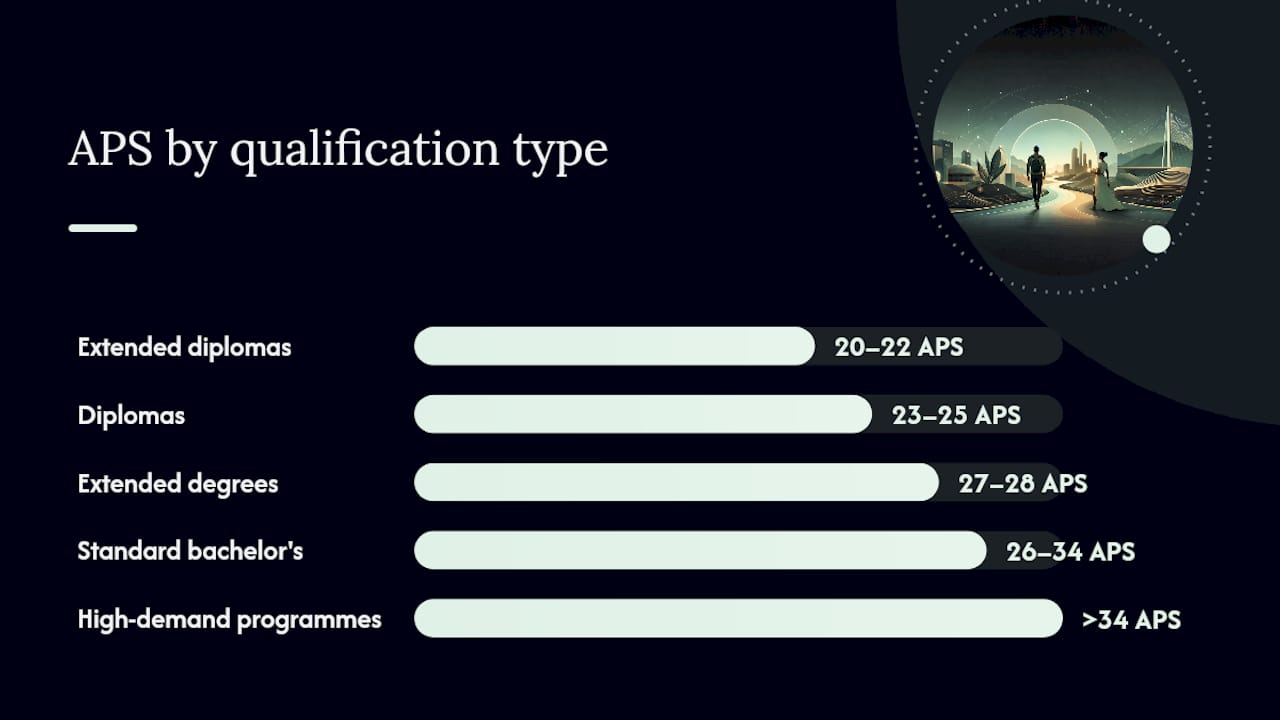
Rough baseline ranges look like this:
- Extended diplomas: roughly 20 to 22 APS
- Diplomas: roughly 23 to 25 APS
- Extended degrees (with a foundation or bridging year built in): roughly 27 to 28 APS
- Standard bachelor’s degrees: roughly 26 to 34 APS, depending on the faculty.
- High demand programmes (Engineering, Health Sciences, certain Commerce streams): often above 34, sometimes climbing higher in a given intake year
The UJ Undergraduate Prospectus lists these minimums programme by programme, and it also carves out conditional entry rules for mature age applicants and students who’ve previously qualified for higher education, which can open doors even when a school leaving APS falls short.
Here’s the part a lot of applicants miss: these published numbers are floors, not guarantees. A Bachelor of Education programme might list a minimum in the mid 20s, a BCom stream might sit a few points higher, and Engineering or Health Sciences programmes routinely draw far more applicants than there are seats. When that happens, UJ doesn’t lower the bar. It raises the effective cut-off by selecting from the top of the applicant pool downward until the class is full.
That’s why the minimum APS printed in the prospectus and the APS you actually need to get in during a competitive year can be two different numbers. Treat the published figure as the entry ticket to the queue, not a seat in the classroom.
Subject requirements and programme-specific rules
Your total APS gets you through the first filter, but it’s not the whole story. Every programme also sets subject-specific requirements, and missing one of those disqualifies you even with an APS well above the minimum.
- Check the subject symbol, not just the total. Many programmes demand a specific achievement level in a named subject. Mathematics is the classic example. A Commerce or Engineering degree might require a symbol of 3 or higher in Mathematics specifically, separate from your overall points count.
- Confirm your language requirement. UJ programmes typically require a pass in the language of instruction and in an additional recognised language, and the required level can vary by faculty.
- Understand that substitutions are limited. You generally cannot swap out a compulsory subject for another one just because your APS is strong. A high overall score does not override a missing prerequisite subject.
- Know your fallback options if you’re short a subject. UJ’s admissions guidance points toward alternate programmes, bridging courses, and matric subject upgrades as routes forward if you’re missing something a specific degree demands, and an extended diploma pathway can sometimes let you bridge into the full degree later.
- Remember Life Orientation carries zero weight here too. It doesn’t count toward your APS, and it can’t substitute for a required subject symbol either.
This is the gap that trips up a surprising number of otherwise qualified applicants: strong APS, missing Mathematics at the required level, and a rejection they didn’t see coming.
Selection, buffers and timing: what your APS does and doesn’t guarantee
Meeting the published minimum APS puts you in the applicant pool. It does not put you in the class. UJ ranks applicants by merit and selects according to available space, and once a programme fills, later applicants with an APS at or even above the minimum can still be turned away.
A few practical realities follow from that:
- Oversubscribed faculties often require applicants to achieve an APS score somewhat higher than the listed minimum, particularly in Engineering, Health Sciences, and Law.
- You get two study choices per academic year, and you cannot amend them once submitted, so both need to be realistic.
- Final selection often happens after Matric results are released, meaning your provisional APS from mid-year results can shift, for better or worse, once your final marks land.
- If your final results push your APS up, some programmes allow late reconsideration, but this depends on space still being available at that point in the cycle.
Pro Tip: Don’t apply with your minimum-APS programme as your only realistic option. Aim for a one to two point buffer above the published cut-off for any competitive faculty, and use your second choice as a genuine backup rather than a repeat of your first.
How to calculate your UJ APS step-by-step
The calculation itself takes about five minutes once you have your results in front of you. Here’s the process UJ’s own guidance walks through.
- List your six best NSC or IEB subject percentages, excluding Life Orientation entirely.
- Convert each percentage into its points value using the 1 to 7 band (80 to 100% equals 7 points, down to 0 to 29% equals 1 point).
- Add the six point values together. The sum is your APS, capped at 42.
- Cross-check the result against your target programme’s published minimum in the UJ prospectus.
A worked example makes this concrete. Say your six best subjects came in at 78%, 65%, 72%, 58%, 81%, and 69%. That converts to 6, 5, 6, 4, 7, and 5 points respectively.
Add those six values and you get an APS of 33, comfortably above the baseline for most standard bachelor’s degrees but potentially short for the most competitive Health Sciences or Engineering streams in a high-demand intake year.
The UJ APS Score Calculator PDF runs through this exact conversion with its own worked examples if you want to see the official version side by side. For a faster check that also tells you which programmes your score actually opens up, AskSmarty’s APS calculator runs the same math and matches it against real UJ entry requirements without asking you to upload your marks anywhere.
How to check which UJ courses you qualify for
Once you know your APS, the next job is matching it against real programme requirements rather than guessing from general ranges. UJ’s prospectus and programme pages are the authoritative source for exact minimums, and they update from one intake to the next, so don’t rely on last year’s number if you can help it.
A practical checklist before you submit anything:
- Confirm the subject-specific symbol requirements for your target programme, not just the total APS.
- Check the current application deadline for that qualification and faculty.
- Choose two realistic options rather than two aspirational long shots, since you can’t change your choices later.
- If you’re short on a required subject or a few APS points, look into whether an extended programme or bridging route is available for that faculty.
AskSmarty’s programme search matches your marks privately against UJ’s live requirements alongside thousands of other South African programmes, which turns this checklist into a five-minute task instead of an afternoon of cross-referencing PDFs. You can also work directly through UJ’s own programme listings to confirm what you find.
Perspective: pragmatic advice from an admissions-guide viewpoint
Every application season, students get rejected from programmes their APS technically qualified them for. It’s rarely the APS calculation that fails them. It’s assuming the minimum is the actual bar in a year when demand pushed the real cut-off five points higher.
Build in a buffer for anything competitive, verify every number against UJ’s own pages before you commit a choice to it, and don’t treat a bridging or extended pathway as a lesser option. It’s often the more realistic route into a strong degree. Use a tool like AskSmarty to shortlist quickly, then confirm the details yourself.
— Nkosi
Try Asksmarty’s free APS calculator and course matching
Working out your APS by hand is doable, but checking it against thousands of programme minimums one by one isn’t a realistic way to spend your afternoon. Asksmarty solves that specific problem: enter your marks once, and you get an instant, private match against more than 1,700 university and college programmes across South Africa, UJ included, with no marks ever leaving your device.

There’s no upload, no account creation, and no fee. You get the same APS math UJ’s own calculator uses, paired with a searchable database that shows you exactly which programmes your score currently opens up and which ones need a few more points. If you’re weighing an extended diploma against a standard degree, or wondering whether your Mathematics symbol clears a specific Engineering programme’s bar, that comparison happens instantly rather than page by page through a prospectus PDF.
Head to the APS and admission requirements guide to see how the full points system works across every South African institution, then run your own numbers through the calculator to see your real shortlist for this year’s UJ intake.
Sources
- University of Johannesburg academic regulations (APS table)
- UJ Undergraduate Prospectus 2022 (minimum APS per programme type)
- How to determine your Admission Point Score (APS) — UJ APS Score Calculator PDF
FAQ
How many APS does UJ need?
There’s no single figure since it varies by programme, but baseline minimums start around 20 to 22 for extended diplomas and climb into the high 20s and 30s for standard bachelor’s degrees and competitive faculties.
What can I study with 22 APS at UJ?
An APS of 22 typically qualifies you for extended diploma programmes, which include a foundation or bridging component built into the qualification structure.
Can I go to university with 20 APS?
An APS of 20 can qualify you for select extended diploma programmes at UJ, though you’ll still need to meet any subject-specific symbol requirements for that particular programme.
What is a 27 APS score?
An APS of 27 typically sits in the range for extended degree programmes and some standard diplomas, and it can qualify you for certain bachelor’s degrees depending on the faculty and that year’s demand.
Recommended
Published 2026-09-13 · AskSmarty is an independent guide. Confirm anything time-sensitive on the official source.