What 30, 34, 44+ APS Gets You at Wits, for South African Matriculants
How Wits turns your best seven marks into an APS, why 30 is only a floor, which 30/34/44+ bands open degrees, and how to calculate yours.

Wits calculates your Admission Point Score from your best seven subjects, Life Orientation included, and 30 is the lowest APS the university will consider for any degree, though most admitted students have higher scores. That number is misleading on its own: most students who actually get offers present an APS of 34 or higher. Work out your own APS first, then check it against your specific programme’s cutoff rather than the university-wide floor.
TL;DR:
- Most successful applicants have an APS of 34 or higher, even though Wits considers an APS of 30 as the minimum for entry.
- Calculating your APS accurately involves converting percentage scores to points, including bonuses for English and Mathematics, and selecting your best seven subjects.
- Mathematic Literacy is sufficient for some programmes like Humanities and Law, but Mathematics is essential for Engineering, Science, and most Health Sciences.
- Applying early, confirming current cutoffs, checking subject requirements, and registering for necessary tests like the NBT improve your chances significantly.
Table of Contents
- Wits APS requirements: how the calculation actually works
- Wits admission points by faculty and programme: real cutoffs
- Which subjects Wits requires: Mathematics vs Mathematical Literacy
- What your APS score realistically gets you at Wits
- Checklist: confirming your Wits eligibility before you apply
- Why trust this Wits APS breakdown
- What actually matters when you’re calculating your Wits APS
- Sources
- FAQ
Wits APS requirements: how the calculation actually works
Wits does not average all seven of your matric subjects equally in the way many applicants assume. The university takes your best seven National Senior Certificate subjects, including Life Orientation, and converts each percentage into points using a fixed scale. English has to be either Home Language or First Additional Language, and Mathematics is compulsory for most programmes that involve numbers, statistics, or lab work, according to Wits’ own entry requirements.
The percentage-to-points table looks like this:
- 90 to 100 percent = 8 points
- 80 to 89 percent = 7 points
- 70 to 79 percent = 6 points
- 60 to 69 percent = 5 points
- 50 to 59 percent = 4 points
- 40 to 49 percent = 3 points
- 30 to 39 percent = 2 points.
Wits adds a +2 bonus to English and Mathematics scores once a learner reaches a specified achievement level, and Life Orientation’s contribution is capped rather than scored on the full scale, based on the Wits Schools Liaison NSC scale of achievement. Further Studies or Advanced Programme subjects count too. Wits does not split subjects into “designated” and “non designated” lists the way some other universities do, so every NSC subject you passed is fair game for your best seven.
Pro Tip: A learner with 85% English (7 points, plus the +2 bonus = 9, capped at the subject maximum), 78% Mathematics (6 points, plus bonus), 72% Life Sciences (6), 68% Physical Sciences (5), 65% Geography (5), 60% Afrikaans (5), and 55% Life Orientation (4, capped) lands close to 38 to 40 depending on exact bonus application. Small percentage swings near a grade boundary can shift your APS by a full point, so calculate carefully rather than estimating.
Wits admission points by faculty and programme: real cutoffs
Faculty-level minimums at Wits vary sharply, and the difference between a Humanities degree and an actuarial science stream can be ten APS points or more. Representative figures from Wits’ admission requirements page give you a rough map:
- Humanities and Arts: many mainstream degrees sit around APS 30 to 34
- Commerce (BCom): typically APS 38 and above
- Computer Science and Accounting Science: around APS 44 and above
- LLB and law-stream programmes: commonly APS 46 or higher
- Engineering and most Health Sciences programmes: high 40s, often with Mathematics and Physical Sciences percentage minimums layered on top
These numbers move. Wits treats the APS as the first filter, not the whole selection process, and competitive faculties such as Health Sciences, Engineering, and Law use additional tools, including interviews, portfolios, auditions for programmes like Music or Fine Arts, and the National Benchmark Test, to rank applicants once they clear the APS bar. A cutoff published in the prospectus can climb in a given intake year if the applicant pool is unusually strong, an effect seen elsewhere in university admissions where minimum scores shift with cohort strength rather than staying fixed. Always confirm the current figure on the specific programme page rather than relying on last year’s number.
Which subjects Wits requires: Mathematics vs Mathematical Literacy
Your APS can clear a programme’s minimum and still get you rejected if you took the wrong subject combination. Mathematics, not Mathematical Literacy, is compulsory for Engineering, most Science degrees, Commerce streams like Accounting and Actuarial Science, and the majority of Health Sciences programmes.
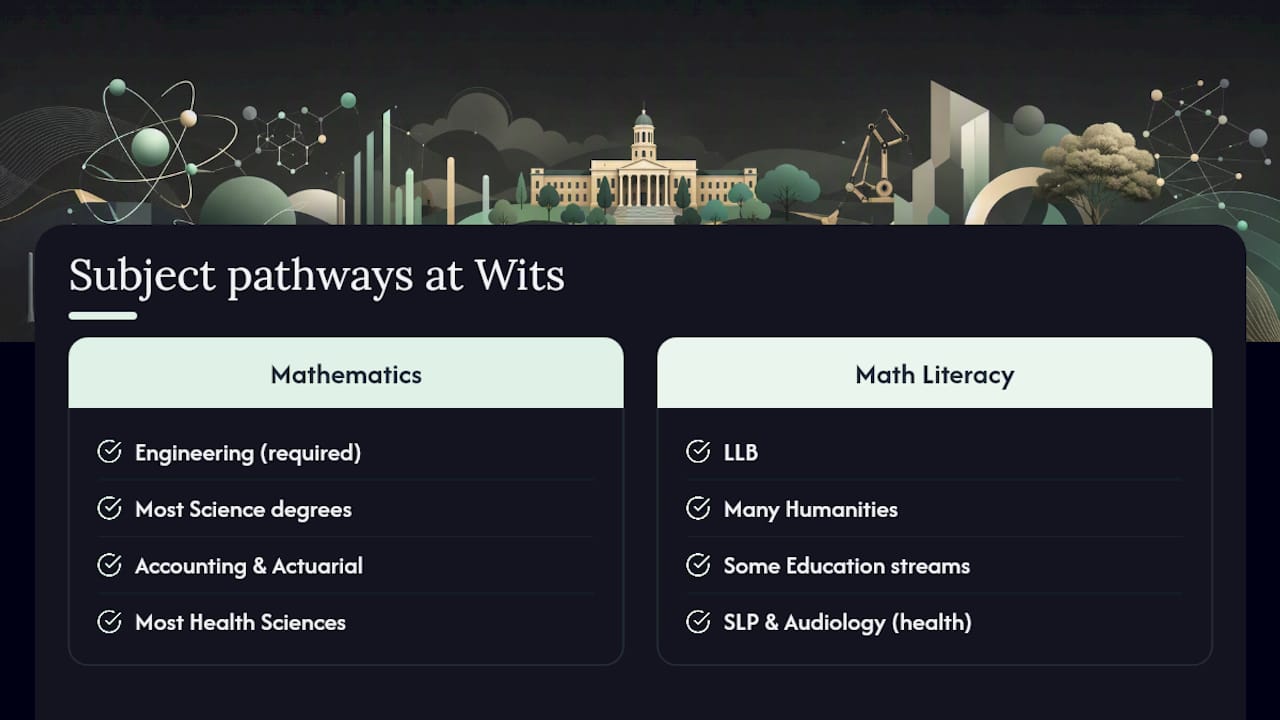
Mathematical Literacy is accepted for LLB, many Humanities degrees, and some Education streams. There are notable exceptions inside Health Sciences worth flagging: Speech-Language Pathology and Audiology at Wits typically accept Mathematical Literacy where you might expect a hard Mathematics requirement.
Pro Tip: If Mathematical Literacy is on your NSC certificate, prioritise Humanities, most Education streams, and LLB in your application shortlist. Applying to a Mathematics-only programme with Mathematical Literacy wastes an application slot no matter how high your overall APS score is.
What your APS score realistically gets you at Wits
Your APS band tells you which door is realistically open, and treating every score above 30 as equally competitive is where most applicants misjudge their chances.
- APS 30 to 33: A degree is technically considered at this floor, but your options narrow to select Humanities or Arts programmes, and even those carry real competition for available seats.
- APS 34 to 39: This is where most successful applicants sit. Many mainstream Commerce, Humanities, and Science degrees become realistic, and this range matches the typical accepted-student profile Wits itself has described.
- APS 40 to 44: Competitive programmes such as Computer Science, Accounting Science, and several Engineering streams come into range, though subject-specific minimums still apply.
- APS 44 and above: Highly selective programmes, including LLB and the most sought-after Engineering and Health Sciences streams, become genuinely achievable, though additional selection criteria still decide the final list.
Apply across bands rather than betting everything on your stretch programme. A safety option inside your comfortable range, a target at your actual APS, and one ambitious stretch pick is a sounder strategy than five applications to the same competitive cutoff.
Checklist: confirming your Wits eligibility before you apply
Work through these steps in order rather than jumping straight to submitting an application:
- Calculate your exact APS using the best-seven method, including Life Orientation and the English or Mathematics bonus where it applies.
- Check whether your target programme requires the National Benchmark Test and register early, since NBT sessions fill up and some faculties will not process your application without a result.
- Pull the current Wits prospectus or your programme’s own page to confirm subject requirements and this year’s indicative APS.
- Submit your application early, with certified documents ready, and list a backup programme alongside your first choice.
A few habits separate organised applicants from ones who miss deadlines:
- Keep certified copies of your ID and latest results on hand before the portal opens.
- Recheck your APS if you write supplementary exams, since a single subject re-write can shift your total.
- Verify your calculation against a second source before you commit to a shortlist.
You can run the numbers yourself with AskSmarty’s APS calculator, which keeps your marks on your own device and matches them against real programme cutoffs rather than a single university-wide figure.
Why trust this Wits APS breakdown
This guide draws directly on Wits’ own entry requirements and Schools Liaison prospectus, not third-party guesswork. Asksmarty builds its APS calculator and its searchable database of South African programmes specifically so marks never leave a student’s device while still producing an accurate match. Nkosi, who writes Asksmarty’s admissions guides, cross-checks every programme figure against the university’s published pages before publication.
What actually matters when you’re calculating your Wits APS
The APS conversation online focuses too heavily on the headline minimum and not enough on the gap between “considered” and “competitive.” Thirty gets your application read. It does not get you a seat, and treating it as a target rather than a floor is the single most common mistake matriculants make when they scan Wits’ requirements page and stop reading.
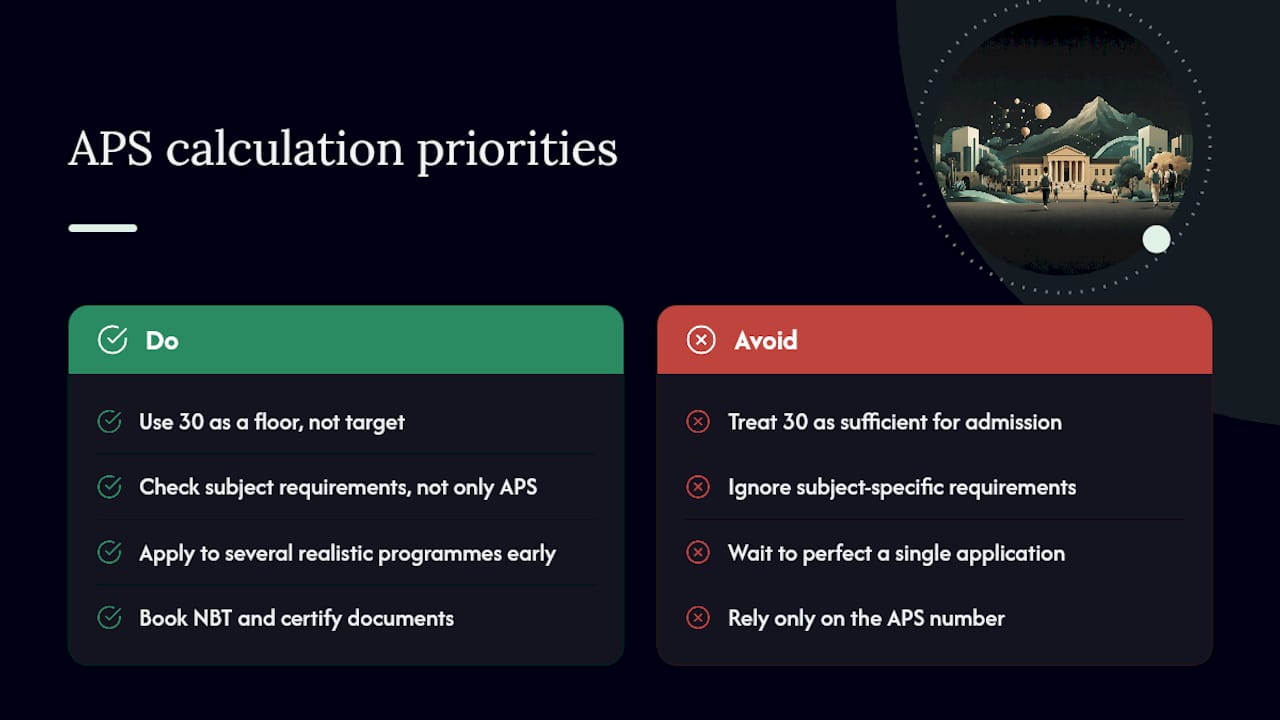
The subject trap matters more than most guides admit. A learner with a strong APS but Mathematical Literacy instead of Mathematics can meet every points threshold for Engineering and still get an automatic rejection, because the subject requirement sits outside the APS calculation entirely. Check both numbers, not just one.
If there’s one thing worth prioritising above chasing a marginally higher APS, it’s applying to a realistic spread of programmes early, with your NBT booked and your documents certified, rather than waiting to perfect a single application to one competitive stream.
— Nkosi
FAQ
Does Wits accept an APS of 21?
No. Wits’ published floor for degree consideration is APS 30, and an APS lower than that falls well short of the minimum for any Wits undergraduate degree.
What can I study at Wits with an APS of 30?
An APS of 30 is the absolute minimum Wits considers, and it typically limits you to select Humanities or Arts programmes rather than Commerce, Science, or Engineering streams, which carry higher cutoffs.
What courses require an APS of 31?
Few Wits degree programmes sit near the APS 30 floor, since most mainstream options require APS 34 or higher; Humanities programmes near the lower end of Wits’ range are the closest match, and you should confirm current figures on the official programme page.
Is Mathematics compulsory for every Wits programme?
No. Mathematics is compulsory for Engineering, most Science and Commerce degrees, and many Health Sciences programmes, but Mathematical Literacy is accepted for LLB, most Humanities degrees, and select Education and Health Sciences streams like Speech-Language Pathology.
How do I check my Wits APS before applying?
Calculate it yourself using the best-seven method with the Life Orientation cap and English or Mathematics bonus applied, or verify it instantly with Asksmarty’s APS calculator, which matches your marks against real Wits programme cutoffs without sending your data anywhere.
Recommended
Published 2026-09-08 · AskSmarty is an independent guide. Confirm anything time-sensitive on the official source.