Bachelor pass requirements: what you need and what's next
Discover the bachelor pass requirements for South Africa's National Senior Certificate. Understand what you need to qualify for university!

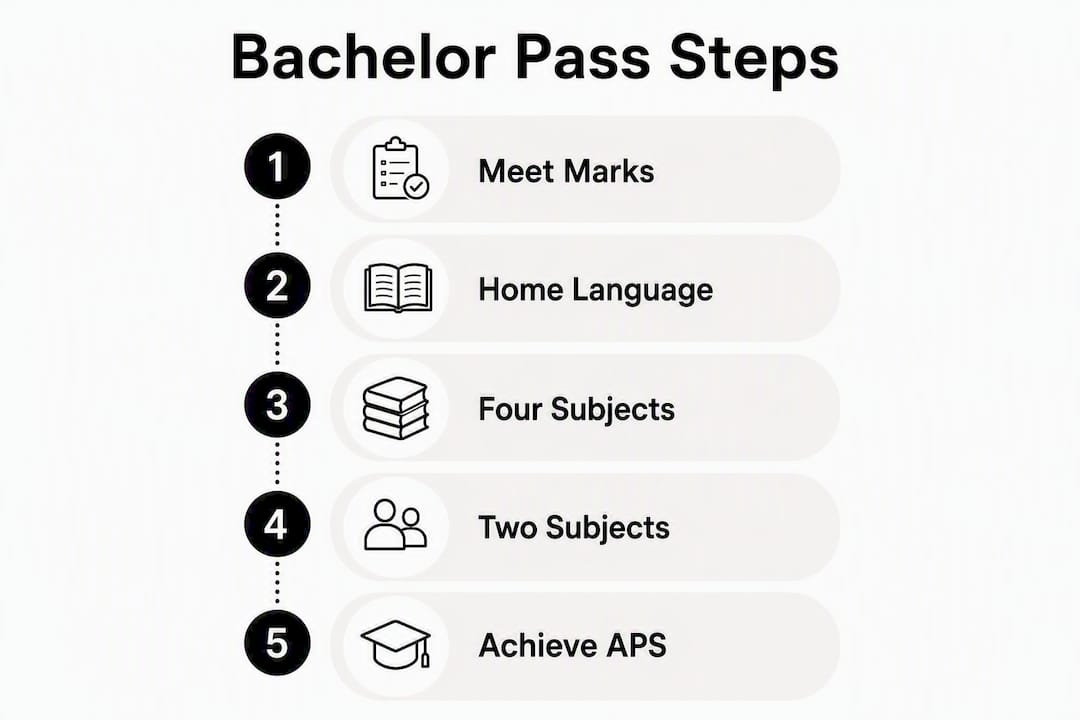
To earn a Bachelor’s pass in South Africa, the Department of Basic Education requires you to meet all of the following in your National Senior Certificate (NSC) simultaneously:
- At least a passing mark at the home language level
- At least a passing mark considered as standard for four other recognised subjects
- At least a passing mark at the minimum threshold in two remaining subjects
- Life Orientation is compulsory but excluded from your Admission Point Score (APS)
Miss even one of those thresholds and your result drops to a Diploma or Higher Certificate pass, regardless of how well you did in everything else.
A Bachelor’s pass is the entry ticket to degree programmes, not a guaranteed seat. Universities use your APS and programme-specific subject requirements to decide who actually gets in. An APS of 23 represents the minimum Bachelor’s pass eligibility, but most competitive degree programmes typically require an APS of 28 or higher.
Tools like Asksmarty’s APS calculator let you test your marks instantly and see which programmes you realistically qualify for, without uploading your results anywhere.
Table of Contents
- What are the official NSC bachelor’s pass criteria?
- How APS is calculated and why it matters more than the pass level
- What can you actually study with a Bachelor’s pass?
- Common myths about the Bachelor’s pass, answered directly
- What to do if you just miss the Bachelor’s pass
- How to confirm your results and apply for a rewrite or remark
- How Asksmarty helps you plan from your actual marks
- Key takeaways
- The part most families get wrong about the Bachelor’s pass
- Asksmarty makes the next step straightforward
- Useful sources
- FAQ
What are the official NSC bachelor’s pass criteria?
The DBE’s NSC requirements are non-negotiable and conjunctive: every condition must be satisfied at the same time. Scoring 80% in four subjects cannot compensate for a 35% home language mark.
| Requirement | Minimum mark | NSC level |
|---|---|---|
| Home language | 40% | Level 3 |
| Four higher-credit subjects | 50% each | Level 4 |
| Two remaining subjects | 30% each | Level 2 |
| Life Orientation | Compulsory | Not counted in APS |
Which subjects count?
- Any of the seven NSC subject groups can fill the four 50% slots, provided they are recognised higher-credit subjects.
- Pure Mathematics and Mathematical Literacy are treated differently by universities. Choosing Mathematical Literacy closes the door to engineering, most BSc programmes, and several BCom variants, even if you clear every DBE threshold.
- Physical Science is similarly gatekeeping for health sciences and engineering.
- Life Orientation does not contribute to APS at any South African university. A high LO mark feels good but changes nothing in the admission calculation.
The ‘all simultaneously’ rule is the most misunderstood part of the bachelor’s pass. A learner who scores 70% in five subjects but 38% in home language will receive a Diploma pass, not a Bachelor’s pass. Every single threshold must be crossed in the same sitting.
SACAP’s pass-type summary and Matric.co.za both provide clear breakdowns of all four NSC pass levels (Bachelor’s, Diploma, Higher Certificate, Senior Certificate) and are worth bookmarking alongside the official DBE guidance.
How APS is calculated and why it matters more than the pass level
Your Bachelor’s pass tells universities you are eligible to apply for a degree. Your APS tells them whether you are competitive for a specific programme. The two are related but not the same thing.

The APS conversion scale
The NSC uses a seven-point scale. Every percentage mark converts to a level, and each level carries an APS value:
| Percentage | NSC level | APS points |
|---|---|---|
| 80–100% | 7 | 7 |
| 70–79% | 6 | 6 |
| 60–69% | 5 | 5 |
| 50–59% | 4 | 4 |
| 40–49% | 3 | 3 |
| 30–39% | 2 | 2 |
| — | 1 | 1 |
Universities sum your best six subjects, excluding Life Orientation, to arrive at your APS.
How to calculate your own APS
- List your seven NSC subjects and their percentage marks.
- Remove Life Orientation from the list.
- Convert each remaining percentage to its APS points using the table above.
- Add the six highest point values together.
- That total is your APS.
Worked examples
Bare Bachelor’s pass (APS 23): A learner scores 40% in home language (3 pts), 50% in four subjects (4 pts each = 16 pts), and 30% in one remaining subject (2 pts). Total: 3 + 16 + 2 + 2 = 23. This meets the DBE criteria but sits at the floor.
Stronger profile (APS 32): Home language 65% (5 pts), Mathematics 70% (6 pts), Physical Science 68% (5 pts), Life Sciences 72% (6 pts), History 60% (5 pts), English FAL 65% (5 pts). Total: 32. This opens most BSc programmes and several engineering options.
The gap between 23 and 32 is the difference between being eligible and being competitive. According to Daily Maverick, most university degree programmes require an APS well above 23, and a bare Bachelor’s pass leaves many applicants without a realistic offer.
Pro Tip: Use the Asksmarty APS calculator to enter your marks and immediately see which programmes across South Africa you qualify for. It runs entirely on your device, so your marks stay private.
What can you actually study with a Bachelor’s pass?
A Bachelor’s pass makes you eligible for degree programmes at South African universities. A Diploma pass qualifies you for diploma programmes; a Higher Certificate pass for higher certificate programmes. The pass level is the gateway; your APS and subject choices determine which specific degree you can enter.

Typical APS ranges by degree family
These are illustrative ranges drawn from university prospectuses and education guides. Individual universities and programmes set their own thresholds, so always check the specific prospectus.
| Degree family | Typical APS range | Key subject requirements |
|---|---|---|
| BA (Humanities/Social Sciences) | ~26–30 | No strict Maths requirement at most universities |
| BCom (Commerce) | ~28–32 | Mathematics recommended; Maths Literacy accepted at some |
| BSc (Science) | ~30–34 | Pure Mathematics and Physical Science usually required |
| BEng (Engineering) | ~32–36 | Pure Mathematics and Physical Science required |
| MBChB (Medicine) | 35–40+ | Pure Mathematics and Physical Science required; NBT often required |
A few things stand out in that table. Engineering and medicine are not just about APS; they require specific subjects that must be chosen in Grade 10 or 11. A learner who takes Mathematical Literacy instead of pure Mathematics cannot enter a BEng programme, regardless of their overall APS. Subject selection is the single most important lever for keeping competitive degree options open.
Some universities also require the National Benchmark Test (NBT) for certain faculties, or a portfolio for design and fine arts programmes. The Bachelor’s pass is necessary but never the whole picture.
Check the University of Pretoria’s programme requirements or Stellenbosch University’s entry criteria on Asksmarty to see exactly what each programme demands beyond the pass level.
Common myths about the Bachelor’s pass, answered directly
A few questions come up constantly, and the answers are shorter than most people expect.
Is 50% a Bachelor’s pass? Not on its own. You need 50% in four subjects, 40% in your home language, and 30% in two others, all at the same time. A single 50% mark means nothing in isolation.
Is an APS of 21 a Bachelor’s pass? No. The minimum APS for a bare Bachelor’s pass is 23, achieved when you score exactly at the DBE thresholds across six subjects. An APS of 21 typically reflects a Diploma-level result.
How much is a Bachelor’s pass worth? The pass itself has no monetary value; it is a qualification level. Its practical worth is access to degree programmes, which in turn affects career and earning potential over a lifetime. The real question is whether your APS is high enough for the specific degree you want.
Quick self-assessment checklist
Run through this before results day to estimate where you stand:
- [ ] Home language mark is 40% or above
- [ ] Four subjects are at 50% or above
- [ ] Two remaining subjects are at 30% or above
- [ ] Life Orientation is not included in your APS count
- [ ] APS total (best six, excluding LO) is calculated and compared to target programme requirements
A percentage mark alone does not tell you whether you qualify for a specific programme. Convert every mark to APS points first, then compare against the prospectus.
What to do if you just miss the Bachelor’s pass
Missing the threshold by a few marks is not the end of the road. South Africa has several structured routes that give you a realistic path forward.
- Request a remark or review. If you believe a paper was marked incorrectly, contact your provincial exam office or school within the official remarking window (usually within 30 days of results release). A single subject remark can shift a result from Diploma to Bachelor’s pass.
- Register for supplementary or rewrite exams. The DBE offers a second-chance matric sitting, typically in May/June. You can rewrite specific subjects to improve marks without repeating the full year.
- Apply for a Diploma programme while planning a rewrite. A Diploma pass still opens TVET college programmes and some university diplomas. Studying while you rewrite keeps momentum going.
- Explore extended degree programmes. Several universities offer extended or foundation-year degrees for students who narrowly miss standard entry requirements. These add one year to the degree but lead to the same qualification.
- Consider TVET or private college routes. A National Certificate (Vocational) from a TVET college is a recognised qualification that can lead to employment or further study. Private colleges often have more flexible entry requirements and offer bridging programmes.
| Route | What it gives you | Typical timeline |
|---|---|---|
| Remark/review | Possible mark correction | 4 weeks after results |
| Supplementary rewrite | Improved subject mark | May/June sitting |
| Extended degree programme | Full degree (one extra year) | 4–5 years total |
| TVET diploma | Vocational qualification | 2–3 years |
| Private college bridging | Entry to degree or diploma | 6 months |
Pro Tip: Contact university admissions offices directly in January, before the main application cycle closes. Ask specifically about extended degree programmes and bridging options. Many universities do not advertise these prominently, but they exist and have separate application processes.
Finances matter here too. TVET colleges receive government subsidies that reduce fees significantly, and the National Student Financial Aid Scheme (NSFAS) covers TVET students who qualify. Check TVET and college options on Asksmarty to compare programmes and fees before committing.
How to confirm your results and apply for a rewrite or remark
Knowing your official result is the first step before any of the routes above become available.
- Check results online. The DBE releases NSC results in January each year. Results are available through the official DBE portal and most provincial education department websites. Your school will also receive your result slip.
- Verify with Umalusi. Umalusi is the quality council that certifies NSC results. If you need to verify the authenticity of your certificate (for a bursary or employer), use the Umalusi verification portal directly.
- Request your statement of results. Your school issues a detailed statement showing marks per subject. You need this to calculate your APS and to apply to universities.
- Apply for a remark. Submit a remark application through your school or provincial exam office within the published window. There is a fee per subject, and the outcome can go up or down.
- Register for the supplementary exam. If a remark is not enough, register for the May/June supplementary sitting through your provincial Department of Education. Registration typically opens in February.
- Track your application status. Once you have applied to a university, check your application status through the university’s portal or via Asksmarty’s status-check tool.
Key timelines to keep in mind:
- Results released: January
- Remark window: January to February (varies by province)
- Supplementary exam registration: February
- Supplementary exam sitting: May/June
- University application deadlines: typically September to October of the year before you want to study
How Asksmarty helps you plan from your actual marks
Once you have your marks or a realistic estimate, the next question is: which programmes can I actually get into? That is where Asksmarty’s tools do the heavy lifting.
The Asksmarty APS calculator converts your subject marks into APS points and immediately shows you a filtered list of programmes across South Africa that match your score and subject profile. You do not create an account, and your marks never leave your device.
What a typical result looks like in practice:
- Enter six subject marks (excluding LO).
- The calculator converts each to APS points and sums them.
- A filtered programme list appears, showing degree, diploma, and higher certificate options you qualify for, along with application deadlines and fees.
- You can click through to a university’s page to download the prospectus or go directly to the official application portal.
The database covers over 1,700 programmes across universities and colleges in South Africa, with entry requirements, deadlines, and application fee details kept up to date.
Knowing your APS before you apply changes how you apply. Instead of guessing which universities to approach, you can prioritise the programmes where your marks are genuinely competitive, and identify which subjects to rewrite to unlock a specific degree.
Key takeaways
A Bachelor’s pass is the NSC minimum for degree eligibility, but your APS and subject choices determine which specific programmes you can actually enter.
| Point | Details |
|---|---|
| All criteria are simultaneous | Missing one DBE threshold (e.g., home language below 40%) drops your pass to Diploma level. |
| APS 23 represents the minimum eligibility threshold; most degree programmes require an APS of 28 or higher, with competitive degrees demanding substantially more. | |
| Subject choice is decided early | Choosing Mathematical Literacy over pure Mathematics in Grade 10 closes engineering and most BSc options permanently. |
| Missing the pass has real routes | Rewrites, extended degrees, TVET, and private colleges are structured alternatives with clear timelines. |
| Asksmarty shows your real options | The free APS calculator matches your marks to over 1,700 programmes without uploading your data anywhere. |
The part most families get wrong about the Bachelor’s pass
Most of the anxiety around matric results focuses on whether a learner will get a Bachelor’s pass. That is understandable, but it is the wrong question to obsess over.
The Bachelor’s pass is a binary: you either meet all the DBE thresholds or you do not. What actually determines your higher education options is the APS score sitting behind that pass, and the subjects you chose two years earlier in Grade 10. A learner with a Bachelor’s pass and an APS of 24 faces a genuinely narrow set of realistic degree options. A learner with an APS of 34 and pure Mathematics has most of the country’s programmes available to them.
The families who navigate this well are the ones who start the APS conversation in Grade 10, not after results day. They run “what-if” scenarios: what happens to my APS if I drop from 65% to 55% in Maths? Which programmes disappear? Which ones open up if I push Physical Science above 60%? Those are the questions that lead to better subject choices, better study focus, and less panic in January.
The other thing worth saying plainly: a Diploma pass is not a failure. TVET colleges produce graduates who enter the workforce faster and often with less debt than university graduates. The question is always fit, not prestige.
Asksmarty makes the next step straightforward
You have read the requirements. Now the practical question is: where do you actually qualify, and what should you apply for?
Asksmarty is a free, independent guide built specifically for South African learners and parents navigating this exact moment. Enter your marks into the APS calculator, and within seconds you see a personalized list of programmes you qualify for, filtered by your APS and subject profile. No registration, no fees, no data uploaded.
From there, you can browse all universities and colleges across South Africa, download prospectuses, check application deadlines, and go directly to official application portals. The database covers over 1,700 programmes, with entry requirements and fees kept current.
Start with your marks. Asksmarty shows you what they open.
Always verify programme-specific requirements directly with the university prospectus before applying, as entry criteria can change between academic years.
Useful sources
- A-Game Academy: How to get a Bachelor’s pass in matric — detailed breakdown of the DBE criteria and subject strategy.
- A-Game Academy: What marks do you need for a Bachelor’s pass? — APS conversion table and worked examples.
- Daily Maverick: A matric Bachelor’s pass isn’t a ticket to university — honest assessment of what APS 23 actually gets you and realistic alternatives.
- SACAP: What are the different types of matric passes? — clear summary of all four NSC pass levels and what each permits.
- Matric.co.za: What are the matric pass requirements? — plain-language guide including Life Orientation’s exclusion from APS.
- DBE Senior Certificate page — official Department of Basic Education guidance on NSC pass levels and university endorsement.
- Asksmarty: APS, NSC passes and admission requirements explained — central hub for understanding how APS and pass types interact with university admission across South Africa.
Check each university’s official prospectus for programme-specific entry requirements, as thresholds vary and are updated annually.
FAQ
What are the minimum marks for a Bachelor’s pass?
You need at least 40% in your home language, 50% in four other subjects, and 30% in two remaining subjects, all in the same NSC sitting. Life Orientation is compulsory but does not count toward your APS.
Is 50% enough to get a Bachelor’s pass?
Only if it appears in four subjects alongside 40% in home language and 30% in two others. A single 50% mark, or even several, does not qualify you on its own.
Is an APS of 21 considered a Bachelor’s pass?
No. A bare Bachelor’s pass typically converts to an APS of 23. An APS of 21 usually reflects a Diploma-level result, which does not qualify you for degree programmes.
Does a Bachelor’s pass guarantee university admission?
No. The Bachelor’s pass confirms DBE eligibility for degree study, but universities set their own APS cutoffs and subject requirements. Most programmes require an APS of 28 or higher, and competitive degrees like engineering or medicine require considerably more.
How do I calculate my APS quickly?
Convert each of your six subject marks (excluding Life Orientation) to APS points using the NSC scale (80–100% = 7, 70–79% = 6, 60–69% = 5, 50–59% = 4, 40–49% = 3, 30–39% = 2), then add them together. The Asksmarty APS calculator does this instantly and shows matching programmes.
Recommended
Published 2026-07-31 · AskSmarty is an independent guide. Confirm anything time-sensitive on the official source.