Best computer science universities in South Africa: 2026 guide
Discover the best computer science universities in South Africa. Calculate your APS, check requirements, and find your ideal program today!

The fastest way to know which South African computer science programmes you qualify for is to calculate your APS, confirm your Mathematics and English subject levels, then match those numbers against verified prospectuses. Asksmarty’s admission calculator does that instantly across more than 1,700 programmes, with your marks staying on your device.
Three things to do right now:
- Calculate your APS using your best six subjects, excluding Life Orientation.
- Check that your Mathematics and English meet the subject-level minimums, not just the total APS.
- Use Asksmarty to match your marks to programmes and get direct links to official prospectuses.
A concrete benchmark: UWC’s BSc Computer Science requires a minimum APS of 27, English at level 4 (50–59%), and Mathematics at level 3 (40–49%). That is one of the more accessible entry points among traditional universities. At the other end, Wits lists an example threshold of APS 44+ for Computer Science, with subject achievement requirements reflected. Knowing where your marks sit on that spectrum is the starting point for every decision that follows.
Table of Contents
- How do you calculate your APS and check subject minimums?
- Which South African CS programmes match your APS?
- How this shortlist was compiled
- What makes each university’s CS programme different?
- Where are these universities located?
- What careers do CS graduates typically pursue?
- Financial aid, scholarships, and bursaries for CS students
- Key takeaways
- The part most applicants get wrong
- Asksmarty makes the matching step instant
- Useful sources and official prospectuses
- FAQ
How do you calculate your APS and check subject minimums?
Your Admission Point Score is built from your best six NSC subjects, converted to a 1–7 scale. Life Orientation is excluded from the calculation at most universities, so do not include it.
The standard conversion works like this:
| Percentage | APS points |
|---|---|
| — | 7 |
| 70% | 6 |
| 60–69% | 5 |
| 50–59% | 4 |
| 40–49% | 3 |
| — | 1 |
Worked example: A student scores 72% in Mathematics (6 pts), 65% in English (5 pts), 58% in Physical Sciences (4 pts), 70% in Life Sciences (6 pts), 55% in Accounting (4 pts), and 62% in Geography (5 pts). Excluding Life Orientation, the APS total is 30. That student meets UP’s minimum for BSc Computer Science and comfortably clears UWC’s threshold.
Subject-level minimums matter just as much as the total. UP requires Mathematics at level 6 for BSc Computer Science, while UWC accepts Mathematics at level 3. A student with APS 30 but only 45% in Mathematics would qualify at UWC but not at UP. Always check both numbers.
NBTs (National Benchmark Tests) add another layer at selective universities. Wits publishes NBT registration deadlines on its admissions pages, and some programmes use NBT results to rank applicants even when the APS minimum is met. Check the specific university’s admissions page for whether NBTs are required and when to register.
Pro Tip: APS calculators convert your percentages automatically and flag subject mismatches. Use one before you shortlist programmes, not after.
Different universities occasionally use institution-specific scales or include/exclude subjects differently. Always confirm whether Life Orientation is excluded and whether the university uses the standard 7-point scale or its own variant.
Which South African CS programmes match your APS?
The table below covers the main options a matriculant should consider, from the matching tool to contact and distance universities. Use it to build a first shortlist, then verify current requirements on each official prospectus before applying.
| Institution | Min APS | Maths requirement | English requirement | NBT / other tests | Competitiveness | Where to apply | Typical application window |
|---|---|---|---|---|---|---|---|
| Asksmarty (matching tool) | — | — | — | — | Matches you to 1,700+ programmes instantly | asksmarty.co.za/universities | Use any time |
| UWC — BSc Computer Science | 27 | Level 3 (40–49%) | Level 4 (50–59%) | Not required | Accessible; ranked selection applies | uwc.ac.za prospectus | April–September |
| UP — BSc Computer Science | 30 | Level 6 (60–69%) | Level 5 | NBT recommended | Selective; second-choice advised | up.ac.za yearbook | March–June |
| TUT — CS/IT pathways | Lower thresholds | Level 4 typically | Level 3–4 | Not typically required | More accessible; vocational focus | tut.ac.za | April–September |
| UFS — Computer Science | Published in prospectus | Level 4–5 | Level 4 | Check prospectus | Regional; structured intake | ufs.ac.za | April–August |
| UNISA — Computing degrees | Flexible / open-distance | Varies by module | Level 3–4 | Not required | Open-distance; bridging available | unisa.ac.za | Multiple intakes |
A few points worth noting:
- Meeting the minimum APS is necessary but not sufficient. UP’s yearbook states explicitly that universities rank applicants and admit only a fixed number into CS programmes.
- UP recommends BSc Information and Knowledge Systems and BCom Informatics as second-choice programmes for applicants who narrowly miss the CS cut-off. Having a backup listed on your application is not a fallback plan; it is standard practice.
- UNISA’s open-distance model means no campus attendance, but students may need to complete preparatory modules if they lack a prior IT background.
- Use Asksmarty to filter by your actual marks and see which rows above you realistically qualify for before spending time on applications.
How this shortlist was compiled
The example requirements above come from official university prospectuses, yearbooks, and programme pages. The selection covers four institution types: a traditional research university (UP), a regional campus university (UWC, UFS), a university of technology (TUT), and an open-distance institution (UNISA).
Sources used:
- UWC BSc Computer Science prospectus (APS, subject levels, curriculum prerequisites)
- UP yearbook 2026, programme 12134002 (APS, Maths level, second-choice programmes)
- Wits school liaison document (competitive thresholds, NBT notes)
- Asksmarty programme database (TUT, UFS, UNISA programme and deadline data)
Verification disclaimer: Admission requirements change annually. The figures in this article reflect the most recently published prospectuses at the time of writing. Before submitting any application, confirm current APS thresholds, subject minimums, and closing dates directly on the university’s official prospectus or student portal. Meeting published minimums does not guarantee admission — most CS programmes use ranked selection with limited intake capacity.
What makes each university’s CS programme different?
UWC runs a four-year BSc Computer Science that builds from first-year Mathematics and Physics modules. The programme’s accessible entry point makes it a realistic target for students with solid but not exceptional matric results, and the Western Cape campus has strong industry links in Cape Town’s growing tech sector.
UP sits at the research-intensive end of the spectrum. The Department of Computer Science in the Faculty of Engineering, Built Environment and Information Technology has a reputation for producing graduates who move into software engineering, data science, and postgraduate research. The higher Maths requirement (level 6) reflects what the curriculum demands from day one.
TUT takes a vocational approach. Degrees and diplomas in CS and IT-related fields are structured around practical skills, making graduates employment-ready in technical support, software development, and systems administration. The broader access thresholds mean more students can enter, and the curriculum reflects industry needs directly.
UFS offers a structured campus experience with regional reach across its Bloemfontein and Qwaqwa campuses. The programme suits students who want a traditional contact-learning environment outside the major metros, with clearly published admission criteria.
UNISA is the right choice when flexibility matters more than campus life. Its computing and information degrees can be studied entirely at a distance, which suits working students or those in areas without easy campus access. Bridging modules are available for students who lack a specific subject background.
Where are these universities located?
UWC is in Bellville, Cape Town, about 25 km from the city centre. The campus is well-connected by public transport and sits close to the Cape Town tech and startup ecosystem.
UP is in Hatfield, Pretoria, a student-heavy suburb with good transport links. The Gauteng location puts graduates close to South Africa’s largest concentration of tech employers, from financial services to government IT.

TUT has its main campus in Pretoria (Arcadia and Soshanguve campuses) with additional campuses in Polokwane and Mbombela, giving it one of the widest geographic footprints of any university of technology.
UFS is based in Bloemfontein, with a second campus in Qwaqwa in the eastern Free State. For students from the central provinces, it removes the cost and disruption of relocating to a major city.
UNISA has no single campus requirement for most programmes. Its regional learning centres across South Africa provide in-person support, but coursework and assessments are primarily online and by correspondence.
What careers do CS graduates typically pursue?
South Africa’s demand for software developers, data analysts, cybersecurity specialists, and systems engineers consistently outpaces the supply of graduates. A BSc Computer Science from UP or UWC opens doors to postgraduate study and research roles, as well as corporate software development positions. TUT graduates tend to move directly into technical roles in IT support, development, and systems integration, often with shorter time-to-employment.
UNISA graduates enter the same job market but often combine study with early work experience, which can accelerate career progression. For students considering the best accounting universities alongside CS options, it is worth noting that BCom Informatics (available at UP) sits at the intersection of both fields and carries its own strong employment outcomes.
Equipping yourself with the right hardware matters too. If you are heading into a CS programme, check a resource like top laptop recommendations for CS students before your first semester.
Financial aid, scholarships, and bursaries for CS students
The National Student Financial Aid Scheme (NSFAS) covers tuition, accommodation, and living costs for qualifying students at all public universities, including CS programmes at UWC, UP, TUT, UFS, and UNISA. Eligibility is income-based, and applications open in September each year for the following academic year.
Beyond NSFAS, several private bursaries target CS and IT students specifically. The Telkom Foundation, Standard Bank, and Investec all run bursary programmes for engineering and IT students, typically requiring a minimum academic average and a commitment to work for the sponsor after graduation. UP’s Faculty of Engineering, Built Environment and Information Technology administers merit bursaries for high-achieving first-year students.
UNISA students who do not qualify for NSFAS can apply for the institution’s own bursary fund, which is structured differently from campus-based aid given the distance model.
Apply for NSFAS and private bursaries as early as possible. Many bursary programmes close before university application deadlines, and late applications are rarely considered.
Key takeaways
Your APS and subject-level minimums together determine which CS programmes you realistically qualify for. Check both before shortlisting any university.
| Point | Details |
|---|---|
| Calculate APS correctly | Use your best six subjects, exclude Life Orientation, and apply the standard 7-point conversion scale. |
| Subject minimums matter | Maths and English levels can disqualify you even when your total APS meets the threshold. |
| Minimums are not guarantees | CS programmes use ranked selection; apply early and include a second-choice programme. |
| Apply before deadlines | Most universities open applications between March and September; NSFAS applications open in September. |
| Use Asksmarty to match instantly | Asksmarty’s APS calculator matches your marks to 1,700+ programmes privately, with direct prospectus links. |
The part most applicants get wrong
The conversation around the best computer science universities in South Africa almost always focuses on prestige and rankings. Students ask “which university is best?” when the more useful question is “which programme can I actually get into, and which one fits how I learn?”
UP’s CS degree is excellent. So is UWC’s. But a student with APS 27 and Mathematics at level 3 who applies only to UP is not being ambitious; they are wasting an application cycle. The smarter move is to apply to UP with a second-choice programme listed, apply to UWC as a realistic primary target, and use UNISA as a distance option if campus access is a constraint.
The second thing applicants underestimate is the gap between minimum requirements and actual admission. Universities publish minimums; they admit by rank. In a competitive intake year, the effective cut-off at UP or Wits can sit well above the stated minimum. That is not a reason to avoid selective universities. It is a reason to apply early, monitor your portal for conditional offers, and have a backup programme ready to accept.
Asksmarty makes the matching step instant
You now have the framework: calculate your APS, check subject levels, build a shortlist of realistic programmes, and apply with a second choice. The part that used to take hours of prospectus-hunting takes seconds on Asksmarty.
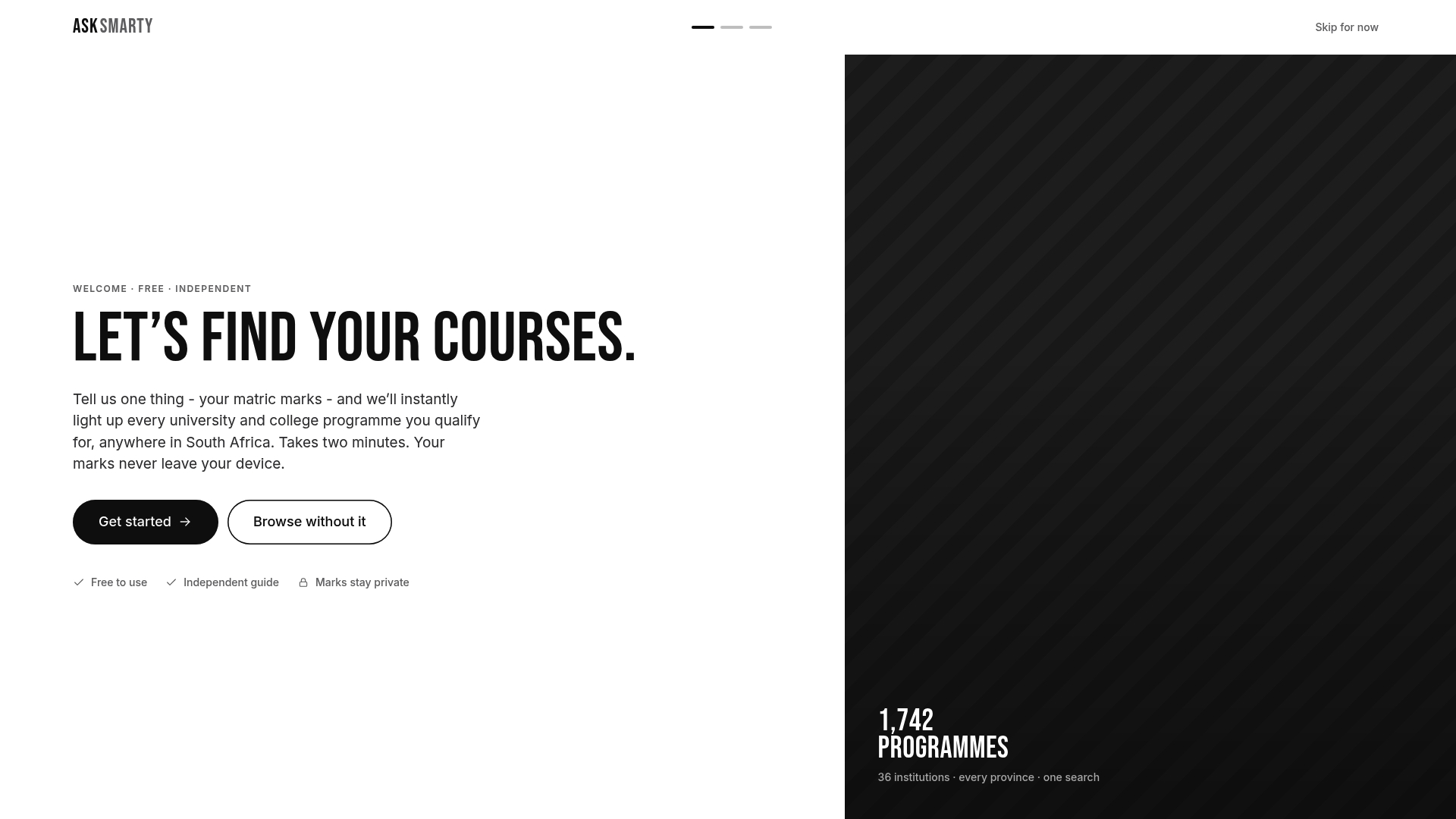
Enter your matric marks into the Asksmarty APS calculator and get an instant list of programmes you qualify for across more than 1,700 options. Your marks never leave your device. Every match links directly to the official prospectus so you can confirm current requirements and deadlines without searching multiple university websites. For a full breakdown of APS rules, NBT requirements, and NSC passes, the Asksmarty requirements guide covers every variable in one place. Ready to apply? The step-by-step application guide walks you through documents, portals, and closing dates for every major university.
Useful sources and official prospectuses
| Source | What it contains |
|---|---|
| UP yearbook 2026 — BSc Computer Science | APS minimum (30), Maths level 6 requirement, second-choice programme list, ranked selection note |
| UWC BSc Computer Science prospectus | APS 27 minimum, subject levels, four-year curriculum and module prerequisites |
| Wits school liaison APS document | Competitive APS thresholds, NBT registration deadlines |
| UNISA Computer Science modules | Module list, bridging requirements, distance registration guidance |
| Asksmarty universities database | 1,700+ programmes, APS calculator, deadline tracker, prospectus links |
- Always check the university’s official student portal for your application status after submitting
- Application fees vary by university; some are free, others charge. Confirm before applying.
FAQ
What is the minimum APS for computer science in South Africa?
It varies by university. UWC requires APS 27 for BSc Computer Science, while UP requires APS 30 with Mathematics at level 6. Wits publishes example guidance for Computer Science with APS 44+ and subject levels reflected.
Does meeting the minimum APS guarantee admission to a CS programme?
No. Most universities rank applicants and admit a fixed number of students. Meeting the minimum makes you eligible, not guaranteed a place.
What subject levels do I need for computer science?
Mathematics and English are the critical subjects. UP requires Mathematics at level 6 (60–69%); UWC accepts level 3 (40–49%). English requirements typically sit at level 4 or 5 depending on the university.
What should I do if my APS is below the CS minimum?
Consider a second-choice programme with lower or different requirements. UP explicitly recommends BSc Information and Knowledge Systems and BCom Informatics as alternatives. UNISA’s distance-learning pathway and bridging modules are another option.
How does Asksmarty help me find CS programmes I qualify for?
Enter your matric marks into the Asksmarty APS calculator and it instantly matches you to programmes across 1,700+ options, with your marks staying on your device and direct links to official prospectuses for verification.
Recommended
- Colleges in South Africa - Private Colleges & TVET Explained | AskSmarty
- How to Apply to a South African University or College | AskSmarty
- AskSmarty - Find your course anywhere in South Africa, check if you qualify, apply
- Registered Private Colleges in South Africa - Official List & Courses | AskSmarty
Published 2026-07-29 · AskSmarty is an independent guide. Confirm anything time-sensitive on the official source.