Bridging Courses in South Africa: Your Options Explained
Bridging courses, foundation years and extended programmes in South Africa explained: how they differ, who qualifies, typical APS requirements and how to apply.

A bridging course in South Africa is a preparatory year, usually without credit towards your final qualification, for students whose matric results fall just short of university entry. Most universities now channel this need through extended or foundation programmes instead. These add a year to the degree, and you study them as part of the degree itself. Which route suits you depends on your marks, your subjects and the institution, so check your own numbers first.
TL;DR
- A bridging course is a separate preparatory year. An extended (ECP) or foundation programme is a longer version of the actual degree, with extra support built in.
- Extended programmes typically ask for an APS about 2 to 4 points lower than the mainstream degree, but places are limited and competitive.
- Most students do not apply for the extended route separately: you apply for the standard programme and the university may place you in the extended one.
- Requirements differ by university and faculty, so compare your APS and subject levels with each programme’s own page before you apply.
- If your marks are too low for any route, upgrading matric subjects is a legitimate next step.
Table of Contents
- What bridging courses are, and what they are not
- Who extended programmes are designed for
- How admission requirements compare
- You usually do not apply for the extended route directly
- Which universities offer these routes?
- What happens once you are in
- Choosing between a bridge, an extended programme and a second attempt
- Our perspective
- Check where you qualify before you apply
- FAQ
- Sources
What bridging courses are, and what they are not
People use “bridging course”, “foundation year”, “foundation programme” and “extended programme” almost interchangeably. They are related but not identical.
A bridging course is generally a one-year preparatory course with introductory subjects. These subjects do not carry credit towards a final degree or diploma. You finish the year, and if you meet the university’s conditions, you then move into the first year of your chosen qualification.
An extended curriculum programme (ECP), also called a foundation programme or extended programme, is different. You are registered for the degree or diploma from day one. The curriculum is stretched, so the qualification takes one year longer, and the extra time is used for foundation modules, academic literacy, and extra tuition in subjects such as mathematics or accounting.
The practical differences:
| Bridging course | Extended / foundation programme | |
|---|---|---|
| Registered for the degree from year one | Usually no | Yes |
| Credit towards the final qualification | Typically none | Foundation modules form part of the programme |
| Length | About one year | Qualification extended by one year |
| Who it suits | Applicants who miss the entry requirements | Applicants who meet minimum criteria but need more academic grounding |
The distinction matters because it affects your fees, your timeline and your funding. Before you commit, ask the admissions office whether the year counts as part of your degree.
Who extended programmes are designed for
Extended provision exists for a specific reason. The Central University of Technology describes the key role of extended provision as supporting educationally disadvantaged students who are underprepared even though they meet the minimum admission criteria. Nelson Mandela University’s undergraduate guide adds that these programmes support students affected by socioeconomic disadvantage or under-resourced schooling, and that places can be highly competitive.
So this is not a second-class route. It is a structured way to reach the same qualification with more support along the way. If you went to a school where mathematics or science teaching was weak, or you simply missed the mark by a few points, it may be the most realistic path.
How admission requirements compare
The same guide says foundation and ECP APS requirements are typically 2 to 4 points lower than mainstream requirements. That is a rule of thumb, not a guarantee, and the real figure depends on the programme. Here are examples taken directly from university pages:
- University of Johannesburg, BCom in Accounting Extended: an APS of 25 with Mathematics or 28 with Mathematical Literacy. The programme excludes students who previously enrolled at a higher education institution.
- University of KwaZulu-Natal, BCom Accounting Extended: an NSC Bachelor’s pass, 28 NSC points excluding Life Orientation, and Level 4 in English, Life Orientation and Mathematics.
- Walter Sisulu University, BSc 4-year ECP: a minimum of Level 3 in English, Mathematics and Physical Sciences, with at least one subject at Level 4 and a summed level score of 10.
- University of Pretoria, BCom 4-year programme: a minimum APS of 26, excluding Life Orientation, with specific language and mathematics requirements for the 2027 intake.
Notice how much the rules vary. Some programmes set a single APS figure, some set subject levels, and some combine both. A few add conditions about previous study. This is why comparing the number alone can mislead you.
Reading the numbers correctly
Your APS is the total of the points your marks earn, and each university has its own rule on whether Life Orientation counts. Two applicants with the same total can end up on opposite sides of a cut-off because of one subject level. Our guide to the minimum subject percentage for university shows how subject thresholds work alongside the total.
It also helps to see how a mainstream cut-off at a single university varies. Our breakdown of what different APS scores get you at Wits and the guide to APS requirements at UJ let you judge how far you are from the standard route, and therefore whether an extended route is the right size of step.
You usually do not apply for the extended route directly
This surprises many applicants. At CUT, students cannot apply directly for an ECP. They apply for the standard undergraduate programme, and may be channelled into the ECP if they meet minimum criteria but need an additional academic foundation.
Other universities list the extended programme as a separate choice on the application form. Policies differ, so read the programme page and the application guide of each institution. If both options are open to you, consider listing the extended version alongside the mainstream one, so you are considered for both.

Meeting the minimum does not secure a place either. The University of Pretoria ranks applicants on their Grade 11 or Grade 12 results, and meeting the minimum requirements does not guarantee placement because space is limited. Apply early, and apply to more than one institution.
Which universities offer these routes?
Many public universities run extended or foundation programmes in at least some faculties. The ones cited in this article are UJ, UKZN, WSU, UP, CUT and Nelson Mandela University. UNISA also offers extended programmes for specific qualifications, including Science and diploma programmes, which answers a common question about whether distance study has a route like this.
The pattern is that extended places cluster in a few faculties: Commerce and Accounting, Science, Engineering, Health Sciences and some Humanities programmes. They are not offered for every qualification. Highly selective degrees such as medicine have their own rules, which you can compare in our guide to medicine entry requirements.
To see examples on our database, look at the Bachelor of Science Extended Curriculum Programme at Sol Plaatje-linked SMU, the BSc (Environmental Sciences) Extended Curriculum at NMU, the BSc (Biological Sciences) Extended Curriculum at NMU and the Diploma in Public Management extended curriculum at NMU. Each shows the entry requirements as published by the institution.
What happens once you are in
Extended programmes are not a free pass. At CUT, students must complete the ECP in full and pass all first-year instructional offerings to continue. Failing core foundation modules can result in termination of studies. Other universities have their own progression rules, so ask what they are before you register.
What you get in return is time and support. Typical features, as described by institutions offering them, include smaller tutorial groups, extra contact time and focused academic skills work. Treat the extra year as a real first year: attend everything, use the tutors, and ask for help early.
If you are also considering study beyond South African borders after finishing a first year, university placement guidance shows what personalised support for applicants looks like when you compare destinations.

Choosing between a bridge, an extended programme and a second attempt
Use these questions to decide.
- Do you meet the minimum for an extended programme? Check the APS and the subject levels. If yes, apply for both the mainstream and extended versions where the institution allows it.
- Are you only a few points short of the mainstream programme? An extended route may fit, since the requirement is typically a few points lower.
- Is a key subject your barrier? If mathematics, physical sciences or English is the problem, a programme with strong foundation modules in that subject helps more than a general year.
- Are you far below every threshold? Rewriting subjects to lift your marks may be the most direct route. Our guide on how to upgrade your matric marks covers the options.
- Can you fund an extra year? The additional year adds cost. Ask each university how fees and financial aid apply to the extended stream before you commit.
It also pays to widen your search. If your dream programme is out of reach, a related qualification may open the same career. Our guides to psychology entry requirements and architecture entry requirements show how to map marks to alternatives in a field.
Our perspective
We built AskSmarty because we saw how many students only discover their options after a rejection. A bridging year or an extended programme can be the difference between giving up and getting a degree, but only if you know early enough that it exists.
Our view is simple: start from your marks, not from a dream programme. Enter your results, see where you qualify, and look at the extended versions of the courses you want alongside the mainstream ones. A programme that accepts you with a lower APS and gives you support is a strong choice, not a consolation prize.
We also believe your marks are your business. That is why they never leave your device when you use our tools, and why we charge nothing and ask for no account. We link you to the official application portals, because the university is where your application belongs.
Nkosi
Check where you qualify before you apply
Our free tool lets you enter your matric marks, calculates your APS and matches you against more than 1,700 university and college programmes, with entry requirements, deadlines and application fee details. Your marks stay on your device, and you do not need an account.
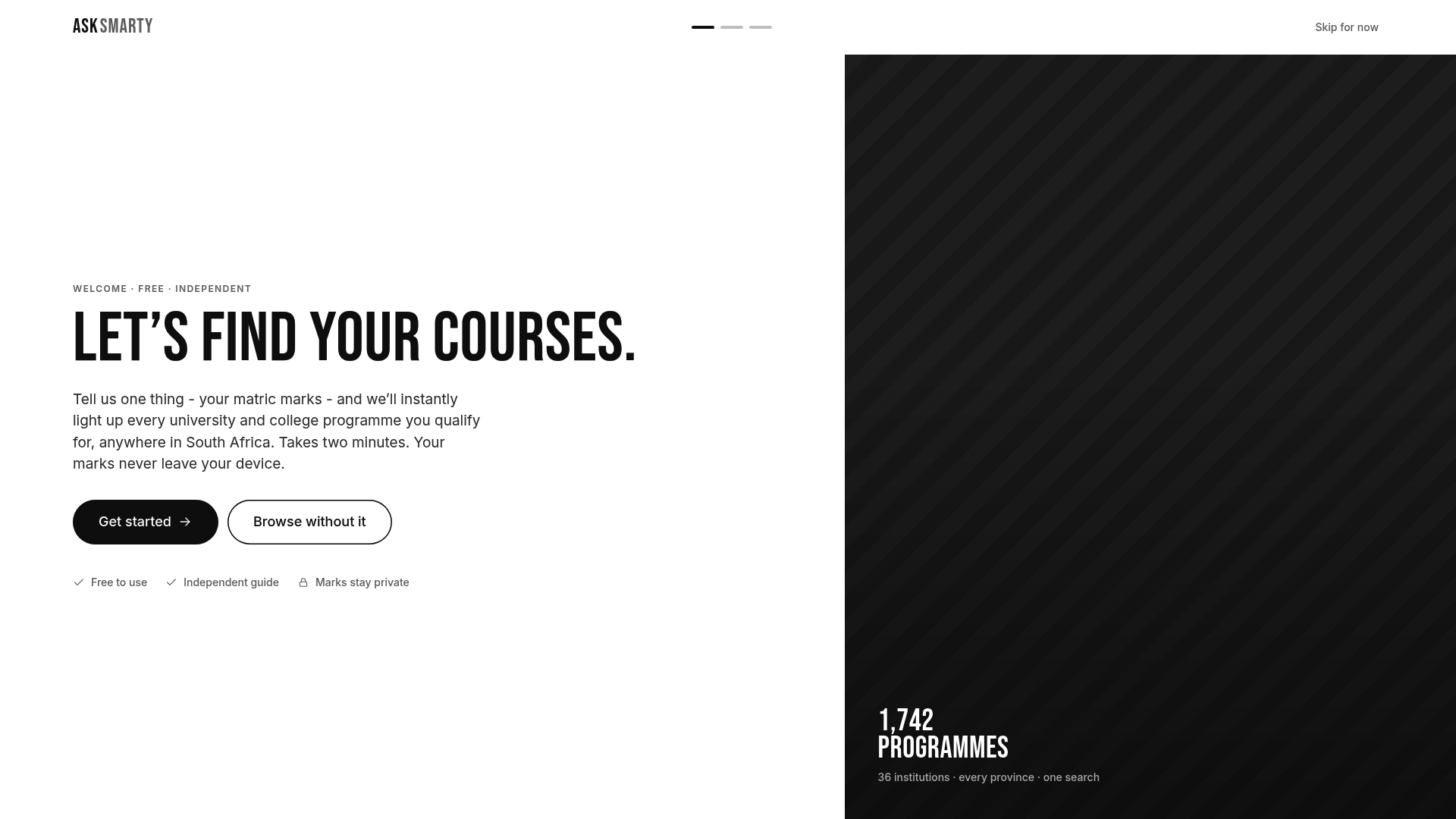
Start on the AskSmarty home page, then open any programme page to see its requirements and the link to the official application portal.
FAQ
Are bridging courses and foundation programmes the same thing?
No. A bridging course is usually a separate preparatory year with introductory subjects that carry no credit towards your final qualification. A foundation or extended programme is part of your degree, which is extended by one year. Ask the university which one it is offering.
Does UNISA allow bridging courses?
UNISA offers extended programmes for specific qualifications, including in Science and diploma programmes. Check the college and qualification you want, because the extended option is not available for every programme.
What are the requirements for an extended programme?
They vary by programme. Many ask for an APS a few points below the mainstream degree, plus minimum levels in subjects such as English and Mathematics. For example, UKZN’s BCom Accounting Extended asks for 28 NSC points and Level 4 in English, Life Orientation and Mathematics. Always read the specific programme page.
Can I apply directly for the extended version?
It depends on the university. At CUT you apply for the standard programme and may be channelled into the ECP. Elsewhere it appears as its own programme choice. The application guide of each institution tells you which applies.
Sources
- Second Chance Programme vs. Bridging Courses: What you need to know
- CUT Extended Curriculum Programme (ECP)
- Nelson Mandela University Undergraduate Guide 2026
- UJ BCom in Accounting Extended
- UKZN Foundation Programme
- WSU Admission Requirements
- University of Pretoria BCom 4-year programme
- UNISA Qualifications with extended programmes
Recommended
Published 2026-11-01 · AskSmarty is an independent guide. Confirm anything time-sensitive on the official source.