Bursaries for 2026: apply now, South African students
Secure your future now! Apply for bursaries for 2026 by registering on StudyTrust, gathering your documents, and submitting early.

The fastest route to 2026 funding is to register on StudyTrust now, check whether NSFAS covers your household income, and submit at least two weeks before the 30 September closing date that most bursary windows share. The Sasol Bursary Programme for 2027 studies opened 1 April 2026 and closes 17 May 2026. Several other corporate and government windows are already live.
Your three actions this week:
- Register on StudyTrust at studytrust.org.za/bursaries — the platform opens 1 June and administers dozens of corporate and private bursaries through one portal.
- Gather your documents now: certified ID, full academic record (all years, not just your latest results), proof of address, proof of household income or an affidavit, and proof of registration or acceptance.
- Submit early. Application portals slow down significantly near late September; experienced applicants submit at least two weeks before the deadline.
TL;DR: StudyTrust (opens 1 June, closes 30 September), NSFAS (rolling government window), and Sasol (closes 17 May 2026 for 2027 studies) are the three anchors of South African bursary funding. Start there.
Table of Contents
- Where can you find bursaries for 2026 right now?
- Which bursaries are open now for 2026/2027?
- How do you apply for a bursary, step by step?
- What are the eligibility rules and what do bursaries actually cover?
- Short profiles of the major bursary providers
- Are bursaries still open, and how do you spot a scam?
- How Asksmarty tools help you match programmes and track deadlines
- Key takeaways
- What most students get wrong about bursary applications
- Asksmarty makes bursary planning faster and more private
- Useful sources and official application pages
- FAQ
Where can you find bursaries for 2026 right now?
South African bursary funding splits into four distinct channels, and knowing which to use first saves weeks of searching.

| Channel | Examples | Typical window | What it covers |
|---|---|---|---|
| Platform aggregator | StudyTrust | Opens 1 June, closes 30 Sept | Multiple corporate & trust bursaries via one portal |
| Government / statutory | NSFAS, Funza Lushaka | NSFAS: rolling; Funza: annual via e-Gov | Tuition, accommodation, living allowance |
| Corporate / industry | Sasol, Implats, Sibanye Stillwater, IDC | Varies; many open Q1–Q2 | Tuition, stipend, books; work-back applies |
| Specialised / trust | CSIR-Sasol Foundation, SARAO, Motsepe Foundation, Hortgro, Wilmar | Varies by sector | Full or partial funding; field-specific |
Platform aggregators are your most efficient starting point. StudyTrust manages dozens of corporate and private bursaries through a single application portal, so one registration puts you in front of multiple funders at once. The platform typically opens in early June and most windows close around the end of September.
Government sources cover the widest population. NSFAS funds low-income students at public universities and TVET colleges, covering tuition and living costs for qualifying applicants. Funza Lushaka targets teaching students specifically, with applications processed through the e-Gov portal. Both have published eligibility criteria and official portals you can verify directly.
Corporate and industry bursaries tend to open earlier in the year and often include psychometric testing and work-back obligations. Sasol, Implats, Sibanye Stillwater, and the IDC each run their own portals. Some, like Sasol, are explicitly recruitment-focused: they are looking for future employees, not just funding students.
Specialised and trust bursaries serve niche fields. SARAO funds astronomy and STEM students connected to national radio-astronomy projects. The CSIR-Sasol Foundation covers STEM undergraduates comprehensively. Hortgro and Wilmar target agriculture. The Motsepe Foundation and Cyril Ramaphosa Foundation fund broader development objectives.
Verification rule: always apply through the provider’s own domain or through StudyTrust’s official portal. If a link takes you anywhere else, treat it as a red flag until you can confirm it on the provider’s main website.
Pro Tip: Before you open a single application form, use the Asksmarty APS calculator to confirm your admission score. Many bursaries require a minimum APS, and knowing yours upfront stops you wasting time on applications you will be screened out of automatically.
Which bursaries are open now for 2026/2027?
The table below covers the most significant programmes. Dates marked “typical” follow historical patterns; always confirm on the provider’s official page before submitting.
| Bursary | Deadline / window | Who it’s for | What it covers | Work-back? | Apply via |
|---|---|---|---|---|---|
| StudyTrust (multiple) | Opens 1 June, closes 30 Sept | Undergraduates; fields vary by sponsor | Tuition, accommodation, stipend (varies) | Depends on sponsor | studytrust.org.za |
| NSFAS | Rolling (annual) | Low-income SA students at public institutions | Tuition, accommodation, living allowance | No | nsfas.org.za |
| Sasol Bursary Programme | Opened 1 Apr 2026, closes 17 May 2026 | Engineering & science undergraduates | Tuition, accommodation, stipend | Yes | sasol.com |
| CSIR-Sasol Foundation | Typical: Q1–Q2 | STEM undergraduates at public universities | Tuition, accommodation, meals, living allowance, books, laptop | Yes (years funded = years worked) | csir.co.za |
| Funza Lushaka | Annual via e-Gov portal | Teaching students ≤30 years old (first-time applicants) | Full tuition and living costs | Yes (teach in public school) | funzalushaka.doe.gov.za |
| IDC External Bursary Scheme | Typical: Q2–Q3 | Financial, industrial & technical fields | Tuition and stipend | Yes | idc.co.za |
| Implats / Sibanye Stillwater | Typical: Q1–Q2 | Mining-related engineering & science | Tuition, accommodation, stipend | Yes | Provider portals |
| SARAO Undergraduate Scholarship | Annual | Astronomy, physics, engineering, data STEM | Tuition and stipend | Project-based | sarao.ac.za |
| Masakh’iSizwe (MiS) Bursary | Annual | Engineering & built environment | Tuition and accommodation | Yes | dhet.gov.za |
| Motsepe Foundation | Annual (check foundation site) | Broad fields; leadership focus | Varies | Varies | motsepe-foundation.co.za |
A few entries worth flagging separately:
Columbus Stainless Bursary targets metallurgical and mechanical engineering students, with geographic preference for applicants from the Middelburg area. Wilmar Bursary and Hortgro Bursary both serve the agricultural sector, with Hortgro specifically focused on deciduous fruit industry skills. Master Builders KwaZulu-Natal Bursary Fund covers built-environment students in KZN. The Gert-Johan Coetzee Fashion Bursary is one of the few South African bursaries dedicated to fashion design. The North-West University DSAC Language Bursary funds language studies at NWU. The ASSET Bursary (Association for Educational Transformation) and Brian Koeppen Memorial Scholarship are smaller trust-funded awards worth checking if you fall within their specific criteria. The FMCSA Ford Bursary and NSTF bursaries round out the corporate and science-technology trust category.
How do you apply for a bursary, step by step?
Getting the mechanics right matters as much as meeting the eligibility criteria. A strong application rejected for a missing document is still a rejection.
Step-by-step application checklist
- Calculate your APS score using the Asksmarty APS calculator and confirm you meet the academic minimum for each bursary you plan to target.
- Identify your programmes on the Asksmarty programme search and note the exact programme name as it appears in the prospectus. Bursary forms ask for this precisely.
- Register on StudyTrust (studytrust.org.za) and on any individual provider portals (Sasol, IDC, CSIR) that are not administered through StudyTrust.
- Compile your full document pack before opening any form. Incomplete submissions are a leading cause of technical rejections.
- Complete each application form carefully, paying attention to field-of-study alignment and the personal motivation section.
- Submit at least two weeks before the deadline. Portals slow down near late September.
- Save your submission confirmation (screenshot or email receipt) and log the expected outcome date for each application.
Required documents
| Document | Notes | Common pitfall |
|---|---|---|
| Certified copy of ID | Must be within 3 months of certification date | Expired certification |
| Full academic record | All years, not just most recent | Submitting only the latest results |
| Proof of address | Utility bill or municipal statement | Older than 3 months |
| Proof of household income | Payslips, SARS assessment, or affidavit | Missing co-earner’s income |
| Proof of acceptance / registration | Offer letter or student number | Not yet registered when applying |
| Motivational letter | Tailored to the sponsor’s sector | Generic, untailored letter |
Pro Tip: Consolidate your complete academic record — every year’s results, not just your most recent — before you open a single application. A missing transcript from a prior year is one of the most common technical rejection causes on bursary portals, and fixing it mid-submission wastes time you do not have.
What are the eligibility rules and what do bursaries actually cover?
Common eligibility criteria
Most South African bursaries filter on some combination of these:
- Academic minimum: — Typically 60–70% average or a minimum APS score; high-performance corporate bursaries like Sasol set higher bars.
- Income threshold: — NSFAS uses a household income ceiling. Some StudyTrust-administered bursaries target the “missing middle” — households earning between R350,000 and R700,000 per year, with some programmes accepting up to R850,000.
- Age: — Funza Lushaka requires first-time applicants to be of a qualifying age limit, generally younger applicants.
How selection actually works
Being a top achiever is often not enough on its own. StudyTrust’s selection guidance is explicit: committees balance academic potential, financial need, and the direct relevance of the study programme to the sponsor’s skills pipeline. A student with a 75% average applying for a bursary in a field the sponsor does not fund will lose to a 68% student whose programme matches the sponsor’s labour-market needs.
“Selection is not purely grades; programme relevance and financial need matter.” — StudyTrust
Frame your personal statement around why your chosen field aligns with the sponsor’s sector, not just your academic record.
What bursaries cover and what they do not
Full bursaries typically cover tuition, accommodation, a living allowance, and a book allowance. The CSIR-Sasol Foundation bursary goes further, adding meals and a once-off laptop allowance. Partial bursaries may cover tuition only.
Scholarships vs. bursaries vs. recruitment bursaries: a scholarship is merit-based and usually non-repayable. A standard bursary combines merit and need, also non-repayable. A recruitment bursary is effectively a conditional loan: it converts to repayable debt with interest if you fail to honour the work-back obligation. The typical clause requires one year of post-graduation employment with the sponsor for each year of funding. Read this clause before you sign.
Short profiles of the major bursary providers
StudyTrust
StudyTrust is a platform and administrator, not a single bursary. It manages applications for dozens of corporate and private trust bursaries through one portal, which opens on 1 June and closes most windows on 30 September. Applying through StudyTrust puts you in front of multiple funders simultaneously. The platform is free to use and does not work through intermediaries.
NSFAS
NSFAS funds South African students at public universities and TVET colleges whose household income falls below the published threshold. It covers tuition, accommodation, and a living allowance. Applications open annually on the NSFAS portal (nsfas.org.za). For a detailed breakdown of who qualifies and how to appeal a decision, the Asksmarty NSFAS guide covers the full process.
Sasol Bursary Programme
Performance-based and explicitly recruitment-focused. The 2027 study window opened 1 April 2026 and closes 17 May 2026. Psychometric testing is mandatory. Outcomes are communicated by end of September 2026. Sasol targets engineering and science students and expects a work-back commitment after graduation. Apply directly at sasol.com.
CSIR and CSIR-Sasol Foundation
The CSIR Bursary Programme and the CSIR-Sasol Foundation Bursary Programme both fund STEM undergraduates at public universities. The CSIR-Sasol Foundation package covers registration, tuition, accommodation, meals, a living allowance, an annual book allowance, and a once-off laptop allowance. A work-back obligation applies: the number of years worked post-graduation must equal the number of years funded. Mentorship and vacation work are included.
Funza Lushaka
Administered by the Department of Basic Education through the e-Gov portal. Covers full tuition and living costs for students training as teachers. First-time applicants must be 30 years or younger. A post-graduation service obligation requires recipients to teach at a public school for the number of years funded.
IDC External Bursary Scheme
The Industrial Development Corporation targets students in financial, industrial, and technical fields aligned to South Africa’s industrial skills gaps. The scheme typically prioritises unemployed South African citizens. Apply through idc.co.za and check the current window dates on the IDC site directly.
SARAO Undergraduate Scholarship
The South African Radio Astronomy Observatory funds students in astronomy, physics, engineering, and data-heavy STEM disciplines. Ties to national facilities and project-based experience make this bursary particularly valuable for students aiming at research careers. Apply at sarao.ac.za.
Implats Bursary and Sibanye Stillwater Bursary
Both target mining-related engineering and science students. Geographic and community eligibility rules apply, so check whether your home address falls within the sponsor’s operational footprint before investing time in the application. Work-back obligations are standard.
Masakh’iSizwe (MiS) Bursary
Administered through the Department of Higher Education and Training, MiS funds engineering and built-environment students. Apply via dhet.gov.za.
Motsepe Foundation and Cyril Ramaphosa Foundation
Both foundations fund broader development objectives across multiple study fields. Check their official sites for current application windows; neither follows a fixed annual schedule that can be confirmed here without a live source.
Smaller and sector-specific bursaries
The Columbus Stainless Bursary favours metallurgical and mechanical engineering students near Middelburg. Hortgro and Wilmar serve the agricultural sector. The Master Builders KZN Bursary Fund covers built-environment students in KwaZulu-Natal. The Gert-Johan Coetzee Fashion Bursary is the go-to for fashion design students. The NWU DSAC Language Bursary funds language studies at North-West University. The ASSET Bursary, Brian Koeppen Memorial Scholarship, and FMCSA Ford Bursary are smaller awards with specific criteria worth verifying directly with the administering body.
Are bursaries still open, and how do you spot a scam?
Are bursaries still open for 2026?
Yes. The StudyTrust platform opens 1 June 2026 and most windows close 30 September 2026. Sasol’s window for 2027 studies closes 17 May 2026. NSFAS applications are processed on a rolling annual basis. Several corporate and trust bursaries post windows throughout Q1 and Q2, so checking provider sites regularly from now through August is worthwhile.
Is the Motsepe Foundation bursary still open for 2026? The Motsepe Foundation does not publish a fixed annual schedule on a single verified page; check motsepe-foundation.co.za directly for the current status.
How to spot a bursary scam
Legitimate bursary programmes never charge an application fee. StudyTrust’s official guidance is unambiguous: bursaries are never for sale, and no legitimate provider works through paid intermediaries. If someone asks you to pay to apply, it is a scam.
Red flags to watch for:
- Any request for an upfront payment, “processing fee,” or “registration deposit.”
- Contact via WhatsApp, personal Gmail, or a domain that does not match the provider’s official website.
- Pressure to apply immediately with no verifiable deadline on the provider’s own site.
- Requests for banking details before you have received a formal offer letter.
- Social media posts offering bursaries with no link to an official provider domain.
Verification checklist before sharing personal documents:
- Confirm the application URL matches the provider’s official domain exactly.
- Find the bursary admin contact email on the provider’s site and verify it matches what you were given.
- Search the provider’s name on the Companies and Intellectual Property Commission (CIPC) register or on StudyTrust’s listed programmes.
- Save a screenshot of the official application page with the URL visible.
- Log your submission confirmation number or email receipt immediately after applying.
Pro Tip: If you are unsure whether a bursary listing is legitimate, search for it on StudyTrust’s official portal or on the provider’s own domain. If it does not appear on either, do not share personal documents until you can verify it through an official channel.
How Asksmarty tools help you match programmes and track deadlines
Knowing which bursaries are open is only half the work. The other half is confirming that your academic profile actually qualifies you for the programmes those bursaries fund.
Asksmarty’s free tools address exactly that gap:
- APS calculator: Enter your NSC results and get your APS score instantly. Your marks never leave your device. Use this before applying to any bursary that lists a minimum APS requirement.
- Programme search: Search over 1,700 university and college programmes filtered by field, institution, and entry requirements. This is how you confirm the exact programme name to write on your bursary form.
- Deadline tracker: Asksmarty’s university and programme pages list application deadlines and fee details so you can cross-reference bursary closing dates with institutional registration windows.
- Prospectus downloads: — Confirm programme modules and entry requirements directly from the prospectus before naming a programme on a bursary application.
Using these tools in sequence takes about 20 minutes and removes the two most common early-stage mistakes: applying for a bursary in a field your programme does not match, and naming a programme incorrectly on the form.
“Asksmarty’s programme search keeps your marks private and gives you an immediate match to programmes you qualify for — no intermediary, no fee, no data shared.” — Asksmarty
The privacy model matters here. When you use the APS calculator, your results are processed locally on your device. No marks are stored or transmitted. For students cautious about sharing academic data before they have chosen a provider, this is a meaningful safeguard.
Key takeaways
South African students applying for bursaries in 2026 should register on StudyTrust before 1 June, submit all applications at least two weeks before the 30 September deadline, and never pay any fee to apply.
| Point | Details |
|---|---|
| Start with StudyTrust | The platform opens 1 June and closes most windows 30 September; one registration covers multiple bursaries. |
| Sasol closes 17 May 2026 | The Sasol Bursary Programme for 2027 studies closes 17 May 2026; psychometric testing is required. |
| Selection is three-way | Academic potential, financial need, and programme relevance to the sponsor’s skills pipeline all count. |
| Work-back clauses are enforceable | Recruitment bursaries convert to repayable debt with interest if you do not complete the service obligation. |
| Asksmarty tools are free | Use the APS calculator and programme search at asksmarty.co.za to confirm eligibility before applying. |
What most students get wrong about bursary applications
The conventional advice is to apply to as many bursaries as possible. That instinct is understandable, but it tends to produce a pile of generic applications that score poorly on the one criterion selectors weight most heavily: programme relevance to the sponsor’s skills pipeline.
A student who applies to twelve bursaries with the same motivational letter is not twelve times more likely to succeed. They are likely to score poorly on the alignment criterion across all twelve. The smarter approach is to identify four or five bursaries where your field of study genuinely matches the sponsor’s sector, write a tailored motivation for each, and submit early enough that portal slowdowns do not become your problem.
The other thing students consistently underestimate is the work-back clause. A recruitment bursary from a mining company or a petrochemical firm is not free money. It is a conditional employment contract signed before you graduate. If your career plans change, or if the company’s circumstances change, the obligation does not disappear. Read the clause, calculate the post-graduation commitment in years, and decide whether that trade-off suits your goals before you accept.
One more thing: the students who get rejected most often on technical grounds are not the ones with the weakest academic records. They are the ones who submitted an incomplete academic record or a motivational letter that could have been written for any bursary on the list. Both are fixable before you submit.
Asksmarty makes bursary planning faster and more private
Applying for bursaries means juggling deadlines, programme names, APS requirements, and document checklists across multiple portals at once. Asksmarty gives you a free, private toolkit to handle the eligibility and programme-matching side of that process before you open a single application form.
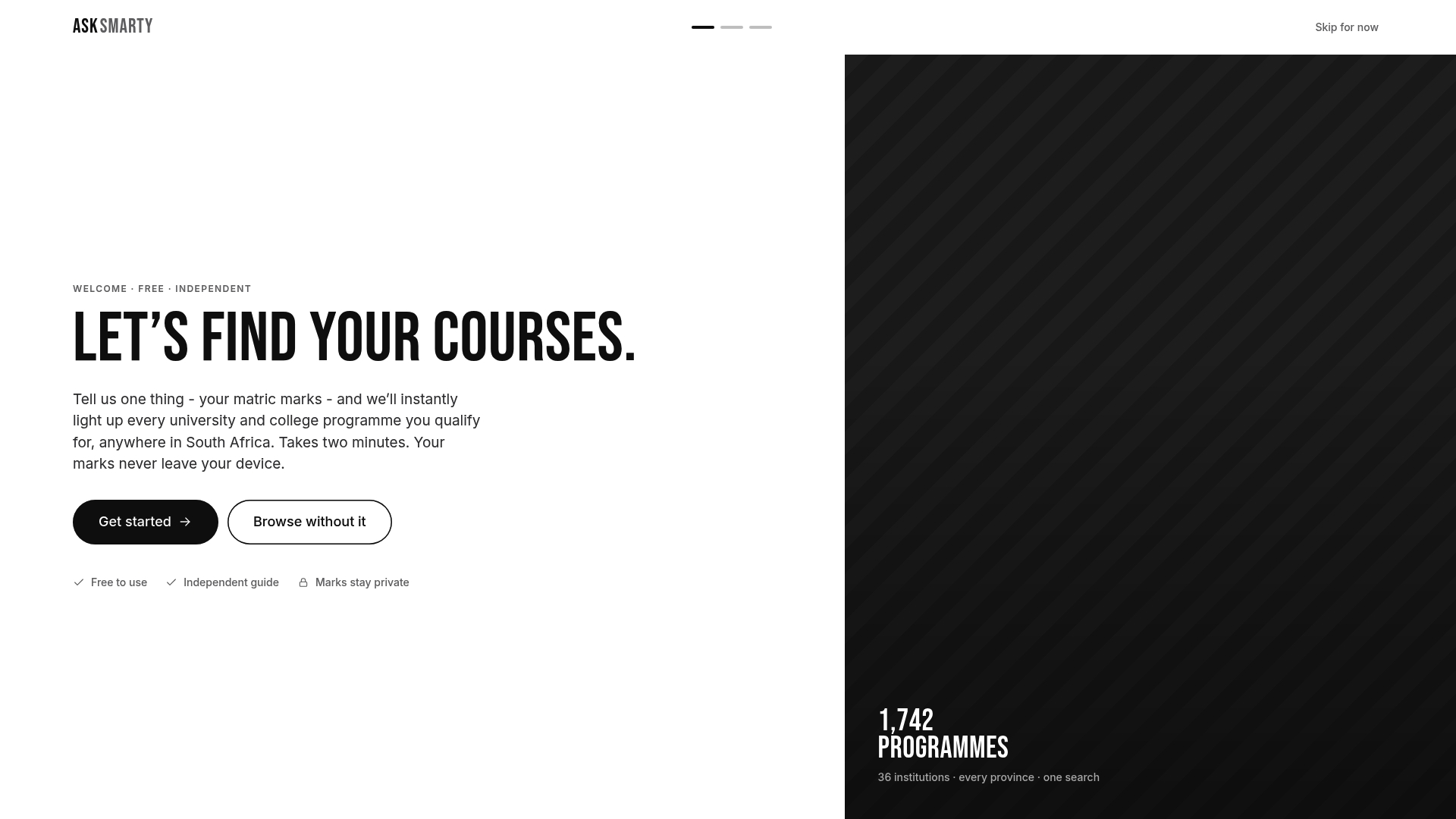
The APS calculator confirms your admission score in under a minute, with your marks staying on your device. The programme search covers over 1,700 courses across South African universities and colleges, so you can confirm the exact programme name and entry requirements before writing them on a bursary form. The university and college listings include deadlines and application fee details, letting you cross-reference bursary windows with institutional registration dates in one place.
No fees, no registration required, no data shared. Check your eligibility, confirm your programme, and go into your bursary applications with the right information already in hand.
Useful sources and official application pages
Before submitting any application, verify the deadline and contact details on the provider’s own domain. The sources below are the primary pages to bookmark.
| Source | What it publishes | Verification note |
|---|---|---|
| StudyTrust | Multiple corporate & trust bursaries; opens 1 June | Check domain: studytrust.org.za |
| Sasol bursary page | 2027 engineering & science window; closes 17 May 2026 | Check domain: sasol.com |
| Funza Lushaka | Teaching bursary; e-Gov portal application | Check domain: funzalushaka.doe.gov.za |
| CSIR-Sasol Foundation | Full STEM funding details; work-back terms | Cross-check on csir.co.za |
| StudyTrust applications | Application portal; income ranges; submission tips | Check domain: studytrust.org.za |
| NSFAS (nsfas.org.za) | Government funding; income thresholds; appeal process | Official government domain |
| SARAO (sarao.ac.za) | Astronomy & STEM scholarships | Official national facility domain |
| IDC (idc.co.za) | Industrial bursary scheme; current window dates | Official IDC domain |
After submitting: save your confirmation email or screenshot immediately. Many providers communicate outcomes by end of September where published, but timelines vary. Log each application’s expected outcome date in a spreadsheet or calendar so you are not waiting on a decision you missed.
Link verification checklist:
- The URL starts with the provider’s official domain (not a redirect or shortened link).
- The page shows a published deadline and a named contact email.
- The contact email matches the provider’s domain (not a personal Gmail or Hotmail address).
FAQ
Are bursaries still open for 2026 applications?
Yes. The StudyTrust platform opens 1 June 2026 and most windows close 30 September 2026. Sasol’s window for 2027 studies closes 17 May 2026, and NSFAS processes applications on a rolling annual basis.
Is the Motsepe Foundation bursary still open for 2026?
The Motsepe Foundation does not publish a fixed annual schedule on a single verified page. Check motsepe-foundation.co.za directly for the current application status and any open windows.
What is the Cyril Ramaphosa bursary and how do you apply in 2026?
The Cyril Ramaphosa Foundation funds bursaries focused on leadership development and broader education objectives. Application details and current windows are published on the foundation’s official site; verify the current status and apply directly through their portal to avoid intermediaries.
Which bursaries are available right now?
The Sasol Bursary Programme (closes 17 May 2026), NSFAS (rolling), and several corporate bursaries administered through StudyTrust are currently active. Use the Asksmarty programme search to confirm your programme qualifies before applying.
Do bursaries need to be paid back?
Standard bursaries and scholarships are non-repayable. Recruitment bursaries include a work-back clause: if you do not complete the required post-graduation service with the sponsor, the bursary converts to repayable debt with interest. Read the contract before accepting any recruitment bursary offer.
This article provides general information about bursary opportunities and application processes. Eligibility criteria, deadlines, and funding terms change annually. Always confirm current details directly with the bursary provider before submitting an application.
Recommended
Published 2026-07-30 · AskSmarty is an independent guide. Confirm anything time-sensitive on the official source.