How to check college accreditation in South Africa before you enrol
Learn how to check college accreditation in South Africa to ensure your institution and qualifications are recognized and respected.

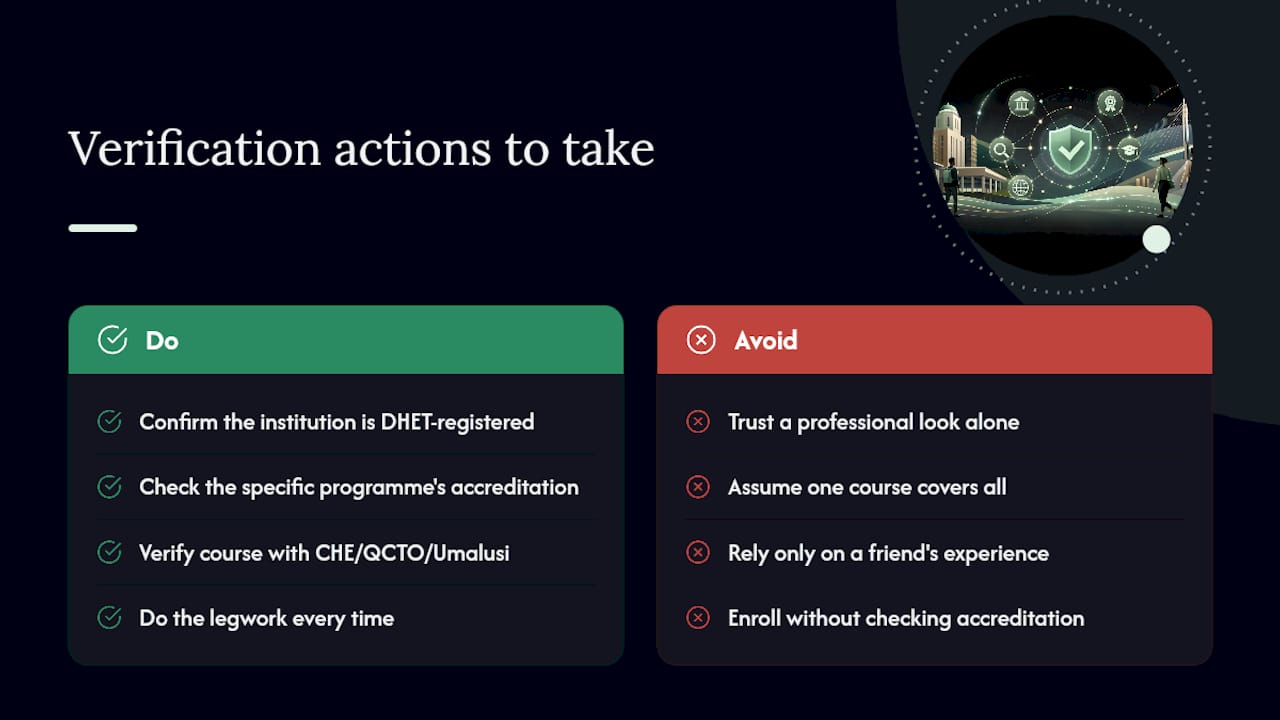
Check the college on the DHET Register of Private Colleges first, then confirm the specific programme with the Council on Higher Education (CHE), the Quality Council for Trades and Occupations (QCTO), Umalusi, or the relevant SETA. That order matters: DHET tells you whether the institution itself is legally allowed to operate, while the other bodies confirm whether the actual qualification you’ll walk away with is worth anything.
Here’s the split you need to hold in your head:
- DHET registers private colleges and publishes masterlists of established public institutions.
- CHE accredits higher education programmes at universities and private higher education providers.
- QCTO, Umalusi, and SETAs cover trade qualifications, National Certificate (Vocational) programmes, and occupational training.
Before you search anything, write down the college’s exact registered name, its registration number if advertised, and the physical campus or site of delivery where you’d actually attend. Then run the DHET lookup. If the online register is confusing or the college isn’t listed where you expect, call the DHET directly on 0800 87 2222 rather than taking the college’s word for it.
Key Takeaways
Verifying accreditation in South Africa means confirming institutional registration with DHET and programme accreditation with CHE, QCTO, Umalusi, or SAQA separately, never assuming one check covers both.
| Point | Details |
|---|---|
| Start with DHET | Check the DHET register first to confirm the college is legally registered before checking anything else. |
| Registration isn’t accreditation | A registered college can still offer programmes that were never accredited by CHE, QCTO, or Umalusi. |
| Match the right regulator | Use CHE for degrees and diplomas, QCTO for trades, Umalusi for NC(V), and SETAs for sector skills programmes. |
| Check Section B too | DHET’s Section B lists cancelled registrations, which some colleges keep operating under despite losing legal standing. |
| Foreign qualifications need SAQA | Only the qualification holder can apply for a SAQA evaluation, and it places the qualification on the NQF rather than rating the foreign college. |
| Use Asksmarty to shortlist verified options | Asksmarty’s private colleges list and programme search help you start from providers already appearing on official registers. |
Table of Contents
- What does check college accreditation actually involve in South Africa?
- How do I check a specific programme before applying?
- Private colleges and TVETs: reading the register correctly
- What if I have a foreign qualification?
- Red flags that mean you should stop and verify further
- Where to check accreditation status right now
- Why this verification process matters more than it seems
- Find registered programmes without the guesswork
- Sources
- FAQ
What does check college accreditation actually involve in South Africa?
Verifying accreditation isn’t one lookup. It’s a chain of checks across three or four different regulators, because South Africa splits oversight between the body that registers an institution and the bodies that accredit what it teaches.
The Department of Higher Education and Training maintains the Register of Private Colleges, which lists every legally registered private provider along with the qualifications each one is registered to offer, the NQF level of those qualifications, and the sites where they may deliver them. If a college doesn’t appear here, it has no legal standing to operate as a private higher or further education institution in South Africa, no matter how polished its website looks. DHET also publishes a masterlist of registered and established PSET institutions, which is the go-to resource for confirming public TVET colleges and universities.
Registration is not the same thing as accreditation, and this is where most confusion happens. A college can be legitimately registered with DHET and still offer a programme that has never been accredited by the relevant quality council. The Council on Higher Education is explicit about this distinction and points students back to DHET registers for institutional checks while directing programme-level questions to the appropriate quality council. In practice, that means a diploma can carry a college’s name proudly while sitting entirely outside any accredited framework.
Here’s how the regulators map to what you’re actually studying:
| Regulator | What it covers | When you’d check it |
|---|---|---|
| DHET | Institutional registration for private colleges; masterlists for public PSET institutions | Before applying anywhere, to confirm the college legally exists |
| CHE | Higher education programme accreditation (degrees, diplomas, higher certificates) | For university-style qualifications at public or private providers |
| QCTO | Occupational and trade qualifications | For artisan trades, apprenticeships, and workplace-based qualifications |
| Umalusi | National Certificate (Vocational) and general/further education qualifications | For NC(V) programmes typically run through TVET colleges |
| SETA | Sector-specific skills programmes and learnerships | For industry-linked short courses tied to a particular sector |
If you’re applying for something that sounds like a trade or artisan pathway, QCTO is your reference point. If it’s a vocational certificate through a TVET college, Umalusi. If it’s a degree, diploma, or higher certificate, CHE. Getting this wrong and checking the wrong register is one of the most common mistakes prospective students make, because colleges rarely volunteer which body actually oversees their specific programme.
How do I check a specific programme before applying?
Work through this in order, and don’t skip steps because a college’s marketing materials look convincing.
- Get the exact details. Write down the programme’s full title, the campus or site of delivery, and the provider’s official registered name (not a trading name or abbreviation).
- Search the DHET register or masterlist. Confirm the provider appears, then check that the registration number matches what’s on the college’s own paperwork or website.
- Check the qualification is actually listed. Registration doesn’t cover every course a college teaches. Look for your specific programme and its NQF level in the register.
- Cross-check with the right quality council. Depending on the qualification type, confirm accreditation status with CHE, QCTO, Umalusi, or the delegated SETA.
- Ask the college directly if anything doesn’t match. Request the registration number, accreditation certificate, exam centre number, and the NQF level and programme code in writing.
Pro Tip: Third-party sites and forum posts often copy old DHET data. Always cross-check against the live DHET register or the most recent official PDF, since registrations get updated and cancelled more often than people expect.
If the college can’t produce a registration number or accreditation certificate on request, that alone is a serious warning sign. A legitimately registered provider will have this documentation ready, because they need it for their own compliance reporting.
Private colleges and TVETs: reading the register correctly
The DHET Register of Private Colleges is split into two sections, and knowing the difference saves you from a costly mistake. Section A lists colleges currently registered along with the qualifications they’re accredited to offer and the corresponding NQF levels. Section B lists colleges whose registration has been cancelled, either provisionally or in full. Checking Section B matters because a college can keep operating under a familiar name even after losing its registration, and prospective students rarely think to look there.

When checking N1 to N6, NC(V), or Adult Education and Training (AET) listings, confirm the site of delivery matches where you’ll actually attend. A provider can be registered for one campus and not another.
Watch for these common tricks:
- Colleges advertising “accredited” courses that are actually unregistered part-qualifications.
- Providers selling partial modules of a full qualification as if they’re standalone certificates.
- Marketing that references an old registration number tied to a cancelled listing.
What if I have a foreign qualification?
If your qualification came from outside South Africa, DHET and CHE registers won’t help you directly. That’s SAQA’s job: the South African Qualifications Authority evaluates foreign qualifications and determines where they sit on the National Qualifications Framework.
A few things to know before you apply:
- Only the person who holds the qualification can apply for evaluation, not a college or agent on their behalf.
- The outcome is a SAQA Certificate of Evaluation, which South African institutions, employers, and licensing bodies use to assess your qualification.
- SAQA is not rating whether your foreign college was reputable. It’s placing an existing qualification within the NQF, nothing more.
- If your field requires professional registration (engineering, health sciences, law), also check with the relevant professional body, since SAQA evaluation alone doesn’t guarantee professional recognition.
Red flags that mean you should stop and verify further
Walk away, or at least pause, if you spot any of the following before signing anything or paying a deposit.
- The college has no listing on the DHET register under its advertised name.
- The registration number on their marketing material doesn’t match what’s on the official register.
- Staff pressure you to pay registration or “reservation” fees before you’ve verified accreditation.
- There’s no exam centre number for programmes that require external examination.
- The qualification code or NQF level doesn’t match anything CHE, QCTO, or Umalusi has on record.
If you suspect deliberate misrepresentation rather than a simple registry gap, request everything in writing, keep screenshots and receipts, and report it to DHET. Preserve every document and communication, since this evidence matters if the case later needs to go to a consumer-protection body or the police.
Where to check accreditation status right now
Keep these on hand when you’re actually running the checks:
- DHET general helpline: 0800 87 2222, for cases the online register doesn’t clarify.
- CHE’s FAQ page for programme-level accreditation questions.
Registers get updated regularly, so bookmark the live pages rather than relying on a saved PDF from months ago.
Why this verification process matters more than it seems
Most students assume that if a college has a professional-looking campus and a working website, it’s automatically legitimate. That assumption is exactly what unregistered providers rely on. The gap between “looks credible” and “is legally registered” is where a lot of South African students lose money on qualifications that employers and universities won’t recognize.
What surprises people most is learning that registration and accreditation aren’t the same fight. A college passing its DHET registration doesn’t mean every course on its brochure has been through CHE, QCTO, or Umalusi. Providers sometimes register for one or two flagship qualifications and then market a much wider course catalogue, banking on students assuming the whole institution is covered.
The practical fix isn’t complicated, but it does require a bit of legwork: confirm the institution, then confirm the specific programme, every single time, even if you’ve heard good things about the college from a friend. A friend’s experience with one qualification says nothing about whether the diploma you’re eyeing has ever been accredited.
Find registered programmes without the guesswork
Running these checks manually across DHET, CHE, and SAQA takes time, and most prospective students don’t know where to start looking. Asksmarty compiles a list of registered private colleges alongside the programmes they offer, so you can shortlist providers that already appear on official registers instead of starting from a cold search.
Beyond the private colleges list, Asksmarty’s programme search tool lets you filter courses by entry requirements and NQF level without submitting your marks anywhere; everything runs on your own device, so your results stay private. If you’re still working out what you qualify for, the APS calculator turns your matric marks into a clear picture of which programmes are realistically within reach. Start with the South African universities and colleges page and narrow down your options from there.
Sources
FAQ
How do I verify if a college is accredited?
Check the college’s name against the DHET Register of Private Colleges for registration status, then confirm the specific programme’s accreditation with CHE, QCTO, or Umalusi depending on the qualification type.
How do I check my accreditation status online?
Search the live DHET register or masterlist by the institution’s official registered name, and compare the registration number and NQF level shown against what the college has told you.
How do I check if a college is registered with SAQA online?
SAQA doesn’t register South African colleges; it evaluates foreign qualifications and places them within the NQF. For local college registration, use the DHET register instead.
Can I check my SAQA accreditation online?
You can apply for a SAQA evaluation only if you personally hold the foreign qualification; SAQA issues a Certificate of Evaluation once the process is complete.
What’s the difference between institutional registration and programme accreditation?
Institutional registration confirms a college legally exists and can operate; programme accreditation confirms the specific qualification you’re studying has been quality-assured by CHE, QCTO, or Umalusi.
Recommended
Published 2026-08-22 · AskSmarty is an independent guide. Confirm anything time-sensitive on the official source.