Computer science entry requirements for SA students
Discover the entry requirements for computer science programs in South Africa, ensuring you meet the criteria for a successful application.

Most BSc Computer Science programmes in South Africa need an APS in a range generally spanning from the lower 30s to mid-40s, a strong Mathematics result at about Level 6 or higher, and English at Level 5 or higher. If you fall short, gateway and extended programmes can still get you there, just with an extra year attached.
Before you dig into the details, check that you have:
- A National Senior Certificate (NSC) with a bachelor’s pass
- Mathematics, not Mathematical Literacy, at the required level
- English at Level 5 or higher
- Your final six subjects counted (Life Orientation excluded) to calculate your APS
Key Takeaways
Meeting South Africa’s computer science entry requirements comes down to three fixed numbers: your APS total, your Mathematics level, and your English level.
| Point | Details |
|---|---|
| APS range | Most BSc Computer Science programmes require an APS between 30 and 44, depending on the institution. |
| Mathematics is non-negotiable | Mathematics (not Mathematical Literacy) at Level 6 or higher is typically required regardless of overall APS. |
| English threshold | English at Level 5 (60%+) is the common minimum across most South African programmes. |
| Alternatives exist | Extended and gateway programmes add a foundation year for students who narrowly miss standard thresholds. |
| Verify before applying | Use the Asksmarty APS calculator to confirm your exact eligibility across multiple universities at once. |
Table of Contents
- Computer science entry requirements at a glance
- Which subjects and documents do universities actually require?
- How is your APS actually calculated?
- Do you need to write the NBT?
- What if you don’t meet the minimums yet?
- How do you apply, and when are the deadlines?
- How competitive is admission, really?
- What about fees and funding?
- Where can you verify your own eligibility?
- Check your APS and matching programmes now
- Sources
- FAQ
Computer science entry requirements at a glance
Here’s what actually gets checked when your application lands on a faculty’s desk:
- APS score: Most programmes require an APS score typically in the range supported by the universities, varying with the institution and competitiveness of the intake
- Mathematics: Typically Level 6 (70%+), with some universities asking for Level 7 (80%+)
- English: Usually Level 5 (60%+) as either home or first additional language
- Extra tests: Some faculties request National Benchmark Test (NBT) scores alongside your NSC results
- Documents: Certified ID copy, full NSC statement of results, and proof of residence
Run your marks through an APS calculator before you assume anything. Small counting differences between universities change eligibility more often than students expect.
Which subjects and documents do universities actually require?
Mathematics is the one subject you cannot substitute. Universities want to see Level 6 or higher on your NSC certificate, and Wits’ Computer Science entry page lists Maths Level 6 and English Level 5 as its baseline, a pattern repeated across most South African science faculties. Mathematical Literacy will not open this door, no matter how high your overall APS climbs.

English sits just behind Maths in importance. Physical Science and Information Technology aren’t always compulsory, but they strengthen your application and make first-year content noticeably less of a shock.
On paperwork, keep these ready before application season opens:
- Certified copy of your ID or birth certificate
- Full NSC final results (or your latest school report if you’re still writing exams)
- Proof of residence
- Foreign qualification evaluation, if you matriculated outside South Africa
Pro Tip: If your overall APS clears the bar but your Maths mark sits one level below what a programme demands, don’t assume the total score saves you. Subject-specific minimums are usually treated as hard cutoffs, not averaged away by a strong APS elsewhere.
How is your APS actually calculated?
Your Admission Point Score comes from your best six NSC subjects, with Life Orientation excluded from the count entirely. Each subject’s achievement level converts to points, and universities set their own minimum APS thresholds for each programme, which vary depending on how many students compete for a seat.
Here’s how the conversion typically works:
| NSC Achievement Level | APS Points |
|---|---|
| Level 7 (around 80% and above) | 7 |
| Level 6 (around 70% and above) | 6 |
| Level 5 (around 60% and above) | 5 |
| Level 4 | 4 |
| Level 3 (around 40% and above) | 3 |
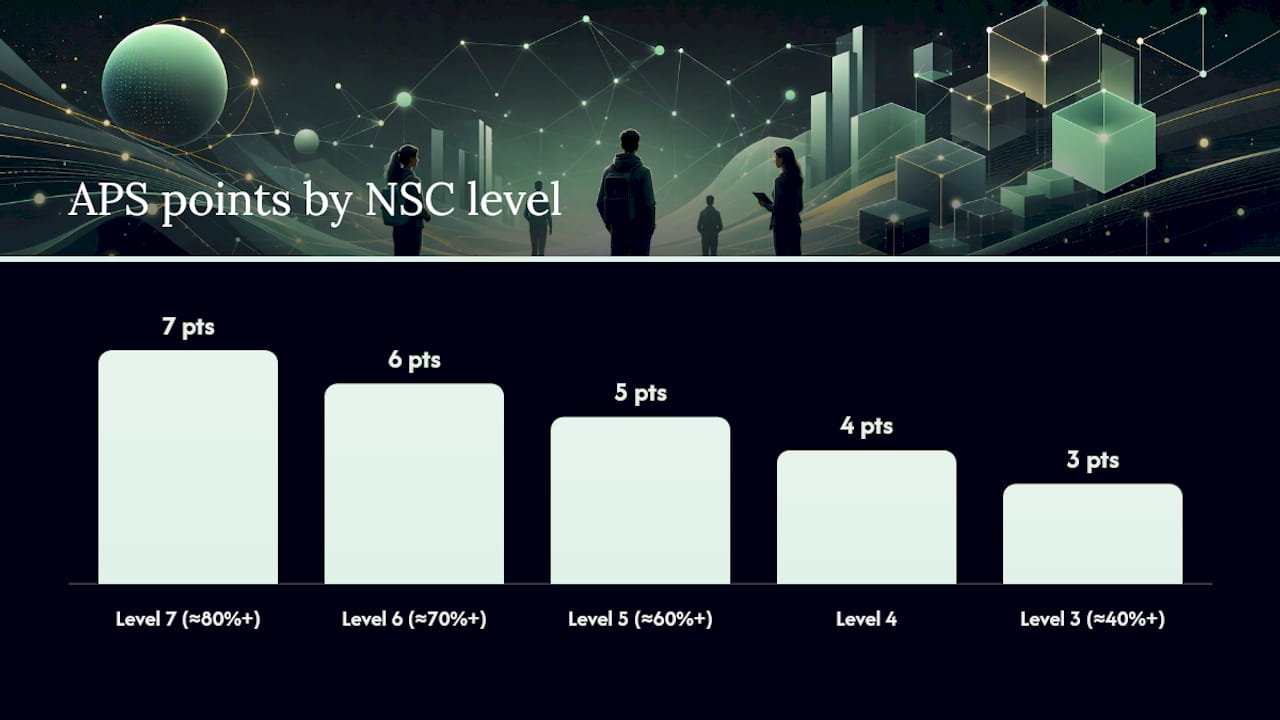
A student with Maths (Level 6 = 6 points), English (Level 5 = 5 points), Physical Science (Level 5 = 5 points), Life Sciences (Level 4 = 4 points), Geography (Level 4 = 4 points), and Afrikaans (Level 5 = 5 points) lands on an APS of 29. That’s below most Computer Science thresholds, which shows exactly why one weak subject can knock you out of contention even with decent marks elsewhere.
Pro Tip: *If you’re rewriting a subject to boost your APS, target the one closest to its next threshold.
Do you need to write the NBT?
The National Benchmark Test checks your academic literacy, quantitative literacy, and mathematics readiness, separate from your NSC results. Some faculties use NBT scores for placement decisions rather than admission itself, deciding whether you start in a standard or extended stream.
- Not every South African university requires NBT for Computer Science, check each programme page directly
- Universities that do request it typically use scores for placement, not as a pass/fail gate
- Some faculties supplement NBT with a short interview or portfolio review for borderline applicants
- Book your NBT slot through the official National Benchmark Tests site well before application deadlines, since results take weeks to process
What if you don’t meet the minimums yet?
Falling short of a programme’s APS or subject threshold doesn’t end your options. Extended degree programmes add a foundation year covering mathematics and introductory computing alongside academic literacy support, letting you catch up before tackling the standard first-year curriculum.
- Extended/gateway programmes: They accept slightly lower APS scores in exchange for an additional year of study
- Recognition of Prior Learning (RPL): Lets mature applicants or those with relevant work experience qualify without a traditional NSC pathway
- Bridging courses: Some institutions and private colleges offer standalone bridging years before mainstream university entry
- Check each university’s programme page directly, since not every institution offers a gateway route for Computer Science specifically
How do you apply, and when are the deadlines?
South African universities generally open applications between April and June for the following academic year, with popular programmes closing earlier than less competitive ones. Waiting until the official deadline is usually a mistake, since spaces in high-demand faculties fill months in advance.
- Finalise your NSC results and calculate your APS
- Run your marks through a programme matching tool to see which universities you qualify for right now
- Complete each university’s online application before its specific closing date
- Upload certified documents, ID, results, and proof of residence, in the exact format each portal requests
- Accept or decline offers within the stated window
- Register once your offer is confirmed and, where required, pay your registration deposit
Missing a single uploaded document is the most common reason applications stall in review queues.
How competitive is admission, really?
Published minimums are the floor, not a promise. When a Computer Science programme receives far more applications than seats, admissions offices often admit students scoring well above the stated minimum, which means a bare APS of 30 rarely secures a place at a high-demand faculty in a strong application year.
- Aim several points above the published minimum wherever possible
- Strengthen Mathematics specifically, since it carries more weight than a marginal APS gain elsewhere
- Prior programming experience helps but isn’t required. Most first-year modules teach from scratch, so don’t panic if you’ve never coded
- Check whether your target university runs a contextual or gateway admissions track for applicants from under-resourced schools
Pro Tip: Coding portfolios and hackathon entries look great on paper, but they supplement your application. They won’t replace a missed Maths threshold.
What about fees and funding?
Tuition varies by institution and by whether you’re in a standard three-year programme or an extended four-year one, so there’s no single number to quote here. Extended programmes cost more overall simply because they run longer, even if per-year fees are similar.
- NSFAS covers tuition and living costs for eligible students based on household income thresholds
- Universities also run merit bursaries and departmental awards specific to science and engineering faculties
- Check application fee details and funding deadlines directly on each university’s page, since NSFAS applications often close separately from academic applications
Where can you verify your own eligibility?
Don’t rely on secondhand summaries, including this one, for your final decision. Run your actual marks through an APS calculator to see where you stand today.
- Check official programme pages: Wits Computer Science, UP’s BSc Computer Science, and UJ’s BSc Computer Science and Informatics
- Confirm NBT requirements on the university’s own admissions page, not a third-party summary
- Look specifically for subject-level minimums, general APS ranges hide the Maths and English cutoffs that actually disqualify applicants
A local admissions perspective
Every year, students assume a slightly-below-threshold Maths mark ends their Computer Science ambitions. It usually doesn’t. Extended programmes and gateway routes exist precisely for that gap, and plenty of practising South African developers started there. What matters more is checking your actual numbers against the actual programme page, not against a rumour from a friend’s cousin who applied three years ago.

Check your APS and matching programmes now
There are other ways to figure out where you stand: calling university admissions offices directly, digging through PDF prospectuses, or asking a school counsellor who’s juggling three hundred other students. Asksmarty exists because that process wastes time you don’t have during matric finals. Enter your NSC marks once, and the APS calculator instantly shows your score and which of over 1,700 South African programmes you currently qualify for.
Your marks never leave your device, there’s no signup fee, and no institution sees your data unless you choose to apply. Once you’ve got your APS, browse matched programmes across South African universities and colleges and follow the official application link straight to each institution’s portal. Start with your calculator result, then apply before the closing dates you find there.
Sources
- Computer Science (Wits) — course finder entry requirements
- Computer Science and Informatics (UFS) — general / FAQ
Always confirm current thresholds on the university’s own programme page. Universities revise APS and subject minimums between intakes.
FAQ
What APS is needed for computer science?
Most South African BSc Computer Science programmes require an APS between 30 and 44, though the exact number depends on the university and how competitive that year’s applicant pool is.
Which subjects does computer science need?
Mathematics at Level 6 or higher and English at Level 5 or higher are the standard requirements, with Physical Science recommended but not always compulsory.
How many years is computer science at UJ?
UJ’s BSc in Computer Science and Informatics runs as a standard three-year full-time degree, matching the typical structure across South African universities.
How long is a computer science course?
A BSc Computer Science degree in South Africa usually takes three years full-time, though extended programmes with an added foundation year take four years for students needing extra academic preparation.
Recommended
- University Admission Requirements - APS, NSC Passes, NBT & NQF Explained | AskSmarty
- How to Apply to a South African University or College | AskSmarty
- University of South Africa - Programmes, Deadlines & How to Apply | AskSmarty
- AskSmarty - Find your course anywhere in South Africa, check if you qualify, apply
Published 2026-08-20 · AskSmarty is an independent guide. Confirm anything time-sensitive on the official source.