Map your APS to South African courses with private matches to 1,700+
See which South African degrees, diplomas and TVETs your APS band opens. Use a private on-device matcher to find matches across 1,700+ programmes before...

Run your marks through an APS calculator and check each programme’s subject minima. That single step tells you which South African courses you qualify for right now. Exclude Life Orientation where the university’s rules say to, then confirm the specific subject requirements on the programme page itself. Concrete examples of what different APS bands typically unlock come next.
TL;DR:
- An APS calculator that includes or excludes Life Orientation can significantly affect your qualifying score, so use the official university or national tools for accuracy.
- Students should focus on subject-specific minimums, especially in maths and physical sciences, since they often determine eligibility regardless of the overall APS score.
- APS bands indicating eligibility range from 18 to 21 for diplomas and certificates, 22 to 26 for extended degrees and some diplomas, and 27 or higher for broad degree access, but thresholds vary by institution and year.
- Falling short of an APS cutoff often means considering extended programmes, diplomas with transfer pathways, or vocational courses at TVET colleges, rather than abandoning the application altogether.
- Using Grade 11 marks early allows students to identify weaker subjects, improve their scores, and target conditional offers before final results arrive.
Table of Contents
- How to find courses for my APS score
- What courses can you study at different APS levels?
- What if your APS falls short of the requirement?
- Use Grade 11 marks to plan before final results
- How Asksmarty helps you check your options
- How to raise your APS if you’re short
- Why subject requirements matter more than your total APS
- How admission policies differ across South African universities
- A closing note on making the most of your score
- Try Asksmarty’s free APS calculator now
- Sources
- FAQ
How to find courses for my APS score
Your APS score comes from your best six or seven subjects, each converted to points based on your percentage. A mark of 80% and above usually earns 7 points, 70 to 79% earns 6, and so on down to a single point for a bare pass. Most calculators add those subject scores together, but here’s where things get tricky: some universities include Life Orientation in that total, and many don’t. The North-West University APS calculator spells out its own conversion table, and its own guidance notes that calculators differ this way. Rely on one national number and you could easily misjudge where you stand.
Checking your options properly means working through a short sequence rather than trusting a single app result.
- Calculate your APS using your actual NSC results, checking whether the calculator includes or excludes Life Orientation.
- Filter programmes by that score using a national course finder or a specific university’s calculator.
- Confirm the subject-specific minimums on the actual programme page, not just the APS cutoff.
- Save or shortlist the matches you qualify for and note each application deadline.
You’ll find this kind of calculator on individual university sites, on NWU’s studies portal, and through the Asksmarty APS calculator, which runs entirely on your device.
Two things trip students up every year:
- Assuming a diploma and a degree at the same institution share the same subject rules. They rarely do.
- Ignoring maths and physical science minimums because the overall APS looked high enough.
Pro Tip: If you’re eyeing engineering, health sciences, or any technical degree, check the maths and physical science percentage minimums before you get excited about your total APS. A 32 APS with a 50% in maths can knock you out of programmes a 28 APS with 70% in maths would sail into.
What courses can you study at different APS levels?
APS bands aren’t hard walls. They’re rough zones where certain programme types become realistic, and the exact cutoff shifts by institution and by year. Still, patterns hold firm enough to plan around.
Around 18 to 21 points puts you in range for diplomas, TVET certificate programmes, and a handful of vocational degrees. Business studies diplomas, hospitality management, office administration, and some foundation phase teaching diplomas often sit in this band. This is also where TVET colleges become a genuinely strong option rather than a fallback, since many trades and technical qualifications lead directly into employment.
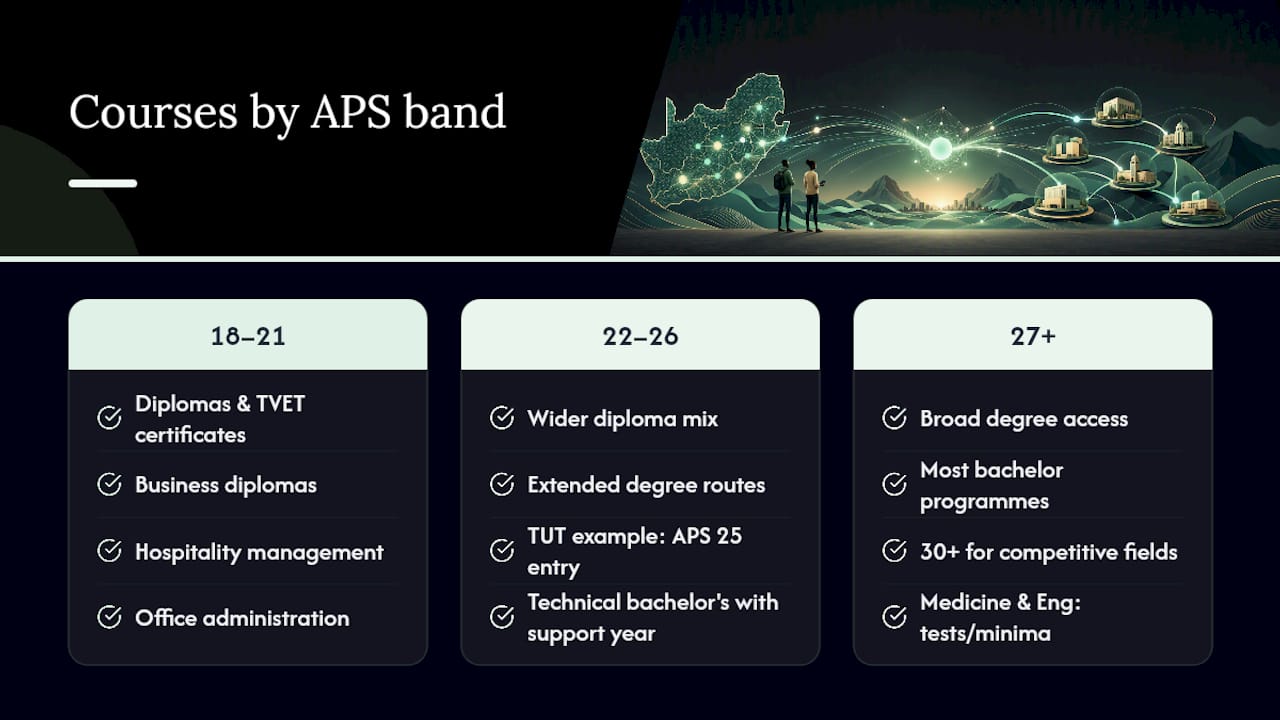
Around 22 to 26 points, with 25 as a common reference figure, opens up a wider mix. TUT’s published examples show that an APS of 25, excluding Life Orientation, qualifies students for several diploma programmes and certain extended degree routes at Tshwane University of Technology. Extended curriculum BEd programmes in foundation and intermediate phase teaching also tend to sit here. Some technical bachelor’s degrees use a lower entry APS paired with a support year.
27 points and above starts opening genuine degree access across a wider range of faculties, and 30 plus generally puts you in contention for competitive fields. Here’s the catch: medicine, engineering, and other high-demand degrees rarely run on APS alone. They add selection tests, interviews, or steep subject-specific minimums (think 70% plus in physical science for some engineering streams) that can disqualify a student with a perfectly respectable overall score.
None of these bands are fixed law. A university can raise its cutoff in a high-demand year if applications spike, and one faculty’s 25 might be another faculty’s 30. Subject passes, selection tests, and each institution’s own admission policy all shift the real number. Treat the bands above as a planning tool, not a guarantee, and always confirm against the current admission requirements for the specific programme.
What if your APS falls short of the requirement?
Falling short of a programme’s APS cutoff doesn’t end your options. It usually just changes the route.
Extended programmes stretch a normal three-year degree into four years, adding foundational support in the first year for students who show potential but land just under the standard cutoff. They’re common in engineering, science, and education faculties specifically because those fields lose too many capable students to a rigid entry line.

Diplomas run shorter, often more career-focused, and generally carry a lower APS threshold than the equivalent degree. Many diplomas allow credit transfer into a related degree later if your marks hold up, though the credit recognition varies a lot between institutions.
TVET colleges offer another route entirely, with vocational and trade qualifications that often lead straight into work and sometimes back into higher education through recognized pathways. Registered private colleges round out the picture for students who want a structured, career-focused alternative outside the traditional university system.
Before you commit to any of these, ask the admissions office directly:
- Can I transfer credits from this diploma into a degree later?
- Is this an extended programme, and what does the additional year actually cover?
- What are the total costs across the full duration, not just year one?
Pro Tip: Ask specifically whether a “conditional” or “provisional” offer requires you to maintain a minimum average in your first semester. Some conditional places get withdrawn if you dip below a set mark, and nobody mentions that detail until it’s too late.
Use Grade 11 marks to plan before final results
Your Grade 11 final marks work as a genuine trial run for your APS, and using them that way gives you a real window to act. Nelson Mandela University’s guidance recommends exactly this: run your Grade 11 numbers through a calculator early enough to still change the outcome.
- Calculate an estimated APS from your Grade 11 final marks.
- Identify the one or two subjects dragging your score down, usually maths, physical science, or a language.
- Put focused effort into those specific subjects rather than spreading revision evenly across everything.
- Decide whether to apply now on your Grade 11 or trial results and accept a conditional offer, or hold off and apply once your final NSC results are out.
Most universities let you apply with provisional marks and confirm the place once final results land, so applying early rarely costs you anything except the effort of doing it.
How Asksmarty helps you check your options
Asksmarty runs an on-device APS calculator against a searchable database covering more than 1,700 university and college programmes across South Africa. Enter your marks, filter by subject and APS band, and you get a list of programmes you actually qualify for, with direct links to each institution’s application portal.
Your marks never leave your device. Nothing gets uploaded, stored, or shared, and the tool is free to use with no processing fees attached. The workflow is simple: enter your results, review your matches, then click through to the official admission requirements for any programme that catches your eye to confirm the subject-specific minimums before you apply.
How to raise your APS if you’re short
A low APS isn’t a fixed number. Several routes exist to push it higher before or after your final NSC results.

Supplementary exams give you a second attempt at a subject you underperformed in, usually written early in the following year, and a passed supplementary replaces the original mark in most cases. This matters most for a single weak subject dragging down an otherwise solid total, since fixing one subject by even one grade band can shift your whole APS.
Rewriting through independent exam bodies is another option some students use, sitting a subject again through a different NSC-recognized route to boost a specific percentage. It costs time and money, so it works best when one subject stands between you and a specific programme’s cutoff, not as a blanket fix.
Bridging courses, often run by private colleges or university-affiliated centres, target students whose overall marks are close but not quite there. These typically focus on foundational content in maths, science, or academic literacy over a few months, aiming to get you into a mainstream programme rather than an extended one.
None of these routes work as a shortcut around genuinely weak preparation. They work when a student’s overall ability is solid but one exam, one subject, or one bad semester pulled the number down. Before choosing any of them, check with the specific university whether a supplementary or rewritten mark gets accepted for the intake you’re targeting. Rules differ by institution and sometimes by faculty within the same university.
Why subject requirements matter more than your total APS
Two students with identical APS scores can qualify for completely different programmes, and the reason almost always comes down to subject-specific minimums sitting underneath the total.
A programme might state “APS of 30” as the headline number, but bury a requirement for 60% in mathematics and 50% in physical science inside the fine print. Miss either one and the overall APS becomes irrelevant. This shows up constantly in engineering, health sciences, and commerce degrees that need accounting or maths at a specific level, and it’s the single most common reason a student assumes they qualify and then gets rejected.
The TUT prospectus material on ICT programmes illustrates this pattern clearly, listing subject-specific thresholds alongside the APS total and confirming that Life Orientation sits outside the calculation for many of its programmes. That detail alone changes a student’s real score, sometimes by two or three points, depending on how strong or weak their Life Orientation mark happens to be.
Language requirements catch students out too. A programme taught primarily in English will usually specify a minimum English mark regardless of your APS, and some professional degrees add a separate literacy or numeracy benchmark on top of both. The safest habit is treating your APS as a first filter, not a final answer, and reading the full subject breakdown on every programme that clears your initial score check.
How admission policies differ across South African universities
Every South African public university sets its own APS thresholds, and there’s no single national standard that applies uniformly across the sector. A programme requiring 28 APS at one institution might sit at 32 at another, even when the qualification carries the same name and NQF level.
Some universities weight their calculators differently too. Certain institutions include Life Orientation in the total; others explicitly strip it out, which is why the NWU calculator’s own guidance flags this variation directly rather than assuming students already know. A student who calculates APS once using a generic formula and assumes it applies everywhere can misjudge their eligibility at more than one institution simultaneously.
Distance and extended-programme routes add another layer of institutional variation. NWU’s distance learning division runs separate selection criteria for its distance and extended offerings, often with different entry thresholds than the equivalent contact programme on campus. This flexibility exists specifically because a rigid national APS standard would shut out students who are capable but need a different pace or format to succeed.
The practical takeaway: never assume one university’s rule applies at another, even for a programme with an identical title. Confirm each institution’s specific policy through its own programme pages or prospectus before ruling yourself in or out.
A closing note on making the most of your score
Your APS is a starting filter, not a verdict on your future. I’ve seen too many students treat a lower number as a closed door when it’s really just a different route, often a faster or cheaper one, into the same career. Calculate your score honestly, check subject minima before you get attached to a programme, and take extended or diploma routes seriously if that’s where your marks land. Run your numbers through a calculator and build your shortlist today.
— Nkosi
Try Asksmarty’s free APS calculator now
You’ve done the maths, checked the subject rules, and now you need one place to see where you actually stand. Asksmarty is the alternative to guessing your way through separate university portals: enter your marks once, and you get matched instantly against 1,700 plus South African programmes, without uploading anything to a server or paying a cent.
The Asksmarty APS calculator processes your marks entirely on your own device, so nothing gets stored or shared anywhere. Once you have your matches, cross check the subject-specific admission requirements for anything on your shortlist, since a programme that clears your APS filter can still carry a maths or science minimum that changes the picture. Run your marks through it now and see exactly which programmes are within reach before application deadlines close.
Sources
FAQ
What can I study with 20 APS points?
Around 18 to 21 points typically qualify you for certificate and diploma programmes, including business studies, office administration, and some hospitality diplomas, along with a range of TVET college qualifications.
Does UJ accept 21 APS?
Some diploma and higher certificate programmes at the University of Johannesburg accept an APS around 21, though most degree programmes require a higher score. Check the specific programme’s admission requirements directly, since minimums vary widely by faculty.
What courses can I do with 19 APS?
Around 18 to 21 points, most options sit in the certificate, diploma, and TVET space rather than mainstream degrees, covering fields like business administration, hospitality, and various trade qualifications. Confirm subject minimums for each programme, since a score with a strong maths mark can open different doors than the same score with a weak one.
What courses require a 31 APS score?
Scores of 30 plus generally put you in contention for competitive degree programmes in commerce, science, and some engineering streams, though subject-specific minimums (particularly in maths and physical science) often matter as much as the total score itself. Programmes like medicine typically need both a high APS and separate selection criteria beyond the number alone.
Recommended
Published 2026-08-30 · AskSmarty is an independent guide. Confirm anything time-sensitive on the official source.