Courses without maths: options for South African matriculants
Explore diverse higher-education options in South Africa without needing Pure Mathematics. Your future starts here!

Yes, you can study many recognised higher-education programmes in South Africa without Grade 12 Pure Mathematics. Hundreds of degree, diploma, and certificate programmes accept Mathematical Literacy instead, and a good number require no maths qualification at all. The short list below covers the highest-probability options for most matriculants:
- Bachelor of Arts (BA) — humanities, languages, media, psychology
- Bachelor of Social Work (BSW)
- Bachelor of Education (BEd) — foundation or intermediate phase
- Diploma in Hospitality Management or Tourism
- Diploma or certificate in Public Relations or Marketing
- TVET NCV programmes in Office Administration, Educare, or Hospitality
Pro Tip: Before you apply anywhere, run your subjects and marks through the Asksmarty APS calculator to see exactly which programmes you qualify for — it takes under two minutes and your marks never leave your device.
Key takeaways
Many programmes in South Africa accept Mathematical Literacy or require no maths at all, and checking your APS against specific programme requirements is the single most useful step you can take right now.
| Point | Details |
|---|---|
| Maths Literacy is widely accepted | BA, BEd, BSW, hospitality, PR, and HR programmes commonly accept Maths Literacy instead of Pure Maths. |
| APS trade-off is real | Missing Pure Maths often raises the required APS by 2–3 points; strong marks in other subjects can close that gap. |
| TVET is the fastest low-entry route | NCV programmes at NQF 4–5 often require no maths subject and can be completed in 2–3 years. |
| Upgrading is possible | You can rewrite NSC exams, complete a matric upgrading course, or apply for a university extended programme. |
| Asksmarty speeds up the search | The free APS calculator filters over 1,700 programmes by subject requirement, with your marks staying on your device. |
Table of Contents
- What courses can you study without Pure Mathematics?
- Where can you study without Pure Maths in South Africa?
- How do universities treat the lack of Pure Mathematics?
- What can you do if you failed or did not take Grade 12 Maths?
- How do you choose the right course without maths?
- How Asksmarty helps you find courses you qualify for
- Sources
- FAQ
What courses can you study without Pure Mathematics?
The range is wider than most people expect. Many respected programmes in South Africa do not require Pure Mathematics, and the fields below cover the majority of what matriculants without Pure Maths actually go on to study.
Arts and humanities
A Bachelor of Arts (NQF 7) is the most flexible undergraduate degree in the country. You can major in English, isiZulu, History, Philosophy, Psychology, or Political Science, among others. The UJ Bachelor of Arts accepts Mathematical Literacy for most majors. Career outcomes include roles in content writing, publishing, government communications, and NGO work.
Education
BEd Foundation Phase and BEd Intermediate Phase programmes (NQF 7) are consistently accessible without Pure Maths. The UJ BEd Senior and FET Phase page illustrates how subject requirements shift by specialisation — English-focused teaching streams, for instance, do not demand Pure Maths. Foundation-phase graduates teach Grades R–3; intermediate-phase graduates teach Grades 4–6.
Social sciences and social work
The Bachelor of Social Work (NQF 7) at UJ and most other public universities accepts Mathematical Literacy. Social work graduates enter child protection, community development, and healthcare support roles. It is one of the more employment-stable degrees for students without Pure Maths.
Media, communication, and public relations
A Diploma in Public Relations or BA in Communication (NQF 6–7) suits students with strong language skills. These programmes feed into junior PR, social media, and journalism roles. Marketing diplomas at the same level follow a similar entry profile.
Creative arts and design
Diploma in Graphic Design, Fashion Design, or Fine Arts (NQF 6) programmes at universities of technology and private colleges rarely require Pure Maths. Portfolio quality often matters more than your maths subject.
Hospitality and tourism
A Diploma in Hospitality Management or Diploma in Tourism Management (NQF 6) is available at universities of technology, private colleges, and TVET colleges. TVET NCV Hospitality (NQF 4–5) has some of the lowest entry thresholds in the sector and leads directly into hotel and events operations.

Selected business streams
Not all business programmes are maths-heavy. Human Resources Management, Office Administration, and Marketing diplomas commonly accept Mathematical Literacy. Core accounting and finance degrees typically still require Pure Maths, so check each programme individually before assuming a business course is accessible.
Where can you study without Pure Maths in South Africa?
The four main routes each suit a different situation. EduFunds distinguishes programmes that accept Maths Literacy from those that require no maths at all, and the route you choose shapes how quickly you start, what you pay, and how employers view your qualification.
Public universities and universities of technology
Public universities offer the most recognised degrees but also the most competitive entry. Many accept Mathematical Literacy for non-quantitative programmes, though they often raise the overall APS requirement to compensate. Universities of technology (UTs) lean toward applied diplomas and tend to be slightly more flexible on subject combinations.
- Entry: APS-based; Maths Literacy accepted for many programmes
- Duration: 3–4 years for a degree; 3 years for a diploma
- Cost: Subsidised fees; NSFAS-eligible
- Best for: Students who want a nationally recognised degree and meet the APS threshold
TVET colleges
TVET colleges are often the fastest route to employment if you want a practical, low-entry option. Many NCV programmes at NQF 4–5 require no maths subject at all. The 50 public TVET colleges across South Africa cover every province — you can browse them by province on the Asksmarty TVET colleges directory.
- Entry: Grade 9 or Grade 12 depending on the programme level
- Duration: 2–3 years for NCV; 1–2 years for N-courses
- Cost: Low fees; NSFAS covers many TVET students
- Best for: Students who want to start working quickly in a practical field
Private colleges and distance learning
Private colleges and distance-learning providers commonly accept students without Pure Maths and offer more flexible start dates than public institutions. Accreditation quality varies, so checking the SAQA/NQF registration of any programme before you enrol is non-negotiable.
- Entry: Often lower APS requirements; some accept mature-age students
- Duration: Varies; many diplomas run 1–2 years
- Cost: Higher than public institutions; limited NSFAS access
- Best for: Students who need flexibility or missed the public-university application window
Whichever route you choose, confirm the institution is registered with the Department of Higher Education and Training (DHET) and that the programme carries a SAQA-registered NQF level. A qualification that cannot be verified on the SAQA database has limited value in the job market.
How do universities treat the lack of Pure Mathematics?
The short answer: most non-quantitative programmes either accept Mathematical Literacy outright or ask for a higher overall APS to make up for the absence of Pure Maths. Understanding this trade-off lets you plan your application strategically rather than guessing.
Mathematical Literacy vs Pure Mathematics
Maths Literacy is not simply “easier maths.” It covers practical, workplace-oriented numeracy — budgets, measurements, basic data interpretation — and many universities accept it for degrees in the humanities, education, social sciences, and communication. What it does not do is qualify you for programmes that use calculus, statistics, or quantitative research methods as core content (think actuarial science, engineering, or core accounting).
APS thresholds and the trade-off
University of Johannesburg programme pages illustrate the pattern clearly: a programme may require an APS of 26 with Pure Mathematics but 28 with Mathematical Literacy. For an LLB, some institutions accept either subject provided the overall APS threshold — for example, APS 33 — is met. The gap is usually 2–3 APS points, which you can close by performing well in your other subjects.
Key insight: A higher APS in your language, life orientation, and elective subjects can fully offset the absence of Pure Maths for most humanities and social-science degrees. Focus your energy there.
You can check exactly how your current marks translate into an APS score using the Asksmarty admission requirements guide, which explains how APS is calculated, what NSC pass types mean, and when an NBT is required.
Extended and foundation programmes
Many universities offer extended or foundation degrees — sometimes called “augmented” or “EDP” programmes — for students who meet the interest profile for a degree but fall short on one subject. These add a preparatory year to the standard degree, bringing the total to four years for a three-year degree. North-West University and several other public universities list extended programmes in economic and management sciences as a recognised route for students without Pure Maths.
Programme-page checklist
Before submitting any application, work through these five checks on the official programme page:
- Required subject: does the programme list Pure Maths, Maths Literacy, or “Maths or Maths Literacy”?
- Minimum APS: what is the threshold, and does it differ by maths subject?
- NBT requirement: is a National Benchmark Test required, and for which components?
- Extended programme option: is there a foundation/extended entry route if you fall short?
- Application deadline: public universities typically close applications between July and September for the following year.
What can you do if you failed or did not take Grade 12 Maths?
Failing or skipping maths does not close the door on higher education. You have four realistic paths, and the right one depends on how much time you can invest and which career you are aiming for.
-
Rewrite your NSC examination. You can re-sit any matric subject in the November NSC exam cycle or the supplementary sitting in February/March. Contact your nearest Department of Basic Education district office to register as a part-time candidate. This is the most direct route if you want to qualify for a programme that requires Pure Maths.
-
Enrol in a matric upgrading course. Private colleges and some TVET colleges offer matric upgrading programmes that run over 6–12 months. These prepare you for the NSC exams and can improve both your subject mark and your overall APS. Confirm the college is registered with Umalusi before you pay any fees.
-
Apply for a bridging or foundation year. If you meet the general entry requirements for a degree but lack a specific subject, a university’s extended programme adds one preparatory year. You study the foundational content alongside your first-year modules and then continue into the mainstream degree. Applications for extended programmes often close earlier than standard applications, so check deadlines in July or August.
-
Choose a programme that does not require maths at all. TVET NCV programmes, many private college diplomas, and several public university degrees in the humanities and education accept Mathematical Literacy or have no maths requirement. If your goal is to start studying as soon as possible, this is the fastest route. Browse SA university and college programmes filtered by subject requirement to find options that fit your current marks.
How do you choose the right course without maths?
Having options is good. Having too many options without a framework to evaluate them is how students end up in programmes they regret. Work through these questions before you commit.
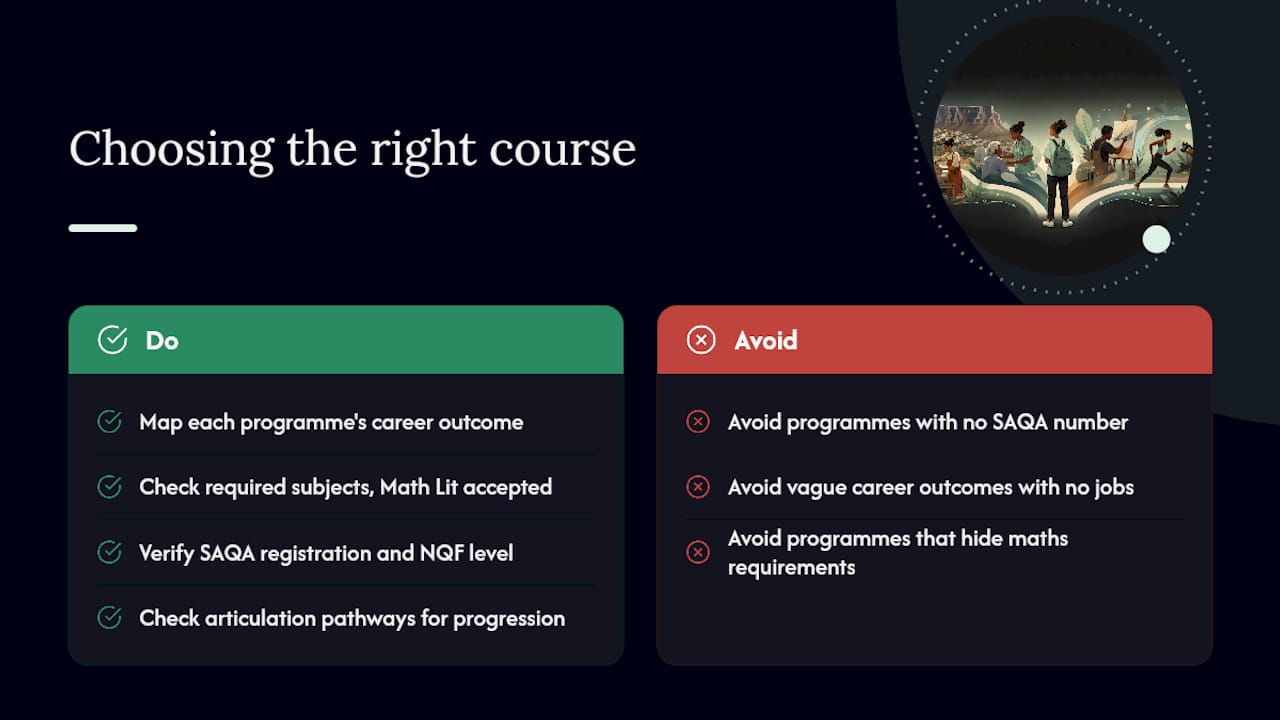
Interest and career fit. A qualification you finish is worth more than a prestigious one you drop out of. Map the career outcome of each programme you are considering and ask whether you would genuinely want to do that work for several years.
APS and subject fit. Check the programme’s required subjects against your actual matric results. Do not assume Mathematical Literacy is accepted — verify it on the institution’s official programme page or on the Asksmarty programme search, which filters by subject requirement.
NQF level and accreditation. A Diploma at NQF 6 and a Degree at NQF 7 are not interchangeable in the job market. Higher NQF levels generally open more doors, but a well-regarded NQF 6 diploma in a practical field can outperform a poorly accredited degree. Always verify the SAQA registration number.
Cost and location. Public universities are subsidised and NSFAS-eligible. Private colleges cost more and have limited funding options. Distance learning removes travel costs but requires self-discipline. Factor in accommodation and transport, not just tuition.
Progression options. Can you upgrade from a diploma to a degree later? Some institutions offer articulation pathways; others do not. If you want to keep your options open, check whether the qualification you are considering allows you to continue studying.
Red flags to watch for. Be cautious of any programme that cannot show you its SAQA registration number on request, lists vague “career outcomes” without naming actual job titles, or buries a maths module requirement inside the curriculum after advertising “no maths needed” at entry.
Pro Tip: Ask the admissions office one direct question: “Can a student with Mathematical Literacy complete every module in this programme without additional maths support?” The answer tells you more than the brochure will.
How Asksmarty helps you find courses you qualify for
Checking dozens of programme pages manually takes hours, and it is easy to miss a subject-requirement note buried in a PDF prospectus. Asksmarty cuts that process down to a few minutes.
Here is how it works:
- Enter your matric subjects and marks into the APS calculator. The tool calculates your APS score instantly.
- Filter the programme database by subject requirement — select “Maths Literacy accepted” or “no maths required” to see only programmes you are eligible for.
- Check deadlines and application fees for each result, then follow the official portal link to apply directly.
Your marks never leave your device. The calculator runs entirely on your browser, so no personal data is transmitted or stored. That matters if you are cautious about sharing your results before you are ready.
Asksmarty’s database covers over 1,700 programmes across South African universities and colleges, with entry requirements, NQF levels, and application deadlines in one place — so you are comparing real requirements, not guesses.
What the maths requirement really means for your future
The anxiety around not having Pure Maths is understandable, but it is often bigger than the actual obstacle. Most students who come through without Pure Maths and end up in the right programme say the same thing: the subject requirement mattered at the gate, not inside the degree.
What actually shapes your outcome is whether you chose a programme aligned with your strengths and a career you want to pursue. A BA in Communication from a well-regarded university, a Diploma in Hospitality from an accredited institution, or a BEd Foundation Phase degree can each lead to a stable, meaningful career. The maths requirement is a filter, not a ceiling.
One practical tip from admissions experience: apply to extended programmes early. They fill faster than most students expect, and the students who miss out are usually the ones who waited until October to check whether the option existed. If you are on the fence about whether your APS is strong enough, run the calculator first and then decide — do not skip the application because you assumed you would not qualify.
Check which programmes you qualify for with Asksmarty
Knowing which courses accept Maths Literacy is one thing. Knowing whether you specifically qualify for them, based on your actual marks, is what gets you to an application.
Asksmarty’s free APS calculator and programme search matches your matric marks to over 1,700 programmes across South African universities and colleges, filtered by subject requirements, NQF level, and application deadlines. Your marks stay on your device — nothing is stored or shared. Check your admission requirements and see exactly where you qualify before the application window closes.
Sources
- Courses that don’t require Maths in South Africa - iFundi
- Courses that don’t require mathematics in South Africa: complete 2027 guide - EduFunds SA
FAQ
Which courses don’t require maths in South Africa?
BA degrees, BEd Foundation Phase, Bachelor of Social Work, Diploma in Hospitality, Diploma in Public Relations, and most TVET NCV programmes commonly accept Mathematical Literacy or require no maths subject at all. Check each programme’s official page for the exact subject requirement.
What can I study with 19 APS points?
An APS below typical university minimums still allows access to many TVET NCV programmes and some private college diplomas in hospitality, office administration, or educare. A matric upgrading course can raise your APS before you apply to university programmes.
Which course is good without maths?
Social Work, Education (foundation phase), and Communication or Media Studies are strong choices — they lead to stable careers, are offered at multiple public universities, and consistently accept Mathematical Literacy. Use the Asksmarty programme search to filter options by your specific subject profile.
What can I study if I failed maths?
You can rewrite the NSC exam, enrol in a matric upgrading programme, apply for a university extended/foundation year, or choose a programme that accepts Mathematical Literacy or requires no maths. TVET colleges are the fastest entry point if you want to start studying immediately.
Does Maths Literacy count for university admission?
Yes, for many programmes. Universities typically accept Mathematical Literacy for humanities, education, social science, and some business degrees, though they may require a higher overall APS than they would with Pure Mathematics. Always confirm on the institution’s official programme page or through the Asksmarty APS calculator.
Recommended
Published 2026-08-14 · AskSmarty is an independent guide. Confirm anything time-sensitive on the official source.