APS Examples: Where You Qualify for Criminology in South Africa
Learn the NSC subjects and APS bands that get South African students into criminology. Includes worked APS examples and Asksmarty's APS calculator to...

To study criminology at a South African university, you generally need an NSC with degree endorsement (or an equivalent qualification), an Admission Point Score somewhere between the mid-20s and low-30s depending on the institution, and passes in English plus Mathematics or Mathematical Literacy. Meet those three benchmarks and most programmes are within reach; fall short on any one and you’ll likely need an alternative route in.
TL;DR:
- Most universities require an NSC with degree endorsement and a mid-20s to low-30s APS score to qualify for criminology programs.
- English and Mathematics or Mathematical Literacy are essential subjects, with English usually needing at least a 50% achievement level.
- A strong APS score is necessary but not sufficient, as competitive campuses admit only the top-ranked applicants due to oversubscription.
- Alternative entry pathways include higher certificates, diploma articulation, recognition of prior learning, and mature-age or subject upgrade options.
- Accreditation verified through SAQA ensures the degree qualifies for employment or further study, making registration status more important than reputation.
Table of Contents
- Criminology entry requirements: the academic qualifications universities accept
- Subjects and marks: what actually gets you in
- How the APS works and what score you actually need
- Other entry routes and special cases
- How to apply: documents and deadlines
- How Asksmarty helps you check where you actually qualify
- Competitive admission: when marks alone aren’t enough
- What it costs to apply
- Why accreditation matters more than the brand name
- What I’d prioritise if I were applying today
- Check your options with Asksmarty before you commit
- Where to verify final requirements
- Sources
- FAQ
Criminology entry requirements: the academic qualifications universities accept
Every South African university builds its criminology entry requirements around the National Senior Certificate. For a bachelor’s degree, you generally need an NSC with degree endorsement, sometimes still called a matric exemption. This confirms the National Qualifications Framework has classified your results at the level required for degree study, not just a diploma or higher certificate. UNISA’s Bachelor of Arts in Criminology) requires exactly this, alongside a specific minimum in the language of tuition.
If your school-leaving certificate predates the current NSC system, or you completed schooling outside South Africa, the SAQA qualifications registry is where universities and applicants both check how a qualification maps onto NQF levels. It’s the official reference point, not a guideline site.
A few routes worth knowing:
- NSC with degree endorsement: the standard path into a bachelor’s programme.
- Senior Certificate (pre-2008): still accepted by some institutions if it meets matric exemption equivalence.
- Higher certificate or diploma articulation: completing a related higher certificate or diploma first, then transferring credits into year one or two of a criminology degree.
- Foreign qualifications: evaluated against NQF levels via SAQA before a university will consider the application.
The articulation route matters more than most applicants realise. If your APS falls just short of a university’s criminology threshold, a one-year higher certificate in a related field (often policing, law, or social science) can get you into the degree through the back door, sometimes with credit for courses already passed.
Subjects and marks: what actually gets you in
Language ability carries more weight in criminology admissions than most applicants expect, since the degree leans heavily on reading, writing, and argument.
Universities set a minimum achievement level in the language of tuition, commonly English. UNISA, for instance, expects a minimum achievement level in the language of instruction as part of its BA Criminology requirements.
Mathematics versus Mathematical Literacy is the second big fork in the road. Criminology sits in the humanities and social sciences, so most universities accept Mathematical Literacy rather than demanding pure Mathematics. That said, requirements differ by institution and by which faculty houses the criminology programme (some place it under Law, others under Humanities or Social Sciences).
Typical subject expectations look like this:
- English (home or first additional language): minimum rating specified by each university, often around level 4 (50 to 59%).
- Mathematics or Mathematical Literacy: either usually accepted, though a Faculty of Law may prefer Mathematics.
- Life Orientation: counted differently across universities. Some exclude it or weight it lower in the APS calculation.
- History or Life Sciences: not always mandatory, but useful preparation and sometimes listed as recommended rather than required.
Always check the specific programme page. UWC’s admission information lists the recognised 20-credit NSC subjects it uses for its weighted points system, and that list isn’t identical across universities.
How the APS works and what score you actually need
The Admission Point Score converts your NSC results into a single number universities use to rank applicants. Each subject’s achievement level, typically on the standard 7-point NSC scale, converts to points, and your top six or seven subjects (rules differ by university) get added together.
Pro Tip: Life Orientation is often excluded or capped at a lower weighting in APS calculations, so don’t assume a strong LO mark will rescue a weak APS elsewhere.
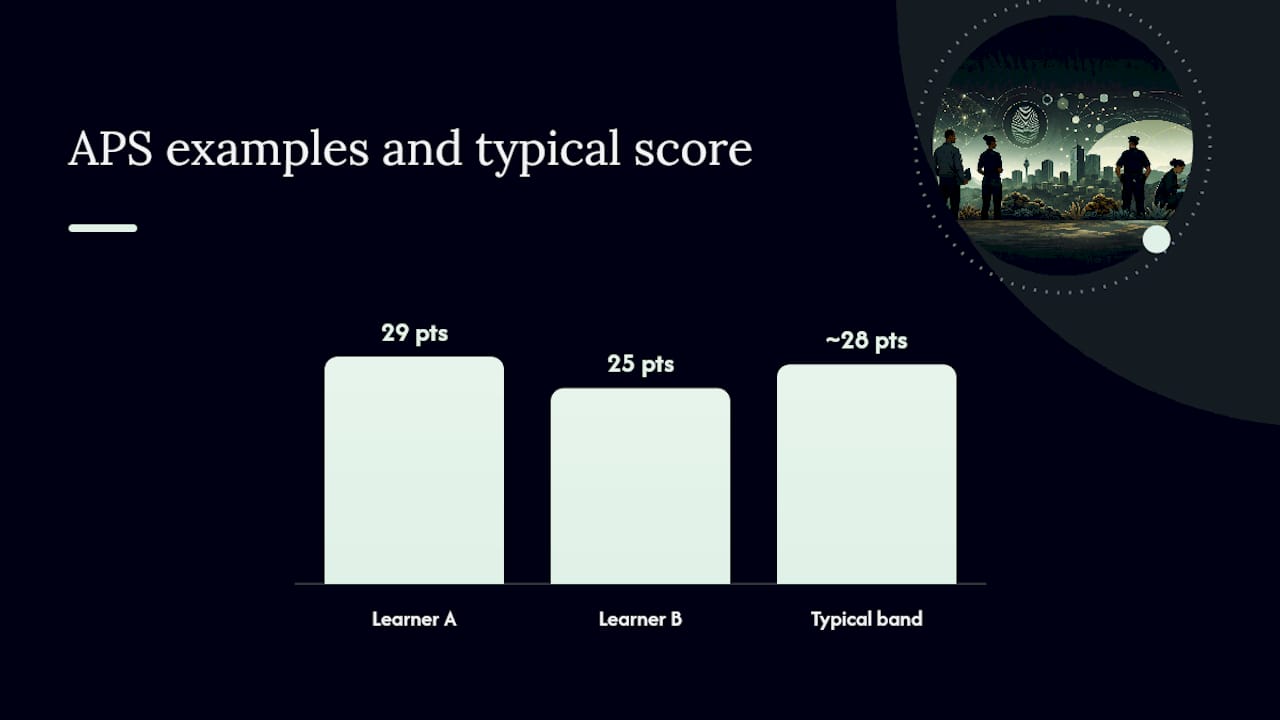
Representative programmes in criminology and related social sciences commonly sit in the mid-20s to low-30s on a standard APS scale, though exact thresholds shift year to year and by campus.
Two worked examples show how this plays out:
- Learner A: English (Level 5), Mathematical Literacy (Level 5), Life Sciences (Level 4), Geography (Level 5), Afrikaans (Level 4), Life Orientation (Level 6). Adding the top six ratings on a standard scale gives an APS around 29, comfortably inside most criminology bands.
- Learner B: English (Level 4), Mathematics (Level 3), History (Level 5), Business Studies (Level 4), Life Sciences (Level 4), Life Orientation (Level 5). This nets an APS closer to 25, which clears some universities’ minimums but may sit below more competitive campuses.
A minimum APS gets your application considered. It doesn’t guarantee a seat, especially at capped programmes where demand outstrips available places and the university simply admits from the top of the ranked pool down.
Other entry routes and special cases
Not everyone finishes matric with the marks they wanted, and South African universities do build in alternatives.
Mature-age entry exists at most institutions for applicants who are typically 23 or older and didn’t complete a qualifying NSC. It usually involves a placement test rather than a straight APS calculation. Recognition of prior learning (RPL) works similarly, giving credit for relevant work experience or informal training, particularly useful for someone who’s spent years in policing, correctional services, or private security wanting to formalise that experience into a degree.
Other routes worth knowing:
- Diploma-to-degree articulation, where credits from a completed diploma transfer into a related bachelor’s programme.
- Conditional admission, where a university accepts you provisionally pending final matric results or a supplementary exam.
- Subject upgrading through institutions offering matric rewrite programmes, useful if one weak subject is holding your APS back.
Pro Tip: If you’re one APS point short, ask the admissions office directly whether they’ll consider a supplementary exam result or an upgraded subject mark before the intake deadline. Policies here are rarely advertised clearly on the website.
How to apply: documents and deadlines
Getting the paperwork right matters as much as the marks themselves, since incomplete applications get bumped down the queue or rejected outright.
- Gather your documents: certified copy of your ID, certified copies of your NSC results (or statement of results if final certificate isn’t issued yet), proof of any additional qualifications, and passport photos where required.
- Find the right programme code: universities list criminology under different faculties, so confirm the exact code on the official university programme page before submitting anything.
- Apply through the correct portal: most South African universities now run applications online, with step-by-step guidance available for the larger institutions.
- Submit within the window: application periods typically open around April or May the year before intake and close between July and September, though closing dates for popular programmes can arrive earlier once quotas fill.
- Track your status: expect an acknowledgement email, followed by a conditional or final offer once your final results are captured, usually from January onward.
How Asksmarty helps you check where you actually qualify
Working out your APS by hand across five or six universities gets tedious fast, and one arithmetic slip can send you chasing the wrong programmes. Asksmarty’s admission calculator converts your matric marks into a shortlist of programmes you genuinely qualify for, without your marks ever leaving your device. Run your results through it once, then follow the official university links it surfaces to confirm and apply directly.
Competitive admission: when marks alone aren’t enough
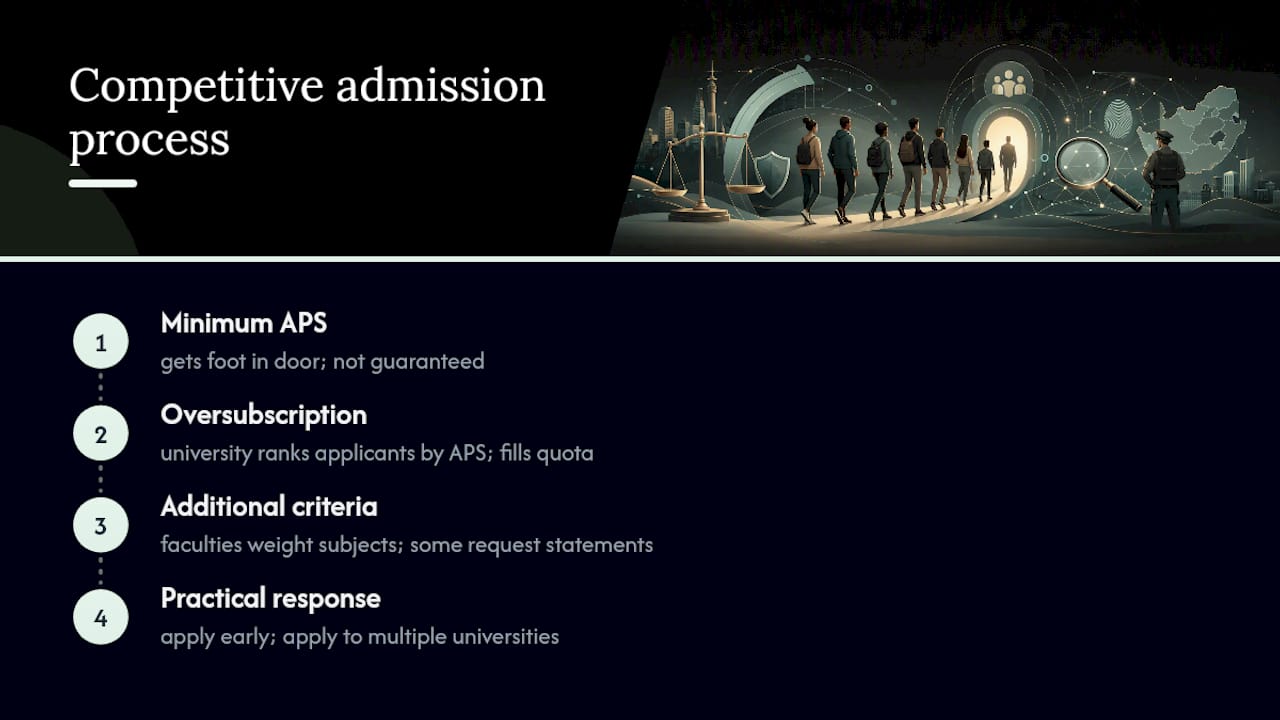
Meeting the minimum APS gets your foot in the door. It doesn’t mean the door stays open.
At oversubscribed campuses, particularly the larger metropolitan universities, criminology and related social science programmes frequently receive far more qualifying applications than available seats. When that happens, admission stops being a threshold exercise and becomes a ranking exercise. The university simply works down its list of applicants from the highest APS, filling places until the quota is reached, and everyone below that line gets deferred or redirected to a related programme.
Some faculties layer on extra criteria beyond the NSC and APS. A programme housed under a Faculty of Law, for instance, may weigh Mathematics performance more heavily than a programme sitting in Humanities. A handful of universities also request a personal statement or motivation letter for competitive social science degrees, though formal interviews remain uncommon for criminology specifically compared to fields like Medicine or Law.
The practical response is straightforward: apply early, since some universities move to a rolling admission model where earlier applicants with the same APS get preference simply for beating the rush. Applying to more than one university also hedges against a single institution’s cutoff moving up unexpectedly in response to a stronger-than-usual applicant pool that year.
What it costs to apply
Application fees vary widely across South African universities, and a few charge nothing at all.
Some institutions waive fees entirely for online applications, while others charge anywhere from roughly $100 to $200 or more, occasionally higher for late or paper-based applications. Fee waivers sometimes apply automatically for applicants who can show financial need, though the process for claiming one differs by university and usually requires supporting documentation submitted alongside your application.
Budget for more than one application fee if you’re applying broadly, which is worth doing given how much APS thresholds shift between institutions for the same qualification. A full comparison of what each university actually charges is worth checking before you commit to a shortlist, since a fee that looks small per application adds up once you’re applying to four or five campuses.
Beyond the application fee itself, factor in costs for certifying copies of your documents (usually free at a police station or Post Office, but sometimes charged at commissioners of oaths), and postage or courier costs if a university still requires physical submission of any paperwork.
Why accreditation matters more than the brand name
A criminology degree is only worth what it’s recognised for, and recognition comes from formal accreditation, not reputation alone.
South African qualifications sit on the National Qualifications Framework, and a criminology degree registered correctly will carry a specific NQF level and qualification ID that you can look up directly through the SAQA registry. This matters practically: employers, postgraduate admissions officers, and professional bodies (particularly relevant if you’re aiming toward policing, correctional services, or forensic-adjacent careers) will check that your qualification is properly registered before they treat it as valid.
Accreditation also affects whether credits transfer if you switch universities partway through, or whether a postgraduate programme elsewhere will accept your undergraduate degree as a valid entry qualification. An unaccredited or improperly registered qualification can leave you with a degree certificate that doesn’t open the doors you expected.
Before enrolling anywhere, confirm the specific qualification code and NQF level on the university’s official programme page, not a secondary summary site, and cross-check it against the SAQA registry if anything looks inconsistent.
What I’d prioritise if I were applying today
Get your language mark and APS locked down first. Everything else, extra subjects, extracurriculars, a strong motivation letter, only matters once those two boxes are ticked. I’ve seen too many strong applications undermined by uncertified documents submitted days before a deadline, which is an entirely avoidable mistake.
Apply to more than one university. APS mapping for criminology-type degrees isn’t standardised, so a mark that falls short at one campus can clear the bar comfortably at another.
— Nkosi
Check your options with Asksmarty before you commit
Asksmarty gives you a way to check where you actually qualify for criminology and related programmes without guessing your way through five separate university APS systems. Because your marks are calculated privately on your own device, there’s no signup wall and no risk of your results sitting on a server somewhere you can’t control.
Run your NSC results through the APS calculator and you’ll get a shortlist of programmes matched to your actual marks, not a generic list of every criminology degree in the country. From there, browse the full database of South African universities and colleges to compare campuses side by side, then follow the official application link straight through to the university once you’ve found a match worth pursuing.
Where to verify final requirements
Entry requirements shift slightly year to year, so treat these as your starting checklist, not the final word.
- University admission PDFs such as VUT’s minimum requirements document and WSU’s undergraduate admission PDF.
- The SAQA qualifications registry to confirm NQF level and qualification ID.
Always cross-check against the university’s own page before submitting anything, since published PDFs get updated ahead of each new intake year.
Sources
- Qualifications registry — SAQA
- Understanding APS scores for university applications in South Africa — Edupstairs
- Application information | UWC
- 2027 Undergraduate minimum admission requirements — VUT (PDF)
FAQ
What are the requirements to study criminology in South Africa?
You typically need an NSC with degree endorsement, an APS in the mid-20s to low-30s depending on the university, and minimum passes in English plus Mathematics or Mathematical Literacy. Always confirm the exact figures on the specific university’s programme page before applying.
How much do criminologists earn in South Africa?
Salary data varies significantly by employer, sector (government versus private), and experience level, and no single figure applies across the field. Check specific job listings and professional bodies for current salary benchmarks in your area of interest.
What APS score do you need to study criminology?
Most criminology and related social science bachelor’s programmes fall in the mid-20s to low-30s on the standard APS scale, though thresholds differ by university and by year. Running your marks through Asksmarty’s APS calculator gives you an accurate, programme-specific answer.
What subjects does criminology require?
English at a minimum specified level (often around 50%), plus either Mathematics or Mathematical Literacy, form the core requirement at most universities. Some faculties prefer Mathematics over Mathematical Literacy, so check the specific programme’s subject list before finalising your applications.
Recommended
Published 2026-08-29 · AskSmarty is an independent guide. Confirm anything time-sensitive on the official source.