Documents for application: the checklist SA students need
Learn the key documents you need for university applications in South Africa, including your Statement of Results and ID proof.

You need four things to apply to a South African university: your Statement of Results or final Matric certificate, a certified copy of your ID, proof of residence, and any programme-specific extras like a portfolio or bursary form. Most universities accept a Statement of Results while you wait for your final National Senior Certificate (NSC), which usually takes weeks longer to arrive.
That conditional path matters because almost no matriculant has their final certificate in hand the moment applications open. Universities know this, which is why the Statement of Results functions as valid, temporary proof of your marks and pass status. You submit it now, and follow up with your certificate once it’s issued.
- Statement of Results or final Matric certificate (NSC)
- Certified copy of your ID or Smart ID card
- Proof of residence (utility bill, affidavit, or lease)
- Certified academic transcripts, if requested
- Programme-specific documents (portfolio, motivation letter, funding proof)
Pro Tip: Before chasing a single certified copy, run your marks through AskSmarty’s APS calculator to see exactly which programmes you qualify for. It saves you from certifying documents for a course you won’t actually get into.
TL;DR:
- Submitting a Statement of Results allows provisional university admission while waiting for the final Matric certificate, which can take four to six weeks to replace if lost or damaged.
- Certifying multiple copies of your ID and supporting documents in one visit saves weeks and simplifies the application process, especially for funding and university requirements.
- Most delays occur because students wait until the deadline to request the longest lead-time documents, such as replacement certificates, rather than starting early.
- Using a tool like AskSmarty’s APS calculator helps identify suitable programmes first, preventing unnecessary certification of documents for courses you cannot enter.
- Formatting documents as single PDFs under 5MB, clearly naming files, and keeping proof of submission improve online application efficiency and troubleshooting.
Table of Contents
- Complete documents checklist for university applications
- How to get, certify, and replace your matric documents
- Realistic timelines and mistakes that sink applications
- Submitting documents online: formats, file size, and follow-up
- What to do when a document is missing or delayed
- Why most application advice skips the real bottleneck
- Let AskSmarty tell you which documents actually matter
- Key Takeaways
- Sources
- FAQ
Complete documents checklist for university applications
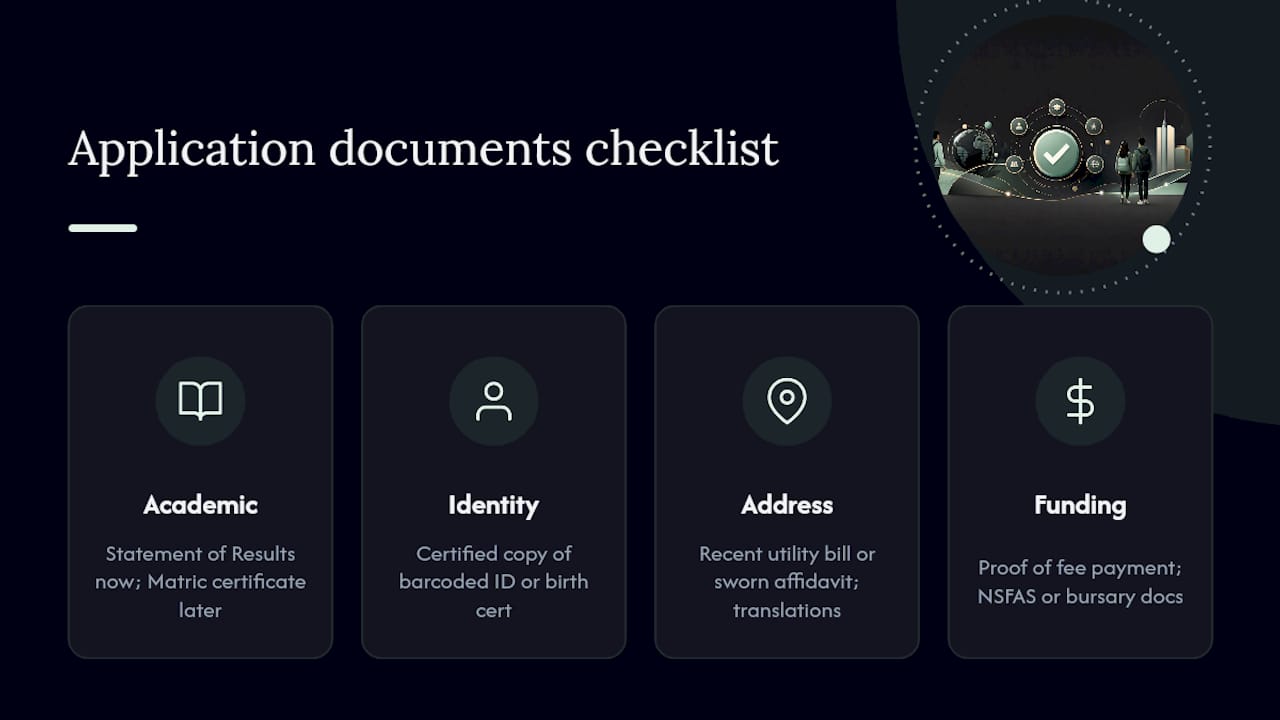
Every South African university phrases its requirements slightly differently, but the underlying paperwork is remarkably consistent. Building your own application documents checklist around these four categories keeps you from scrambling in the final week before a deadline.
1. Academic documents
Your Statement of Results or final Matric certificate anchors the whole application. The debate over matric certificate vs statement of results confuses a lot of first-time applicants, so here’s the distinction: the Statement of Results is issued immediately when NSC results are released and lists your subjects, percentage marks, and pass status. The Matric certificate is the permanent, formal qualification document that follows later. Universities will provisionally admit you on the statement, but they need the certificate eventually to confirm enrollment. If you wrote through the Independent Examinations Board (IEB) rather than the NSC, your equivalent documents follow the same logic.
2. Identity documents and certified copies
Every application needs a certified copy of your green barcoded ID book, ID card, or Smart ID. Some institutions also want a birth certificate, particularly if you’re under 18 or your ID doesn’t yet reflect your current surname.
3. Proof of address and supporting paperwork
A recent utility bill, bank statement, or a sworn affidavit works if nothing is in your name yet. If any document isn’t in English, you’ll need a certified translation. Some programmes, especially in art, design, or performance, want a CV or portfolio attached.

4. Funding documents
If you’re applying for NSFAS or a private bursary, your Statement of Results doubles as proof of academic standing for that process too. Keep proof of any application fee payment, since some universities check that before processing your file at all.
Missing even one item here is the single biggest reason applications stall. Universities collect your personal details, academic history, and programme choices as a package, and incomplete documentation is a routine cause of delay or outright rejection. Treat the checklist as non-negotiable, not optional polish.
How to get, certify, and replace your matric documents
Getting a Statement of Results is straightforward. It’s issued automatically when results are released each January, and you or your school can collect it right away. The final Matric certificate follows later that year, once the Department of Basic Education (DBE) finishes processing and the National Senior Certificate is formally issued.
If your certificate is lost, damaged, or never arrived, you’ll need to request a replacement through the DBE or your Provincial Education Department (PED). Umalusi’s guidance on issuing statements and certificates confirms that replacement requests must go through the PED or a public assessment body, supported by an affidavit and certified copies of your ID.
- Submit a completed replacement form (available from DBE/PED offices or online)
- Attach a sworn affidavit explaining the loss or damage
- Include certified copies of your ID
- Pay the applicable administrative fee
Getting documents certified is simpler than most students expect. A commissioner of oaths, a police station, or a Home Affairs office can all certify copies for free or a small fee. Apostilles aren’t relevant here, since that’s only for documents used outside South Africa.
If your ID reflects a different surname than your school records (common after marriage or a legal name change), you’ll need documentation from Home Affairs alongside your affidavit before the DBE will process a replacement.
Pro Tip: Certify five or six copies of your ID in one visit rather than one at a time. Nearly every university and funding application needs its own certified copy, and repeat trips to a police station eat weeks you don’t have.
Realistic timelines and mistakes that sink applications
Plan around this: a replacement Matric certificate typically takes four to six weeks once your file is on the DBE system, while a fresh Statement of Results can usually be issued far faster for a small fee. These are two separate processes, run on separate timelines, and confusing them is where students lose the most time.
Academic advisors consistently recommend identifying whichever document has the longest lead time and starting that one first. If you already suspect your certificate was lost or damaged, don’t wait until the deadline is a week away to find out for certain.
The mistakes that repeatedly derail applications:
- Submitting an uncertified photocopy instead of a certified one
- A name mismatch between your ID and school records with no affidavit attached
- Missing pages in a scanned transcript
- Uploading a file format the university’s portal doesn’t accept
- Requesting a certificate replacement only after the deadline has already passed
Submitting documents online: formats, file size, and follow-up
Most South African university portals want PDFs, not photos or Word documents. Combine multi-page documents (your full Statement of Results, for instance) into a single PDF rather than uploading each page separately.
- Scan at a resolution that keeps text legible but stays under the portal’s file size limit, usually 5MB per document.
- Name each file clearly, for example “Surname_Initial_StatementOfResults.pdf”, so admissions staff can identify it instantly.
- Double check every page loaded correctly before hitting submit; a corrupted upload looks identical to a missing document from the university’s side.
- Keep a folder of every file you’ve submitted so you can resend instantly if asked.
Many institutions issue conditional offers based on your initial upload, then request certified hard copies later, once you’ve accepted a place. Respond to these requests fast. AskSmarty’s university-specific application guides walk through exactly what institutions like UNISA and Stellenbosch expect at each stage, which spares you the guesswork of a generic checklist.
Pro Tip: Screenshot your submission confirmation page immediately after uploading. If a university later claims a document never arrived, that timestamp is your proof.
What to do when a document is missing or delayed
Don’t let a missing certificate stall your entire application. Submit your Statement of Results as conditional proof and move forward. Universities expect this and process it routinely.
If a document genuinely isn’t available yet, an affidavit explaining the situation, drawn up at a police station or commissioner of oaths, is usually accepted as a placeholder while you sort out the original.
When emailing an admissions office about a delay, include:
- Your full name and ID number
- Your exam number
- The expected date your document will be ready
- A copy of whatever proof you do have (Statement of Results, affidavit, receipt of replacement request)
If you’re chasing multiple documents at once, prioritise ruthlessly. Start the certificate replacement first, since it has the longest lead time, then handle certified ID copies and proof of address, which you can usually turn around within days.
Why most application advice skips the real bottleneck
The advice students get about applications tends to focus on deadlines and forms, and almost never on the paperwork chain that actually causes delays. In practice, the bottleneck is rarely the application itself. It’s waiting on a DBE replacement certificate that takes six weeks, or discovering three days before a deadline that your ID doesn’t match your school records.
Conventional checklists treat every document as equally urgent. They aren’t. A Statement of Results, an affidavit, or a certified ID copy can be sorted in days. A replacement Matric certificate cannot. Sequencing matters more than most guides admit, and it’s the single biggest lever a student actually controls.
The other gap is programme-matching. Students often certify a full stack of documents before confirming they even qualify for the course they’re chasing. Run your marks through a tool like AskSmarty’s APS calculator first, then chase paperwork for programmes you can genuinely get into. That order of operations, marks first, documents second, is where most of the wasted effort in this process actually comes from.
— Nkosi
Let AskSmarty tell you which documents actually matter
Before you certify a single copy, find out which programmes your marks qualify you for. AskSmarty’s APS calculator takes your matric marks and matches them against entry requirements across more than 1,700 programmes nationwide, and your marks never leave your device.
Once you know your realistic options, AskSmarty’s admission requirements guide explains exactly how APS scores, NSC passes, and NBT results factor into each institution’s decision, so you’re not guessing at what’s actually required. Step-by-step, university-specific pages, from UNISA to Stellenbosch, list the precise documents each admissions office expects, so you can prioritise your Matric certificate, certified ID copies, or proof of residence in the right order.
Every tool on the platform is free, with no processing fees and no account required. Start with the programme search to see where you actually qualify, then build your document list around those specific offers.
Key Takeaways
Preparing application documents in South Africa comes down to sequencing: submit your Statement of Results now, chase your final certificate in parallel, and certify copies early.
| Point | Details |
|---|---|
| Know the difference | A Statement of Results is temporary and accepted conditionally; the final Matric certificate confirms enrollment. |
| Certify early, in bulk | Get several certified ID copies at once from a police station or Home Affairs to avoid repeat trips. |
| Replacement takes weeks | A lost or damaged Matric certificate typically takes four to six weeks to replace through the DBE or PED. |
| Sequence by lead time | Start your longest lead-time document first, and handle quick items like affidavits closer to the deadline. |
| Match marks before certifying | Use AskSmarty’s APS calculator to confirm which programmes you qualify for before securing every document. |
Sources
- Understanding your matric statement of results explained
- Umalusi on issuing of matric statements of results and certificates | South African Government
- Certification Services
FAQ
Can I apply with a Statement of Results instead of a Matric certificate?
Yes. Universities routinely accept the Statement of Results as conditional proof, since final certificates are issued later in the year.
How long does it take to replace a lost matric certificate?
Replacement through the DBE typically takes four to six weeks once your file is confirmed on the system.
Where can I get my documents certified?
A commissioner of oaths, a police station, or a Home Affairs office can certify copies of your ID and other documents at no cost or a small fee.
What if my ID name doesn’t match my school records?
You’ll need an affidavit explaining the discrepancy, along with supporting Home Affairs documentation, before the DBE processes a certificate replacement.
How do I know which programmes I actually qualify for?
Enter your marks into AskSmarty’s APS calculator to see matching programmes across South African universities before you start certifying documents.
Recommended
Published 2026-08-27 · AskSmarty is an independent guide. Confirm anything time-sensitive on the official source.