Environmental science entry requirements for SA matriculants
Discover the essential entry requirements for environmental science degrees in South Africa, and ensure your qualifications meet university standards.

Most environmental science degrees in South Africa require an NSC Bachelor’s pass, an Admission Point Score somewhere between 28 and 32, Mathematics at Level 4 or higher, and either Life Sciences or Physical Science at Level 4. Some universities also require the National Benchmark Test.
- NSC Bachelor’s degree pass, not a Diploma or Higher Certificate pass
- APS typically 28 to 32, depending on the university
- Mathematics Level 4 minimum; Mathematical Literacy is rarely accepted for BSc routes
- Physical Science or Life Science at Level 4
- NBT required by some institutions, especially for competitive programmes
At UKZN, the published minimum is an APS of 28 with Mathematics and Physical Science, Life Science, or Agricultural Science at Level 4. Check your own number against a specific programme before you assume you qualify. Run your marks through AskSmarty’s APS calculator to see which environmental science programmes you actually meet the bar for right now.
Key Takeaways
Meeting environmental science entry requirements in South Africa comes down to a Bachelor’s-pass NSC, Mathematics and a science subject at Level 4 or above, and an APS usually between 28 and 32.
| Point | Details |
|---|---|
| Confirm your pass type | An NSC Bachelor’s pass is required; diploma or higher certificate passes don’t qualify for BSc entry. |
| Check subject levels early | Mathematics Level 4 and Physical Science or Life Science at Level 4 are the common minimums. |
| Register for the NBT on time | Some programmes require NBT results, and late registration can cost you an application cycle. |
| Verify accreditation | Look for SAQA registration, CHE accreditation, and SACNASP endorsement where employability matters. |
| Use AskSmarty to check eligibility | Run your marks through AskSmarty’s APS calculator to match against real programmes before applying. |
Table of Contents
- What academic profile do universities actually want?
- Does environmental science require the NBT?
- How do you apply, and what documents do you need?
- What accreditation and professional recognition should you check?
- What if you don’t meet the direct entry requirements?
- Admissions advisor note: what selection committees actually look for
- How AskSmarty helps you confirm eligibility and apply
- Where to check official entry rules and programme details next
- Sources
- FAQ
What academic profile do universities actually want?
The phrase “environmental science entry requirements” covers more than a single APS cutoff. It’s really three separate filters stacked together: your NSC pass type, your subject levels, and, at some institutions, your NBT scores. Miss any one and the rest doesn’t matter.
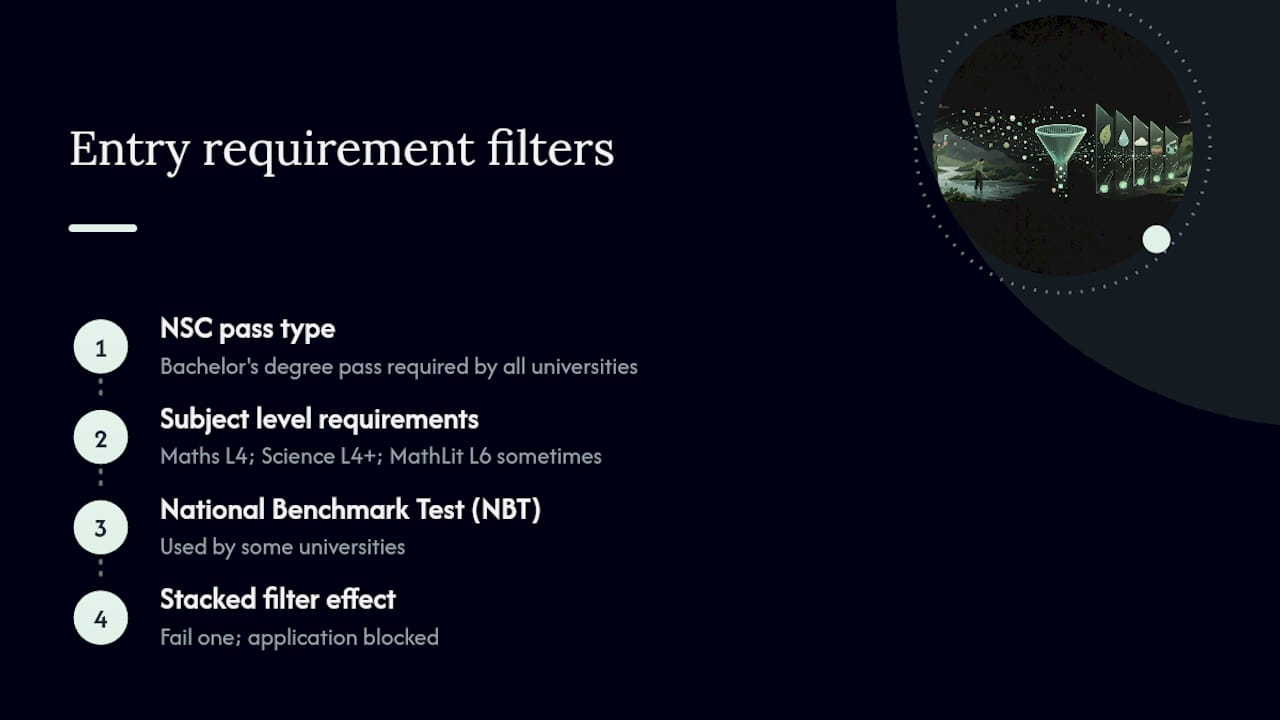
Start with the pass type. You need an NSC Bachelor’s degree pass, confirmed by your Grade 12 results meeting the minimum requirements for degree study, not just a diploma-level pass. That’s non-negotiable across every South African university offering a BSc in environmental science.
Subject requirements are where things diverge. UKZN asks for Mathematics Level 4 plus one of Physical Science, Life Science, or Agricultural Science at Level 4. The University of Mpumalanga sets an APS set around 30 points and specifically wants English at Level 4, Mathematics at Level 4 (or Mathematical Literacy at Level 6), plus Geography and a natural science subject at Level 4. Notice that Mathematical Literacy is sometimes accepted, but only at a much higher level, and only at some universities. If your school offered Mathematical Literacy instead of pure Mathematics, that single choice narrows your options considerably.
Physical Science or Life Science matters because environmental science blends chemistry, biology, and earth systems. Programmes elsewhere list prerequisites like general chemistry with lab, calculus, and biology as the foundation courses students build on in first year, which tells you why South African universities are strict about the science subject at school level. If you arrive without it, you’re not ready for the lab-heavy first-year modules waiting for you.
Does environmental science require the NBT?
Some programmes require the National Benchmark Test alongside your NSC results, particularly at universities using it to assess academic literacy and quantitative reasoning before placing students into standard or extended curricula. University of Pretoria uses APS as the primary selection tool but also allows conditional offers based on Grade 11 results, and runs extended four-year programmes for applicants who fall just short of the standard entry bar.
Register for the NBT through the national NBT website well before the application deadline. Universities don’t accept late results, and the test only runs on set dates throughout the year, so leaving it until after you’ve submitted your application is a common and avoidable mistake. If a specific programme’s prospectus mentions the NBT, treat it as mandatory rather than optional, even if the wording sounds soft.
How do you apply, and what documents do you need?
Applications generally open in April or May of your matric year and close between July and September, though competitive programmes at research-intensive universities close earlier. You’ll need your certified ID copy, your latest school report or final NSC results once available, proof of application fee payment (where charged), and sometimes a personal statement or motivation letter for competitive spots. AskSmarty’s step-by-step application guide breaks down what each university wants and when.
Apply to more than one university if your APS sits near a threshold. A score of 29 might clear one institution’s Bachelor of Science in Environmental Science and fall short at another, so treat every application as an independent bet rather than assuming consistency across the sector.
What accreditation and professional recognition should you check?
A legitimate environmental science qualification carries a SAQA registration number and Council on Higher Education (CHE) accreditation. Sol Plaatje University’s Bachelor of Environmental Science is a useful example: it’s SAQA-registered under QUAL ID 123429, includes compulsory work-integrated learning in the fourth year, and is noted as meeting endorsement requirements from the South African Council for Natural Scientific Professions (SACNASP).
SACNASP endorsement matters if you plan to register as a professional natural scientist after graduating, which most environmental consulting, government, and conservation roles eventually require. Not every degree carries this endorsement automatically, so check the specific programme rationale, not just the university’s general reputation. UWC’s BSc Environmental and Water Science publishes its full module structure by semester, which is worth reading if you want to see how fieldwork and specialised modules build up over four years before you commit.
What if you don’t meet the direct entry requirements?
You have real options if your APS or subject levels fall short this year. Extended degree programmes, like the one University of Pretoria runs, spread first-year content over two years and accept students who narrowly miss the standard cutoff. TVET colleges and private institutions offer bridging courses or foundation years in the sciences, which can strengthen your Mathematics or Physical Science marks before you reapply. Browse alternative college pathways if a bridging year makes more sense than waiting a full application cycle.
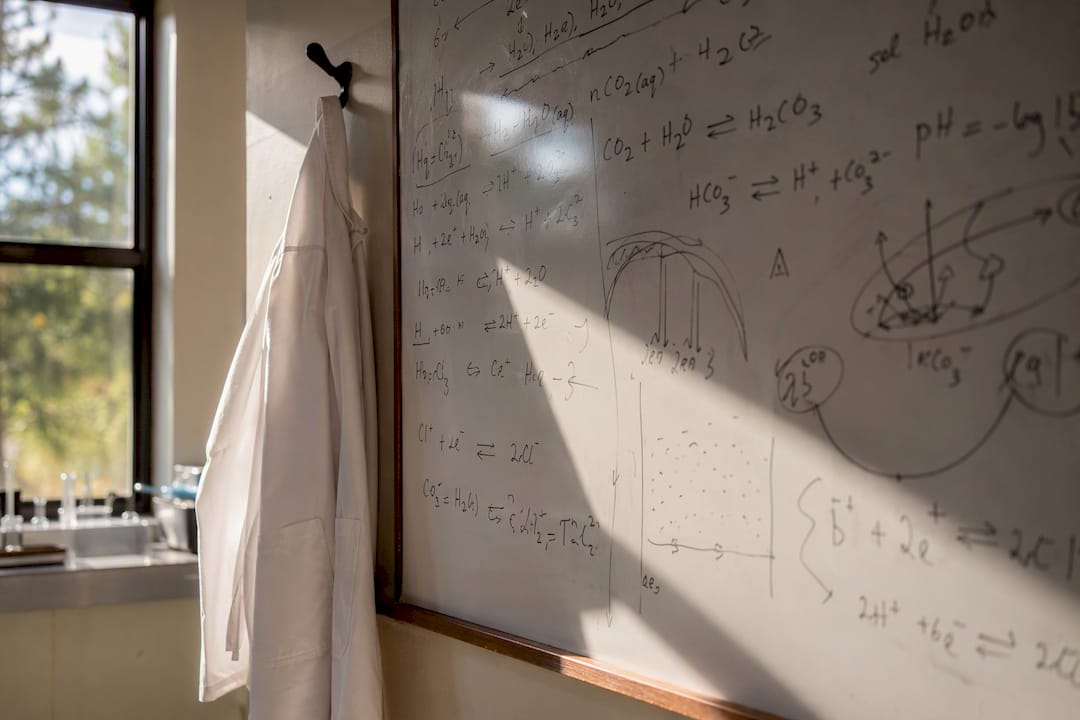
Rewriting a single NSC subject through supplementary exams is another route some students overlook. If your Mathematics mark is one or two percentage points below a Level 4, a rewrite can shift your entire eligibility picture without costing you a year.
Admissions advisor note: what selection committees actually look for
Selection committees weigh your APS first, then check whether your subject marks clear the specific thresholds, and only then look at NBT results or portfolio evidence where required.
Pro Tip: If your APS sits right on the border, spend your final term strengthening one science subject rather than spreading effort evenly. A jump from Level 3 to Level 4 in Physical Science often does more for your application than a few extra APS points elsewhere.
Qualifications registered with SAQA, accredited by the CHE, and endorsed by SACNASP carry real weight with committees, and examples from Sol Plaatje University, Stellenbosch, UFS, and UP show how differently these degrees can be structured even when the underlying accreditation is solid.
How AskSmarty helps you confirm eligibility and apply
AskSmarty is the free way to check exactly where you qualify before you spend money on application fees. Enter your matric marks into the APS calculator and it matches you against environmental science programmes across every South African university in the database, without your marks ever leaving your device.
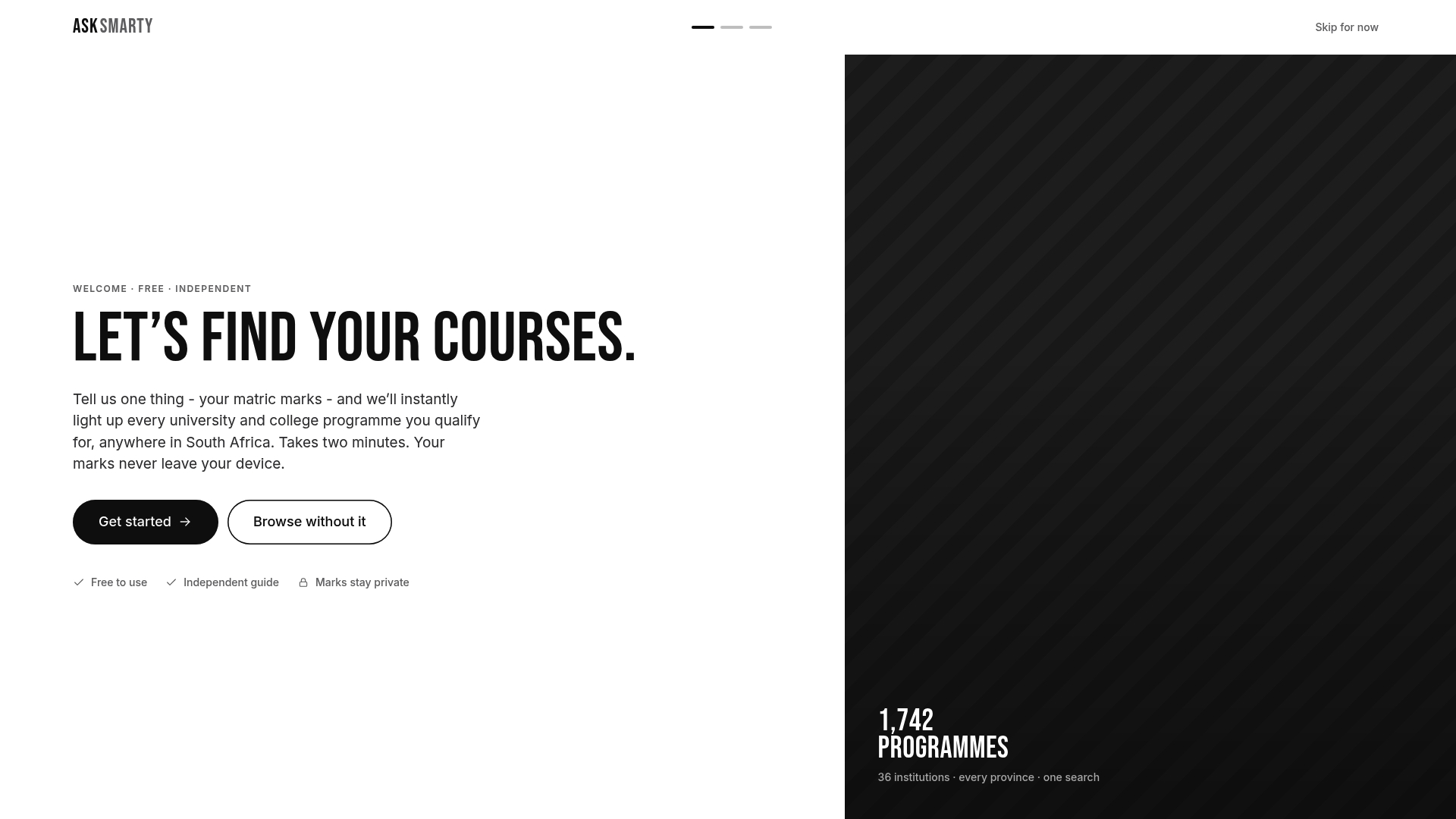
From there, use the programme search to compare APS thresholds, subject requirements, and deadlines for Sol Plaatje University, Stellenbosch, UFS, UP, and every other institution covered in this guide, side by side. Check the specific entry requirements breakdown for how APS, NSC results, and the NBT combine at each university, then move straight to applying once you’ve confirmed you meet the bar.
Where to check official entry rules and programme details next
Don’t rely on secondhand summaries, including this one, for your final decision. Go to the primary sources before you submit anything.
- SAQA’s qualification database confirms whether a specific degree is registered and what qualification ID applies, as shown on Sol Plaatje University’s listing.
- University programme prospectuses for Sol Plaatje, Stellenbosch, UFS, UP, and UWC list the exact APS minimum, subject-level requirements, and NBT instructions for that specific year’s intake.
- AskSmarty’s university pages for Stellenbosch and UFS summarise deadlines and requirements without you needing to dig through PDF prospectuses.
| Source | What to check |
|---|---|
| SAQA qualification page | Registration status, qualification ID, NQF level |
| University prospectus | APS minimum, subject levels, NBT requirement, WIL structure |
| SACNASP guidance | Whether the specific degree qualifies for professional registration |
| AskSmarty APS calculator | Your personal eligibility against live programme data |
Preparation at school level matters just as much as the paperwork. The AP Environmental Science framework used internationally emphasises inquiry-based lab work and data analysis, the same skills South African universities expect you to arrive with regardless of which specific subjects you took. If you’re still choosing subjects in Grade 10 or 11, prioritise a genuine science subject and solid Mathematics over Mathematical Literacy wherever a BSc is even a possibility.
Sources
- SAQA
- Bachelor of Science in Environmental Science - Agriculture and Science (UKZN)
- UMP - Bachelor of Science in Environmental Science
- AP central (College Board) - AP Environmental Science
FAQ
What APS do I need for environmental science in South Africa?
Most universities set the threshold between 28 and 32, though UKZN accepts 28 and the University of Mpumalanga requires 30.
Is Mathematical Literacy accepted for a BSc in environmental science?
Rarely, and only at a higher level than pure Mathematics would require; most BSc programmes want Mathematics at Level 4, not Mathematical Literacy.
Do all universities require the NBT for environmental science?
No, requirements vary by institution and programme, so check the specific prospectus rather than assuming it applies everywhere.
What if my APS doesn’t meet the minimum?
Extended degree programmes, bridging courses at TVET colleges, and subject rewrites are all realistic paths to qualifying in a future intake.
How do I check if I qualify for a specific programme?
Enter your NSC marks into AskSmarty’s APS calculator to see which environmental science programmes across South Africa you currently meet the entry bar for.
Recommended
- University Admission Requirements - APS, NSC Passes, NBT & NQF Explained | AskSmarty
- University of South Africa - Programmes, Deadlines & How to Apply | AskSmarty
- How to Apply to a South African University or College | AskSmarty
- AskSmarty - Find your course anywhere in South Africa, check if you qualify, apply
Published 2026-08-19 · AskSmarty is an independent guide. Confirm anything time-sensitive on the official source.