Higher certificate requirements in South Africa: who qualifies?
Unlock your educational journey! Discover the higher certificate requirements in South Africa and find out if you qualify for further studies.

Most students qualify for a Higher Certificate with a National Senior Certificate (NSC) pass or NC(V) Level 4 certificate, a minimum score in the language of learning and teaching, and an Admission Point Score (APS) that clears the programme’s threshold. That is the statutory floor. It is a starting point, not a guarantee, because each institution layers its own conditions on top.
A Higher Certificate is an NQF level 5 qualification, one step above matric and below a diploma. The accepted routes into one are narrower than people assume, but wider than the alternative of not studying at all.
Accepted entry routes include:
- A National Senior Certificate (NSC) that meets the minimum achievement level
- An NC(V) Level 4 certificate from a TVET college
- A Senior Certificate (the older matric qualification), often used by mature applicants
- Mature-age exemption or Recognition of Prior Learning (RPL) for candidates without a full NSC
Pro Tip: Competitive Higher Certificate programmes often list an APS between 18 and 21), but plenty of providers accept lower scores. Always check the specific programme page before assuming you’re out of range.
Key Takeaways
Higher Certificate admission in South Africa rests on three pillars: a valid NSC or NC(V) Level 4 qualification, a language score that clears the institution’s threshold, and an APS that meets the programme’s specific cutoff.
| Point | Details |
|---|---|
| Statutory floor | NSC or NC(V) Level 4 plus a minimum language-of-learning score, typically 30% to 40%. |
| APS range varies | Many programmes expect 18 to 21 points, though some accept lower scores. |
| NQF level and credits | Higher Certificates sit at NQF level 5 with around 120 credits, usually completed in one year full time. |
| Alternative routes exist | Mature-age entry, bridging programmes, and RPL all offer paths around missed minimums. |
| Check your matches free | AskSmarty’s APS calculator and programme search let you confirm eligibility across 1,700+ programmes at no cost. |
Table of Contents
- What a higher certificate requirements framework actually covers
- What are the statutory minimum requirements?
- How does APS affect your higher certificate application?
- What if you don’t meet the minimum requirements?
- Which institutions offer higher certificates in South Africa?
- How long does a higher certificate take to complete?
- How do you apply, and what will it cost?
- How AskSmarty helps you check what you qualify for
- Get your programme matches without the guesswork
- Sources
- FAQ
What a higher certificate requirements framework actually covers
A Higher Certificate sits at NQF level 5 on South Africa’s qualifications framework, the same level the South African Qualifications Authority (SAQA) uses to classify short, focused, vocational qualifications that sit just above matric. It’s designed to get you into a specific field quickly, whether that’s early childhood education, business administration, or IT support, without the full three-year commitment of a degree.
Most Higher Certificates carry about 120 credits and typically run for one year full time. Distance learners and part-time students often take longer, with institutions setting a maximum completion window around two to three years depending on policy. The NQF level for these programmes is 5.
The credit count and NQF level matter beyond the paperwork. They determine whether the qualification can later count toward a diploma or degree, a point worth remembering before you pick a programme purely on convenience.
What are the statutory minimum requirements?
The legal floor for Higher Certificate admission comes from the Higher Education Act’s minimum admission requirements, which sets out what an NSC holder needs to be considered for entry. That policy establishes the baseline; it does not set the final word, because institutions can and do add their own conditions.
The statutory minimums generally include:
- A National Senior Certificate (NSC) achieved at the required level, or an NC(V) Level 4 certificate
- A minimum score in the language of learning and teaching, most commonly landing between 30% and 40% depending on the institution
- Any additional subject or achievement requirements the specific programme has published
NC(V) Level 4 applicants face their own version of this. Policy guidance for the National Certificate (Vocational) sets achievement-rating expectations across fundamental and vocational subjects, so a bare pass certificate isn’t automatically enough. Admissions officers look at subject-level performance, not just the final certificate.
Meeting the statutory minimum doesn’t guarantee a seat. Institutions retain the right to set higher standards, issue conditional offers, or require bridging study even when a candidate technically clears the NSC baseline, as the IEB explains in its guidance on NSC achievement categories.
That single fact catches more applicants off guard than any other part of the process. Nelson Mandela University’s entry requirements page, for instance, states the statutory language minimum clearly, then adds that programme-specific criteria still apply on top. Always read both the general policy and the exact programme page before you assume you’re covered.
How does APS affect your higher certificate application?
Your Admission Point Score converts your NSC subject results into a single number institutions use to rank applicants. Each subject’s percentage maps to a points value (usually 1 to 7), and your best six or seven subjects get added together, language and life orientation rules vary by institution.
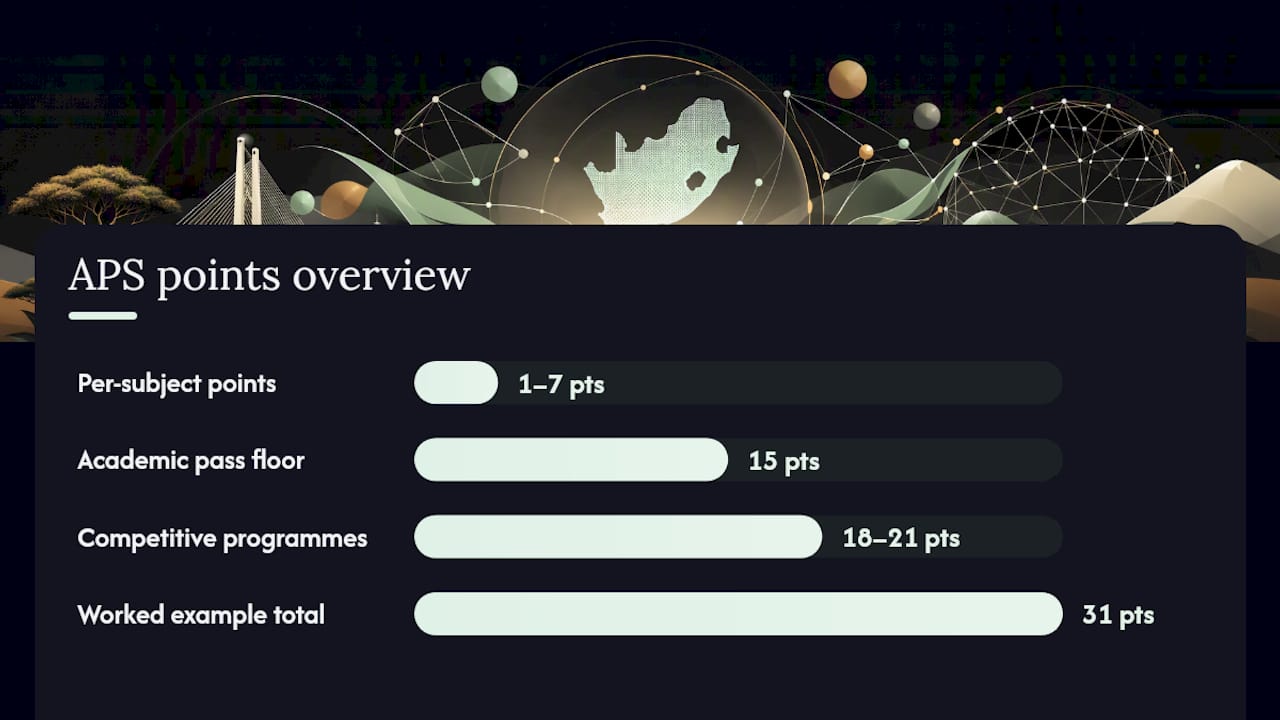
Many Higher Certificate programmes advertise a competitive APS in the 18 to 21 range. Some guides list an academic pass threshold as low as 15 points, but treat that as a floor, not a target. Competitive programmes at established providers routinely sit higher.
Here’s a worked example using six subjects:
That totals 31 points across six subjects, comfortably above most Higher Certificate thresholds. If your own score sits closer to the programme minimum, don’t panic. Providers often weigh a strong language mark and a relevant subject (Mathematics for technical streams, English for education and communication programmes) more heavily than the raw total.
Pro Tip: Run your actual NSC results through the AskSmarty APS calculator before you apply anywhere. It converts your marks instantly and shows which programmes you already qualify for, without you having to guess at conversion tables.
- Your best six subjects typically count toward APS, check each institution’s exact rule
- Life Orientation is often capped or excluded, verify per provider
- A strong language mark can offset a weaker score elsewhere
What if you don’t meet the minimum requirements?
Falling short of the statutory minimum doesn’t end your options. Several routes exist specifically for applicants in that position.
Mature-age entry lets candidates who are usually 23 or older apply without a full NSC, subject to an institutional assessment. Bridging or foundation programmes, many offered through open distance e-learning (ODeL) providers, help you build up the subject marks or language score you’re missing before reapplying. Recognition of Prior Learning (RPL) evaluates work experience or informal training as a substitute for missing academic credentials, and it’s worth investigating if you’ve been out of school for years.
If any of this applies to you:
- Contact the institution’s admissions office directly and ask about RPL or mature-age policies
- Request the specific bridging or foundation course list for your intended field
- Ask what documentation supports an RPL application (work references, portfolios, certificates)
Which institutions offer higher certificates in South Africa?
You’ll find Higher Certificates across four main types of providers, each with a different mix of cost, flexibility, and campus experience.
Public universities offer them alongside degrees and diplomas, often as an access route into further study. Unisa’s Higher Certificate in Education is a widely cited example: NQF level 5, 120 credits, and a 40% language-of-learning requirement delivered entirely through distance learning. Universities of technology and comprehensive institutions such as Central University of Technology run campus-based equivalents with a stronger vocational focus. Private colleges and TVET colleges also offer Higher Certificates, often with more flexible entry and smaller class sizes, while registered private colleges vary widely in accreditation and cost.
When comparing options, weigh delivery mode (distance versus campus), total cost, and whether credits articulate into a diploma later. Every programme publishes its own entry criteria, so treat the general university admission requirements as a starting reference, then confirm details on the specific programme page.
How long does a higher certificate take to complete?
Full-time students typically finish in one year. Part-time and distance learners often take two to three years, and most institutions set that as the outer limit rather than a fixed expectation.
Credits matter beyond the certificate itself. Many providers allow Higher Certificate credits to count toward the first year of a related diploma or degree, effectively shortening your next qualification if the subjects align closely enough.
- Full-time: around 1 year
- Part-time or distance: typically 2 to 3 years
- Maximum registration period: institution-specific, often capped around 3 years
Pro Tip: Before enrolling, ask the admissions office in writing which specific modules articulate into which diploma or degree. Verbal assurances during open days don’t always match the fine print in the credit transfer policy.
How do you apply, and what will it cost?
Applying is procedural, but skipping a step costs you weeks. Work through it in order.
- Shortlist programmes using a database filtered by NQF level and APS
- Confirm the minimum requirements for each shortlisted programme
- Gather your documents (see below)
- Submit your application online or in person before the deadline
- Track your application status and respond promptly to any requests for extra documents
You’ll typically need your NSC or NC(V) certificate (or academic transcript if results are still pending), a certified copy of your ID, proof of residence, and, for mature-age applicants, supporting age documentation. Some programmes also request a short motivation letter or portfolio.
Application fees are usually small relative to tuition, though some institutions waive them entirely depending on the applicant’s circumstances. Tuition itself varies widely by provider and mode of study. If cost is a concern, check your NSFAS eligibility early and search for programme-specific bursaries well before the application deadline, funding decisions often lag behind admission decisions, so applying late on both fronts compounds the risk of missing a registration date.
How AskSmarty helps you check what you qualify for
Working out where you stand across dozens of providers by hand is slow and easy to get wrong. AskSmarty was built to remove that guesswork: enter your NSC marks, and it matches you against a database of more than 1,700 university and college programmes, including Higher Certificates at NQF level 5.
Using it takes three steps:
- Enter your subject percentages into the APS calculator
- Filter results by qualification type to isolate Higher Certificate programmes
- Save or export the list of programmes you currently qualify for
Your marks stay on your device throughout, nothing is uploaded or sold to third parties, which matters if you’re comparing options quietly before telling anyone your plans.
A quick coach note for borderline applicants
If your APS sits just below a programme’s threshold, don’t assume the door is shut. Contact admissions directly and ask about conditional offers or a bridging route before writing off the qualification entirely.
If language is your only weak point, that’s the mark worth improving first, since it’s the one requirement almost every institution enforces without exception. From there, run your numbers through AskSmarty’s programme search to see, realistically, which options are already within reach.
Get your programme matches without the guesswork
There are other ways to figure out where you qualify: calling each university’s admissions office one by one, digging through PDF prospectuses, or asking a school counselor who’s tracking hundreds of students at once. All of that works eventually. None of it is fast.
AskSmarty is free to use and keeps your marks private, they never leave your device while the tool checks them against its database of programmes. Instead of guessing whether your APS clears a specific Higher Certificate’s threshold, run your results through the APS calculator and get a real answer in minutes. Once you have your score, search available programmes filtered to Higher Certificate options, or check the general admission requirements page to understand how your specific NSC results stack up before you commit to an application fee anywhere.
Sources
- Higher Education Act: Minimum admission requirements for higher certificate, diploma and bachelor’s degree programmes requiring a National Senior Certificate (NSC) — South African Government
- Entry requirements — Nelson Mandela University
- Achievement of the NSC with entry to Higher Certificate study — IEB
Contact your target institution directly to confirm programme-specific documents and deadlines before submitting anything.
FAQ
Who qualifies for a Higher Certificate?
Anyone with a National Senior Certificate or NC(V) Level 4 certificate that meets the minimum language score, plus an APS that clears the programme’s threshold. Mature-age applicants and those with Recognition of Prior Learning can also qualify through alternative routes.
How much does a Higher Certificate cost?
Costs vary significantly by institution and mode of study, with application fees generally small relative to overall tuition. Check the fees breakdown for a specific institution and confirm your NSFAS or bursary eligibility before applying.
Which course can I do with a 15 APS score?
An APS of 15 is described in some guides as a basic academic pass threshold for Higher Certificate study, though most competitive programmes expect scores closer to 18 to 21. Use AskSmarty’s APS calculator to see exactly which programmes accept your specific score.
How long does a Higher Certificate take?
Full-time study usually takes one year, while part-time or distance-learning routes can take two to three years depending on the provider. Most institutions set a maximum completion window rather than forcing a fixed timeline.
Recommended
Published 2026-08-18 · AskSmarty is an independent guide. Confirm anything time-sensitive on the official source.