Holland codes explained: pick majors and careers that fit
Discover how Holland codes explained can guide you in choosing majors and careers that align with your interests and preferences.

Holland Codes (RIASEC) are a three-letter interest profile that maps your top work preferences to career environments, developed by psychologist John Holland and now embedded in tools like the O*NET Interest Profiler and Career Key. Your code comes from ranking six interest types: Realistic, Investigative, Artistic, Social, Enterprising, and Conventional. The top three become your code, for example “ISA” or “ECS.” Take a reliable RIASEC test such as those offered by O*NET, Career Key, or Truity, note your top three letters in order, and you have a working map to careers and majors that genuinely suit you.
Table of Contents
- What the six RIASEC personality types actually mean
- How to read your three-letter Holland Code
- Using your Holland Code to choose careers and majors
- Where to take a reliable Holland Code assessment
- What Holland Codes do well and where they fall short
- Key takeaways
- Why Holland Codes matter more than students realise
- Useful sources and further reading
- FAQ
What the six RIASEC personality types actually mean
Each type describes a cluster of interests and preferred activities, not a fixed personality. Most people score across several types; the code just tells you where your energy naturally goes.
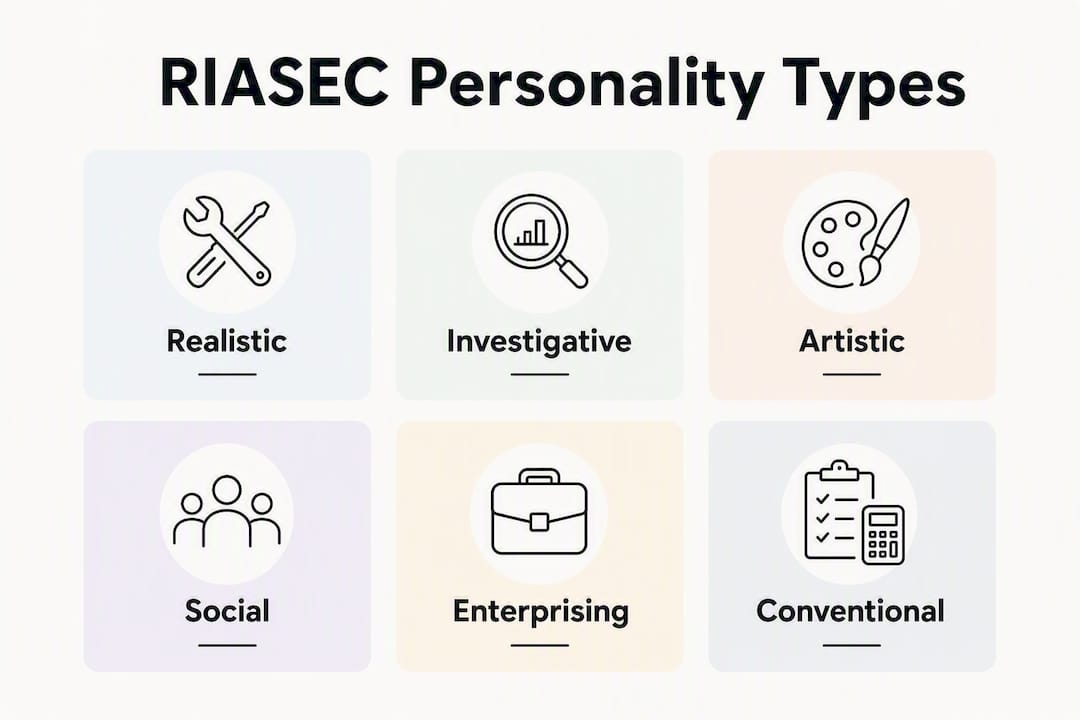
Realistic ®: the builder and doer
Realistic types prefer working with tools, machines, or the outdoors over abstract ideas or people management. They tend to be practical, physically coordinated, and direct.
Careers: mechanical engineer, electrician, civil engineer, construction manager, agricultural scientist.
Pro Tip: Realistic types often underestimate roles in technical sales or field consulting, where hands-on knowledge is the core credential and client interaction is secondary.
Investigative (I): the analyst and thinker
Investigative types are drawn to research, data, and problem-solving. They prefer working independently and are comfortable with ambiguity as long as there is a puzzle to solve.

Careers: data scientist, medical researcher, software developer, forensic analyst, environmental scientist.
Investigative personality careers cluster heavily in STEM, but the type also fits roles in economics, philosophy, and policy analysis where rigorous thinking is the main output.
Pro Tip: Pure I types can struggle in roles that demand constant client-facing work. If your secondary letter is S (Social), look for research roles with a mentoring or teaching component, such as university lecturer or science communicator.
Artistic (A): the creator and expresser
Artistic types value self-expression, originality, and unstructured environments. They resist rigid rules and thrive when given creative latitude.
Careers: graphic designer, architect, writer, film director, UX designer, music producer.
Pro Tip: Artistic types often overlook technical writing, instructional design, and brand strategy, all of which reward creativity but provide enough structure to stay commercially viable.
Social (S): the helper and connector
Social types are energised by working with people, whether teaching, counselling, or coordinating. They tend to be empathetic, patient, and skilled at communication.
Careers: teacher, social worker, nurse, human resources specialist, speech therapist, career counsellor.
Pro Tip: Social types with a secondary Enterprising (E) letter are well-suited to nonprofit management or community development roles, where people skills and organisational drive both matter.
Enterprising (E): the leader and persuader
Enterprising types are motivated by influence, competition, and results. They gravitate toward leadership, sales, and business development.
Careers: marketing manager, lawyer, entrepreneur, financial advisor, real estate agent, politician.
Pro Tip: Enterprising types who score low on Conventional © often struggle with administrative detail. Pairing with a strong operations partner, or choosing roles with dedicated support staff, tends to produce better outcomes than fighting the preference.
Conventional ©: the organiser and implementer
Conventional types prefer clear procedures, accuracy, and structured environments. They are reliable, detail-oriented, and comfortable with data and systems.
Careers: accountant, actuary, database administrator, compliance officer, financial analyst, medical records specialist.
CareerForce notes that every organisation needs all six types to function, which means no code is more or less valuable than another. The Conventional type, often underrated, is what keeps most organisations from falling apart.
How to read your three-letter Holland Code
The three letters are ranked: the first shows your dominant interest, the second your supporting preference, and the third a tertiary pull. They reflect what you enjoy, not what you are currently good at. A student who has never coded can still score high on Investigative if they love solving problems and researching ideas.
Letter order matters more than people think
Consider the code IAS (Investigative, Artistic, Social). Someone with this profile is most energised by research and analysis, uses creativity as a secondary tool, and values human connection third. A fitting environment might be a research institute where they write and present findings to colleagues. Now flip it to SAI (Social, Artistic, Investigative): the same three letters, but now the person is primarily motivated by helping others, expresses that through creative means, and uses analytical thinking to support the work. A school counsellor who designs engaging student workshops fits SAI far better than IAS.
What hexagon adjacency tells you
Holland’s hexagonal model arranges the six types in a specific order: R, I, A, S, E, C. Adjacent types share compatible traits; opposite types show the most tension. Investigative and Artistic sit next to each other, so an IA combination is comfortable and common in fields like architecture or scientific illustration. Realistic and Social sit opposite each other on the hexagon, meaning an RS code can signal internal conflict: the person prefers working alone with tools but also craves human connection. That tension is not disqualifying, but it does mean the person needs to be deliberate about which need gets met at work and which gets met elsewhere.
A code with opposite letters: what to do
Take RES (Realistic, Enterprising, Social). Realistic and Social are hexagon opposites, so the person may feel pulled between independent, hands-on work and people-centred leadership. Roles like site supervisor, field training coordinator, or technical sales manager can bridge that gap because they require both physical expertise and people management. The key is to look for job titles that explicitly combine both demands rather than hoping one side of the tension will disappear.
Using your Holland Code to choose careers and majors
Knowing your code is only useful if you act on it. Here is a practical sequence.
-
Interpret your full three-letter code. Read all three letters together, not just the first. The dominant letter narrows the field; the second and third letters tell you which version of that field will actually hold your attention.
-
Shortlist career clusters and majors. Match your dominant letter to broad fields: I types toward STEM or social science, A types toward design or communications, S types toward education or health, E types toward business or law, C types toward finance or administration, R types toward engineering or trades. Use your secondary letter to narrow further.
-
Research job-level matches on O*NET. O*NET tags thousands of occupations with RIASEC codes. Search your three-letter code and browse the matched roles, paying attention to the work activities and work context sections, not just the job title.
-
Test the fit in practice. Before committing to a degree, try a short course, volunteer placement, or part-time role in the field. A Social type who shadows a school counsellor for a week learns more about fit than any test can tell them.
-
Plan your training pathway. Once you have a shortlisted field, check entry requirements. State education resources map Holland types to educational pathways, and Asksmarty’s programme search lets South African students filter courses by interest area and check APS requirements directly.
When the job fits your dominant letter but not your second or third: a role that matches your top interest but ignores your secondary preference will satisfy you for a while, then start to feel hollow. An Enterprising type who also scores high on Artistic (EA) will find a pure sales role draining over time. Look for roles in creative industries, brand management, or content strategy where persuasion and creativity both show up in the job description.
Where to take a reliable Holland Code assessment
Three instruments stand out for accessibility and report quality.
| Assessment | Questions | Time | Output | Cost |
|---|---|---|---|---|
| O*NET Interest Profiler | 60 | ~15 min | Six scores + matched occupations | Free |
| Career Key | ~40 | ~10 min | Six scores + three-letter code + career matches | Free (basic) |
| Truity | 60 | ~10–15 min | Six scores + detailed type descriptions | Free (basic) |
Most reliable online assessments use roughly 60 items and take 10–15 minutes to complete. They measure interest patterns, not aptitude or intelligence, so there are no right or wrong answers.
O*NET Interest Profiler is the most authoritative option for US-based users because it links directly to O*NET’s occupational database. You finish the test and immediately browse matched careers with salary data, education requirements, and growth projections attached.
Career Key is built directly on Holland’s original theory and provides a clean three-letter code with matched careers. The free version gives enough to work with; the paid report adds narrative depth rather than better science.
Truity offers a polished experience with detailed type descriptions. The free results show your six scores and dominant type; a paid upgrade adds a full career report. For most users, the free version is sufficient to identify the three-letter code.
Statistic callout: Typical RIASEC assessments run approximately 60 items and take 10–15 minutes, measuring interest preferences rather than skills or knowledge.
Pro Tip: Answer each item based on whether you would enjoy the activity, not whether you are currently good at it. Responding to abstract labels (“Am I creative?”) triggers social desirability bias; responding to concrete activities (“Would I enjoy designing a logo?”) produces a more accurate profile.
JobCannon also offers a free 60-item RIASEC test that returns all six dimension scores and the three-letter code without gating results. It is a solid option when you want a quick second opinion on your code.
What Holland Codes do well and where they fall short
Holland Codes measure interest congruence, the fit between what you enjoy and what a role requires. Research shows that people working in environments congruent with their RIASEC profile report higher job satisfaction. That is a meaningful finding, but the model has real limits worth knowing.
They measure interests, not skills. A high Investigative score does not mean you are good at research; it means you enjoy it. Always pair your code with an honest skills audit before committing to a pathway.
Social desirability bias is a genuine problem. People tend to answer in ways that reflect who they want to be rather than who they are. The fix is to focus on activity-based items rather than trait labels, which is why the O*NET Profiler phrases items as activities (“Build kitchen cabinets”) rather than adjectives (“Are you practical?”).
Interests shift over time. Career counsellors recommend retesting at major transitions: finishing school, changing industries, returning to study after a break. A code you got at 17 may not reflect you at 25.
Your lowest scores are also useful. Elgin College’s career guidance notes that your bottom-scoring dimensions signal what to avoid. A role that heavily demands your lowest-scoring type will cause friction even if the job title matches your top code. An Artistic type forced into heavy Conventional work (rigid data entry, strict compliance procedures) will feel the mismatch within months.
Best practice: use the full three-letter code, not just the first letter. Read your results alongside informational interviews with people actually doing the jobs you are considering. The code opens the door; real conversations tell you what is behind it.
Key takeaways
Holland Codes give you a three-letter interest map that connects your natural preferences to specific careers and study pathways, but the code only works when you act on all three letters together.
| Point | Details |
|---|---|
| Take a 60-item test | Use O*NET Interest Profiler, Career Key, or Truity for a reliable three-letter code. |
| Read all three letters | The dominant letter narrows the field; the second and third letters determine which version of that field fits you. |
| Use lowest scores too | Your bottom-scoring types signal roles likely to cause dissatisfaction, even when the job title looks right. |
| Retest at transitions | Interests shift; revisit your code when finishing school, changing careers, or returning to study. |
| Test fit before committing | Shadow a professional or take a short course before enrolling in a full degree programme. |
Why Holland Codes matter more than students realise
Most students pick a degree based on subject grades or parental advice. Holland Codes offer something different: a structured way to ask “What kind of work environment will I actually want to show up to?” That question is underused in early career planning, and the cost of ignoring it shows up years later in burnout and mid-career pivots.
What the framework does particularly well is expose mismatches before they become expensive. A student who scores high on Artistic and low on Conventional, then enrols in a chartered accounting programme because it “pays well,” is setting up a conflict that grades alone will not resolve. The interest data was there; nobody asked the right question.
The three-letter code also does something that single-type models miss: it captures the tension and the nuance. A person is rarely just one thing. The second and third letters are where the real career fit lives, and most guides bury that point in a footnote. Read your full code. The first letter tells you the broad direction; the second and third tell you which specific path in that direction will keep you engaged past the first year.
For students in South Africa navigating programme choices, pairing a Holland Code result with Asksmarty’s APS calculator and programme database gives you both the interest fit and the entry-requirements reality check in one place. Knowing your code is the first step; knowing which programmes you actually qualify for is what turns that insight into a real application.
Useful sources and further reading
- Holland’s Theory of Career Choice (Career Key) — the clearest explanation of the RIASEC model grounded in Holland’s original research, with hexagon diagrams and career-matching tools.
- O*NET Interest Profiler — the most authoritative free RIASEC assessment for US users, linked directly to occupational data for thousands of careers.
- Holland Codes (Wikipedia) — useful background on the model’s history, academic development, and relationship to instruments like the Self-Directed Search.
- Holland Occupational Themes (Elgin College) — practitioner-focused descriptions of each type with guidance on retesting and using lowest scores.
- How Holland Codes Help You Find Your Career Match (CareerForce) — concise summary of how codes map to career clusters and occupational families.
- Holland’s Six Personality Types (ND CTE) — plain-language type descriptions with sample occupations, useful for quick reference.
- Asksmarty Programme Search — South African students can search over 1,700 programmes by interest area and check APS entry requirements after identifying their Holland Code.
FAQ
What are the six Holland Codes?
The six Holland Codes are Realistic ®, Investigative (I), Artistic (A), Social (S), Enterprising (E), and Conventional ©, together forming the RIASEC acronym. Each describes a cluster of work interests and preferred environments.
How do I find out my Holland Code?
Take a free 60-item RIASEC assessment such as the O*NET Interest Profiler, Career Key, or Truity; your top three scores become your three-letter code. The test takes roughly 10–15 minutes and measures interests, not skills.
How do I interpret my Holland Code?
Read all three letters in order: the first is your dominant interest, the second your supporting preference, and the third a tertiary pull. Adjacent letters on the hexagon indicate compatible preferences; opposite letters signal potential tension between work demands.
What is a Realistic Holland Code?
Realistic ® types prefer working with tools, machines, or the physical environment and tend toward practical, hands-on careers such as engineering, construction management, or agricultural science. It is the most common dominant type in trade and technical occupations.
Can my Holland Code change over time?
Yes. Interests shift at major life transitions such as finishing school, changing industries, or returning to study, so career counsellors recommend retesting at each of those points rather than treating one result as permanent.
Recommended
Published 2026-08-06 · AskSmarty is an independent guide. Confirm anything time-sensitive on the official source.