How to calculate your APS: a guide for South African matrics
Learn how to calculate APS easily with our step-by-step guide. Get your Admission Point Score for South African universities today!

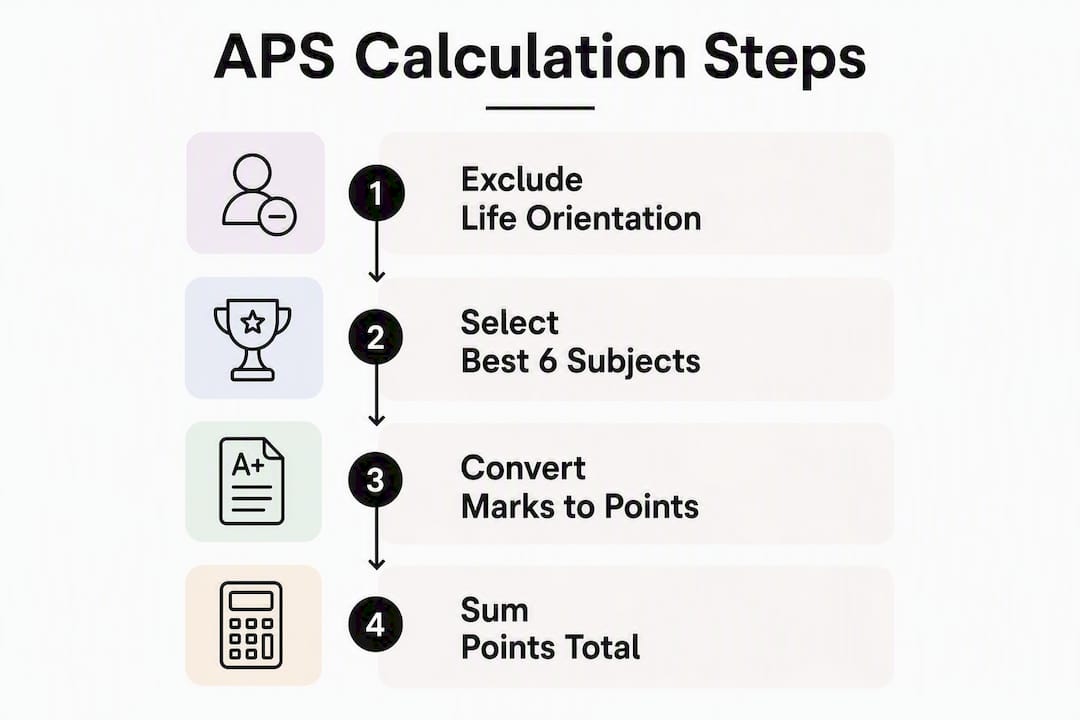
Your APS (Admission Point Score) is the sum of the NSC achievement ratings for your six best subjects, with Life Orientation excluded. Convert each percentage to a point value using the standard 7-point scale, add those six numbers together, and you have your APS.
Here is the fastest way to do it right now:
- List your final Grade 12 subject percentages.
- Remove Life Orientation from the list.
- Keep your six highest-scoring subjects.
- Convert each percentage to an NSC point using the table in Section 3 below.
- Add the six points. That total is your APS.
Run those marks through Asksmarty’s APS calculator to verify your result privately and see which programmes you qualify for across South Africa. If you hold an IEB, Cambridge, or foreign qualification rather than a standard NSC, jump to Section 6 for conversion guidance before you calculate.
Table of Contents
- What APS is and why South African universities use it
- The standard conversion table and what your total means
- Which subjects count toward your APS?
- Step-by-step worked example
- How university APS calculations differ and how to check yours
- What APS means for your chances
- Using calculators safely: Asksmarty’s tool and what to watch for
- Key takeaways
- Why aiming higher than the minimum is the only sensible strategy
- Asksmarty makes APS verification straightforward
- Useful sources to verify your APS
- FAQ
What APS is and why South African universities use it
APS stands for Admission Point Score. It is a number derived from your final Grade 12 or NSC subject achievement ratings, and South African universities use it as the first filter when they assess applications.
The score serves two distinct purposes, and confusing them is one of the most common mistakes students make:
- Minimum entry requirement: a floor below which your application is automatically declined, regardless of other factors.
- Ranking tool: when a programme receives more qualifying applications than it has places, universities rank applicants by APS (and sometimes by specific subject performance) to decide who gets in.
Meeting the minimum does not guarantee a seat. A programme with 200 places and 800 qualifying applicants will admit the 200 highest-ranked candidates, which often means the effective cut-off sits well above the published minimum.
Universities also consider programme-specific subject requirements, National Benchmark Test (NBT) results, and sometimes selection interviews. Your APS is necessary but rarely the whole picture. For a full breakdown of what universities look at beyond the score, the admission requirements guide on Asksmarty covers NSC passes, NBT, and NQF levels in one place.
Pro Tip: Check both the faculty minimum APS and the programme-specific subject requirements before you apply. A student with a strong overall APS can still be declined if they lack the required mark in Mathematics or Physical Sciences for a specific degree.
The standard conversion table and what your total means
The NSC uses a 7-point achievement scale. Every percentage you earned maps to a point value, and that mapping is fixed across most South African universities.

| Percentage | NSC Achievement Level | APS Points |
|---|---|---|
| 80–100% | 7 (Outstanding) | 7 |
| 70–79% | 6 (Meritorious) | 6 |
| 60–69% | 5 (Substantial) | 5 |
| 50–59% | 4 (Adequate) | 4 |
| 40–49% | 3 (Moderate) | 3 |
| 30–39% | 2 (Elementary) | 2 |
| 0–29% | 1 (Not Achieved) | 1 |
The standard 7-point conversion gives a maximum APS of 42 (seven points across six subjects). That is the benchmark most South African universities publish their minimums against. A score considered competitive varies by programme; highly sought-after programmes at research-intensive universities often have effective cut-offs well above the published minimum.
Not every institution uses this exact scale. Some use an 8-point variant, which raises the theoretical maximum to 48. UCT applies percentage-based scoring in certain faculties rather than converting to points at all. A few institutions double the weighting of a key subject such as Mathematics. These variations are not rare edge cases; they affect a significant number of programmes, which is why the conversion table above is a starting point, not the final word.
Key figure: On the standard 7-point scale, the maximum APS is 42. If a university’s published minimum for a programme is 30, you need at least five subjects averaging in the 50–59% band to qualify.
Which subjects count toward your APS?
Life Orientation is excluded from the standard APS calculation at most South African universities. After removing it, you use your six best remaining subjects. If you passed more than six academic subjects, drop the one with the lowest mark.
A few things to keep in mind:
- The top-six rule is standard, not universal. Most universities follow it, but some institutions or specific faculties may count seven subjects or handle LO differently. Always verify.
- Life Orientation may still be recorded. Some universities note your LO result for reference even when it does not contribute to your APS total. A handful of programmes may include it, so check the admissions page for your chosen course.
- Programme-specific subjects can override the “drop your lowest” logic. If a degree requires Mathematics at a minimum of 50%, you must include Mathematics in your six, even if it is not one of your strongest marks.
Pro Tip: When a programme requires a specific subject, lock that subject into your six first, then fill the remaining five slots with your highest-scoring subjects. Never drop a required subject just because another mark is higher.
For students applying to distance-learning institutions, the same rules generally apply, though it is worth checking the specific requirements on the UNISA page if that is your route.
Step-by-step worked example
Here is a realistic set of Grade 12 results. The student passed eight subjects, including Life Orientation.

| Subject | Percentage | APS Points |
|---|---|---|
| English Home Language | 74% | 6 |
| Afrikaans First Additional | 61% | 5 |
| Mathematics | 55% | 4 |
| Life Sciences | 68% | 5 |
| Geography | 72% | 6 |
| History | 48% | 3 |
| Business Studies | 82% | 7 |
| Life Orientation | 79% | Excluded |
Step 1: Remove Life Orientation. That leaves seven academic subjects.
Step 2: Identify the lowest-scoring subject among the remaining seven. History at 48% (3 points) is the weakest.
Step 3: Drop History. The six included subjects are English, Afrikaans, Mathematics, Life Sciences, Geography, and Business Studies.
Step 4: Add the six APS points: 6 + 5 + 4 + 5 + 6 + 7 = 33.
This student’s APS is 33 out of a maximum 42.
Quick checklist to follow with your own marks:
- Confirm your qualification type (NSC, IEB, Cambridge, or other).
- List all subjects with final percentages.
- Remove Life Orientation.
- Identify any programme-required subjects and lock them in.
- Convert each remaining percentage to an APS point using the table above.
- Add the six highest points.
- Verify the total against your chosen university’s published requirements.
How university APS calculations differ and how to check yours
The standard 7-point NSC scale is the most common system, but universities adapt it in ways that can shift your calculated total by several points. Common variations include:
- Alternative point scales: some institutions use an 8-point scale, raising the maximum to 48.
- Percentage-based systems: UCT uses raw percentages in certain faculty calculations rather than converting to a 7-point score.
- Subject doubling: a few universities weight Mathematics or English twice, effectively making one subject count for two slots in the total.
- Faculty-specific rules: the same university may apply different conversion methods across its faculties. Engineering and Health Sciences often have stricter or different formulas than Humanities.
Different calculators can return different APS totals for the same set of marks because of these scale and LO treatment differences. That is not a bug; it reflects genuine institutional variation.
How to verify for your specific university:
- Go to the university’s official admissions or prospectus page.
- Look for a faculty-specific APS calculator or a published conversion table.
- Run your marks through that tool, not a generic one.
- If the result differs from your hand calculation, use the university’s figure for your application.
- For edge cases (unusual subject combinations, borderline marks), contact the admissions office directly before submitting.
For institutions with particularly distinct rules, the UCT page and the University of Pretoria page on Asksmarty include faculty-level admissions notes that can save you a lot of digging.
Non-NSC qualifications: IEB results are generally accepted at face value using the same 7-point conversion. Cambridge International results require a formal conversion, and NWU’s APS calculator is one of the few publicly available tools that handles NSC, ISC, SACAI, and foreign certificates in a single interface.
What APS means for your chances
There is a meaningful gap between qualifying for a programme and being admitted to it.
“Meeting the minimum APS validates the academic baseline; universities use APS to rank applicants when places are limited.” — Edupstairs
A minimum APS meeting the programme’s published requirement means your application will be considered. It does not mean you will receive an offer. When many more qualifying applicants than places apply, the university ranks them by APS to decide admissions. Students near the published minimum are often the first to miss out.
Practical advice for navigating this:
- Aim at least 3–5 points above the published minimum for your target programme.
- Pay close attention to required subject performance. A student with an APS of 34 but only 45% in Mathematics may be outranked by a student with an APS of 31 and 70% in Mathematics for an engineering programme.
- Apply to a spread of programmes: one or two aspirational choices, two or three realistic ones, and at least one where your APS sits comfortably above the minimum.
- If your results are borderline, check the university’s re-mark and resubmission policy. Some institutions will update your APS and reconsider your application if an official re-mark improves your marks. Always submit the updated official results directly to the admissions office.
Using calculators safely: Asksmarty’s tool and what to watch for
A good APS calculator does three things a manual calculation cannot: it checks multiple universities at once, it flags programme-specific subject requirements you might have missed, and it reduces the risk of simple arithmetic errors.
Common mistakes students make with calculators:
- Using a generic tool that applies the standard 7-point scale to a university that uses a different system.
- Forgetting to exclude Life Orientation, which inflates the total.
- Entering predicted marks instead of final certified results.
Asksmarty’s APS calculator is built specifically for South African students. Enter your subject marks, select your certificate type, and the tool returns your APS alongside a list of matched programmes from over 1,700 courses in its national database. Your marks never leave your device, so there is no privacy risk and no registration required.
Steps to use it:
- Open the Asksmarty APS calculator.
- Select your qualification type (NSC, IEB, or other).
- Enter your final percentage for each subject.
- The calculator excludes Life Orientation automatically and applies the correct conversion.
- Review your APS total and the matched programme list.
Pro Tip: Always do the hand calculation first using the table in Section 3. When your manual total and the calculator’s result match, you can be confident in the number. If they differ, check which subjects you included and whether Life Orientation was accidentally counted.
Because different calculators can return different totals for the same marks, cross-check Asksmarty’s result against your chosen university’s own published calculator before you submit an application.
Key takeaways
Your APS is the single most important number in your university application, but calculating it correctly and verifying it against the right institution’s rules is what actually matters.
| Point | Details |
|---|---|
| Standard formula | Add NSC points for your six best subjects; Life Orientation is excluded in most cases. |
| Maximum score | The standard 7-point scale gives a maximum APS of 42; some universities use different scales. |
| Verify per university | Always check your chosen institution’s own calculator or admissions page — rules vary by faculty. |
| Aim above the minimum | Meeting the minimum APS qualifies you; a higher score improves your ranking for competitive programmes. |
| Use Asksmarty | Asksmarty’s free APS calculator matches your marks to over 1,700 programmes privately, with no registration. |
Why aiming higher than the minimum is the only sensible strategy
The published minimum APS is the number universities want you to focus on. It is also, in many cases, the least useful number for planning your application.
Here is what most guides do not say plainly: at oversubscribed programmes, the published minimum is effectively a historical artefact. It reflects the lowest score that would have been admitted in a year when applications were lower or the cohort was weaker. In a competitive year, the real cut-off can sit five or six points above what the prospectus states.
Students who calculate their APS, confirm it meets the minimum, and stop there are making a planning error. The better question is not “do I qualify?” but “where do I rank?” That shift in framing changes how you approach subject choice in Grade 11, how many programmes you apply to, and how seriously you take re-mark options when a result disappoints.
APS is also not the only axis universities rank on. A student with a lower overall APS but an outstanding Mathematics result will often outrank a student with a higher APS and a weak Mathematics mark for a quantitative programme. The score is a useful starting point but not the sole factor in admissions decisions.
Asksmarty makes APS verification straightforward
Calculating your APS by hand is a good habit. Knowing which programmes you actually qualify for across South Africa is a different challenge entirely, and that is where most students lose hours they do not have.
Asksmarty’s free APS calculator and programme matcher solves that in minutes. Enter your marks once, and the tool instantly shows you which of over 1,700 university and college programmes you qualify for, ranked by how well your APS fits each entry requirement. There is no account to create, no fee, and your marks stay on your device. The platform also lists up-to-date application deadlines and direct links to official application portals, so you move from “I know my APS” to “I know where to apply” without switching between a dozen university websites.
Check your university admission requirements and run your marks through the calculator to see your matched programmes now.
Useful sources to verify your APS
Always use your chosen university’s own published calculator or admissions office for the final figure you submit on an application. The sources below are the most reliable starting points.
| Source | What you will find there |
|---|---|
| UJ APS guidance | Official University of Johannesburg APS rules and the top-six subject method |
| NWU APS calculator | Supports NSC, ISC, SACAI, and foreign certificates with conversion guidance |
| UJ APS Score Calculator PDF | Downloadable conversion table and worked examples from UJ |
| Asksmarty APS calculator | Privacy-preserving calculator with programme matching across 1,700+ courses |
| Asksmarty programme search | Search and filter all SA university and college programmes by APS and subject |
| Asksmarty how to apply | Step-by-step application guide for South African universities and colleges |
For IEB results, the same 7-point conversion applies in most cases. For Cambridge International or foreign school certificates, contact the admissions office of your chosen university directly, or use the NWU APS calculator, which includes a foreign-certificate conversion tool. SACAI candidates should also verify directly with their target institution, as treatment varies.
FAQ
How do I calculate my APS score?
Convert each of your six best Grade 12 subject percentages to an NSC point (80–100% = 7, down to 0–29% = 1), exclude Life Orientation, and add the six points. The total is your APS, with a maximum of 42 on the standard scale.
Can I calculate my APS score myself?
Yes. Use the 7-point conversion table in this article, exclude Life Orientation, pick your six best subjects, and add the points. Asksmarty’s free APS calculator can verify your result instantly without storing your marks.
What does a 27 APS score mean?
Meeting or exceeding the published minimum APS is necessary to be considered for many diploma and degree programmes at South African universities, but it may not be competitive enough for oversubscribed courses where the effective cut-off is higher.
Is a 20 APS score enough for a diploma?
A score of 20 qualifies for some certificate and diploma programmes, particularly at colleges and certain universities of technology, but requirements vary by institution and programme. Always check the specific admissions page for your chosen course.
Does Life Orientation count toward my APS?
Life Orientation is excluded from the standard APS calculation at most South African universities. A small number of institutions or specific programmes may include it, so verify with your chosen university before finalizing your calculation.
Recommended
Published 2026-08-03 · AskSmarty is an independent guide. Confirm anything time-sensitive on the official source.