6 Steps to Choose a Degree in South Africa Using Your APS Calculator
Use six practical steps to match your APS and subject minima to real South African degrees. Run an APS calculator, check funding, and build a shortlist.

Pick the degree your marks genuinely qualify you for, then check it leads somewhere you actually want to go. That means running your APS now, shortlisting three careers you’d tolerate at 8 AM on a Monday, and checking subject minima before you fall in love with a programme. Everything else, cost, campus, prestige, comes after those two checks.
TL;DR:
- Most students should prioritize matching their APS and subject minima over reputation, as a high APS alone does not guarantee entry into competitive programmes.
- Completing a diploma or a bachelor’s with 480 credits offers better chances for postgraduate study and employment than a lower-credit qualification, especially if planning for future Master’s degrees.
- Using tools like APS calculators helps identify realistic options across universities, sorting programs by how closely they match your actual marks and subject strengths.
- Applying early with provisional Grade 11 results and preparing all supporting documents can improve chances before programs fill, especially for popular courses.
- Degrees with built-in practical experience and clear articulation pathways tend to maintain relevance and employability more reliably than those based solely on hype or prestige.
Table of Contents
- How to choose a degree: a 6-step decision checklist
- Understanding qualification types and NQF levels in South Africa
- Match your marks to programmes: APS, subject minima, and faculty rules
- How do you know which degree is right for you?
- Cost and funding: NSFAS, bursaries, and affordability checks
- When to apply: timelines and next practical steps
- How AskSmarty’s tools speed up shortlisting
- Choosing under pressure: a short editorial note
- Check what you qualify for before you apply anywhere
- Where to verify requirements and deadlines
- Sources
- FAQ
How to choose a degree: a 6-step decision checklist
Work through these steps in order. Skipping ahead to “which university has the nicest campus” before step one is how students end up in the wrong faculty.
- Calculate your APS. Use your best six or seven NSC subjects to get a number you can compare against real programme requirements.
- List three careers, not one. Write down jobs you’d actually want, not just ones your family approves of.
- Check subject minima for each. A high APS means nothing if you don’t have Maths or Physical Sciences at the level a faculty demands.
- Research graduate outcomes. Does the degree lead to jobs, or just to another degree?
- Compare costs and funding routes. Know what you can afford before you fall for a programme you can’t finish.
- Build a reach, target, and safety list. One ambitious option, two you’ll probably get into, applied to using your Grade 11 results where universities allow provisional offers.
That last step matters more than people think. A “reach” application costs you nothing extra, but a shortlist with only reach options is a plan built on hope.
Understanding qualification types and NQF levels in South Africa
Not all “degrees” are the same length or lead to the same place, and the South African National Qualifications Framework sets out exactly how they differ — for detailed information about qualification levels, see Theology Programs & Bible Degrees — All Levels. The CHE defines qualification types by NQF level and credit volume, and that structure decides how far and how fast you can progress afterward.
- Higher certificate (NQF 5): roughly one year, 120 credits, often a fast entry point or a bridge into a diploma.
- Diploma (NQF 6): typically three years, 360 credits, career focused with a practical bent.
- Bachelor’s degree (NQF 7 or 8): three years (360 credits) or four years (480 credits) depending on the field.
- Honours (NQF 8): an extra year that opens the door to a master’s.
- Master’s and doctorate (NQF 9 and 10): research or coursework routes into specialised or academic careers.
The credit gap between a 360-credit and 480-credit bachelor’s isn’t just a formality. A 480-credit Level 8 bachelor’s gives you far more direct entry into postgraduate study than a 360-credit Level 7 version, so if you already know you want a master’s eventually, check the credit total before you enrol.
Match your marks to programmes: APS, subject minima, and faculty rules
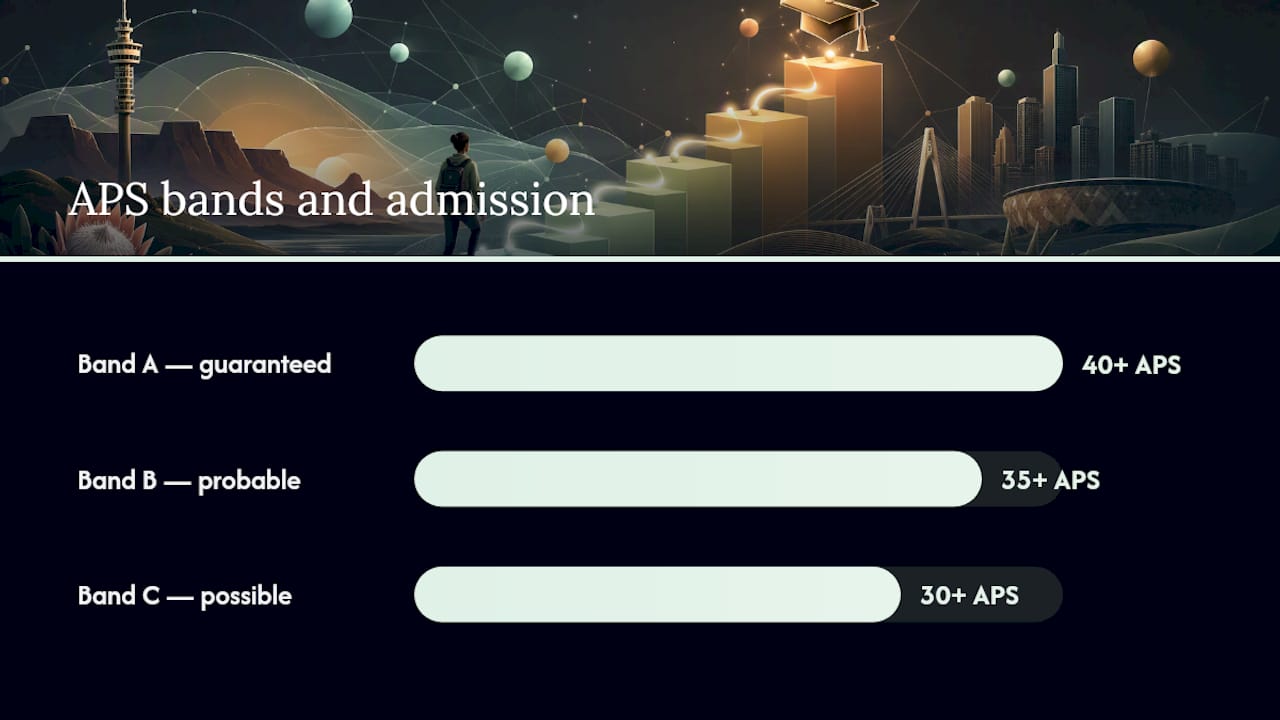
Your Admission Point Score converts your matric percentages onto a 1 to 7 scale per subject, and the total is the first filter every South African university applies. Typical bands run like this, according to APS calculator guidance: 30+ opens many general undergraduate programmes, 35+ is usually needed for competitive streams like engineering or accounting, and medicine often demands 40+ alongside strong Maths and Physical Sciences marks.
APS alone won’t save you if you’re missing a subject minimum. UCT’s admissions guidance shows a bachelor’s minimum generally needs an NSC rating of 4 (50 to 59%) in four subjects, but individual faculties layer stricter subject-specific rules on top. This is exactly why a student with a strong overall APS can still get rejected from a specific major.
- Check the university’s admission requirements for both APS and subject minima before you apply, not after.
- If you’re short on Maths or Physical Sciences, look at extended-degree programmes, bridging years, or TVET diplomas with articulation into a degree later.
- Rewriting a weak NSC subject is slower but sometimes the cleanest fix.
Pro Tip: If you narrowly miss the cutoff for a restricted major like Actuarial Science, applying for a general BSc or BCom and choosing your major in year two often keeps the door open without wasting a year.
Faculties often publish Band A, B, and C tables where your APS and NBT results predict guaranteed, probable, or possible admission, worth checking before you assume you’re safely in.
How do you know which degree is right for you?
Marks get you in the door. Career fit decides whether the degree was worth it. Start by pulling actual data instead of guessing from vibes.
- Check university graduate employment reports and destination surveys for the specific programme, not just the institution’s brand name.
- Search LinkedIn for people who studied that exact degree five to ten years ago and see where they landed.
- Look at whether the programme includes work-integrated learning or internships, because employability tracking beats chasing trend lists that go stale in two years.
- Prioritise degrees with built-in practical exposure over ones that sound exciting but leave you with zero workplace experience at graduation.
Fields like data science, health sciences, and skilled trades tend to show consistent demand in South Africa, but demand shifts. A degree that forces you to build real skills through WIL placements holds up better over a decade than one that simply rode a hype cycle the year you enrolled.
Cost and funding: NSFAS, bursaries, and affordability checks
Run the affordability math before you fall for a programme, not after your first semester. NSFAS covers tuition, accommodation, and a living allowance for eligible students from qualifying households, but eligibility criteria and funding caps change yearly, so check current rules directly rather than relying on what a friend told you last year.
- Apply for bursaries and employer scholarships early. Many close months before university applications do.
- Budget realistically for accommodation, transport, and textbooks, not just tuition.
- Consider part-time work or vacation work tied to your field, which often doubles as WIL experience.
- A cheaper TVET diploma with a clear articulation path into a degree can beat an unaffordable bachelor’s you’ll drop out of in year two.
When to apply: timelines and next practical steps
South African university applications generally open and close between August and October, and many popular programmes fill their intake before the final deadline arrives, according to Department of Education guidance. Waiting for final Matric results before applying is a mistake most students only make once.
- Apply using your Grade 11 results for provisional acceptance, since most universities accept this as a starting point.
- Gather certified ID copies, Grade 11 (and later Grade 12) results, and proof of residence ahead of time.
- Prepare early for any interviews, portfolios, or auditions required by creative or health science programmes.
- Submit applications to your reach, target, and safety options simultaneously rather than waiting to see how one turns out first.
- Track deadlines for each institution separately. They rarely align.
How AskSmarty’s tools speed up shortlisting
Working out your real chances across a dozen programmes by hand is slow and error prone. AskSmarty’s APS calculator converts your marks into your APS instantly and keeps that data on your device rather than sending it anywhere, which matters if you’re comparing options before you’re ready to commit to any university.
- Enter your subjects and marks once, then see which programmes across South African universities and colleges you currently qualify for.
- Search the national programme database by faculty, APS, or institution to compare entry requirements and deadlines side by side.
- Cross-check the exact subject minima listed against your own NSC subjects before you apply anywhere.
Pro Tip: Run your marks through the calculator, then sort results by APS gap, closest matches first, to build your reach, target, and safety list in under ten minutes instead of an entire weekend.
Choosing under pressure: a short editorial note
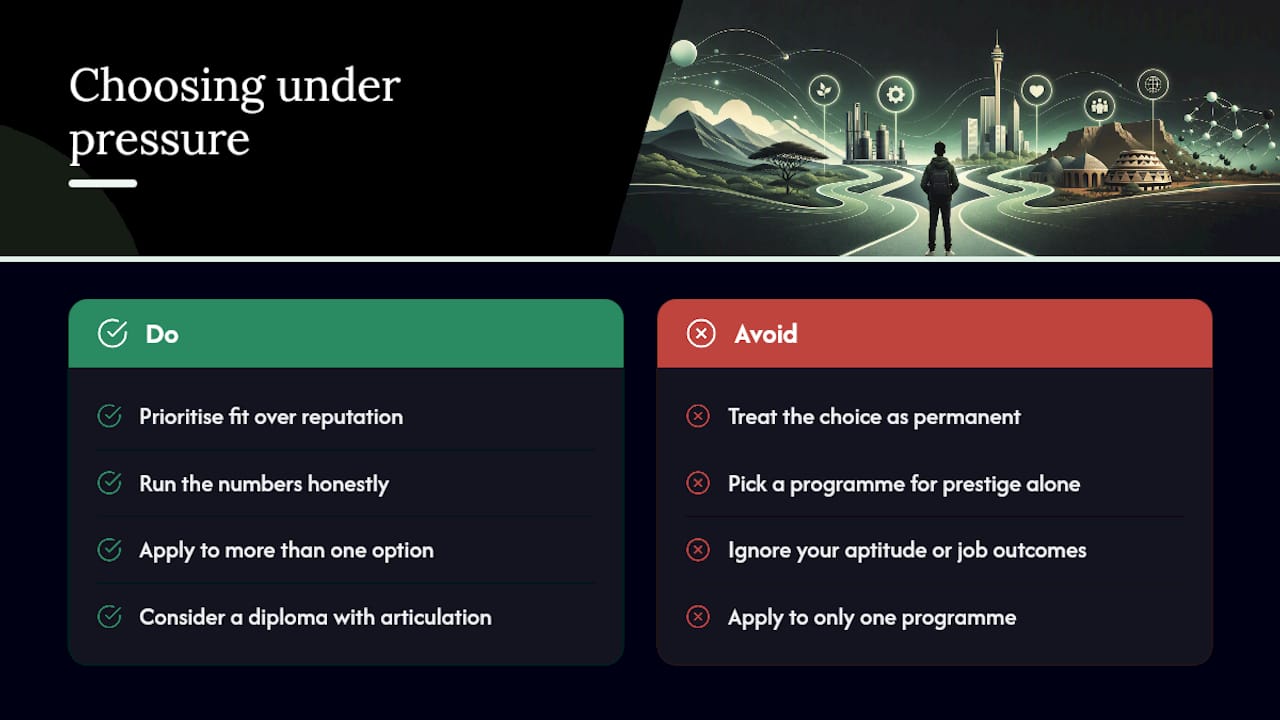
Everyone treats this decision like it’s permanent. It isn’t. Plenty of successful people switched majors, took a diploma route into a degree later, or spent a year in something unrelated before finding their field. What actually costs you time is choosing a programme purely for prestige and discovering in year two that you have no aptitude for it.
Prioritise fit over reputation, run the numbers honestly, and apply to more than one option. If a bachelor’s doesn’t feel right after checking the requirements and the job outcomes, a diploma with articulation isn’t a downgrade. It’s a different route to the same destination.
— Nkosi
Check what you qualify for before you apply anywhere
Guidance counsellors and open days help, but they can’t run your exact marks against 1,700 programmes in a few seconds. AskSmarty does that for free, without collecting your marks or charging application fees, so you see real matches instead of guessing which universities to even bother applying to.
Enter your subjects into the APS calculator and you’ll get a straight answer on where you stand against real subject minima, not a generic “you might qualify” guess. From there, search the full programme database to build your reach, target, and safety shortlist in one sitting, then check the detailed admission requirements page for anything you’re still unsure about before submitting.
Where to verify requirements and deadlines
Cross-check any decision against official sources before you submit an application:
- CHE NQF framework for qualification levels and credit requirements.
- University admission pages (UCT’s is a useful model) for faculty-specific subject minima.
- Department of Basic Education for subject-choice and career-pathing guidance.
- AskSmarty’s programme search for current deadlines and application fees per institution.
Sources
- THE SOUTH AFRICAN NATIONAL QUALIFICATIONS FRAMEWORK
- 2024 National Senior Certificate NSC guidelines for admissions (UCT example)
- How to apply (Department of Education guidance)
FAQ
What are the best degrees to have in South Africa?
There’s no single “best” degree. The strongest choice is one where your marks meet the subject minima, the field shows steady graduate employment, and you can genuinely see yourself doing the work for years, not just the first semester.
How do I know which degree is right for me?
Check three things together: your APS against the programme’s actual requirement, whether the career it leads to has real graduate demand, and whether you’d still want that job after the excitement of “getting in” fades. Tools like AskSmarty’s calculator let you test this against real programmes in minutes.
What is the easiest degree to study in South Africa?
“Easiest” varies by person and depends more on your strengths than the subject label. A degree that matches your existing skills, in Maths, writing, or a practical trade, will almost always feel easier than one chosen for prestige alone.
Which is the best degree to choose?
The best degree is the one you qualify for on paper and can sustain through three or four years of study. Compare your APS and subject results against actual entry requirements before ranking programmes by reputation.
Recommended
Published 2026-09-02 · AskSmarty is an independent guide. Confirm anything time-sensitive on the official source.