Read a Prospectus Fast for SA Applications and Verify Your APS
Find the three prospectus items to check first, learn how to calculate your APS from each prospectus, and use an APS calculator plus official downloads to...

Download the current-year prospectus for your intended intake, find your programme’s entry line, and check three things immediately: your APS or subject minima, the campus and mode of delivery, and the closing date. That single scan tells you whether you qualify and how much time you have. Everything else in the document (fees, modules, contact details) matters, but it can wait until you’ve confirmed those basics on official sites like AskSmarty or the university’s own .ac.za portal.
TL;DR:
- Most universities release updated prospectuses between February and April, so always download the current-year document directly from the official site.
- Your APS is calculated by converting your best six subject percentages into points using the institution’s own scale, then comparing the sum to the programme’s minimum.
- Check each programme’s specific closing date, especially for selective faculties, to avoid missing early application deadlines that can be months before the general window.
- Fees often include registration, exam, study materials, and residence costs, not just tuition, so estimate the total initial payment needed for registration and living expenses.
- Verify the accreditation status by confirming SAQA ID numbers and NQF levels directly with DHET, avoiding institutions that omit or obscure this essential registration information.
Table of Contents
- What to read first: a prospectus checklist that saves you hours
- How do you calculate your APS from the prospectus?
- What does the fees section actually cost you?
- What order should you tackle your application in?
- How do you verify a programme is actually accredited?
- How AskSmarty helps you read a prospectus faster
- What are the parts of a typical university prospectus?
- What do prospectus abbreviations like APS, NBT, and NQF actually mean?
- How do you compare two prospectuses side by side?
- What red flags should make you stop and double-check a prospectus?
- Author perspective: a short workflow and the mistakes that cost students spots
- Sources
- FAQ
What to read first: a prospectus checklist that saves you hours
A prospectus is the official, year-specific document listing every programme a university or college offers, along with entry requirements, fees, and deadlines. Reading one cover to cover wastes time. Instead, work through it in this order.
- Confirm the year. Institutions typically publish updated prospectuses between February and April for the following academic year, so a 2025 PDF floating around on a forum is useless for a 2027 application. Download directly from the university’s site, not a third party that might charge for an outdated copy.
- Find your programme’s entry line. This row shows APS, compulsory subject minima, which campus offers it, and whether it runs part-time or online.
- Check the dates. General closing dates usually run from August to October, but selective programmes close earlier. Note the exact date, not just the month.
- Scan the fees summary. Look for tuition ranges, registration costs, and any mention of NSFAS or bursary contacts.
- Skim the module list. Check for work-integrated learning (WIL), practicals, or industry placements tied to the qualification.
The WSU prospectus is a solid example of this structure in practice: programme tables, APS conversion charts, and dated fee schedules all sit in clearly labelled sections rather than buried in narrative text.
How do you calculate your APS from the prospectus?
Add the percentage-based points for your best six subjects, using the conversion table printed in the prospectus itself. Most universities score each subject out of seven points based on your percentage band (80 to 100% typically earns 7 points, 70 to 79% earns 6, and so on), then sum the six highest, excluding Life Orientation entirely.
Follow these steps with the actual document open in front of you:
- List all your subjects and their percentages, Matric or Grade 11 if you’re applying provisionally.
- Remove Life Orientation from the count.
- Convert each remaining subject to points using the prospectus’s own table, not a generic online chart, since conversion scales vary between institutions.
- Add your best six subject scores together for your APS.
- Compare that number against the programme’s minimum listed in the entry requirements row.
Here’s where it gets tricky: not every university uses APS in the same way. The University of Cape Town uses a Faculty Points Score instead, a system with its own weighting per faculty, and it also requires National Benchmark Tests for most undergraduate applicants. Wits applies its own subject weighting for competitive programmes like Engineering and Health Sciences. Never assume one prospectus’s rules apply to another institution’s application.
Pro Tip: If you’re applying provisionally on Grade 11 marks, recalculate the moment your Matric results are released. A provisional offer can be withdrawn if your final APS drops below the line, so treat that early number as a placeholder, not a guarantee.
For a fast, privacy-preserving check that accounts for these institutional differences without you typing your marks into an unfamiliar site, AskSmarty’s APS calculator runs the numbers against the correct scoring system per university.
What does the fees section actually cost you?
The tuition figure printed at the top of a fees page is rarely the full amount you’ll pay. Add up registration fees, exam fees, study materials, and, if you’re not commuting, residence costs before you compare one institution’s “cost” against another’s.
- Tuition per year or per module, depending on how the programme is structured.
- Registration fee, charged once at the start of the year regardless of tuition.
- Examination and materials fees, sometimes bundled, sometimes listed separately.
- Residence and meal costs, if you’re not living at home.
- Books and equipment, especially significant for programmes requiring lab kits or design software.
Most prospectuses also flag a Minimum Initial Payment, an upfront amount self-funded students must pay to secure registration even after receiving an offer. Miss that payment and your registration can be delayed or blocked entirely, regardless of how strong your APS was.
If you’re relying on financial aid, the prospectus will usually point you toward NSFAS documentation requirements and a bursary office contact, often tucked into a small section near the back rather than the main fees table. It’s worth reading that section as carefully as the fees themselves, since NSFAS timelines don’t always line up with a university’s own registration deadlines. AskSmarty’s fees page breaks down which South African institutions charge application fees and which don’t, useful context before you commit to applying anywhere.
What order should you tackle your application in?
Deadlines in a single prospectus aren’t uniform. Health Sciences and other selective faculties routinely close their applications months before the general deadline, and missing that earlier date means waiting an entire year, even if the general window is still open.
- Identify every deadline that applies to you, not just the headline date on the cover page. Check each programme’s entry line individually.
- Register for the National Benchmark Test early if your chosen university requires it. NBT registration has its own timeline, and your registration number typically needs to appear on your application.
- Gather documents before you start the online form: certified ID copy, latest school results, proof of any application fee payment.
- Submit and save your reference number immediately. You’ll need it to track status later.
- Check status periodically through the university’s applicant portal, and read the difference between a provisional offer (conditional on final Matric results) and a firm offer carefully.
Pro Tip: Waiting until January of your final year to start reading prospectuses is usually too late for competitive public university spots. Application windows generally open in April or May, and the strongest programmes fill their selective slots well before the general closing date arrives.
How do you verify a programme is actually accredited?
Every legitimate South African qualification carries an NQF level (indicating where it sits on the ten-level National Qualifications Framework) and a SAQA ID that confirms it’s registered with the South African Qualifications Authority. Public universities rarely need scrutiny here, but private colleges and TVET institutions vary widely in how clearly they disclose this.
- Check for both numbers explicitly. A legitimate prospectus lists the SAQA ID and NQF level directly on the programme page, not buried in fine print or omitted entirely.
- Cross-reference with DHET. Private higher education institutions must be registered with the Department of Higher Education and Training, and that registration status is publicly searchable.
- Treat vagueness as a red flag. If a prospectus describes a qualification only in marketing language, “industry-recognized,” “internationally accredited,” without a SAQA ID attached, verify independently before applying. AskSmarty’s guide to checking college accreditation walks through exactly what to look for.
How AskSmarty helps you read a prospectus faster
Reading dozens of PDF prospectuses side by side to find where you qualify is genuinely tedious, and it’s exactly the problem AskSmarty was built to solve. The tools work together rather than replacing the official document.
- APS calculator: enter your subjects and marks once, and see which programmes you meet the minimum for, accounting for institution-specific scoring differences.
- Programme matcher: filters across more than 1,700 university and college programmes nationally by your actual marks, not just by course name.
- Prospectus downloads: direct links to correct-year, official PDFs for institutions including UNISA, UCT, and NWU.
- Portal links: once you’ve confirmed eligibility, AskSmarty routes you straight to the university’s own application system.
| Step | What you do | Where it happens |
|---|---|---|
| Match your marks | Enter subjects and percentages | AskSmarty calculator |
| Confirm the programme | Cross-check entry requirements | Official prospectus PDF |
| Note the deadline | Record the closing date for your faculty | Prospectus dates section |
| Apply | Submit through the university’s own system | Official university portal |
Your matric marks never leave your device during this process. AskSmarty doesn’t submit applications or store your academic record; it guides you to the right programme and the right official portal, then steps out of the way.
What are the parts of a typical university prospectus?
Every South African prospectus follows a broadly similar structure, even though layout and length vary between institutions. Knowing the shape of the document means you stop reading pages that don’t matter for your decision.
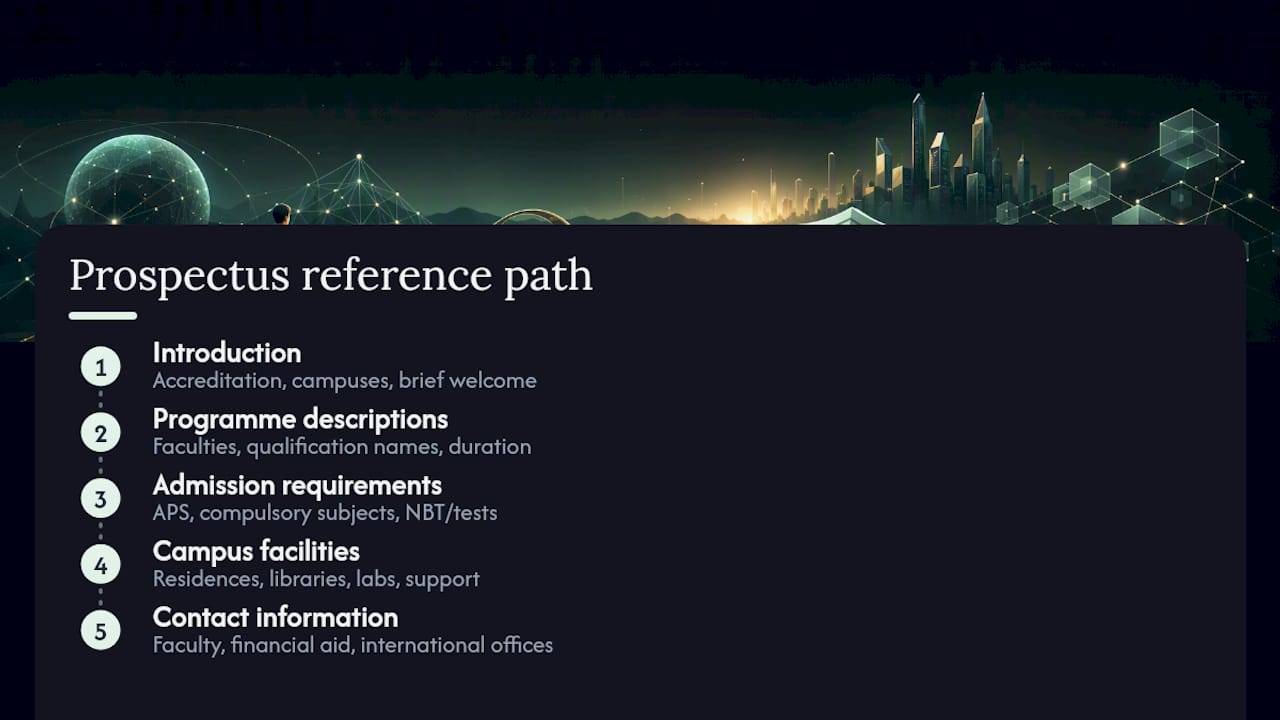
The introduction usually covers the institution’s accreditation status, campus locations, and a general welcome message, skimmable, rarely essential. Course or programme descriptions come next, organized by faculty, listing qualification names, duration, and a short outline of what the degree or diploma covers. This is where you’ll spend most of your time.
Admission requirements sit either alongside each programme or in a consolidated section near the front, showing APS, compulsory subjects, and any additional tests like the NBT. Some institutions list requirements twice, once in a summary table and again in the detailed programme entry, so check both if the numbers ever look inconsistent.
Campus facilities describe residences, libraries, labs, and student support services. Useful if you’re deciding between campuses of the same university, but not decision-critical for admission itself. Finally, contact information for faculty offices, financial aid, and international student support usually appears at the back, exactly where you’ll need it once you have specific questions the document itself can’t answer.
Treat the prospectus less like a book and more like a reference manual: you go in with a question (do I qualify, what does it cost, when’s the deadline) and pull out the answer from the relevant section.
What do prospectus abbreviations like APS, NBT, and NQF actually mean?
Prospectuses are dense with acronyms that assume you already know the system, which is frustrating if this is your first application. A short glossary clears up most of the confusion.
APS stands for Admission Point Score, the sum of your best six subject scores excluding Life Orientation. FPS (Faculty Points Score) is UCT’s alternative system, weighted differently by faculty. NBT refers to National Benchmark Tests, standardized assessments some universities require alongside your Matric results. NQF (National Qualifications Framework) indicates the level of a qualification on South Africa’s ten-tier framework, running from basic certificates at level 1 up to doctorates at level 10. SAQA is the South African Qualifications Authority, the body that registers and validates qualifications nationally. WIL stands for work-integrated learning, meaning practical placements built into a curriculum. MIP is the Minimum Initial Payment required at registration for self-funded students.
You’ll also see NSC (National Senior Certificate, your Matric qualification) and DHET (Department of Higher Education and Training, the government body overseeing higher education policy). Once these terms click, prospectus language stops feeling like a foreign dialect and starts reading like a straightforward reference document. AskSmarty’s admission requirements guide breaks each of these terms down further if you want more detail on how they interact.
How do you compare two prospectuses side by side?
Comparing programmes across institutions only works if you’re comparing the same thing in each document. A Bachelor of Commerce at one university and a Bachelor of Business Science at another might sound similar but carry different APS minima, different compulsory subjects, and very different career outcomes.
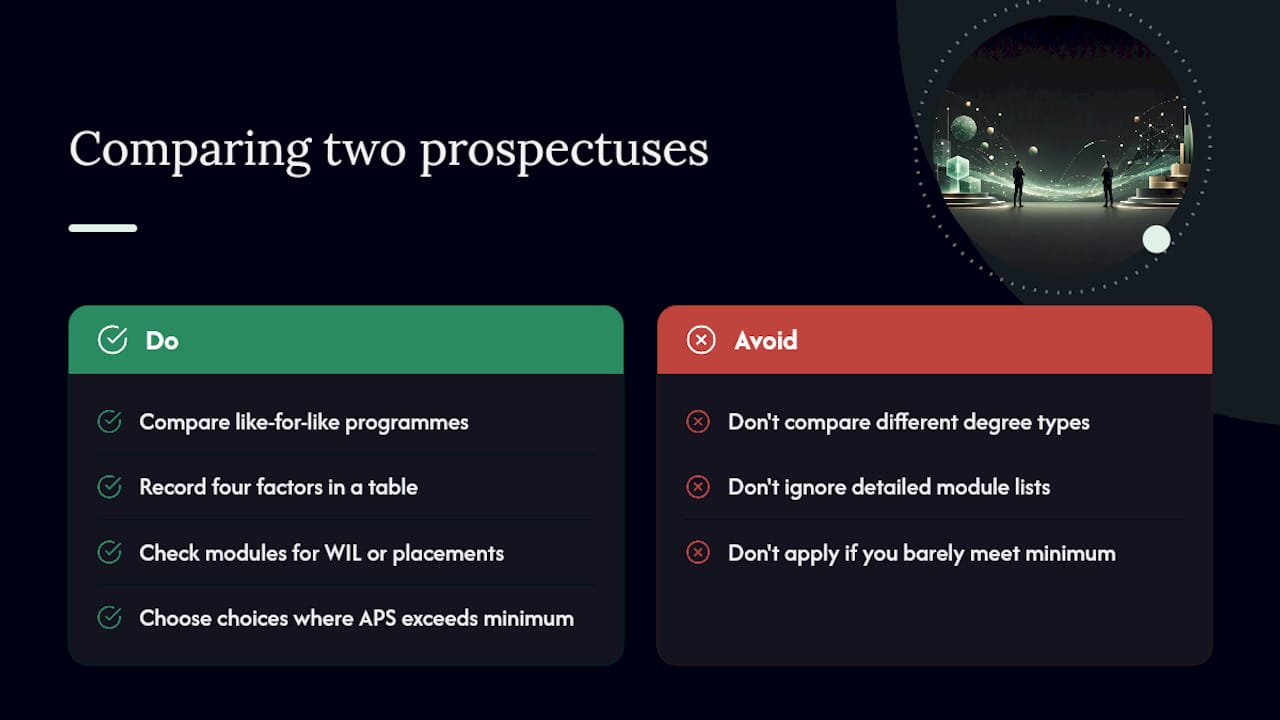
Line up four factors every time: entry requirements (APS or FPS, plus subject minima), total cost including residence and books, module content and whether WIL is built in, and the closing date. Write these down in a simple table of your own rather than trying to hold four PDFs in your head simultaneously.
Pay particular attention to module lists when comparing similar-sounding degrees. A prospectus that includes work-integrated learning, capstone projects, or industry placements in its curriculum tends to produce graduates who are more workplace-ready than an equivalent theoretical-only programme, even when both carry the same qualification name. That distinction rarely shows up in the course title, only in the detailed module breakdown a few pages in.
Also check whether your APS actually clears the bar comfortably or just scrapes it. Institutional guidance on planning your APS strategy suggests picking a primary choice and a realistic backup where your score exceeds the minimum, rather than applying only to programmes where you’re right on the line.
What red flags should make you stop and double-check a prospectus?
Most prospectuses are straightforward, but a few warning signs suggest you need to dig deeper before applying or paying anything.
- Missing or vague SAQA IDs. A private college that doesn’t list registration numbers clearly is either an oversight or a genuine accreditation problem, and you can’t tell which without checking.
- No conversion table for APS. If a prospectus states a minimum APS but doesn’t show how percentages convert to points, verify against the university’s admissions office directly rather than guessing.
- Unclear or contradictory deadlines. If the general date and a faculty-specific date conflict, the earlier one is almost always the real deadline.
- Fees listed without a “correct as of” date. Institutions revise fees annually, so figures without a clear reference year should be confirmed before you budget around them.
- Outdated prospectus year. Applying using last year’s document risks working from expired deadlines and old fee figures entirely.
None of these red flags mean a university or college is untrustworthy. They mean you should confirm the detail directly with the admissions office or a verified source like AskSmarty’s university directory before you commit time or money to an application.
Author perspective: a short workflow and the mistakes that cost students spots
Match the prospectus year to your intake, find your programme, confirm your APS against the subject minima, note the closing date, and register for the NBT if it’s required. That’s the whole workflow. Everything else is detail.
The mistakes I see repeatedly aren’t complicated ones. Students read an old prospectus because it ranked higher in a search. They skip subject minima because their overall APS looks fine, not realizing a single missing compulsory subject disqualifies them regardless of total score. And they miss selective deadlines because they assumed one closing date applied to the whole university. Use a calculator that accounts for institutional scoring differences as a safety net, not as a replacement for reading the actual document.
— Nkosi
Sources
- 2027 university application dates: everything you need to know
- DHET: Register private higher education institution
- UCT: 2024 National Senior Certificate guidelines for admissions
- WSU prospectus 2027 – how to download and use it
- 2027-2028 prospectuses: download prospectuses, courses, admission requirements and application - Uni24
FAQ
What is a prospectus for a South African university?
A prospectus is the official document a university or college publishes listing its programmes, entry requirements (APS or subject minima), fees, key dates, and campus details for a specific intake year.
How do I calculate my APS from a prospectus?
Convert your best six subjects, excluding Life Orientation, into points using the prospectus’s own conversion table, then add them together and compare against the programme’s listed minimum.
Where can I find the correct-year prospectus?
Download directly from the institution’s official .ac.za website or a trusted aggregator like AskSmarty, since prospectuses are typically updated between February and April for the following year.
Why do some programmes have earlier application deadlines?
Selective programmes, including most Health Sciences degrees, close earlier than the general application window, so check each faculty’s specific date rather than relying on one university-wide deadline.
What is the difference between APS and UCT’s Faculty Points Score?
APS sums your best six subject scores using a standard conversion scale, while UCT’s Faculty Points Score applies faculty-specific weighting and generally requires National Benchmark Test results as part of the calculation.
Recommended
Published 2026-09-03 · AskSmarty is an independent guide. Confirm anything time-sensitive on the official source.