Map Your Marks in Minutes: HR Entry Requirements for South Africa
Check APS ranges, subject rules and alternative routes for HR study in South Africa. Map your marks in minutes with a free APS calculator.

Most Bachelor of Commerce or Bachelor’s degrees in Human Resource Management want an Admission Point Score (APS) around 28 to 30, plus pass levels in English and either Mathematics or Mathematical Literacy. Diplomas are more forgiving, usually sitting between 20 and 25 APS, and lean on Mathematical Literacy far more often. None of this guarantees you a seat, though. Universities rank every applicant against everyone else chasing the same limited spots, so hitting the minimum just gets you into the pool.
TL;DR:
- Meeting the minimum APS does not guarantee admission, as universities rank all applicants and admit from the top until capacity is reached.
- A Bachelor of Commerce in Human Resource Management typically requires an APS of 28 to 30, while diplomas may accept around 20 to 25 APS.
- Universities often exclude Life Orientation from the APS total, so achieving the required score in relevant subjects like English and Mathematics or Mathematical Literacy is crucial.
- Alternative pathways such as recognition of prior learning, higher certificates, or bridging programs can provide entry into HR programs without meeting direct APS thresholds.
- Applicants should calculate their exact APS early, verify specific subject requirements, and prepare backup options like diplomas or higher certificates to maximize admission chances.
Table of Contents
- Quick checklist: degree vs diploma entry at a glance
- Typical APS and subject examples from major South African universities
- Alternative routes: RPL, higher certificates and bridging programmes
- How admissions decisions work: ranking, capacity, deadlines and required documents
- Step-by-step next actions for applicants
- Practical tips from an admissions guide
- Map your marks to real HR programmes in minutes
- Sources
- FAQ
Quick checklist: degree vs diploma entry at a glance
Before you chase down transcripts, run through this self-check against your own results.
- Credential: a National Senior Certificate (NSC) or National Certificate (Vocational), registered against South Africa’s National Qualifications Framework (NQF).
- APS thresholds: degrees generally sit near 28 to 30; diplomas often land between 20 and 25, though every institution sets its own scale.
- Subjects: English at the required level, plus Mathematics or Mathematical Literacy at the achievement level the programme specifies. Diplomas commonly require an NSC rating of 3 (40 to 49%) in at least four recognised 20-credit subjects.
- Paperwork: certified ID copy, NSC results or a statement of results, certified academic transcripts, and a portfolio if the programme asks for one.
- Timing: apply well before closing dates and check each institution’s online portal for status updates rather than waiting for a phone call that may never come.
The NQF and APS system explained in detail is worth bookmarking if any of these terms feel unfamiliar.
Typical APS and subject examples from major South African universities
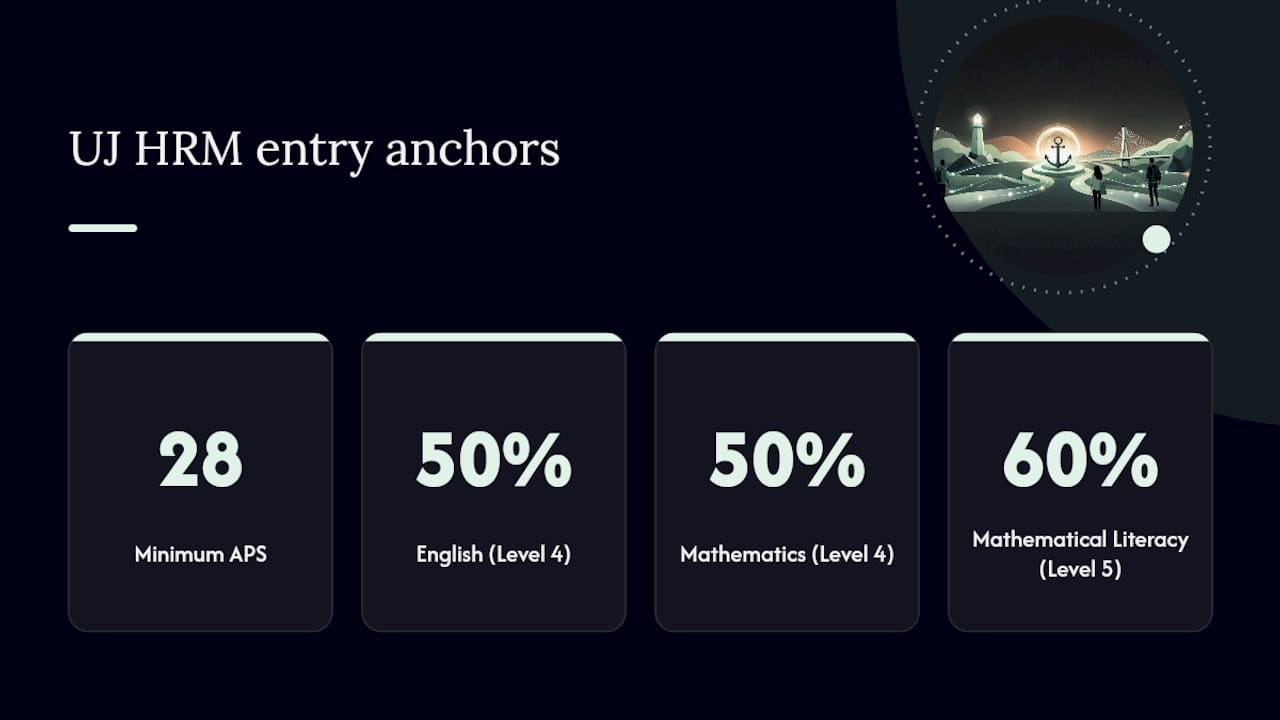
Numbers tell the story better than generalities here. At the University of Johannesburg, the Bachelor of Human Resource Management asks for a minimum APS of 28, English at level 4 (50%), and Mathematics at level 4 (50%) or Mathematical Literacy at level 5 (60%). That Mathematical Literacy allowance matters. It gives students who didn’t take pure Maths a genuine route into the field rather than shutting the door outright.
The University of Pretoria sets the bar higher for its BCom specialising in Human Resource Management: a minimum APS of 30, English at level 5 (60 to 69%), and Mathematics at level 4 (50 to 59%). One detail catches students off guard every year. Life Orientation doesn’t count toward that APS total, so don’t bank on it padding your score.
UNISA, as a distance provider, tends to publish similarly accessible thresholds for its diploma-level HR offerings, though its open-enrollment model means the ranking pressure works differently than at a contact university with fixed campus capacity.
Meeting the minimum does not guarantee admission. Institutions rank every eligible applicant by APS or a combined score and admit from the top down until seats run out, reflecting common admissions benchmarking practices applied internationally. Two students with identical marks can get opposite outcomes depending on how many other applicants applied that year.
Converting your NSC results into APS points is mechanical once you know the scale: each subject’s achievement level (1 through 7) maps to points, you exclude Life Orientation, and you total your best six or seven subjects depending on the institution’s rule. The AskSmarty APS calculator does this conversion automatically and flags where you sit against real programme thresholds.
Alternative routes: RPL, higher certificates and bridging programmes
Not meeting the direct-entry numbers isn’t the end of the story. Recognition of Prior Learning (RPL) lets some institutions admit mature applicants based on age and relevant work experience rather than matric results alone, and most universities publish a separate RPL checklist for exactly this scenario.
- A Higher Certificate (NQF Level 5) in a related field can articulate vertically into a Diploma (NQF 6) and eventually a Bachelor’s degree, a pathway SAQA records explicitly support.
- Some universities require a bridging or foundation module in English or Mathematics before you progress into first-year HR content, particularly if you scored just under the exemption threshold.
- RPL and higher certificate pathways are formally recognised alternatives, not backdoor shortcuts.
Pro Tip: Email the admissions office directly and ask for their specific RPL application form rather than relying on general web copy. Requirements shift by faculty and by year, and a five-minute email can save you a wasted application.
How admissions decisions work: ranking, capacity, deadlines and required documents
Understanding the mechanics behind a rejection or acceptance letter changes how you plan your applications.
- Ranking comes first. Every eligible applicant is scored and ordered, and the university admits from the top of that list until the programme’s capacity is filled. This is why two applicants with the same APS can get different outcomes in different years.
- Conditional offers happen often. If your final NSC results aren’t out yet, you might get a conditional offer based on your Grade 11 marks or trial exam results, confirmed once your final matric certificate arrives.
- Documents get checked line by line. Expect to submit a certified ID copy, your NSC or statement of results, proof of application fee payment, and any prior academic transcripts if you’ve studied before.
- Deadlines are firm, not suggestions. Apply before the closing date listed on the institution’s own portal, and check that portal periodically. A missed upload can knock you out of the ranking pool entirely, regardless of your marks.
Step-by-step next actions for applicants
Turning all of this into something you can actually do today looks like this:
- Calculate your real APS first, excluding Life Orientation, using the AskSmarty APS calculator so you know your exact number before comparing it to any threshold.
- Search for HR programmes you actually qualify for through AskSmarty’s programme database, which privately matches your marks against more than 1,700 South African qualifications without your data ever leaving your device.
- Confirm subject-level clauses on the official page. APS alone doesn’t tell the full story. A programme might require English level 4 specifically, not just a matching total score.
- Build a backup plan now, not in January. If your APS falls short of a degree, look at a diploma such as the Diploma in Human Resource Management at MUT (APS 25), which often articulates into a degree later once you’ve proven yourself academically.
Practical tips from an admissions guide
Here’s what I’d tell my own sibling applying this year: check your APS early enough that a low score still leaves you time to apply for a diploma or higher certificate as a backup, not as a panicked afterthought in December. The mistakes that sink applications aren’t usually about being a weak student. They’re clerical: missing a specific subject clause buried in fine print, uploading a certified document after the deadline window closed, or misreading how Life Orientation gets excluded from an APS total. Read the programme requirements twice before you submit anything.
— Nkosi
Map your marks to real HR programmes in minutes
Working out whether your APS clears UP’s 28 or UP’s 30 by hand, then cross-checking Mathematics versus Mathematical Literacy clauses across a dozen university pages, eats an evening fast. AskSmarty is the free alternative to that manual spreadsheet work: enter your matric marks once, privately, and see every human resource management diploma and degree across South Africa’s universities you currently qualify for, ranked by real APS thresholds rather than guesswork.
No fees, no processing charges, and your marks never leave your device. Every match links straight through to the official programme page, so you can check closing dates and application portals without hunting for them separately. If your numbers fall short of a degree today, the same search surfaces diploma and higher certificate options that can get you there on a slightly longer road. Run the APS calculator now and search HR programmes that match your actual marks before the next application deadline closes.
Sources
- Bachelor of Human Resource Management - University of Johannesburg
- Diploma in Human Resource Management - SAQA qualification record
- BCom specialising in Human Resource Management - University of Pretoria
- Diploma: Human Resource Management - SAQA
FAQ
What are the requirements to study human resources management in South Africa?
You typically need an NSC with English and Mathematics or Mathematical Literacy at specified levels, plus an APS around 28 to 30 for a degree or 20 to 25 for a diploma, though exact numbers vary by institution.
Can I study HR without Mathematics?
Yes. Many degree programmes, including UJ’s Bachelor of Human Resource Management, accept Mathematical Literacy at a specified level instead of pure Mathematics, and most diplomas do too.
How much does an HR diploma at UNISA cost?
UNISA doesn’t publish a single flat fee for its HR diploma since costs depend on the number of modules registered per year; check UNISA’s official fee schedule or the AskSmarty fees guide for current figures before applying.
How much does an HR professional earn per month in South Africa?
Salary figures vary widely by seniority, industry, and region, and no verified national figure for entry-level HR pay is available here. Check recent salary survey data from a recognised source such as SABPP before making career decisions based on pay.
What’s the difference between an HR diploma and an HR degree?
A diploma sits at NQF Level 6 with roughly 360 credits and focuses on practical HR administration, while a Bachelor’s degree sits at NQF Level 7, demands a higher APS, and covers more theory alongside practice.
Recommended
Published 2026-09-09 · AskSmarty is an independent guide. Confirm anything time-sensitive on the official source.