Late applications 2026: which SA universities are still open
Don't miss your chance! Learn which South African universities are accepting late applications 2026 and secure your future today.

Yes, you can still apply to several South African universities and colleges for 2026, but the window is narrow and closing fast. Distance-learning institutions like UNISA, certain universities of technology, and most TVET colleges remain your strongest options right now. Selective programmes — medicine, pharmacy, radiography — are almost universally closed to late applicants.
Three things to do immediately:
- Open the official admissions portal for every institution on your list and check the “last updated” timestamp on any deadline page.
- Gather your certified ID, matric results or statement of results, proof of residence, and proof of payment for the application fee.
- Use Asksmarty’s programme matcher to filter programmes by your APS score and identify which ones still show open status.
Late application windows typically run for only 5–14 days, and some close within hours of opening. TVET colleges are the exception: many accept walk-in applications through March or April.
Table of Contents
- Which universities still accept late applications for 2026?
- What do late application windows look like at each university?
- How do you actually submit a late application?
- Which programmes are realistically open — and which are not?
- What do late application fees look like — and are there concessions?
- What happens after you submit a late application?
- Why distance learning and TVETs are often your best late-stage bet
- How Asksmarty helps you find open programmes fast
- Key takeaways
- An admissions advisor’s perspective on late applications
- Asksmarty makes finding open programmes faster
- Useful sources
- FAQ
Which universities still accept late applications for 2026?
Late application windows exist because universities end up with unfilled seats after declined offers and registration no-shows. They are not a second chance at a full intake — they are a corrective measure to fill specific gaps. That distinction matters for how you approach them.
The institutions most likely to have open late windows right now fall into three broad categories:
- Distance-learning universities: UNISA is the most accessible late option in South Africa. It runs a dedicated late undergraduate window (commonly January 13–27 for the February intake) and charges an R135 application fee. Its larger capacity and multiple intake periods make it the go-to for applicants who missed contact-university deadlines.
- Universities of technology and regional universities: Institutions like DUT, TUT, and several regional universities typically open short late-enquiry windows in January. DUT, for example, published an official late-applications list for 2026 with a late fee of R470 for applicants without a prior CAO application.
- TVET colleges: These accept walk-in and rolling late applications more readily than any traditional university. Many campuses run on a first-come, first-served basis well into March or April for certain programmes.
Contact universities at the more selective end — UCT, Wits, Stellenbosch — rarely reopen for late applicants, and when they do, it is for a handful of seats in non-competitive programmes. UCT’s late-application position is worth checking directly, but do not build your entire plan around it.
Programmes that are almost never available late: MBChB, BPharm, BRad, Nursing, and any degree with a professional council quota. These fill at the main deadline and do not reopen.
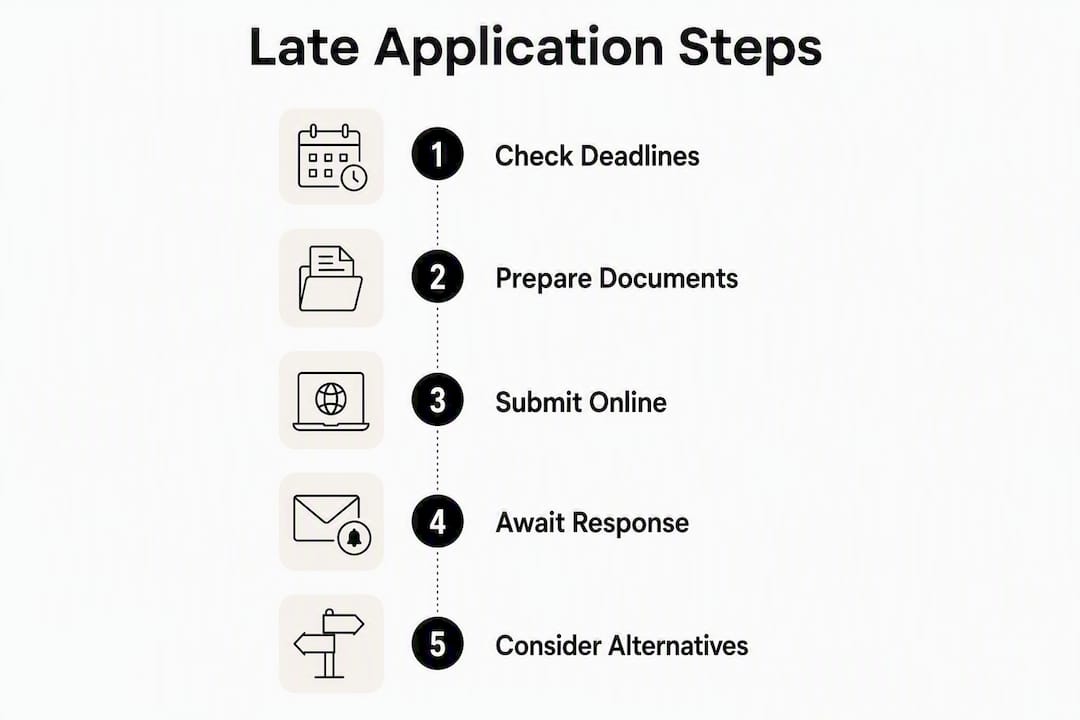
What do late application windows look like at each university?
The table below covers the seven must-check institutions plus TVET and private college routes. Deadlines and fees change; always verify the “last updated” date on each portal before acting.

| Institution | Late window? | Typical late deadline | Programmes likely open | Late fee | How to apply | Distance study? |
|---|---|---|---|---|---|---|
| UNISA | Yes | Jan 13–27 (Feb intake) | Most undergraduate qualifications; check exclusions per faculty | R135 | unisa.ac.za / admissions portal | Yes — fully distance |
| NMU | Yes | 30 September 2026 (general); 30 June 2026 for MBChB, BPharm, BRad, Nursing | General degrees and diplomas (selective programmes excluded) | Check portal | mandela.ac.za / NMU on Asksmarty | No |
| UP | Check portal | Check portal | Selected faculties only | Check portal | up.ac.za/online-application / UP on Asksmarty | No |
| UCT | Limited | Check portal | Non-competitive programmes only | Check portal | uct.ac.za admissions | No |
| NWU | Check portal | Check portal | Selected programmes | Check portal | nwu.ac.za admissions | Partial (distance campus) |
| UL | Check portal | Check portal | Selected programmes | Check portal | ul.ac.za / UL on Asksmarty | No |
| UFH | Check portal | Check portal | Selected programmes | Check portal | ufh.ac.za admissions | No |
| TVET colleges | Yes | Rolling — often through March or April | N-programmes, vocational diplomas, artisan qualifications | Varies by campus | Walk in or check campus portal | No |
| Private colleges | Yes | Rolling | Diplomas, certificates, short courses | Varies | Check each college’s portal | Varies |
Pro Tip: Always screenshot the page showing the deadline and the “last updated” date. If a portal changes its information after you apply, that screenshot is your evidence.
NMU’s published deadlines are among the clearest in the country: 30 June 2026 for MBChB, BPharm, BRad, and Nursing; 30 September 2026 for general late applications, with specific programme exclusions noted on the admissions page. Use those dates as your anchor when planning.
How do you actually submit a late application?
Speed is the single biggest factor. Successful late applicants have all documents ready and act the moment a window opens — delays of even a few hours can cost a place, especially at contact universities where seats are counted in the dozens.
Step-by-step process:
- Monitor portals and set alerts. Bookmark the admissions page for every target institution. Set a browser alert or calendar reminder to check daily from early January. For UJ specifically, the late enquiry system is online-only and typically runs for around five days — no walk-ins are accepted.
- Prepare your documents before the window opens. Do not wait until you see a window to start gathering paperwork.
- Complete the portal application form. Most institutions use their own online portal; a few still accept email submissions. Read the instructions on the portal carefully — some require you to upload all documents in a single PDF.
- Pay the application fee immediately. Keep the payment confirmation. EFT, bank deposit, and online card payments are the most common options. Upload proof of payment as part of your application, not as a follow-up.
- Screenshot everything. Capture the submission confirmation page with a visible timestamp. Save it to at least two devices or cloud storage.
- Follow up within 24–72 hours. If your portal status shows “pending” after two days, call or email the admissions office. Sitting quietly is how late applicants get passed over.
Documents checklist:
- Certified copy of your South African ID (or passport for international applicants)
- Certified matric certificate or official statement of results
- Proof of residence (not older than three months)
- Academic transcripts (for transfer students)
- Proof of application fee payment
- SAQA evaluation certificate (for foreign qualifications)
- NBT results where required (check per faculty)
For e-certified documents, most institutions now accept digitally certified copies uploaded directly to the portal. Check whether your target university specifies a certification method — some still require a commissioner of oaths stamp on physical copies for certain documents.
See Asksmarty’s full application guide for a complete document preparation checklist and APS calculation instructions.
Which programmes are realistically open — and which are not?
Programmes that commonly remain open during late windows:
- Distance-learning undergraduate degrees and diplomas (UNISA across most faculties)
- Education and humanities degrees at several contact universities
- Business and commerce diplomas at universities of technology
- TVET N-programmes, vocational qualifications, and artisan training
- Private college diplomas and certificate courses
- Some science and social science programmes at regional universities
Programmes that are almost always closed to late applicants:
- MBChB (medicine) and all health sciences with professional council quotas
- BPharm, BRad, and Nursing at most institutions
- LLB at highly competitive law faculties
- Architecture, fine arts, and other portfolio-based programmes
- Any programme that was already oversubscribed at the main deadline
If your target programme is closed, the most practical alternatives are: a related diploma at a TVET or university of technology that feeds into your intended career, a bridging or foundation course that qualifies you for the full degree in 2027, or UNISA’s July intake for distance-learning degrees. Private colleges with SAQA-recognised qualifications are a legitimate route for many fields, particularly business, IT, and design.
Before committing to any alternative, confirm the programme is registered on the National Qualifications Framework (NQF) via the SAQA database. A qualification that is not SAQA-recognised will not count toward professional registration or postgraduate study.
What do late application fees look like — and are there concessions?
Fees vary significantly. UNISA charges R135 for a late application, which is among the lowest in the sector. DUT’s published late fee is R470 for applicants who did not submit a CAO application. Most contact universities charge between R100 and R500 for late submissions, though some waive the fee entirely for applicants who applied on time through the main cycle and are simply being reconsidered.
A significant number of students secure places through late applications each year, with success odds higher at TVETs and private colleges than at selective contact universities.(https://www.edufunds.co.za/late-university-applications-south-africa-2026/). Success rates are considerably higher at TVETs and private colleges than at selective contact universities. That figure reflects how real the late-application route is — but it also means competition for the available seats at popular institutions is genuine.
Fee concessions and waivers:
- NSFAS applicants: some institutions waive or defer the late application fee for students with confirmed NSFAS eligibility. Check the specific institution’s financial aid office.
- Documented financial hardship: a few universities accept a written motivation with supporting documents for a fee waiver. This is not guaranteed and varies by institution.
- Transfer students: some institutions treat internal transfers differently from new late applicants and may not charge a late fee.
Payment tips:
- Pay by online card or EFT for instant proof of payment.
- Bank deposits can take 24–48 hours to reflect — use them only if the portal allows pending payment confirmation.
- Upload your proof of payment at the same time as your application, not afterward.
For a full breakdown of which institutions charge fees and which offer concessions, the Asksmarty application fees guide covers the current fee landscape across South African universities.
NSFAS timing note: NSFAS typically accepts late funding applications up to a cut-off — reported as 28 February 2026 for the current cycle. If you receive a late offer after that date, contact NSFAS directly to confirm whether your funding application can still be processed.
What happens after you submit a late application?
Most portals move through three statuses: pending review, provisionally accepted, and accepted. The gap between submission and a decision can be as short as 48 hours at institutions running a rolling late list, or as long as two weeks at larger contact universities.
Realistic timeline:
- Days 1–3: Application logged; portal shows “pending.”
- Days 3–7: Initial review; some institutions send an automated acknowledgement.
- Days 7–14: Decision communicated by email or portal update. Check daily.
- Within 48–72 hours of a provisional offer: respond and pay any registration deposit. Provisional offers at late-application stage expire fast.
Conditional offers are common. You may be offered a place contingent on final matric results, a specific subject pass, or submission of an outstanding document. Meet every condition by the stated deadline — missing a conditional requirement is the most common reason late acceptances fall through.
If you receive no offers after two weeks, do not wait. Apply to a TVET college (walk-in applications are still accepted at many campuses through March), register for UNISA’s July intake, or enrol in a bridging course that qualifies you for a 2027 start. Reapplying in the main 2027 cycle with a stronger application is a better outcome than a gap year with no plan.
Track your application status across multiple institutions using Asksmarty’s application status checker.
Why distance learning and TVETs are often your best late-stage bet
Distance learning and TVET colleges are not consolation prizes. For a late applicant, they are often the most practical and fastest route to a qualification.
UNISA advantages for late applicants:
- Largest student body in Africa, with capacity that contact universities cannot match
- Multiple intake periods (February and July) give you two genuine entry points per year
- Fully distance-based, so there are no accommodation or relocation costs
- R135 application fee is among the lowest available
- Wide programme range across most faculties
UNISA trade-offs: Self-directed study requires strong time management. Support services exist but are not as immediate as a contact campus. Some professional programmes still have limited intakes.
TVET colleges:
- Walk-in applications accepted at many campuses, often through March or April
- First-come, first-served intake means speed matters more than a perfect academic record
- Practical, vocational programmes with direct career pathways
- Higher late-stage acceptance odds than any traditional university
Accreditation check — do this before you enrol:
| Check | What to verify |
|---|---|
| NQF registration | Programme listed on SAQA’s NQF database |
| DHET registration | Institution registered with the Department of Higher Education |
| Professional body recognition | Required for engineering, health, education, and law |
| Credit transfer rules | Whether credits count toward a future degree |
Private colleges with SAQA-recognised qualifications sit between TVETs and traditional universities in terms of flexibility. Many offer rolling intakes and accept late applicants well into February. Check the Asksmarty private colleges directory for a list of registered institutions and their programmes.
How Asksmarty helps you find open programmes fast
Finding a programme you qualify for, that is still open, and that fits your career goals — all at the same time — is the hard part of a late application. Asksmarty is built specifically for that problem.
What the tool does:
- Enter your matric marks on-device; they never leave your device or get stored anywhere.
- The APS calculator instantly shows which programmes you meet the minimum requirements for.
- Filter the programme database (over 1,700 programmes) by institution, faculty, deadline status, and study mode.
- Each programme listing links directly to the official university portal so you can apply without an intermediary.
- University-specific late-application pages (for example, UNISA and NMU) show deadline status and programme exclusions in one place.
Pro Tip: Use the career-interest quiz on Asksmarty before filtering by deadline. It takes three minutes and often surfaces programme options you would not have considered — which matters when your first-choice programme is closed.
Asksmarty does not submit applications on your behalf. It is an information and matching tool. Once you identify a programme, you apply directly through the university’s official portal. That keeps the process clean, fast, and fully under your control.
Key takeaways
Late applicants who act immediately, with documents ready, and who target realistic institutions have a genuine chance of securing a 2026 place — UNISA, TVET colleges, and selected universities of technology are the most accessible routes.
| Point | Details |
|---|---|
| Check portals now | Visit UNISA, NMU, and your target universities today; note the “last updated” timestamp on every deadline page. |
| Documents ready before the window | Certified ID, matric results, proof of residence, and proof of payment must be ready to upload the moment a window opens. |
| Selective programmes are closed | MBChB, BPharm, BRad, and Nursing are excluded from late windows at most institutions; target general degrees, diplomas, or TVET qualifications instead. |
| NSFAS has its own deadline | NSFAS late funding applications had a reported cut-off of 28 February 2026; confirm directly with NSFAS if you receive a late offer. |
| Use Asksmarty to match fast | Asksmarty’s APS calculator and programme database help you find eligible, open programmes and link directly to official portals — free, private, and no application processing. |
An admissions advisor’s perspective on late applications
The biggest mistake late applicants make is treating the late window like a second main application cycle. It is not. Seats are counted in single digits at most contact universities, and the institutions that do reopen are doing so to fill specific gaps — not to accommodate everyone who missed the deadline.
What actually works: having every document certified and ready before you even know a window is open. The applicants who secure late places are almost always the ones who submitted within the first few hours. A provisional offer at this stage expires faster than most students expect — respond within 48 hours, not 48 days.
The other thing most guides understate is the value of applying to multiple institutions simultaneously. Do not put everything on one university. Apply to UNISA, apply to a TVET, and apply to your preferred contact university at the same time. If the contact university comes through, great. If not, you have not lost weeks waiting.
One more thing: if every late window closes before you get a place, that is not the end. UNISA’s July intake, a bridging course, or a TVET qualification that feeds into your intended career are all legitimate paths forward. A 2027 start with a stronger application and a clear plan beats a rushed 2026 enrolment in a programme that does not fit.
Asksmarty makes finding open programmes faster
Sorting through late-application portals across a dozen institutions, cross-referencing your APS score against each programme’s requirements, and tracking which deadlines have already passed — that is the actual work of a late application, and it takes time you do not have.
Asksmarty cuts that process down significantly. Enter your marks once (privately, on your own device), and the platform immediately shows you which of its 1,700+ listed programmes you qualify for, filtered by deadline status and study mode. Each result links directly to the official university portal so you can apply without going through an intermediary. University-specific pages for UNISA, NMU, UL, and others show late-window status, fee details, and programme exclusions in one place.
Check your APS score and eligible programmes now, then browse the full university and college directory to find institutions still accepting applications. Asksmarty is free to use and does not process or submit applications — your data stays on your device.
Useful sources
These are the official and authoritative pages used to confirm the information in this guide. Check each one directly for the most current deadlines and programme exclusions.
- Nelson Mandela University — Academic Admissions: Official NMU admissions page with 2026 deadline dates for selective and general programmes. Check the programme exclusions list before applying.
- University of Pretoria — Online Application: UP’s application portal; verify late-window status and faculty-specific rules directly.
- EduFunds SA — Late university applications 2026: Practical guide covering competitiveness, NSFAS timing, and document checklists.
- DUT — Late applications PDF: Official DUT document listing late-application programmes and the R470 late fee for 2026.
- Asksmarty — Universities directory: Searchable index of South African universities and colleges with deadline status and programme links.
Verify before you rely: every deadline page can change. Always check the “last updated” timestamp and contact the admissions office directly if a date is unclear.
FAQ
Which SA universities are still open for late applications?
UNISA, NMU (until 30 September 2026 for general programmes), and several universities of technology including DUT typically accept late applications. TVET colleges are the most consistently open, with many campuses accepting walk-ins through March or April.
Can I still apply late for 2026 if I missed the main deadline?
Yes, for certain institutions and programmes. Distance-learning universities like UNISA and most TVET colleges are your most accessible options; selective contact universities have very limited or no late availability.
Which programmes are excluded from late application windows?
MBChB, BPharm, BRad, and Nursing are excluded from late windows at most universities, including NMU. Any programme with a professional council quota or that was oversubscribed at the main deadline is unlikely to reopen.
Does NSFAS still apply if I get a late offer?
NSFAS late funding applications had a reported cut-off of 28 February 2026 for the current cycle. If you receive a late offer after that date, contact NSFAS directly to confirm whether your funding can still be processed.
How do I find programmes I qualify for that are still open?
Use Asksmarty’s APS calculator to check your score, then filter the programme database by deadline status and study mode to find open options that match your marks.
Recommended
Published 2026-08-05 · AskSmarty is an independent guide. Confirm anything time-sensitive on the official source.