Mature age exemption in South Africa: who qualifies and how to apply
Discover how to qualify for a mature age exemption in South Africa, ensuring access to a degree. Start your application today!

If you are 23 or older and did not obtain a matriculation endorsement under the old Senior Certificate system, a mature age conditional exemption is the statutory route that allows you to register for a first degree at a South African university. The single most important first step is not filling in any form: it is contacting your chosen university’s admissions office and securing a letter of registration, invitation, or eligibility. Without that letter, the Matriculation Board will not process your application at all.
Three bodies govern this process:
- Universities South Africa (USAf) / Matriculation Board — issues exemption certificates and sets the statutory criteria
- Department of Higher Education and Training (DHET) — publishes the Government Notices (including GN 1226 and its amendments) that give the rules legal force
- University senate / faculty admissions offices — set programme-level APS scores and subject prerequisites that the exemption certificate does not override
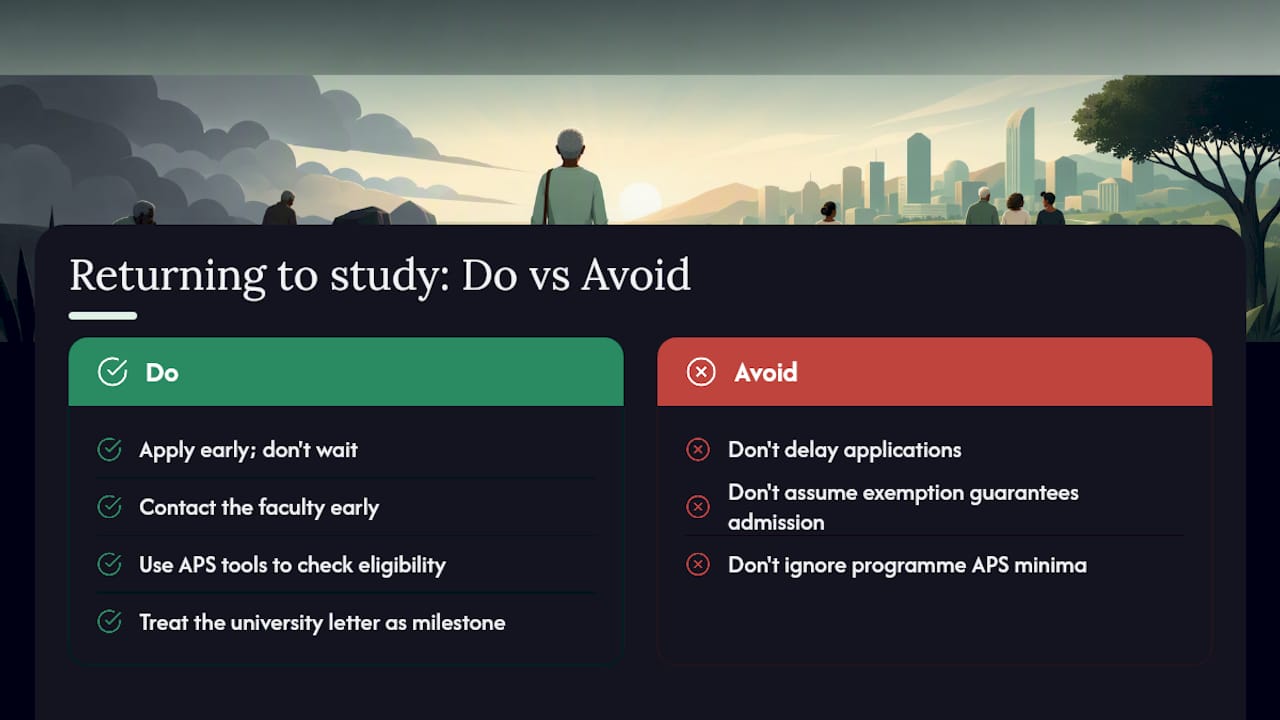
One thing to fix in your mind early: a mature age exemption is a legal gateway, not an admission guarantee. The Matriculation Board confirms that holding an exemption certificate satisfies the statutory requirement for first-degree entry, but every faculty still applies its own selection criteria on top of that.
Key takeaways
A mature age conditional exemption is the statutory route for South Africans aged 23 or older who lack a matriculation endorsement, but securing the university eligibility letter comes before any Matriculation Board application.
| Point | Details |
|---|---|
| Age threshold | You must be 23 or older in your enrolment year; applicants aged 45+ may qualify via senate discretion. |
| First action | Contact your target university for a letter of eligibility before paying any Matriculation Board fees. |
| Certificate validity | A mature age conditional exemption is typically valid for five years and can be renewed. |
| Not an admission guarantee | The exemption satisfies the statutory entry requirement only; programme APS and subject prerequisites still apply. |
| Asksmarty APS calculator | Use Asksmarty’s free calculator to check programme eligibility before starting the Matriculation Board process. |
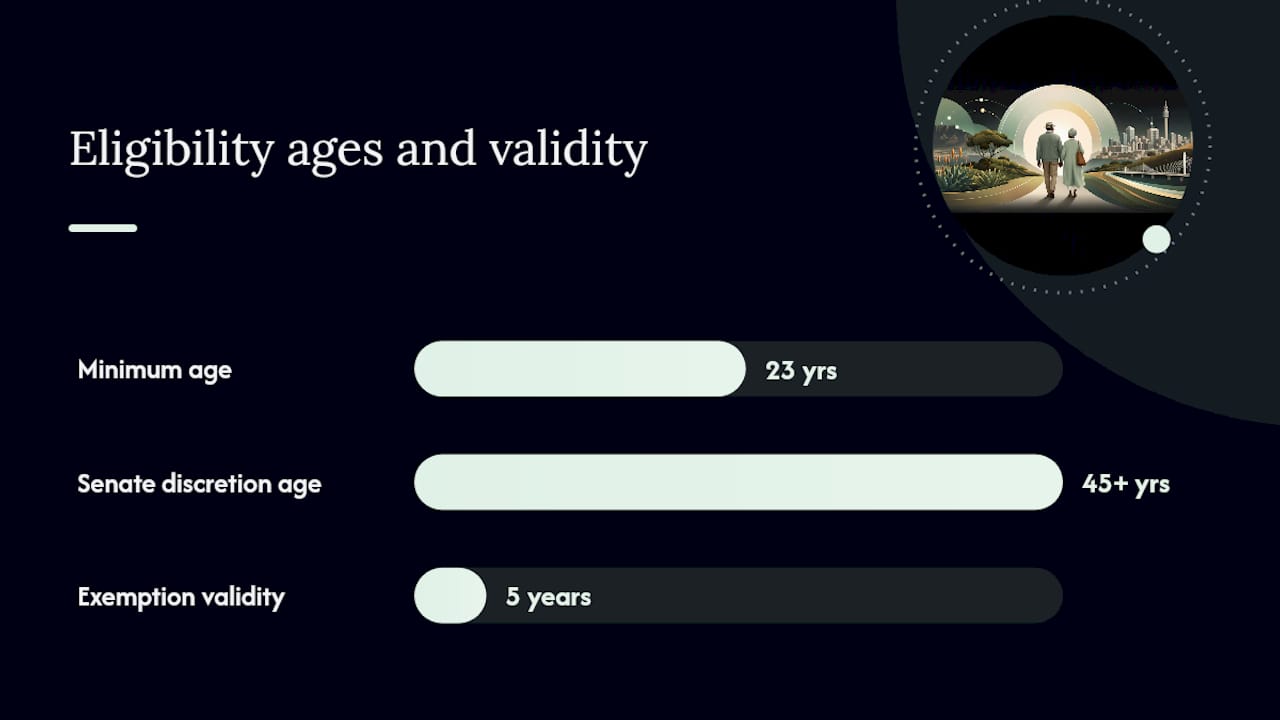
Table of Contents
- What kinds of matriculation exemption exist?
- Who qualifies for a mature age conditional exemption?
- How to apply: the step-by-step process
- How long does the exemption last, and what does it not cover?
- What if you don’t qualify for the mature age exemption?
- How to check which programmes you already qualify for
- Timeline, deadlines, and your document checklist
- Returning to study as a mature student: a realistic perspective
- Asksmarty helps you check your options before you apply
- Sources
- FAQ
What kinds of matriculation exemption exist?
The Matriculation Board issues two broad certificate types:
- Certificate of complete exemption — issued without conditions; the holder meets all statutory requirements for first-degree entry and faces no time limit tied to the certificate itself.
- Certificate of conditional exemption — issued with specified conditions and a defined validity period. Mature age entry falls squarely in this category.
Within conditional exemptions, there are several subtypes:
- Mature age entry certificate — for applicants aged 23 or older who meet the academic minima set out in Paragraph 30 of the regulations. Typically valid for five years and renewable.
- Foreign conditional exemption — for holders of non-South African qualifications; also typically valid for five years.
- Ordinary conditional exemption — often carries a shorter validity, commonly three years.
- Senate discretionary exemption — issued at the discretion of a university senate for applicants who do not meet standard criteria.
The five-year validity on a mature age certificate is worth noting because it gives you a realistic window to sort out programme admission without rushing a re-application.
Who qualifies for a mature age conditional exemption?
Paragraph 30 of the Matriculation Board regulations sets out the statutory criteria. Here is how to self-screen:
- Age threshold — You must have attained the age of 23 before or during the year in which you intend to enrol.
- Minimum academic performance — You must have achieved at least 40% in a minimum of four subjects at Higher Grade (HG) or Standard Grade (SG) level, with at least three of those subjects passed simultaneously in one examination sitting, and at least one of the four must be a recognised HG subject.
- Timing rule — The regulations reference a March 31 cut-off in relation to passing requirements; confirm the exact applicable date with the Matriculation Board for your enrolment year.
- Senate discretionary clause (age 45+) — If you are 45 or older, a university senate may issue an exemption regardless of whether you meet the formal academic minima. This is discretionary, not automatic, and the senate of your target institution must agree.
The regulatory language itself is worth reading directly:
If you are between 23 and 44, you must meet the academic minima. If you are 45 or older, the senate discretionary route is open, but you still need to approach the university first and ask whether they are willing to exercise that discretion for your application.
How to apply: the step-by-step process
Most universities apply to the Matriculation Board on your behalf once you have their institutional letter. That arrangement reduces certification and payment errors significantly. Here is the full sequence:
- Contact your chosen university’s admissions office and request a letter of registration, invitation, or eligibility. Confirm whether the university will submit the application on your behalf or whether you must apply directly.
- Complete the online assessment on the Matriculation Board portal if required for your application type. The Board uses this to verify eligibility before processing.
- Pay the non-refundable application fee and retain proof of payment. Do not pay before you have the university letter; a returned application does not trigger a refund.
- Gather correctly certified copies of all required documents (see the document checklist in the timeline section below). Certification must be done by an approved authority.
- Submit the M30 application form along with your certified documents, proof of payment, and the institutional letter — either directly to the Matriculation Board or through your university’s admissions office.
Acceptable certifiers are specific and non-negotiable. The Matriculation Board accepts certification only from:
- A Notary Public
- The Registrar of a South African public higher education institution
- An admitted attorney or advocate
- A South African embassy or high commission (for applicants abroad)
Standard commissioners of oaths are commonly rejected. This is one of the most frequent reasons applications are returned.
Pro Tip: Secure the university letter before you pay anything. The fee is non-refundable, and if your application is returned for a missing letter or incorrect certification, you lose that money. Confirm the certifier list with the Matriculation Board before you visit any official.
How long does the exemption last, and what does it not cover?
A mature age conditional exemption is typically valid for five years from the date of issue and can be renewed before expiry. Ordinary conditional exemptions often carry a shorter window of around three years, so the mature age certificate gives you more flexibility.
Key limitations to understand:
- Institution-specific — The certificate is issued for one named institution. If you change your target university, you will likely need an amended certificate and may face additional fees. Decide on your institution before submitting.
- Not an admission guarantee — The Matriculation Board is explicit that an exemption satisfies the statutory requirement for first-degree entry only. Faculty and programme selection criteria, including minimum APS scores and specific subject prerequisites, still apply independently.
- Renewal requires early action — Do not wait until the certificate expires. Contact the Matriculation Board before the five-year period ends to initiate renewal.
Warning: The application fee is non-refundable. Before submitting, confirm with your target faculty that you meet the programme-level APS and subject requirements. An exemption certificate that arrives after an application deadline, or for a programme whose APS you do not meet, cannot be refunded or transferred.
Check programme-level admission requirements for your chosen degree before you spend money on the exemption process.
What if you don’t qualify for the mature age exemption?
Not meeting the Paragraph 30 academic minima is not the end of the road. Several alternative routes exist:
- Recognition of Prior Learning (RPL) — Universities assess your work experience, professional training, and informal learning against the outcomes of a qualification. You typically need a portfolio of evidence and may sit a competency assessment.
- Foundation and access programmes — Many South African universities offer year-long bridging courses that lead directly into a degree. Completing one satisfies the entry requirement for the linked degree programme without needing a Matriculation Board exemption.
- University-specific special admission schemes — Some institutions have their own mature student or non-standard entry pathways governed by senate rules rather than the Matriculation Board.
- Senate discretionary entry (age 45+) — As noted above, if you are 45 or older, a senate may admit you at its discretion even without the formal academic minima.
Next steps if you do not qualify:
- Contact the admissions office of your target university and ask specifically about RPL, foundation programmes, and mature student entry schemes.
- Research foundation programmes at institutions like UNISA, which offers distance-learning options suited to working adults. The UNISA prospectus lists current access and foundation offerings.
- Begin assembling an RPL portfolio: gather employment records, professional certificates, training records, and any formal short courses.
- Consider registered private colleges as a stepping stone. Asksmarty’s private colleges directory lists accredited options with their entry requirements.
How to check which programmes you already qualify for
Before spending time and money on a Matriculation Board application, run a quick APS check. Your Admission Point Score is calculated from your six best matric subjects, and every South African university programme publishes a minimum APS alongside specific subject requirements.
Here is how to use the check effectively:
- Enter your matric marks into the Asksmarty APS calculator. Your marks are processed locally on your device and never stored or shared.
- Select your subjects accurately, including Life Orientation (which most universities exclude from the APS calculation, but Asksmarty handles this automatically).
- Review the programme matches the tool returns. Each result shows the minimum APS, required subjects, and the university’s application deadline.
- Note the gap between statutory exemption and programme admission. An exemption tells the Matriculation Board you can register for a degree in principle. The APS check tells you which specific degrees you actually qualify for at which institutions.
Pro Tip: If your APS meets a programme’s minimum but you are borderline, contact the faculty directly and ask about provisional acceptance. Some faculties issue a conditional offer that you can use as the institutional letter the Matriculation Board requires.
Once you have a shortlist of programmes, check the specific university admission requirements page on Asksmarty for APS breakdowns, NSC pass requirements, and NBT details by institution.
Timeline, deadlines, and your document checklist
Processing times at the Matriculation Board vary, but plan for several weeks from submission to certificate issue. Apply as early as possible in the year preceding your intended enrolment, not in the same month you want to register.
Key timing markers:
- Secure the university letter — Do this first, ideally six to nine months before your target enrolment date.
- Certify your documents — Allow time to locate an approved certifier (Notary Public, university Registrar, admitted attorney/advocate, or SA embassy abroad). Standard commissioners of oaths are not accepted.
- Submit to the Matriculation Board — Well before the university’s own application closing date, since the exemption certificate must be in hand before the university can finalise your admission.
- March 31 reference — The regulations reference March 31 in relation to the passing requirements for the mature age route. Confirm with the Matriculation Board whether this date affects your specific application year.
Documents you must prepare:
- South African ID, passport, or birth certificate (certified copy)
- All school leaving certificates and academic transcripts (certified copies)
- Sworn translations of any documents not in English
- University letter of registration, invitation, or eligibility
- Proof of payment of the non-refundable application fee
- Completed M30 application form
Scanned copies are not sufficient for the final certificate process. Physical certified copies are required. If any of your qualifications are in a language other than English, arrange sworn translations through a certified translator before submitting, as the Matriculation Board specifies that only correctly certified translations are accepted.
Returning to study as a mature student: a realistic perspective
There is a gap between what the mature age exemption process looks like on paper and what it actually feels like to navigate it at 30, 40, or 50 while holding down a job and a family. The bureaucratic steps are manageable, but the emotional weight of re-entering formal education after years away is real and often underestimated.
The most common mistake mature applicants make is not the wrong form or the wrong certifier. It is waiting. They spend months deciding whether they are “ready,” whether the programme is the right one, whether the timing is good. By the time they act, the university’s application window has closed, and they lose another year.
The statutory rules actually favour older applicants more than most people realise. The 45-year senate discretionary clause means that if you are in that age bracket, a university senate can admit you without any formal academic record at all. That is a significant provision, and it goes largely unmentioned in most guides. Even below 45, the academic minima in Paragraph 30 are not as demanding as a full matric endorsement. The system was designed to be accessible.
What the system cannot do is guarantee you a place in a competitive programme. A BCom Accounting at a research-intensive university has an APS minimum that the exemption certificate does not touch. Know the difference between the statutory gateway and the programme selection hurdle before you start. Use the APS tools, contact the faculty early, and treat the university letter as your first real milestone, not the exemption certificate itself.
Asksmarty helps you check your options before you apply
Before you approach the Matriculation Board, the most useful thing you can do is know exactly which programmes your marks already qualify you for. Asksmarty’s free APS calculator runs that check instantly, matching your marks against over 1,700 programmes across South African universities and colleges. Your marks never leave your device.
From there, the universities and programmes directory lets you filter by institution, faculty, and deadline, so you can identify which university to approach for your eligibility letter and confirm whether a foundation programme or RPL route might be a faster path than the Matriculation Board process. Every listing includes official application portal links, current deadlines, and fee details. Run the APS check first, then contact your target university’s admissions office with a clear picture of where you stand.
Sources
The following primary sources contain the authoritative rules and application guidance. Bookmark them and refer back when completing your application:
- Exemption Process | Matriculation Board
- Facilitating entry to SA universities - Universities South Africa
FAQ
Who qualifies for the mature age exemption?
Any South African applicant who has attained the age of 23 before or during their intended enrolment year and meets the academic minima in Paragraph 30 qualifies for the standard mature age route. Applicants aged 45 or older may qualify through senate discretion even without meeting the formal academic requirements.
What does a mature age exemption actually mean?
It is a statutory certificate issued by the Matriculation Board confirming that you meet the legal requirement for first-degree entry at a South African university. It does not guarantee admission to any specific programme; faculty selection criteria still apply separately.
How do I apply for a mature age exemption online?
Start by contacting your chosen university’s admissions office for an eligibility letter, then complete the Matriculation Board’s online assessment, pay the non-refundable fee, and submit the M30 form with correctly certified documents. Most universities apply on your behalf once you have the institutional letter.
Does the exemption expire?
A mature age conditional exemption is typically valid for five years from the date of issue and can be renewed. It is issued for one named institution; changing universities usually requires an amended certificate and additional fees.
What if I don’t meet the Paragraph 30 academic requirements?
You can pursue Recognition of Prior Learning (RPL), enrol in a foundation or access programme, or ask your target university whether a senate discretionary entry scheme applies to your situation. Asksmarty’s programme finder lists foundation programmes and their entry requirements across South African institutions.
Recommended
Published 2026-08-16 · AskSmarty is an independent guide. Confirm anything time-sensitive on the official source.