APS 38 and Beyond: Medicine Entry Requirements in South Africa
Practical breakdown of South African medicine entry requirements: APS calculation (SMU's APS 38 example), required tests and documents, MBChB timeline,...

You need a National Senior Certificate bachelor’s pass with top marks in English, Mathematics, and Physical Science or Life Sciences, plus an Admission Point Score most medical schools rank against, not just clear. Meeting the stated minimum rarely secures a place by itself. Your two immediate moves: pull up your target university’s official medicine entry page, then run an APS check with a tool like the AskSmarty calculator to see where you actually stand.
TL;DR:
- Most South African medical schools require high percentages in English, Mathematics, Physical Science, and Life Sciences, with no standard national APS cutoff, but application competitiveness depends on year-specific thresholds.
- Your APS for medicine is calculated using your top six subject percentages on a seven-point scale, with accurate input crucial to assess your true standing.
- Final medical school selection involves both academic ranking and additional criteria like interviews, contextual measures, and proof of clinical or volunteer experience.
- Application deadlines for medicine are set earlier than general university closing dates, and requiring early booking for tests like the National Benchmark Tests is essential to avoid disqualification.
- Alternative routes into medicine include retaking subjects, completing a related degree and applying as a graduate, or participating in bridging programs, especially if initial APS or subject results are below thresholds.
Table of Contents
- What are the academic requirements for medicine in South Africa?
- How do you calculate your APS for medicine?
- How does medical school selection actually work?
- What documents and tests do you need before applying?
- How long does it take to qualify as a doctor?
- How can you strengthen your application beyond your marks?
- Do you need IELTS or TOEFL for a South African medical degree?
- What health and character checks apply to medical students?
- Are there alternative routes into medicine if you don’t meet the standard criteria?
- Do extracurricular activities and work experience matter for medicine applications?
- What I’d tell my own child applying for medicine
- Check what you qualify for before you apply anywhere
- Sources
- FAQ
What are the academic requirements for medicine in South Africa?
Every MBChB programme in South Africa builds its selection around four subjects: English, Mathematics, Physical Science, and Life Sciences. You need a National Senior Certificate bachelor’s pass, which means you have cleared the subject and level combinations that qualify you for degree study, not just a general pass that gets you into any tertiary programme.
Passing isn’t the target. Medical schools rank applicants by actual percentages in those four subjects, and the competition pushes those percentages high.
- English: usually a strong Home Language or First Additional Language result, often in the 60s or higher.
- Mathematics: pure Mathematics only. Mathematical Literacy will not get you considered.
- Physical Science: expected at a high percentage, frequently in the same range as English and Maths.
- Life Sciences: weighted heavily alongside Physical Science at most schools.
Sefako Makgatho Health Sciences University illustrates how concrete this gets: it pre-selects Grade 11 students for MBChB using a minimum APS of 38, factoring in English, Life Sciences, Physical Science, and Mathematics specifically. Other universities set their own subject percentage floors or APS cut-offs, and those numbers move year to year depending on applicant volume. There is no single national threshold for “subjects needed for medicine.” Each school publishes its own version, and you have to check the current one before you build a study plan around outdated numbers.
How do you calculate your APS for medicine?
The Admission Point Score converts your matric percentages into points, usually on a seven-point scale per subject, then adds them up across your best subjects. Most universities use your top six subjects, though the exact formula, including whether Life Orientation counts, varies by institution.
Here’s a simplified worked example using a common seven-point scale:
- English at 75% typically scores 7 points.
- Mathematics at 68% typically scores 6 points.
- Physical Science at 72% typically scores 6 points.
- Life Sciences at 70% typically scores 6 points.
- Two more subjects at similar levels might add another 12 to 13 points combined.
Add those up and you land somewhere in the high 30s to low 40s, which is roughly the zone competitive medical schools expect.
Three things trip students up every year. First, some universities exclude Life Orientation from the APS calculation entirely, while others include it at a capped weighting. Second, “Mathematics” always means pure Maths for medicine applicants, never Mathematical Literacy, regardless of how the APS scale treats it generically. Third, subject substitutions (swapping in a different science) are rarely accepted for medicine even when they’re fine for other degrees.
Rather than guessing, use AskSmarty’s how to calculate APS guide alongside the APS calculator to get an immediate, accurate number based on your own marks.
How does medical school selection actually work?
Selection for medicine happens in phases, and understanding them changes how you plan your Grade 12 year as outlined by the Medical University of South Carolina College of Medicine admissions data, which provides useful context on competitive selection processes. At SMU, pre-selection happens on Grade 11 results, with a minimum APS of 38 required just to be considered provisionally. That provisional offer is not final. You still need to maintain or improve your marks through matric, and final ranking happens on your actual Grade 12 percentages in the core subjects.
Final selection then layers in more than raw academic ranking:
- Universities apply contextual or demographic measures alongside percentage rankings, which means two applicants with similar APS scores can receive different outcomes based on quota considerations.
- Some schools use interviews or additional tests as part of final selection, particularly where applicant numbers far exceed available seats.
- Selection committees at medical schools generally look for evidence of critical thinking and the ability to work in teams, not just top scores. The University of Pretoria’s outcomes-based curriculum design reflects that same expectation for problem-solving ability.
Pro Tip: Don’t relax after a provisional Grade 11 offer. Universities routinely withdraw pre-selection offers from students whose Grade 12 marks drop, so treat your final year as the phase that actually decides your place.
What documents and tests do you need before applying?
Application logistics catch out otherwise strong candidates every year, so treat this as a checklist you start months before the deadline, not the week before it.
- Gather certified copies of your ID document and, once available, your National Senior Certificate or matric exemption certificate.
- Check whether your target university requires the National Benchmark Tests as part of selection. Not every medical school does, but where it’s required, book early since sessions fill up and results take time to process.
- Submit your application through the specific university’s own portal. Unlike some other countries, South African universities generally don’t run a shared centralised application system for medicine, so you apply to each school separately.
- Confirm each medical school’s exact deadline. Medicine programmes routinely close applications far earlier than the general university deadline, sometimes many months in advance.
Missing an NBT booking window or submitting after a medicine-specific cutoff is one of the most preventable reasons strong students get shut out.
How long does it take to qualify as a doctor?
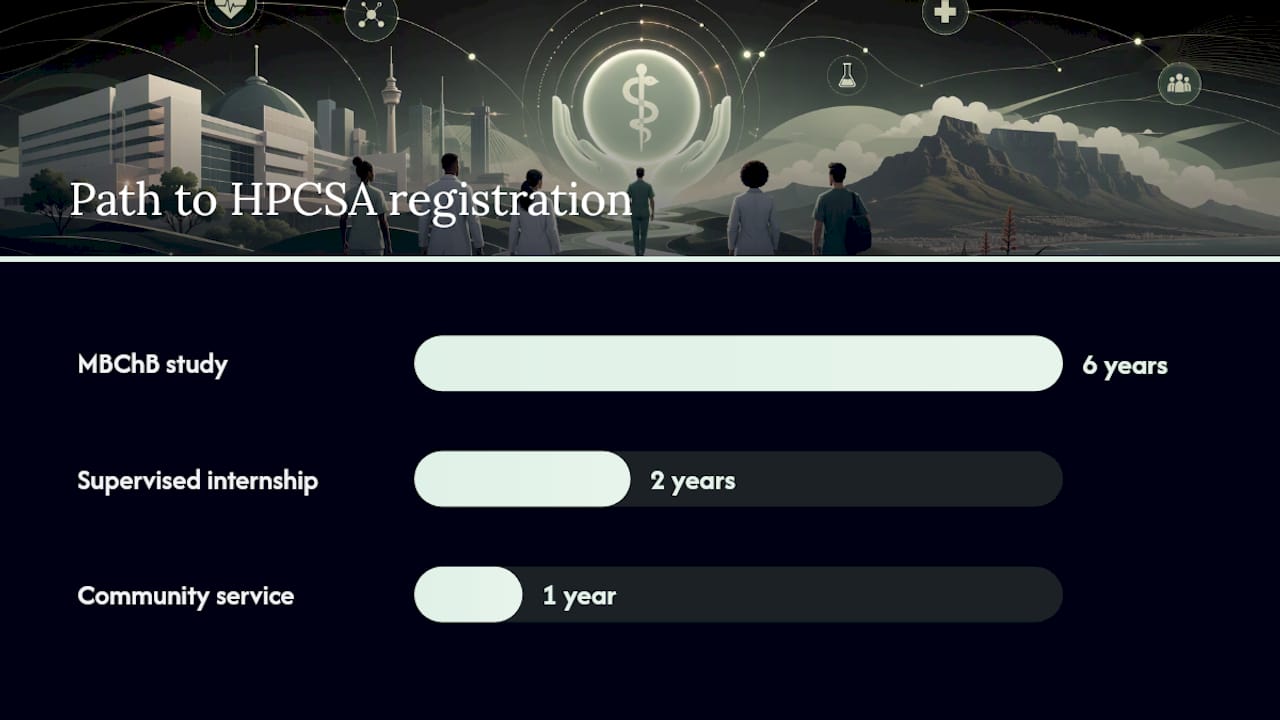
The MBChB is a six-year degree at South African universities. The University of Pretoria’s programme reflects the standard structure: six years of study followed by a two-year internship and one year of community service before you can register independently with the Health Professions Council of South Africa.
That means the realistic timeline from first enrolment to full HPCSA registration is nine years, not six. The internship rotates you through different clinical departments under supervision, and community service typically places you at a public health facility, often outside major cities, to address service delivery gaps. Some universities structure elective placements or research components differently within the six years, so check your specific programme’s curriculum outline rather than assuming every MBChB looks identical.
How can you strengthen your application beyond your marks?
Marks open the door, but universities increasingly want evidence you understand what you’re signing up for. Start building that evidence now, not the week before interviews.
- Push for your highest possible percentages in English, Mathematics, Physical Science, and Life Sciences specifically. A strong overall average with a weak Physical Science mark won’t help you.
- Keep a short, honest log of any voluntary or clinical exposure, clinics, hospices, disability support work, anything that shows sustained contact with people needing care.
- Practise talking through ethical scenarios out loud. Interview panels test how you reason, not whether you have memorised the right answer.
High APS alone doesn’t guarantee a seat. Universities apply contextual and demographic measures on top of academic ranking, which means your marks position you within a pool, not automatically at the front of it.
Pro Tip: Selection committees care more about what you learned from an experience than how many hours you logged. A single well-reflected clinic visit can outweigh a vague list of volunteer hours.
Checking where your specific marks place you across different programmes takes minutes with AskSmarty’s programme finder, and because your marks never leave your device, there’s no data risk in exploring your options honestly.
Do you need IELTS or TOEFL for a South African medical degree?
If English is not your first language and you completed schooling outside South Africa, most universities will ask for proof of English proficiency, typically through IELTS or TOEFL, since medical training and patient interaction depend entirely on strong English communication.
South African universities generally accept an NSC with a strong English Home Language or First Additional Language result as sufficient proof for local applicants. International applicants without an NSC usually need to submit an IELTS score, often around 6.5 or higher on the academic version, or an equivalent TOEFL score, though the exact minimum varies by institution and isn’t standardised nationally for medicine specifically.
This requirement sits separately from your APS and subject requirements. It’s a gate you clear before your academic file even gets ranked, not a factor that adds points to your score. If you’re applying from a South African high school with English as a subject, you almost certainly won’t need to submit a separate language test. If you studied abroad, or completed an international curriculum where English wasn’t the primary instruction language, confirm directly with your target university’s international admissions office what documentation they’ll accept and how far in advance you need to submit it, since language test results can take several weeks to process and older scores sometimes expire before your application deadline.
What health and character checks apply to medical students?
Beyond academics, medical schools run screening that has nothing to do with your matric results but can still stop an application cold if you skip it.
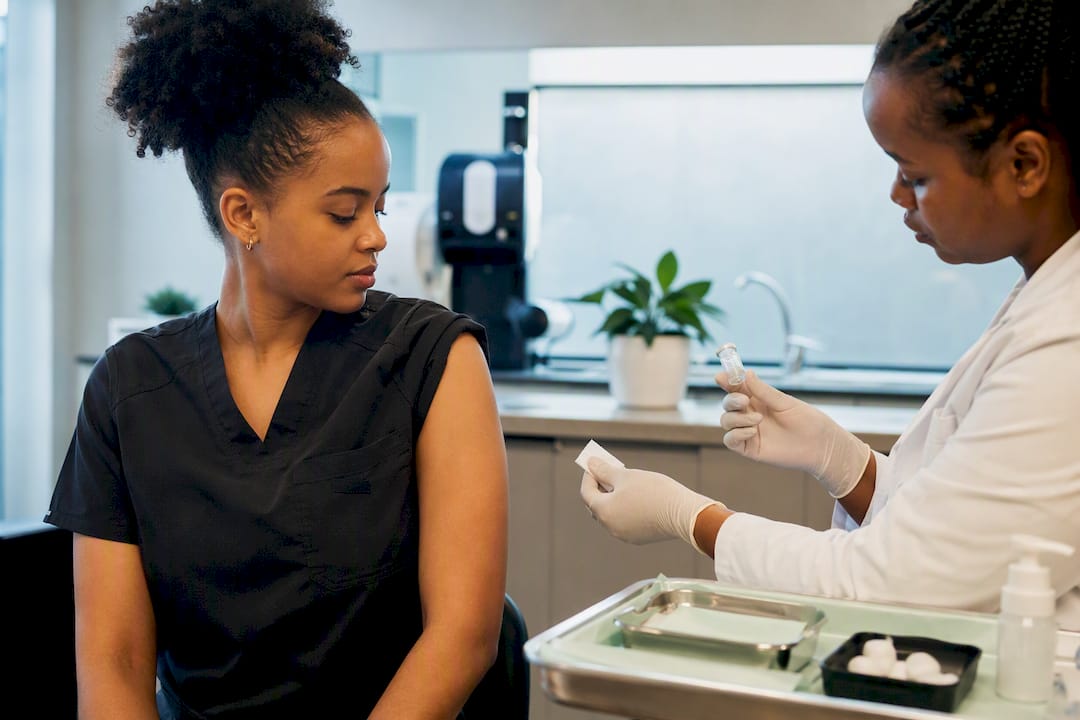
Most South African medical programmes require a medical fitness declaration, sometimes including immunisation records, before you can register, since clinical placements put you in direct contact with patients and infectious material. Universities also frequently request proof of specific vaccinations, hepatitis B being the most common, given the practical exposure students face from early clinical years onward.
Police clearance or a declaration of criminal record checks also feature at many institutions, particularly because clinical training involves placements in hospitals and community health settings where safeguarding matters. This isn’t unique to medicine, but it’s enforced more strictly here than in most other degree programmes because of the vulnerable populations students work with during training.
None of these checks are designed to be obstacles for well-prepared applicants. They exist because a medical degree puts you in clinical environments almost immediately, unlike most other undergraduate programmes where practical exposure comes much later, if at all. The practical takeaway: don’t leave your immunisation records or clearance documentation until the week before registration. Start gathering them once you have a provisional offer, since some checks, particularly police clearance, can take several weeks to process through official channels.
Are there alternative routes into medicine if you don’t meet the standard criteria?
Not meeting the standard APS or subject percentage cutoff in your first attempt doesn’t automatically end your path into medicine, but the alternative routes require patience and, usually, a detour through another qualification first.
Some students rewrite specific NSC subjects to push their percentages higher, particularly in Mathematics or Physical Science, since universities generally accept the improved mark on a valid rewrite. This adds a year but can be the difference between a rejected application and a competitive one.
A more common route is completing a related degree first, often a BSc in a health or biological science, and then applying to medicine as a graduate entrant. Some universities run separate graduate-entry pathways into MBChB with different selection criteria that weigh your degree performance rather than matric results alone. This route typically adds three or more years to your total timeline but suits students whose matric marks don’t reflect their actual academic ability.
Bridging or foundation programmes exist at some institutions for students from under-resourced schools who show strong potential but fall short on the standard subject percentage requirements. These aren’t universal across every medical school, and availability shifts depending on funding and intake capacity each year, so confirm directly with your target university whether such a pathway currently exists rather than assuming it does. If funding is part of what’s holding back your options, NSFAS is the national body to consult on eligibility for financial aid regardless of which pathway you follow.
Do extracurricular activities and work experience matter for medicine applications?
They matter more at the interview and final selection stage than at the initial academic screening, where your subject percentages do almost all the work.
Once you clear the academic threshold, universities want to see that you understand the reality of clinical work, not just that you performed well in the classroom. Volunteering at a clinic, shadowing a healthcare worker, or supporting a disability or aged care facility gives you material to draw on during interviews, where panels commonly ask you to reflect on a specific experience rather than list credentials.
Selection panels tend to value the depth of your reflection over the volume of hours logged. A single meaningful experience you can discuss with genuine insight beats a long list of activities you can barely describe in detail. If you’ve spent time in a hospital ward, a community clinic, or even supporting a family member through illness, think through what that taught you about patience, communication, or the limits of what medicine can fix.
Leadership roles in school, sport, or community organisations also help, mainly because they demonstrate the teamwork and resilience that six years of demanding coursework and clinical rotations require. None of this substitutes for strong marks. But when two applicants sit at similar APS levels, this is often where one gets the interview slot and the other doesn’t.
What I’d tell my own child applying for medicine
Three things, in order: run an APS check against your actual current marks, not the ones you’re hoping for by December. Confirm your target universities’ exact deadlines this week, because medicine cutoffs move earlier than general applications every year. And start a short written log now of any voluntary or health related experience, even one afternoon, so you’re not scrambling to remember details at interview stage.
None of this costs you anything or requires you to hand over your information to anyone. AskSmarty’s tools stay private by design and free to use, and the programme pages go deeper into requirements specific to each school than any general checklist can.
— Nkosi
Check what you qualify for before you apply anywhere
There are online tools that help you avoid manually checking individual university medicine pages one by one. Instead of comparing entry pages across different schools manually, you can enter your marks once, privately, and see which medicine and health science programmes you match.
The APS calculator converts your matric percentages into the score universities use to rank you, so you know where you stand before you spend money on application fees. Your marks never leave your device, and there’s no signup fee or hidden processing cost involved. Once you have your number, head to the programme finder to see the specific medicine and health science courses your APS currently qualifies you for, complete with links through to each university’s official application portal. Run your check today, then use what you learn to decide exactly where to focus your applications.
Sources
- Medicine Undergraduate Admission Requirements | SMU
- Bachelor of Medicine and Surgery MBChB | UP
- MBChB Medicine (A100) - Medical Schools Council
- NBT (National Benchmark Tests)
- NSFAS
FAQ
What is the minimum APS score for medicine?
There’s no single national minimum. SMU pre-selects Grade 11 applicants at a minimum APS of 38, but other universities set their own thresholds, so check each target school directly.
What subjects do you need in Grade 10 to become a doctor?
You need English, Mathematics (pure Maths, not Mathematical Literacy), Physical Science, and Life Sciences carried through to matric, since these are the subjects universities weight most heavily in selection.
Does it take seven years to become a doctor in South Africa?
No. The MBChB itself is a six-year degree, followed by a two-year internship and one year of community service, making the full path to independent HPCSA registration nine years.
How much do doctors earn per month in South Africa?
Public sector doctor salaries are set by government pay scales and vary by grade, specialisation, and years of experience, so figures differ too widely by role to state a single reliable monthly amount here.
Can AskSmarty tell me if I qualify for medicine?
Yes. Enter your matric marks into the APS calculator and the programme finder will show which South African medicine and health science programmes currently match your score.
Recommended
Published 2026-09-07 · AskSmarty is an independent guide. Confirm anything time-sensitive on the official source.