7 steps to a winning motivation letter for South African universities
Step by step guide to write a 300 to 500 word motivation letter for South African universities, with local examples, sample letters, common mistakes,...

A motivation letter for university is a one-page personal statement, typically around 300 to 500 words, that explains why you and only you fit a specific programme. Its job is to connect your marks and experience to the course content and to your reasons for choosing it. Start by spending 20 to 60 minutes researching the actual programme before you write a single sentence.
TL;DR:
- A motivation letter must be highly specific, referencing modules, faculty, or facilities to stand out in competitive South African applications.
- Tailoring each letter for different programmes enhances its impact and avoids the pitfalls of generic, template-like writing.
- Research should inform the letter’s content, including unique programme details, application deadlines, and career goals, to demonstrate genuine interest.
- Clear, concise structure with a personal hook, evidence of suitability, and a confident close is essential within 300 to 500 words.
- Starting early with thorough research and feedback generally leads to stronger, more effective motivation letters.
Table of Contents
- What makes a motivation letter different from an SOP or personal statement
- Why a strong motivation letter matters for admission
- Structure, length, and formatting that actually works
- How to write your letter step by step
- Sample motivation letters to model your own on
- Writing a bursary motivation letter instead of a university one
- Common mistakes and your final pre-submit checklist
- How AskSmarty fits into your application workflow
- Highlighting achievements without sounding like a resume
- Addressing academic gaps or a weak year honestly
- Adjusting tone for different institutions and systems
- Conveying your long-term goals convincingly
- Showing genuine interest in the specific university
- Final proofreading, feedback, and submission steps
- A realistic note on timelines and effort
- Let AskSmarty narrow your list before you write a single letter
- Sources
- FAQ
What makes a motivation letter different from an SOP or personal statement
Universities and colleges in South Africa use several overlapping terms, and confusing them is one of the fastest ways to submit the wrong document. A motivation letter is a focused, one-page argument for why you belong in a specific programme, built around your reasons and your fit with that course. It differs from a cover letter, which typically accompanies a job or internship application and leads with your CV. It also differs from a personal statement, a broader narrative (often used for UK or US undergraduate applications) that covers your whole story rather than one programme’s specific requirements.
Here’s how the documents split in practice:
- Motivation letter: programme-specific, used across most South African university and postgraduate applications, roughly 300–500 words.
- Statement of purpose (SOP): common for postgraduate and research applications, heavier on academic and research goals.
- Cover letter: pairs with a CV for jobs, internships, or work-integrated learning placements.
- Personal statement: broader life narrative, more common in UK-style applications.
European institutions expect a formal, structured academic argument that ties your prior studies directly to the new programme, and tone and structure expectations shift by country. South African universities generally sit closer to this formal end than the more conversational American style, so lean toward structured argument over casual storytelling.
Why a strong motivation letter matters for admission
Admissions staff use the letter to test two things: do you understand the programme, and can you explain why you fit it? A generic letter that could apply to any degree at any institution signals the opposite of both.
Specificity is the single biggest differentiator. Naming a module, a lecturer’s research focus, or a particular lab or facility shows you’ve done the legwork, and vague claims about “always loving science” get filtered out fast in programmes with more applicants than seats.
Programmes at institutions like the University of Cape Town or Stellenbosch University routinely receive far more applications than available places, particularly in health sciences, engineering, and commerce. A letter that reads as tailored rather than templated carries real weight when a selection committee is working through a stack of similar academic records.
Structure, length, and formatting that actually works
A motivation letter should be concise, typically one page and around 300 to 500 words, never a repeat of your CV in paragraph form. Structure it like a short, formal argument rather than a free-flowing essay.
The standard shape looks like this: a formal header, a salutation addressed to a named person where possible, an introduction with a hook, two to three body paragraphs, and a clear conclusion, a format supported by career guidance from Tilburg University. Each part carries a specific job:
- Header: your name, contact details, date, and the programme name (avoids any mix up if you’re applying to more than one course).
- Salutation: “Dear Dr. [Surname]” or “Dear Admissions Committee” if no named contact exists.
- Opening hook: one specific, personal detail that explains your interest, not a generic sentence about passion.
- Body paragraph 1: academic or experience evidence that supports your fit.
- Body paragraph 2: programme-specific fit, naming modules, staff, or facilities.
- Body paragraph 3 (optional): future goals and how the programme gets you there.
- Conclusion: a short, confident close that restates your fit and thanks the reader.
Keep formatting plain: a standard font like Arial or Times New Roman at a clear readable size, single-page PDF, and a file name like “Surname_Firstname_MotivationLetter_ProgrammeName.pdf” so it’s instantly identifiable if printed or forwarded.
Pro Tip: If you can’t find a named admissions contact on the university’s website, “Dear Admissions Committee” is safer than guessing a title or name incorrectly. A wrong name is worse than no name.
How to write your letter step by step
Writing a motivation letter well is less about talent and more about following a sequence. Skipping the research stage is the single most common reason letters read as generic.
1. Research the programme properly. Before drafting anything, record five specific details:
- The exact module names in years two and three, not just the general degree title.
- One or two faculty members whose research or teaching focus interests you.
- Career outcomes graduates typically pursue.
- Any unique facility, lab, partnership, or exchange programme tied to the course.
- The application deadline and any required supporting documents.
The AskSmarty programme search is a fast way to pull module names and faculty details for South African universities and colleges without digging through separate prospectuses one by one.
2. Draft your hook first. Admissions officers respond to a personal, specific opening far more than a generic line like “I have always been passionate about medicine.” Instead, start with a concrete moment or detail that shows genuine interest, something you did, saw, or built that led you here.
3. Build your body paragraphs from your research notes. Convert each research item into evidence. If you noted a specific module on renewable energy systems, connect it to a school project or personal experience that shows why that exact content matters to you. Don’t just say you’re interested. Show the line from your past to that module.
4. Tailor every sentence to the specific programme. This is where most reused letters fail. If you’re applying to three programmes, you need three letters with genuinely different body paragraphs, not one template with the university name swapped out. Reference specific staff, modules, or research areas each time.
5. Edit for word count and CV repetition. Cut anything that just restates your CV or transcript. The letter’s job is to interpret your experience, not list it again. Read each paragraph and ask: does this explain “why,” or does it just repeat “what”? If it’s the second, rewrite it.
6. Get feedback before finalizing. Ask a teacher, a school career counsellor, or a peer who writes well to read it cold, without you explaining anything first. If they can’t tell what programme you’re applying to after one read, the letter needs more specificity, not more length.
7. Finalise and check formatting. Confirm file naming, page count, and any programme-specific submission instructions (some ask for a PDF attachment, others want text pasted into an online form).
Realistically, budget four to six weeks per letter if you’re applying to more than one programme and want each one properly personalised rather than rushed.
Sample motivation letters to model your own on
These two examples are short models, not templates to copy word for word. Use them to see how the structure and tone should feel, then rebuild the content around your own experience.
Undergraduate example (Bachelor of Engineering)
“The first time I rebuilt a broken solar geyser controller for my grandmother’s house, I didn’t just fix it. I wanted to understand why it failed. That curiosity is why I’m applying to the Bachelor of Engineering at [University], specifically drawn to the renewable energy systems module in third year. My Grade 12 Physical Sciences and Mathematics results (both above 75%) gave me the foundation, but it was building small circuits at home that showed me I wanted engineering, not just physics theory. I’m particularly interested in [Faculty Member]'s work on grid integration, and I’d welcome the chance to contribute to that research as an undergraduate. I’m confident this programme will sharpen both my technical skill and my ability to apply it to problems that matter in South African households.”
- Hook: the geyser story, specific and personal.
- Evidence: Physical Sciences and Mathematics marks tied directly to the claim.
- Programme fit: named module and named faculty research area.
Postgraduate example (Master’s in Public Health)
“During my honours research on tuberculosis treatment adherence in rural clinics, I kept running into the same gap: strong clinical protocols undermined by weak community health infrastructure. That gap is what draws me to the Master’s in Public Health at [University], particularly the health systems strengthening stream taught by [Faculty Member]. My undergraduate thesis, which surveyed 40 patients across two clinics, gave me research skills I want to apply at a larger scale, ideally through the department’s partnership with [specific facility or programme]. After graduating, I intend to work with provincial health departments on adherence policy, and this programme is the most direct route to that goal.”
Three quick swaps to personalise either sample for your own application:
- Swap the opening anecdote for your own specific memory tied to the field, never a generic “I’ve always loved…” line.
- Swap the named module or research stream for the actual course content listed on the university’s own programme page.
- Swap the career goal sentence for something concrete, a job title, sector, or organisation type, rather than “make a difference.”
Writing a bursary motivation letter instead of a university one
A bursary motivation letter shares the same structure as a university one, but the emphasis shifts hard toward financial need and impact rather than pure academic fit. Funders want to see that their money solves a real problem and produces a return, usually in the form of a graduate who gives back to a community or sector.
Structure it around three short paragraphs:
- Need: explain your financial circumstances honestly and specifically, without over-explaining or sounding rehearsed.
- Academic fit: connect your marks and interests to the funded field of study, briefly, since this isn’t the letter’s main focus.
- Impact: describe what you intend to do after graduating, ideally something the funder can point to as a direct outcome of their investment.
Always follow the specific bursary’s word limits and documentation requirements exactly. If the AskSmarty guide to bursaries lists a required attachment or form, treat that as non-negotiable, since funders reject incomplete applications before they even read the letter.
Common mistakes and your final pre-submit checklist
Most rejected letters fail for avoidable reasons, not weak academic records. Here are the mistakes that show up again and again, alongside the fix for each.
| Mistake | Quick fix |
|---|---|
| Repeating the CV in paragraph form | Interpret experience instead of listing it |
| Generic opening (“I’ve always been passionate about…”) | Replace with one specific, personal moment |
| No named module, staff member, or facility mentioned | Add at least one specific programme detail per paragraph |
| Wrong salutation (wrong name, wrong title, or generic “Dear Sir”) | Confirm the correct contact or use “Dear Admissions Committee” |
| Letter exceeds two pages | Cut to one page, 300 to 500 words |
| Same letter sent to multiple programmes unedited | Rewrite body paragraphs for each specific application |
| Contradictory claims (e.g. claiming a passion for research with no mention of any project) | Back every claim with a concrete example |
| Missing required attachments or wrong file format | Recheck the university’s submission instructions before sending |
Before you submit, run through this checklist:
- Word count sits between 300 and 500 words.
- The addressee’s name and title are correct, or you’ve used a safe generic salutation.
- At least one specific module, staff member, or facility is named.
- No sentence simply repeats what’s already on your CV or transcript.
- File is named clearly and saved as the correct format (usually PDF).
- Someone else has read it and can correctly guess which programme you’re applying to.
How AskSmarty fits into your application workflow
Writing five or six personalised letters for programmes you might not even qualify for wastes hours you don’t have. Start with the APS calculator to confirm which programmes your marks actually meet, since your marks are checked on your own device and never uploaded anywhere.
From there, use AskSmarty’s programme matching to narrow your list to your realistic top three, then spend your time personalizing a strong letter for each one rather than a weak letter for eight. This is the same research step covered earlier: pull module names, faculty focus, and deadlines for each shortlisted programme before you draft a single paragraph.
Highlighting achievements without sounding like a resume
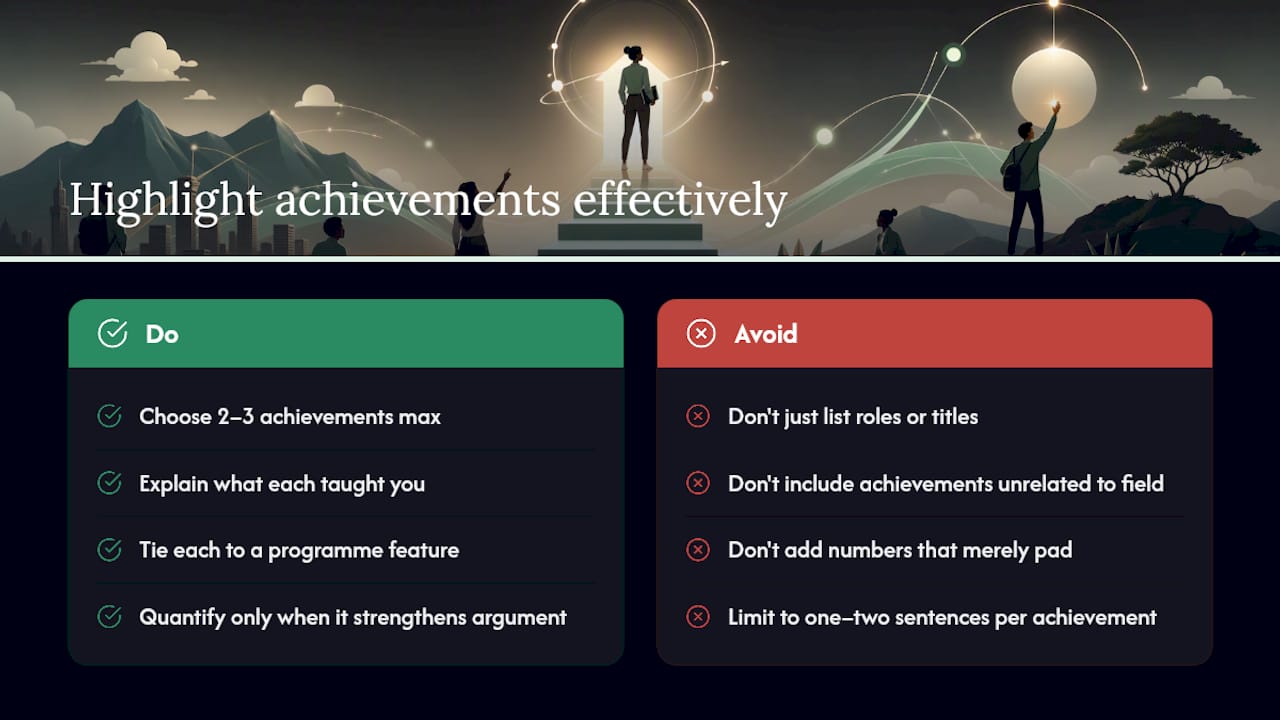
The trick to featuring your achievements well is interpretation, not listing. Instead of writing “I was head prefect and captain of the debate team,” explain what that role taught you and how it connects to the programme.
For example, a prospective law student might write: “Leading debate practice each week taught me how to build an argument under pressure, a skill I want to sharpen further through the Faculty of Law’s moot court programme.” That single sentence does three things a bare list never can: it names the achievement, interprets its relevance, and ties it to a specific programme feature.
Pick two or three achievements maximum, academic, extracurricular, or work experience, and dedicate a full sentence or two to explaining the “so what” behind each one. Quantify where it adds real weight (a specific mark, a competition placing, a number of hours volunteered), but only when the number strengthens your argument rather than pads the paragraph.
Avoid listing achievements that have no clear link to your chosen field. A strong swimming record is impressive, but unless you’re applying to sport science or you can tie it to discipline and time management relevant to a demanding programme, it dilutes your letter’s focus rather than strengthening it.
Addressing academic gaps or a weak year honestly
If your matric results dipped in one subject, or you took a gap year, or your marks in Grade 11 don’t match Grade 12, address it briefly and factually rather than ignoring it or over-explaining it.
The right approach is one short sentence of context followed immediately by evidence of recovery or growth. For example: “My Grade 11 Mathematics mark reflected a difficult year balancing a family health matter, but I improved that mark by 18 percentage points in Grade 12 through consistent extra lessons and self-study.” That sentence acknowledges the dip, explains it without excuse-making, and proves the trajectory matters more than the single low point.
Never spend more than one or two sentences on this. Dwelling on a weakness draws more attention to it, and admissions readers are more interested in your trajectory and self-awareness than in a detailed justification. If the gap involves something sensitive, keep the explanation general rather than sharing more than necessary, and always follow it immediately with a forward-looking sentence about your current readiness for the programme.
Adjusting tone for different institutions and systems
South African universities generally expect a formal, professional register, closer to the structured academic argument style common across European institutions than the more relaxed, story-driven tone sometimes accepted in American applications.
That means avoiding overly casual language, contractions, or humour, even if it feels more “you.” Address the reader formally, structure your argument logically (claim, evidence, connection to programme), and keep emotional language restrained rather than dramatic.
That said, formal doesn’t mean stiff or robotic. A well-written South African motivation letter still reads as a real person’s voice, just a more measured, professional version of it. If you’re applying to a more research-heavy postgraduate programme, lean further into precise, academic phrasing. If you’re applying to a creative or humanities undergraduate programme, you can allow slightly more personality in your hook, provided the body paragraphs stay structured and evidence-based.
Conveying your long-term goals convincingly
Vague future goals (“I want to help people” or “I want to make a difference in South Africa”) read as filler because they could apply to almost any career. Specificity is what makes a goal statement believable.
Instead, name a sector, a type of role, or a specific problem you want to work on. “I intend to work in provincial health policy focused on rural clinic infrastructure” tells an admissions reader far more than “I want to improve healthcare.” The more precisely you can describe the destination, the more convincing your reason for choosing this exact programme becomes, since it shows the degree is a deliberate step, not a default choice.
Where possible, connect your goal back to something concrete you’ve already done or observed, the same way the tuberculosis research example in the postgraduate sample above ties a real research gap to a future policy goal. That link between past evidence and future intention is what separates a genuine plan from an aspirational sentence with no foundation underneath it.
Showing genuine interest in the specific university
Generic praise (“this university has an excellent reputation”) is invisible to admissions readers because every applicant writes some version of it. Real interest shows up in specific, checkable details.
Reference something only true of that particular institution: a named research centre, a specific staff member’s published work, an exchange partnership, or a facility unique to that campus. If you can genuinely say “I chose this programme partly because of [Faculty Member]'s work on X,” that sentence alone does more work than three paragraphs of general enthusiasm.
Spend time on the university’s own programme page and department pages rather than relying only on rankings or general reputation. The goal is to write something that would be factually wrong if pasted into a letter for a different university, that’s the test of genuine, demonstrated interest rather than borrowed praise.
Final proofreading, feedback, and submission steps
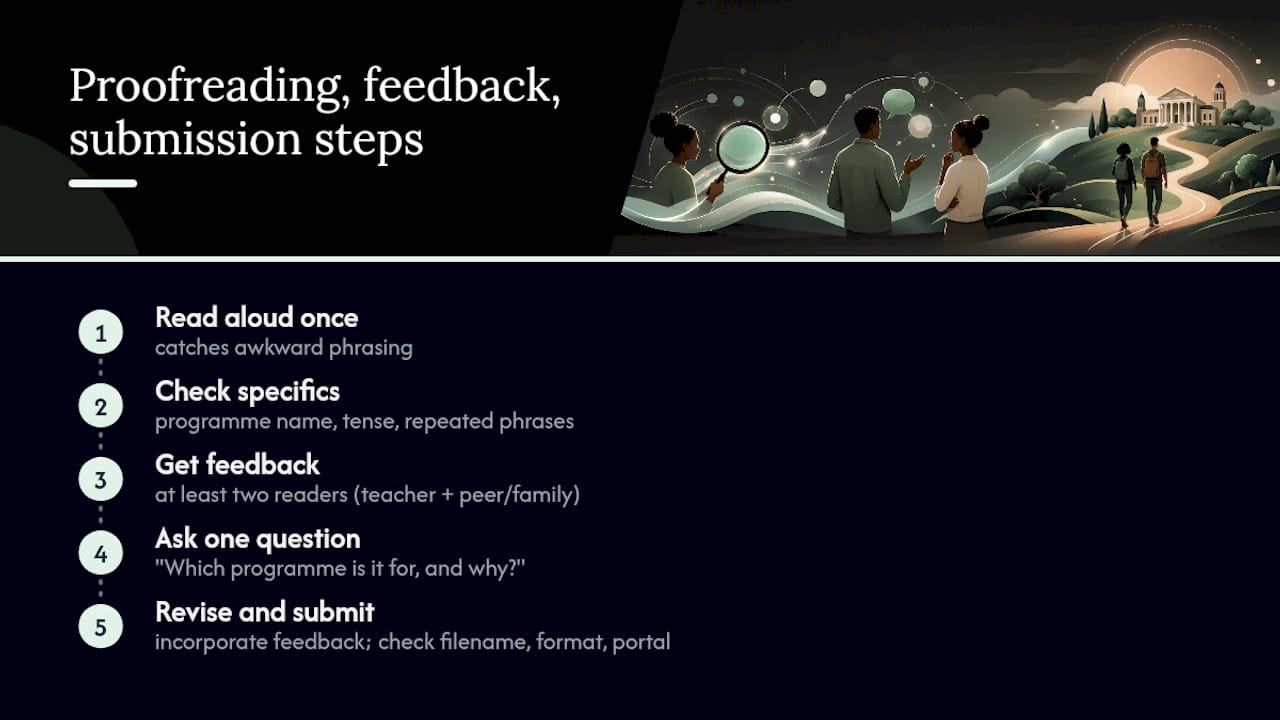
Proofreading a motivation letter needs more than a spellcheck pass. Read it aloud once, since awkward phrasing that looks fine on screen usually sounds wrong when spoken.
Check specifically for: correct programme name throughout (a leftover reference to a different university is a common and damaging error when reusing structure across letters), consistent tense, and no repeated phrases copied between drafts for different programmes.
Then get at least two people to read it before you submit. A teacher or school career counsellor can catch structural or content issues, while a peer or family member can flag anything that reads as unclear or impersonal. Ask each reader one specific question: “Can you tell which programme this is for, and why I want it?” If either answer is unclear, revise before submitting, not after.
Once feedback is incorporated, do a final formatting check: correct file name, correct attachment format, and confirmation that you’re submitting through the right portal or email address listed by the university. The AskSmarty guide to applying covers what most South African portals expect alongside your letter, so you’re not caught out by a missing document at the last step.
A realistic note on timelines and effort
Give yourself more time than feels necessary. Research shows four to six weeks per letter produces noticeably better results than a rushed weekend attempt, mostly because tailoring takes longer than writing.
Start with your top-choice programme first, while your motivation is highest, then use that draft as a structural reference (not a copy-paste template) for the others. Ask your school’s career office or a trusted teacher for feedback early rather than the week before deadlines, when everyone else is asking too. Two honest rounds of feedback, one on content and one on polish, will do more for your letter than a third read-through on your own.
— Nkosi
Let AskSmarty narrow your list before you write a single letter
Writing five tailored letters for programmes you might not even qualify for burns time you don’t have during application season. There are online resources that help South African applicants check their APS score, see which programmes they genuinely qualify for, and only then spend their writing energy where it counts.
The APS calculator keeps your marks on your own device, nothing gets uploaded or stored elsewhere, so you can check eligibility across multiple institutions without any privacy concern. Once you’ve narrowed your options, browse admission requirements for your shortlisted programmes to confirm exact APS cut offs, application fees, and deadlines before you draft anything. Start with your APS score, shortlist three realistic programmes, and put your best writing effort into those letters instead of spreading it thin across ten.
Sources
- How do I write a professional motivation letter? | Tilburg University
- Essential tips for writing a great motivation letter | European Education Area
- How to Write a Motivation Letter: Purpose, Structure, and Examples
- How to Write a Motivation Letter for European Universities
FAQ
What is a good example of a motivation letter for university?
A strong example opens with a specific, personal hook, connects real evidence (marks, projects, experience) to the exact programme, names a module or faculty member, and stays within 300 to 500 words. The undergraduate and postgraduate samples above show this structure in practice.
How do I write a motivational letter for a bursary in South Africa?
Keep the same one-page structure as a university letter, but shift the focus to financial need, how the funding enables your studies, and the impact you intend to make afterward, while strictly following the bursary’s own word limits and document requirements.
How do I start a good motivation letter?
Open with one specific, personal detail or moment that shows genuine interest in the field, never a generic line like “I have always been passionate about.” Admissions readers respond to concrete, memorable openings over broad statements.
Where can I write a motivation letter?
You can draft it in any word processor, but plan your programme research first using tools like the AskSmarty programme search, then write the letter as a one-page document saved as a PDF before submitting it through the university’s application portal.
Recommended
Published 2026-09-05 · AskSmarty is an independent guide. Confirm anything time-sensitive on the official source.