NBT test dates 2026: what matric learners need to know
Prepare for your NBT tests in 2026! Find key dates, registration info, and all the details to ensure a smooth university application process.
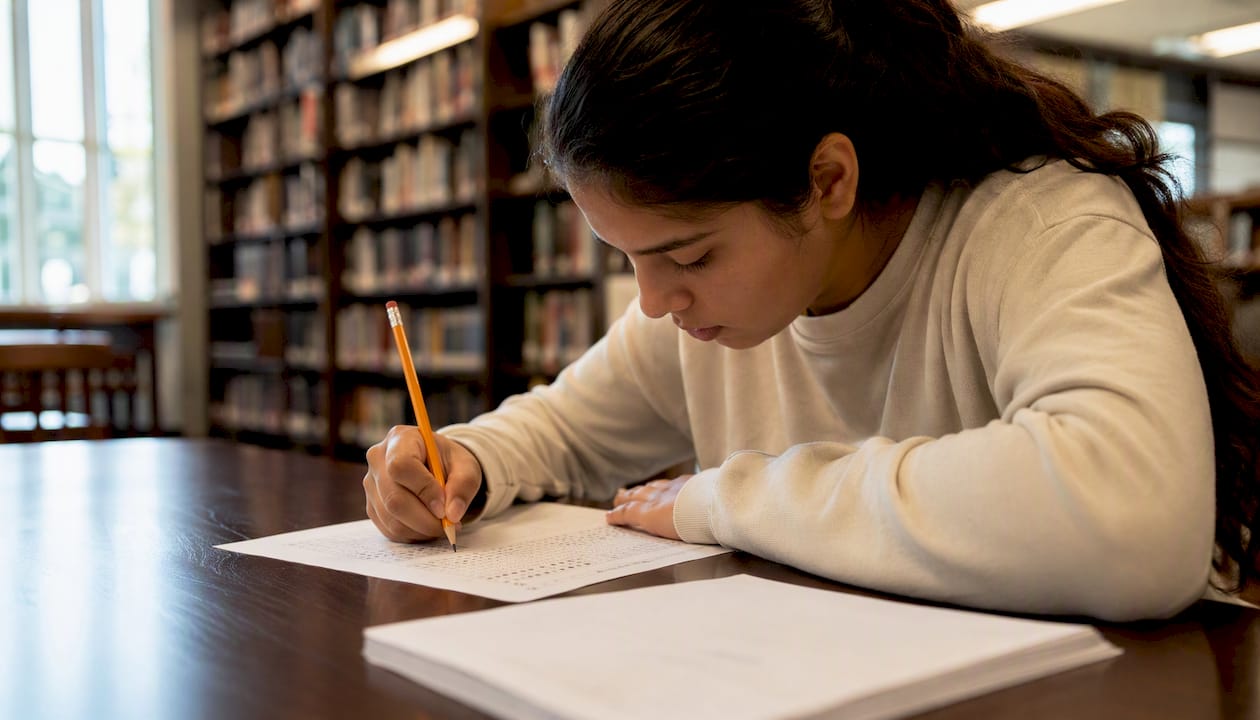
The National Benchmark Test Project runs official 2026 NBT sessions from May through October 2026, with a final opportunity on 9 January 2027. Registrations opened on 1 April 2026. If you are planning for the 2027 university intake, here is what to do right now:
- Download the NBT brochure 2026 (PDF) to see the full calendar and venue list.
- Check which dates and venues are available in your province.
- Register and pay on the NBT booking portal before your chosen session fills up. Fees apply for the tests, and there is no free option.
Key takeaways
The single most important thing to do right now is download the official 2026 NBT brochure, pick two candidate dates, and register before your preferred session fills.
| Point | Details |
|---|---|
| Session window | Official NBT test dates 2026 run May–October 2026; the final session is 9 January 2027. |
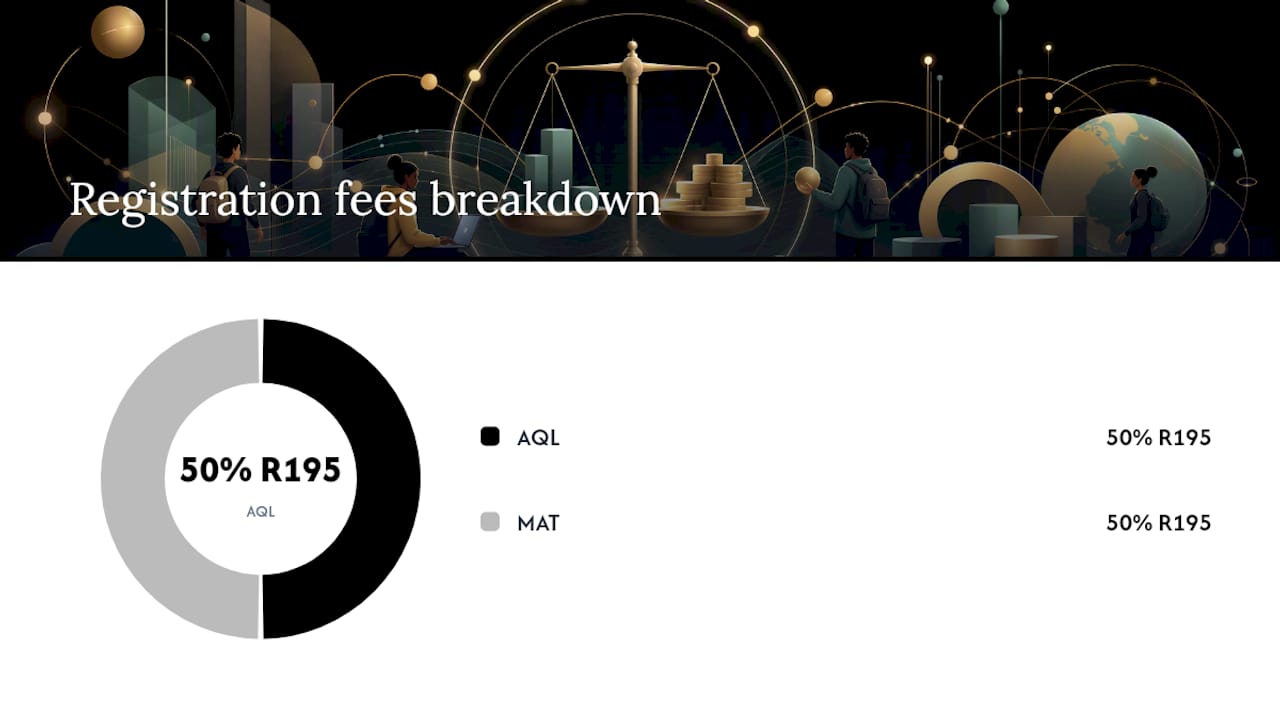
| Fees | AQL costs R195; AQL+MAT costs R390; re-marks cost R250 each. No free option exists. |
| Registration rule | Booking is date- and site-specific. Miss your session and you re-register and pay again. |
| Results timeline | Results are available roughly five weeks after the test; allow four more weeks for universities to process them. |
| Asksmarty | Use Asksmarty’s APS calculator and programme finder after your test to match results to programme entry requirements. |
Table of Contents
- What do the official 2026 NBT test dates look like?
- How do you register for the 2026 NBT?
- What are the AQL and MAT tests, and what should you expect?
- Where can you write the NBT in 2026?
- What are the official 2026 NBT fees?
- How do you get your results, and what happens if you want a re-mark?
- How do you check whether your university requires the NBT?
- Which 2026 session should you book for the 2027 intake?
- The part most students get wrong about NBT timing
- Asksmarty helps you convert your NBT results into the right applications
- Sources
- FAQ
What do the official 2026 NBT test dates look like?
Sessions run across several months, with multiple dates each month. The table below shows sample dates to give you a feel for the cadence. The NBT brochure 2026 (web page) links to a downloadable spreadsheet where you can filter by province and venue.
Note: These are illustrative sample dates. Confirm exact dates and venue availability in the official venues PDF before booking.
Some Sunday sessions use pencil-and-paper format only. Online sessions tend to have broader date availability but not all venues offer both formats. The January 2027 date is the last chance for the 2027 intake cycle, so treat it as a safety net, not a first choice.
How do you register for the 2026 NBT?
Registration is straightforward, but the rules are strict. Follow these steps exactly.
- Create an account on nbtests.uct.ac.za. Use a unique email address you check regularly. You cannot share an account with another candidate.
- Choose your test(s). Decide whether you need AQL only or AQL+MAT. If your target programme requires MAT, register for both now. Candidates registered for both write both tests on the same day.
- Select a specific date and venue. Registration is date- and site-specific. You are booking a seat at a particular location on a particular day, not a general slot.
- Upload your ID details. A valid South African ID book or a passport for non-citizens is required. Have the document number ready before you start.
- Pay via Lesaka EasyPay or EFT. Your registration is only confirmed once payment clears. The fee is R195 for AQL or R390 for AQL+MAT.
- Record your confirmation details. Save your username and your Lesaka EasyPay number. These are the references you will need if a payment query arises or results need to be released.
You will receive an SMS or email reminder approximately two days before your test. If you do not receive it, log in to the portal and verify your booking is active.
The missed-session rule is non-negotiable. Per the NBT brochure 2026, if you miss your scheduled session for any reason, you must re-register and pay the full fee again. There are no refunds and no transfers to another date.
What are the AQL and MAT tests, and what should you expect?
The NBT has two components: Academic and Quantitative Literacy (AQL) and Mathematics (MAT).
AQL tests your ability to read, interpret, and work with information across academic contexts. Every candidate applying to a university that requires the NBT will write AQL. MAT tests mathematical reasoning at a level relevant to quantitative degree programmes, such as engineering, commerce, and the sciences. Not every programme requires MAT, which is why confirming your target faculty’s requirements before booking matters.
If you register for both, you write them on the same day in the same sitting. Plan for a longer day.
Format differences. Online sessions are available on most dates and allow you to write from a registered test centre. Pencil-and-paper sessions, including some Sunday dates, are offered at specific venues. The format does not affect how results are scored or reported.
Test-day checklist:
- Valid South African ID book or passport (no copies, no expired documents)
- Your booking confirmation (printed or on your phone)
- Arrive at least 30 minutes before the session start time
- No calculators, phones, or notes are permitted in the test room
- If you require disability accommodations, contact the NBT Project well in advance of your chosen date. Last-minute requests are not guaranteed.
Where can you write the NBT in 2026?
Venues are published per session, and not every date runs at every venue. The NBT test venues 2026 PDF lists site availability province by province. Sessions are offered across all nine provinces:
- Free State
- Gauteng
- KwaZulu-Natal
- Limpopo
- Mpumalanga
- North West
- Northern Cape
- Western Cape
- Eastern Cape
A few practical points worth knowing before you book:
- Gauteng and Western Cape typically have the most session dates and venue options.
- Northern Cape and Mpumalanga tend to have fewer dates per month, so early booking is critical if you are in those provinces.
- Sunday pencil-and-paper sessions exist in select provinces. Check the venues PDF to see which Sundays apply to your area.
- The downloadable spreadsheet on the NBT brochure page lets you filter by province and session type, which is faster than scrolling the full PDF.
Pro Tip: Book your preferred venue as soon as registration opens. Capacity at smaller provincial venues fills quickly, and you cannot switch to a different site on the day.
What are the official 2026 NBT fees?
Fees are set by the NBT Project and apply uniformly across all venues and session types.
| Test | Fee |
|---|---|
| AQL only | R195 |
| AQL + MAT | R390 |
| Re-mark (per test) | R250 |
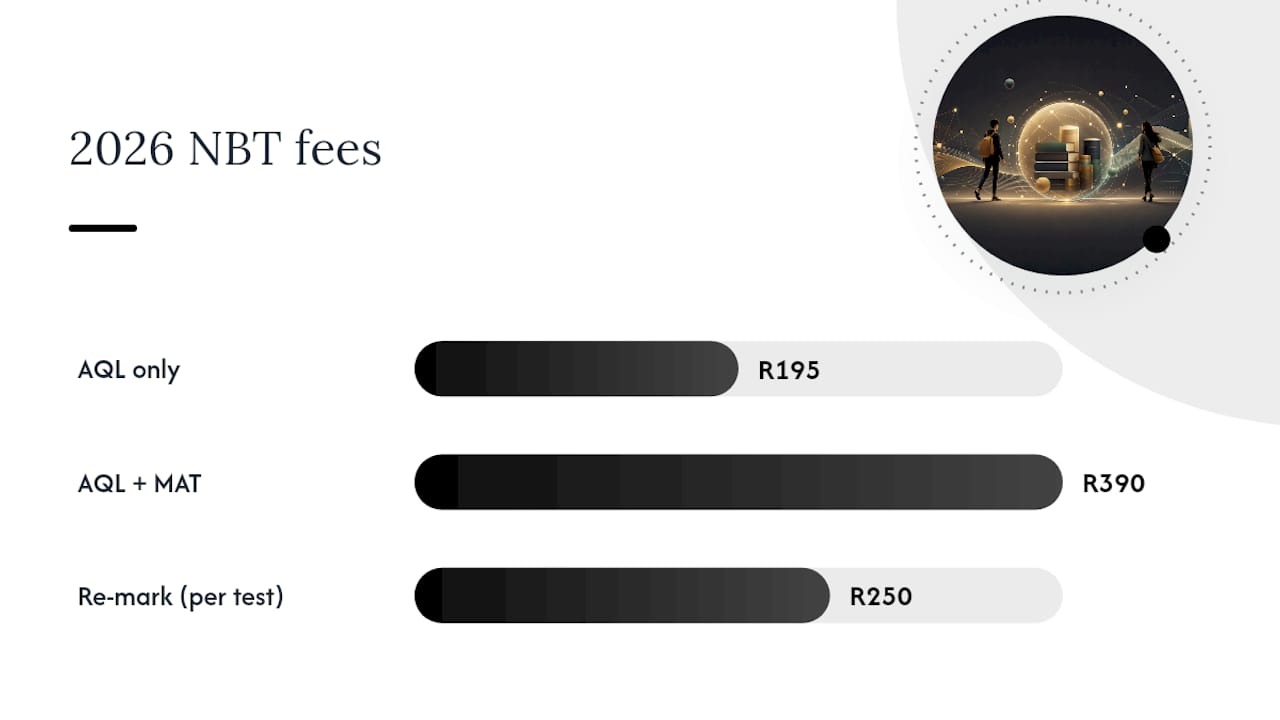
There is no free option. Results are released only after the required payment has been received. Payment is accepted via Lesaka EasyPay or EFT. Keep your payment proof and your Lesaka EasyPay reference number. If your payment is not reflected on the portal within a day or two of an EFT transfer, contact the NBT Project with that reference before your test date.
Missed sessions mean you pay again. No refunds are issued for any reason, including illness or transport problems. Budget for the possibility of a second attempt when you plan your finances.
How do you get your results, and what happens if you want a re-mark?
Results are typically accessible on the NBT website about five weeks after your test date. You log in to the portal at nbtests.uct.ac.za using the username you created during registration.
Universities need time too. Allow at least four weeks for your chosen institution to receive and process results from the NBT Project. That gap matters when you are working backwards from an application deadline.
Requesting a re-mark:
- Log in to the NBT portal after results are published.
- Submit a re-mark request for the relevant test component (AQL or MAT).
- Pay the R250 re-mark fee.
- Wait for the outcome. Re-mark timelines are not instant, so factor this into your planning if you are close to a university deadline.
One important caveat: the NBT Project does not decide whether a university accepts a later or improved result. Each institution sets its own policy on multiple attempts. Some faculties accept the best result; others use only the first. Verify this directly with the admissions office of your target faculty before you decide whether a re-mark or re-write is worth pursuing.
How do you check whether your university requires the NBT?
The NBT Project does not set which tests you must write. That decision sits entirely with each tertiary institution, and requirements can differ by faculty within the same university.
A quick verification process:
- Check the NBT website’s guidance on which institutions require NBT results as a starting point.
- Go directly to your target university’s official prospectus or admissions page and look up the specific programme you are applying to.
- If the prospectus is unclear, contact the faculty admissions office by email and ask explicitly: “Does this programme require AQL, MAT, or both?” Save the written reply.
For example, UCT’s engineering faculty requirements differ from its humanities requirements. The same applies at Wits. Checking the UCT programmes page or the Wits admissions page on Asksmarty gives you a quick overview of what each institution typically asks for, but always confirm with the faculty directly for the current year.
Which 2026 session should you book for the 2027 intake?
The session you choose has real consequences for your application timeline. Here is how to think about it.
Early sessions (May–June) give you the most flexibility. Results arrive around five weeks after the test, which means a May session delivers results by late June. That leaves time for a re-mark, or even a full re-write in August, before most university application deadlines close. If you are aiming for competitive programmes, this is the window to target.
Mid-year sessions (July–August) are the practical sweet spot for most students. The recommended target is to write by 15 August 2026 for early university consideration. A July or early August session still allows four to five weeks for results to reach your institution before the bulk of application deadlines.
Late sessions (September–October) are risky if your target university has an early closing date. Some faculties close applications in September, which means a late-October result may arrive too late to be considered. Use these sessions only if you have confirmed your institution accepts late results, or if you are applying to programmes with later deadlines.
The January 2027 session is a genuine last resort. It works for institutions with late application cycles, but most 2027 intake deadlines will have passed by then.
Scheduling tips:
- Work backwards from your university’s application deadline, not forwards from your availability.
- If you need both AQL and MAT, plan for a longer test day and book travel accordingly.
- Request disability accommodations at least four weeks before your chosen session.
- Set a calendar reminder for five weeks after your test date so you check results promptly.
The part most students get wrong about NBT timing
Most students treat the NBT as a box to tick rather than a variable they can actually control. That framing costs them options.
The five-week results gap is the detail that changes everything. Book in May, and you have your results by late June. That gives you time to re-mark, re-write if needed, and still submit to most universities before their August or September deadlines. Book in October, and you are handing your fate to institutions that may or may not accept late results. The test itself is the same either way. The timing is not.
The other thing worth saying plainly: the NBT does not determine your fate. Universities weight it differently. Some use it for placement into extended programmes. Others use it as a hard admission filter. A few treat it as supplementary information only. Knowing which category your target faculty falls into before you write changes how much pressure you put on a single session. Confirm that with the admissions office, not with a forum post.
Three practical habits that separate prepared students from stressed ones: keep your Lesaka EasyPay reference number somewhere you can find it, check your results on the portal at the five-week mark rather than waiting for a notification, and get your institution’s NBT acceptance policy in writing before you decide whether a re-write is worth the R195 or R390.
Asksmarty helps you convert your NBT results into the right applications
Once you have your NBT results, the next question is which programmes you actually qualify for. That is where Asksmarty is useful. The platform’s free APS calculator lets you check your admission score instantly, and the programme database covers over 1,700 courses across South African universities and colleges, each with entry requirements, application deadlines, and direct links to apply.
Your marks stay on your device. Nothing is submitted or stored. You get immediate matches without paying a cent or filling in a form. After you have your NBT score, use Asksmarty to check university admission requirements and confirm which programmes your combined APS and NBT results open up. It takes a few minutes and removes the guesswork from your application shortlist. Start matching your marks to programmes on Asksmarty now.
Sources
FAQ
How much does the NBT cost in 2026?
The AQL test costs R195. AQL+MAT together cost R390. A re-mark costs R250 per test component. There is no free option.
When should you apply for the NBT for the 2027 intake?
Write by 15 August 2026 for early university consideration. Results take roughly five weeks to reach you, and universities need at least four more weeks to process them, so earlier is always better.
Can you write the NBT without paying?
No. Registration is only confirmed once payment is received via Lesaka EasyPay or EFT, and results are released only after the required fee has been paid.
How do you apply for the 2026 NBT?
Register online at nbtests.uct.ac.za, select your test type, date, and venue, upload your ID details, and pay via Lesaka EasyPay or EFT. Keep your username and Lesaka EasyPay number as proof of registration.
Recommended
Published 2026-08-09 · AskSmarty is an independent guide. Confirm anything time-sensitive on the official source.