No application fee universities in South Africa: 2027 guide
Discover no application fee universities in South Africa for 2027. Learn which institutions offer free applications and get the latest updates.

Several South African universities offer free applications for 2027, including the University of Johannesburg (online applications), Cape Peninsula University of Technology, Walter Sisulu University, and Sol Plaatje University, among others. Some are genuinely free for everyone who applies online; others waive the fee only if your household income falls below a set threshold or if you submit through a specific channel. Always confirm the current policy on the official admissions portal before you submit, since fee rules can change between cycles.
Asksmarty verified fee status against official university admissions portals and the Department of Higher Education and Training (DHET) in 2026. Policies listed here reflect the most recently published information, but universities can update their rules at any time. Re-check the official portal before you submit.
Check the university application fees overview on Asksmarty for a quick cross-university comparison before you start building your list.
Table of Contents
- South African universities with no application fee for 2027
- 1. Cape Peninsula University of Technology (CPUT)
- 2. Central University of Technology (CUT)
- 3. Walter Sisulu University (WSU)
- 4. Nelson Mandela University (NMU)
- 5. University of Johannesburg (UJ)
- 6. University of the Free State (UFS)
- 7. University of the Western Cape (UWC)
- 8. North-West University (NWU)
- 9. Sol Plaatje University (SPU)
- 10. University of Cape Town (UCT)
- 11. University of Pretoria (UP)
- 12. Stellenbosch University (SU)
- 13. University of the Witwatersrand (Wits)
- Which universities still charge fees, and how much?
- How does a “free application” policy actually work?
- When do 2027 application portals open?
- What to prepare before you submit a fee-free application
- How Asksmarty verified this list
- Key takeaways
- Why free applications change how you should build your list
- Asksmarty makes it easier to confirm fees and find the right programme
- Useful sources and official admissions pages
- FAQ
South African universities with no application fee for 2027
The entries below cover every university in the mandatory SERP list. Fee status, application method, and eligibility notes are drawn from official admissions pages. Where a portal link is provided, click through to confirm the current cycle’s rules.
1. Cape Peninsula University of Technology (CPUT)
Fee status: Free (online applications) Application method: Online via the CPUT admissions portal Opening date: Check the CPUT admissions portal; typically opens mid-year Eligibility note: South African citizens applying online; confirm NBT requirements per faculty
CPUT does not charge an application fee for online submissions. Before you submit, verify your APS meets the minimum for your chosen programme, and have your ID, matric results (or predicted results), and supporting documents ready as scanned PDFs.
2. Central University of Technology (CUT)
Fee status: Free Application method: Online Opening date: Check the CUT admissions portal; usually opens around April–May Eligibility note: No income threshold reported; open to all qualifying applicants
CUT has consistently offered fee-free online applications. Confirm the 2027 cycle dates on the official CUT portal, as opening windows can shift.
3. Walter Sisulu University (WSU)
Fee status: Free Application method: Online and on-campus Opening date: Typically opens mid-year; check the WSU admissions portal Eligibility note: South African citizens; APS requirements vary by faculty
WSU is one of the more accessible options for Eastern Cape students. No application fee is charged, and the process is available both online and on-campus, which helps students with limited internet access.
4. Nelson Mandela University (NMU)
Fee status: Free (confirm current cycle on portal) Application method: Online via applyonline.mandela.ac.za Opening date: Check the portal; NMU typically opens applications around April Eligibility note: Programme-specific APS requirements; NBT may be required for certain faculties
NMU uses its dedicated online portal as the primary submission channel. Fee notices and eligibility criteria are published on the Study at Mandela pages. Verify the fee status for your specific programme before submitting.
5. University of Johannesburg (UJ)
Fee status: Free for online applications; paper/on-campus submissions may be charged Application method: Online only for fee-free route Opening date: Check the UJ admissions portal; typically opens around April–May Eligibility note: Online submission is the qualifying method; confirm on the UJ admissions page
UJ is a clear example of an online-only free policy. If you submit a paper application or apply on-campus, a fee may apply. Stick to the online portal and you avoid the charge entirely.
6. University of the Free State (UFS)
Fee status: Free (confirm on portal for 2027) Application method: Online Opening date: Check the UFS page on Asksmarty or the official UFS admissions portal Eligibility note: APS requirements differ across faculties; some programmes require NBT
UFS has offered fee-free online applications in recent cycles. The Asksmarty UFS page tracks deadline updates and links directly to the official portal, so you can monitor changes without hunting across multiple sites.
7. University of the Western Cape (UWC)
Fee status: Free (online applications) Application method: Online Opening date: Typically opens mid-year; check the UWC admissions portal Eligibility note: South African citizens; APS and subject requirements apply per programme
UWC is a popular choice for students in the Western Cape and beyond. No application fee is charged for online submissions. Confirm NBT requirements for health sciences and education programmes specifically.
8. North-West University (NWU)
Fee status: Free (online applications) Application method: Online Opening date: Check the NWU admissions portal; usually opens around April–May Eligibility note: APS requirements vary by campus and faculty
NWU operates across three campuses (Potchefstroom, Mahikeng, Vanderbijlpark), and the fee-free online route applies across all three. Confirm which campus and programme you are targeting before you start, since minimum APS scores differ.
9. Sol Plaatje University (SPU)
Fee status: Free Application method: Online Opening date: Check the SPU admissions portal Eligibility note: Smaller intake; limited programmes; confirm APS per faculty
SPU is a newer institution with a smaller programme offering, but it charges no application fee. If you are based in the Northern Cape or interested in SPU’s specific programmes, it is worth adding to your list.
10. University of Cape Town (UCT)
Fee status: Fee charged (confirm current amount on the UCT admissions portal) Application method: Online Opening date: UCT typically opens applications around April; check the official portal Eligibility note: Highly competitive; NBT required; check for any waiver provisions on the portal
UCT charges an application fee. The amount is not publicly listed here as it can change, so check the official UCT admissions portal for the current figure. UCT does not appear to offer a broad income-based waiver in the same way as UP, but confirm directly.
11. University of Pretoria (UP)
Fee status: Conditional waiver (R300 fee; waived for households earning under R150,000 per annum) Application method: Online Opening date: Check the UP online application page; typically opens around February–March Eligibility note: Household income below R150,000 per annum; supporting documents required (payslips, affidavit)
UP charges R300 for applicants above the income threshold, but waives the fee entirely for households earning under R150,000 per year. You will need to upload proof of income when you apply. The Asksmarty UP landing page links directly to the admissions portal and explains the waiver process step by step.
12. Stellenbosch University (SU)
Fee status: Fee charged (confirm current amount on the portal) Application method: Online via the SU applicant portal Opening date: SU typically opens applications around March–April; check the portal Eligibility note: Highly competitive; NBT required for most programmes; check portal for any waiver provisions
SU charges an application fee. Use the Asksmarty SU online application guide to navigate the portal and confirm the current fee before you start. SU’s portal is well-organised, but the process has several steps, so give yourself time.
13. University of the Witwatersrand (Wits)
Fee status: Fee charged (confirm current amount on the Wits admissions portal) Application method: Online Opening date: Typically opens around April; check the official Wits admissions portal Eligibility note: Highly competitive; NBT required; check for any waiver or financial assistance provisions
Wits charges an application fee. As with UCT and SU, the exact amount can change between cycles, so verify on the official portal before you apply. Wits does not widely advertise a broad income-based waiver, but financial assistance queries can be directed to the admissions office.
Which universities still charge fees, and how much?
Not every South African university has moved to a fully free application model. UCT, SU, and Wits all charge fees, and UP charges R300 unless you qualify for the income-based waiver. The table below maps the three policy types you will encounter.
| Fee policy type | How it works | Typical trigger for a charge | Example |
|---|---|---|---|
| Free for all (online) | No fee for any online applicant | Paper or on-campus submission | UJ, CPUT, WSU |
| Conditional waiver | Fee waived if you meet an income threshold | Household income above threshold; no supporting docs submitted | UP (R300, waived for applicants whose household income is under R150,000 per year with supporting proof) |
| Fee required | All applicants pay regardless of income | Any submission method | UCT, SU, Wits |
The UP fee is a useful benchmark. Universities that charge tend to have application fees in the moderate range, though you should confirm the exact amount on each official portal since figures are updated annually. Paper submissions at institutions that offer a free online route can also attract a processing charge, so the submission method matters as much as the institution.
To request a waiver where one exists, go directly to the admissions portal of the relevant university. For UP, the waiver is available for applicants whose household income is under R150,000 per year; you must upload payslips, a signed affidavit, or a social grant letter during the online application.
How does a “free application” policy actually work?
Three distinct models exist across South African universities, and knowing which one applies saves you from a surprise charge or a rejected waiver claim.
Path 1: Genuinely free for everyone. Universities like WSU, CUT, and SPU charge no fee regardless of your income or how you apply. Submit online, confirm your APS, and you are done.
Path 2: Conditional waiver. UP is the clearest local example. The fee is R300, waived for applicants whose household income is below R150,000 per year and who submit the required proof. This model is common internationally too: a wide-scope guide to no-fee college applications identifies this as one of the three standard free-application structures used globally, confirming it is not unique to South Africa.
Path 3: Online-only free window. UJ waives the fee for online applicants but may charge for paper or on-campus submissions. The free route is real, but it is method-specific.
For conditional waivers, prepare these documents as scanned PDFs before you start:
- Latest payslips for all income earners in the household (typically three months)
- A signed income affidavit from a commissioner of oaths if payslips are unavailable
- A social grant award letter (SASSA) if applicable
- Your South African ID document
Pro Tip: Always take a screenshot of your completed online submission confirmation page and save the reference number. If a fee dispute arises later, that confirmation is your proof that you used the qualifying method.
When do 2027 application portals open?
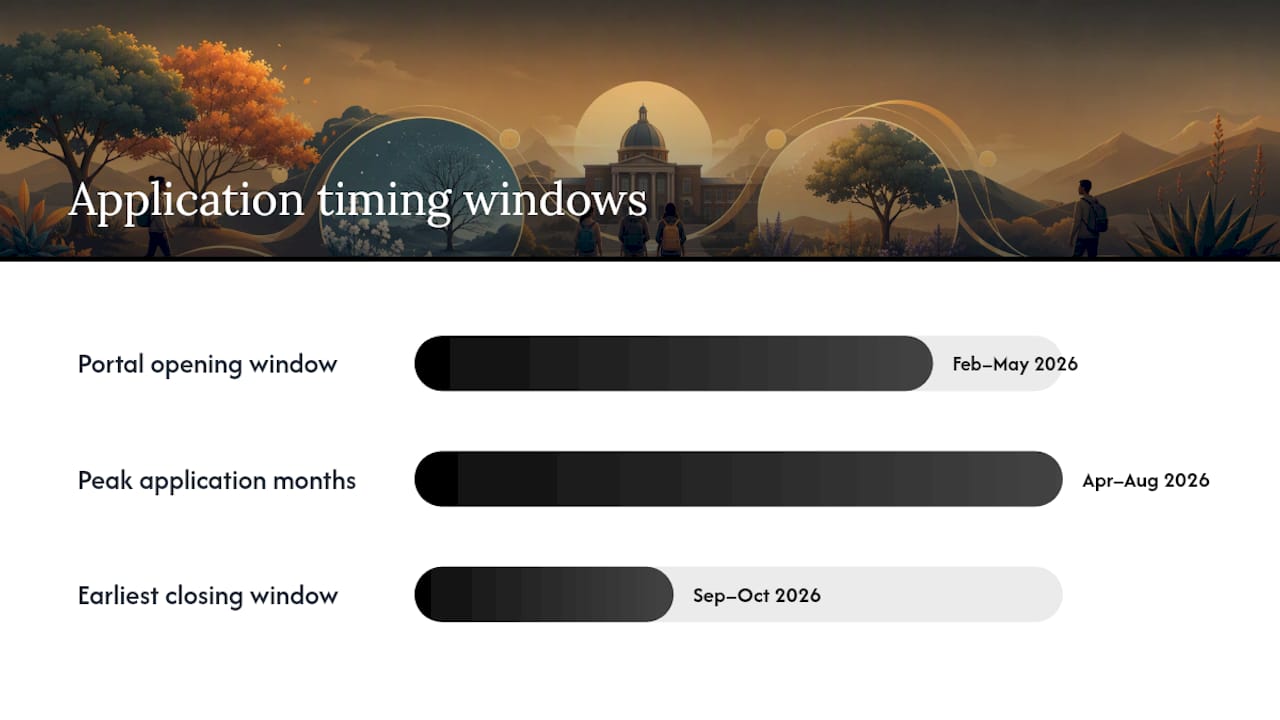
South African university application cycles for 2027 intake typically follow a predictable pattern, though exact dates shift year to year. Most portals open between February and May 2026, with peak application months running from April through August. Closing dates for popular programmes can fall as early as September or October 2026, well before the end of the school year.
The DHET website publishes system-level announcements and links to university admissions pages, making it a useful starting point when you are not sure whether a portal has opened yet.
Practical monitoring tactics:
- Bookmark the admissions page of every university on your list and check it monthly from February 2026 onward.
- Follow each university’s official admissions social media accounts; most post opening-date announcements there first.
- Sign up for email alerts where the portal offers them (UJ and UP both have notification options).
- Add key dates to your phone calendar the moment you see them published.
Watch for phrases like “applications are now open,” “apply for 2027 intake,” or “closing date: [month] 2026” on university pages. Those are your triggers to act.
What to prepare before you submit a fee-free application
Getting your documents ready before you open any portal saves time and reduces the risk of an incomplete submission.
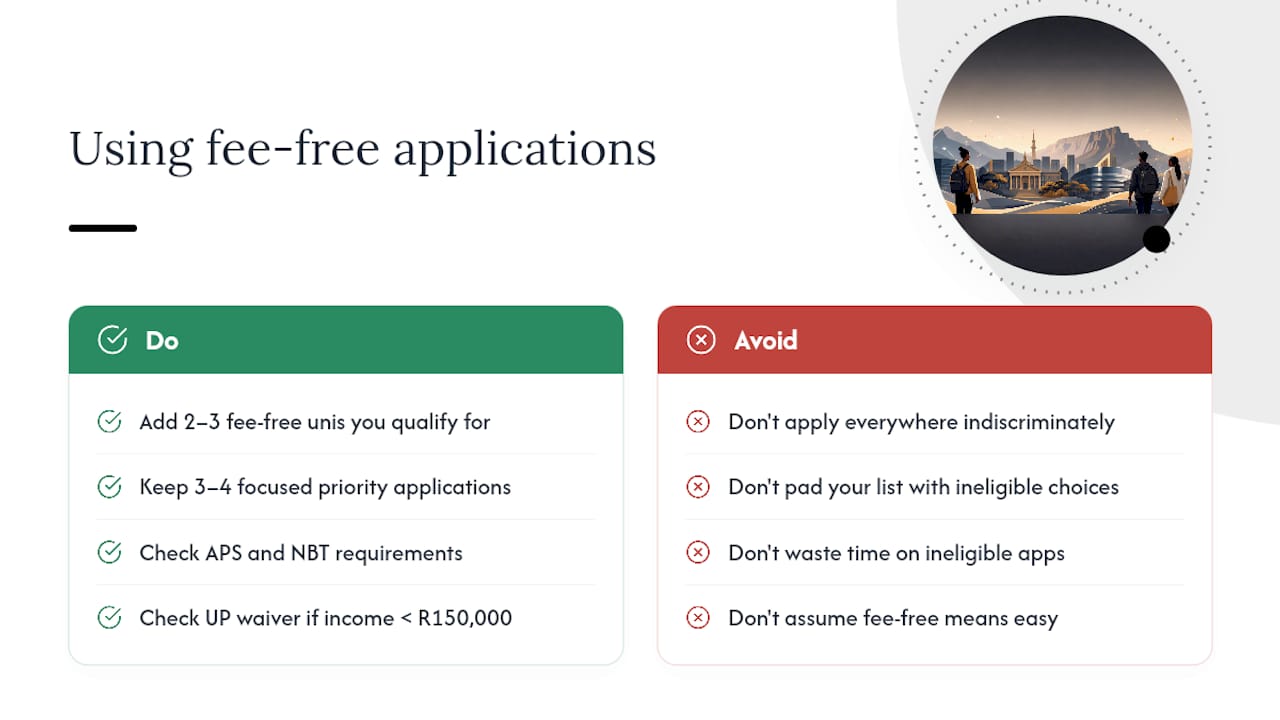
- Calculate your APS. Use the Asksmarty APS calculator to confirm your score before you apply. Many fee-free universities still have competitive entry requirements, and applying without meeting the minimum wastes your time.
Pro Tip: Name your files clearly before uploading: “Surname_Firstname_ID.pdf”, “Surname_Firstname_Matric.pdf”. Admissions offices process thousands of documents; a clearly named file reduces the chance yours gets lost or mismatched.
Read the Asksmarty how-to-apply guide for a full walkthrough of the South African university application process.
How Asksmarty verified this list
Asksmarty compiled this list by checking official university admissions portals directly, cross-referencing with DHET announcements, and flagging entries where fee policies are conditional or method-specific. The verification steps were:
- Visit each university’s official admissions or “apply” page and record the stated fee policy.
- Note whether the free route is unconditional, income-conditional, or online-method-specific.
- Cross-check against the Asksmarty programme database (over 1,700 programmes) to confirm APS and NBT requirements per entry.
- Flag any university where the policy was ambiguous or where the portal had not yet published 2027 cycle information.
Last verified: 2026. Official admissions pages used include UP (application fee page), UJ (admissions page), NMU (apply online portal), SU (applicant portal), and DHET.
Key takeaways
Most South African universities that offer free applications restrict the benefit to online submissions, so confirming your submission method is as important as confirming the fee status itself.
| Point | Details |
|---|---|
| Free vs conditional | Several universities are free for all online applicants; UP waives its R300 fee only for households earning under R150,000 per year. |
| Method matters | UJ and CPUT waive fees for online submissions; paper or on-campus routes may still attract a charge. |
| Documents to prepare | Conditional waivers require payslips, a signed affidavit, or a SASSA grant letter uploaded during the application. |
| Apply early | Most 2027 portals open between February and May 2026; popular programmes close as early as September 2026. |
| Use Asksmarty | The Asksmarty APS calculator and programme search help you confirm eligibility before you apply to any fee-free university. |
Why free applications change how you should build your list
The conventional advice is to apply to three or four universities and focus your energy there. That made sense when every application cost R100–R300. When several institutions charge nothing to apply online, the calculus shifts.
Fee-free routes let you add universities you might have skipped purely on cost grounds. A student who would have stopped at two applications can now realistically apply to six or seven without spending a cent, which genuinely widens the safety net. The catch is that free does not mean easy. CPUT, UWC, and WSU all have competitive programmes, and adding them to your list only helps if you actually meet the APS requirements.
What I see students get wrong is treating fee-free as a reason to apply everywhere indiscriminately. A scattershot list of fifteen applications, half of which you do not qualify for, wastes time you could spend on a stronger personal statement or getting your NBT registration sorted. The smarter move: use the cost saving to add two or three well-chosen universities where you genuinely meet the entry requirements, not to pad the list.
The UP waiver is worth flagging specifically. Many students assume UP is out of reach financially because of the R300 fee. For applicants whose household income is under R150,000 per year, that fee is waived entirely. UP is one of South Africa’s most respected research universities, and a lot of students who qualify for the waiver never apply simply because they do not know it exists.
Asksmarty makes it easier to confirm fees and find the right programme
Sorting through thirteen university portals to check fee status, APS requirements, and deadlines takes hours. Asksmarty pulls that information into one place, verified against official admissions pages, so you spend your time applying rather than searching.
The Asksmarty programme search covers over 1,700 university and college programmes across South Africa. Enter your matric marks and it shows you which programmes you qualify for, with direct links to the official portal for each. Your marks never leave your device. The APS calculator gives you your score in seconds, and the admission requirements guide explains NSC passes, NBT, and NQF levels in plain language. Fee status and application deadlines are listed per university, so you can confirm whether a free application route is available before you commit to a programme.
Check your APS, find programmes you qualify for, and confirm fee status at asksmarty.co.za.
Useful sources and official admissions pages
Policies can change between application cycles. Re-check each official portal before you submit.
- Application fee | University of Pretoria
- Applying to UJ | University of Johannesburg
- Apply online | Nelson Mandela University
- Study at Mandela | Nelson Mandela University
- Applicant portal | Stellenbosch University
- Department of Higher Education and Training (DHET)
- 120+ Colleges With No Application Fee in 2026 (FindMyOrbit)
- Online application | University of Pretoria
For CPUT, CUT, WSU, UWC, NWU, SPU, UCT, and Wits, go directly to each university’s official admissions or “apply” page and search for the current 2027 cycle notice. Admissions contact details are listed on each university’s official website under “Contact Us” or “Admissions Office.”
This article provides general information only. Fee policies, waiver thresholds, and application rules are set by each university and can change. Confirm current requirements directly with the relevant admissions office or on the official portal before submitting.
FAQ
Which South African universities are free to apply to for 2027?
Universities that have offered free online applications in recent cycles include CPUT, CUT, WSU, NMU, UJ (online only), UFS, UWC, NWU, and SPU. UP waives its R300 application fee for applicants whose household income is below R150,000 per year. You must upload supporting proof (payslips, a signed affidavit, or a SASSA grant letter) during the online application process. Always confirm on the official admissions portal before you submit.
Which universities still charge an application fee?
UCT, Stellenbosch University, and Wits charge application fees; UP charges R300 but offers an income-based waiver. Confirm the current amount on each university’s official admissions page, as fees are updated annually.
Which universities can I apply to for free online?
UJ, CPUT, UWC, NWU, UFS, WSU, CUT, and SPU all offer free online applications. The key condition at UJ is that the free route applies to online submissions only; paper or on-campus applications may attract a charge.
How do I qualify for an application fee waiver at UP?
UP waives its R300 application fee for applicants whose household income is below R150,000 per year. You must upload supporting proof (payslips, a signed affidavit, or a SASSA grant letter) during the online application process.
Which universities accept an APS of 18?
Several universities, including WSU, CUT, and SPU, offer programmes with lower APS requirements that vary by faculty and programme. Use the Asksmarty APS calculator to see which specific programmes you qualify for at your score.
Recommended
Published 2026-08-07 · AskSmarty is an independent guide. Confirm anything time-sensitive on the official source.