Nursing entry requirements in South Africa: what you need
Discover the essential nursing entry requirements in South Africa, ensuring you have what it takes to apply for your dream program.

Most nursing programmes in South Africa require a National Senior Certificate (NSC) diploma or degree pass, English at a specified level, Life Sciences or Physical Science, and admission to a programme accredited by the South African Nursing Council (SANC). Your Admission Point Score (APS) usually needs to sit somewhere between 24 and 30, depending on the institution and the year’s applicant pool. Meeting these minimums is the entry ticket, not a guarantee, since most programmes receive far more applications than they have seats.
Before you apply anywhere, check these four things:
- Your NSC or NCV pass type meets the programme’s minimum (diploma pass vs. bachelor’s pass matters)
- English and Life Sciences sit at the subject levels the specific college or university publishes
- Your calculated APS meets or beats last year’s cutoff, not just the stated minimum
- The programme is SANC accredited, so your qualification lets you register and practise afterward
Run your matric marks through Asksmarty’s APS calculator to see which nursing programmes you currently qualify for, then confirm the fine print on the college or university’s own prospectus.
Key Takeaways
Meeting a nursing programme’s minimum APS and subject requirements gets you in the applicant pool, but SANC accreditation and complete documentation determine whether an offer actually converts into a registered nursing career.
| Point | Details |
|---|---|
| Core subjects are non-negotiable | English and Life Sciences (or Physical Science) at specified NQF levels appear on nearly every programme’s checklist. |
| APS minimums aren’t real cutoffs | Published minimums (often 24 to 30) get pushed higher once a programme is oversubscribed. |
| SANC accreditation is mandatory | Only programmes registered under Regulation R.171 let graduates register and practise as nurses. |
| Documentation trips up more applicants than grades | Certified copies, medical fitness proof and bursary affidavits cause more disqualifications than low APS scores. |
| Confirm eligibility before applying | Use Asksmarty’s APS calculator and programme search to match your marks to accredited nursing programmes for free. |
Official pages and prospectuses to check next
Before submitting any application, verify current requirements directly against these sources:
- South African Nursing Council circular on Regulation R.171 for accreditation rules
- Mediclinic Diploma in Nursing prospectus for a private college example
- DUT nursing prospectus and KwaZulu-Natal College of Nursing intake requirements for university and provincial college examples
- The Nursing School Study Center for general admissions test preparation resources
Table of Contents
- Which nursing pathways exist: diploma, bachelor’s, and TVET routes
- Core academic requirements: subjects, APS and what actually gets checked
- What documents and screenings you’ll need to prepare
- When do nursing applications open and how does selection work?
- What if you don’t meet the minimum requirements yet?
- Do you need English proficiency tests for nursing programmes?
- Physical and emotional fitness standards for nursing training
- Is there an age limit for studying nursing in South Africa?
- What the conventional advice on nursing entry gets wrong
- Sources
- FAQ
Which nursing pathways exist: diploma, bachelor’s, and TVET routes
South Africa offers three broad routes into nursing, and they are not interchangeable in scope or career ceiling.
The three-year Diploma in Nursing is a common entry point, offered by provincial nursing colleges and private institutions like Mediclinic. It qualifies you as a registered nurse but may limit career progression compared to a degree.
The Bachelor of Nursing (BNurs), typically a four-year degree offered by universities such as Wits and the University of Pretoria, includes clinical competencies alongside a stronger academic and research foundation. This pathway can facilitate access to postgraduate specialisation and management roles more readily than a diploma.
TVET colleges and NCV routes generally build foundational subject skills (particularly in Maths, Science and English) necessary for entry into diploma or degree nursing programmes, rather than leading directly to professional nursing registration.
Whichever route you pick, confirm accreditation first:
- Diploma and BNurs programmes must be registered under SANC’s Regulation R.171 framework for your qualification to count toward professional registration
- An unaccredited “nursing” course, however cheap or convenient, will not let you register with SANC afterward
- Provincial colleges and universities publish their SANC accreditation status in their own prospectuses, so check before you pay any application fee
Core academic requirements: subjects, APS and what actually gets checked
Three subjects appear on almost every nursing programme’s requirement list: English, Life Sciences (or Physical Science at some institutions), and Mathematics or Mathematical Literacy. The Mediclinic Diploma in Nursing prospectus sets English at NQF Level 4 with a minimum of 40%, Life or Physical Science at NQF Level 4 with 40 to 50%, and either Mathematics or Mathematical Literacy at NQF Level 4 with its own minimum mark. DUT’s nursing leaflet treats Life Sciences and English as essential rather than optional, and a broader summary of DUT’s entry rules confirms Maths or Physical Science is commonly required alongside them.
Your APS comes from your six best subjects, excluding Life Orientation. Each subject level (1 to 7) translates into points, and you add the top six together.
- List your NSC results for all subjects except Life Orientation.
- Convert each mark into a level using the standard 1 to 7 NSC scale.
- Add the levels of your six best subjects to get your APS.
- Compare that number against the specific programme’s published minimum, not a generic nursing average.
A learner with two Level 5s, two Level 6s, and two Level 7s across their best six subjects lands on an APS of 36, well above most published nursing minimums, while someone scraping Level 4s throughout sits closer to 24, right at the floor some provincial colleges state as their minimum threshold.
Here’s the catch: minimums are not cutoffs. When a programme is oversubscribed, the college fills seats with the highest APS scores first, so an applicant sitting exactly at the published minimum often misses out.
What documents and screenings you’ll need to prepare
Nursing applications ask for more than academic transcripts. Provincial and private prospectuses consistently request a similar bundle of paperwork and clearances.
- Certified copy of your Matric certificate or latest NSC results (certification must usually be recent, often within three months)
- Certified copy of your South African ID or birth certificate
- Proof of residence in the applicable province, particularly for provincial college bursary seats
- A short CV, where the institution requests one
- Medical fitness certificate confirming you can meet the physical demands of clinical training
- Proof of immunisation, hepatitis B is the one most commonly requested
- Police clearance certificate, since you’ll work with patients from your first clinical placement
Pro Tip: Get your documents certified in batches of five or six copies at once. Nearly every programme wants its own certified set, and running back to a police station or commissioner of oaths every time a new form arrives wastes weeks you don’t have during application season.
Provincial bursary-linked seats, common at colleges like the Limpopo Province College of Nursing.pdf), also require a signed affidavit acknowledging the service-back obligation tied to accepting government funding.
When do nursing applications open and how does selection work?
Application windows for the following year’s intake typically open around mid-year, with most provincial and university deadlines falling between August and November. That window shifts slightly by institution, so treat every date on this page as a starting point, not gospel, and verify against the current prospectus before you plan around it.
- Applications open, usually online only, through the institution’s own portal.
- The college or university shortlists candidates primarily by APS, filtering out anyone below the published or effective cutoff.
- Shortlisted applicants may face an interview, and some universities layer in a standardised assessment like the National Benchmark Test (NBT) alongside NSC results.
- Successful candidates undergo medical fitness checks and a criminal record screening before receiving a final offer.
- Bursary-linked offers require the signed service affidavit before enrolment is confirmed.
If you’ve received a provincial nursing bursary before and didn’t complete your service obligation, that history can affect your eligibility for a second bursary-linked seat elsewhere. Missed a deadline entirely? Check whether your target institution still accepts late applications, since policies on this vary sharply between universities like NWU and Unisa.
What if you don’t meet the minimum requirements yet?
Falling short of a programme’s academic minimum this year doesn’t mean waiting a full year to reapply with the same results.
- Recognition of Prior Learning (RPL) lets some colleges assess older applicants with relevant work experience, even without a full NSC diploma pass, through a formal assessment process rather than transcripts alone.
- NCV and TVET bridging routes build up Maths, Science and English competency to the level a diploma programme requires, often in a year or less.
- Subject improvement through supplementary exams can push a borderline APS over a specific programme’s cutoff without repeating your entire matric year.
Choose between retaking subjects and switching routes based on how far you actually are from the target. A gap of one or two APS points usually favours improvement; a gap of eight or more usually favours a bridging year instead.
Your application checklist and the mistakes that sink applications
- Confirm the programme’s SANC accreditation status before applying anywhere.
- Calculate your APS accurately, excluding Life Orientation.
- Certify every required document within the institution’s specified window.
- Secure police clearance and a medical fitness certificate ahead of the deadline, not after.
- Submit and pay any application fee before the portal closes, since late uploads are rarely accepted.
Pro Tip: The single most common disqualifying error isn’t a low APS, it’s an incomplete bursary affidavit or a document certified outside the accepted date range. Double-check certification dates before you submit.
Confirm your eligibility with Asksmarty’s programme match
Rather than cross-referencing five different prospectuses by hand, enter your matric marks into Asksmarty’s APS calculator to see your score and matching nursing programmes instantly. Your marks stay on your device throughout. From there, use the programme search to open direct links to each college’s prospectus, then contact the institution only to clarify anything genuinely ambiguous, like bursary terms or interview scheduling.
Do you need English proficiency tests for nursing programmes?
South African nursing programmes generally accept your NSC English mark, whether Home Language or First Additional Language, as sufficient proof of proficiency. You won’t typically need an external test like IELTS or TOEFL unless you completed your schooling outside South Africa or through a foreign curriculum.
What differs is the level required.
If your NSC English result sits below a specific programme’s threshold, some institutions allow a supplementary exam to lift that single subject without repeating the full matric year. It’s worth checking directly with the admissions office, since policies vary by institution and aren’t always spelled out in the standard prospectus.
For applicants who studied through an international curriculum, expect to submit a SAQA evaluation confirming your qualification’s NQF equivalence, plus possibly a recognised English test result if your prior schooling wasn’t conducted in English. This isn’t common among South African-schooled applicants, but it comes up often enough among returning expatriate families that it’s worth flagging early rather than discovering it during application week.
Physical and emotional fitness standards for nursing training
Nursing training is physically demanding from your first clinical placement, and institutions screen for this before admission rather than after you’ve already invested a semester.

The medical fitness certificate required in most application checklists confirms you can manage the physical realities of ward work: extended periods on your feet, lifting and repositioning patients, night shifts, and exposure to clinical environments. A treating doctor or occupational health practitioner typically signs this off, and it usually needs to be dated close to your application submission.
Immunisation records matter just as much as the fitness certificate itself. Hepatitis B proof comes up repeatedly across provincial and private prospectuses, since students handle blood and bodily fluids during clinical rotations from early in their training.
Emotional resilience gets assessed less formally but no less seriously. Interviews at some institutions probe how candidates handle stress, conflict and confronting situations, because nursing students encounter death, trauma and difficult family dynamics well before graduation. There’s no standardised psychometric test used universally across every college, but where interviews are part of selection, expect scenario-based questions rather than pure academic quizzing.
If you manage a chronic condition or disability, don’t assume automatic disqualification. Speak directly with the institution’s admissions or disability support office, since reasonable accommodations are increasingly built into clinical placement planning rather than treated as a blanket barrier.
Is there an age limit for studying nursing in South Africa?
There’s no blanket maximum age restriction written into SANC’s national framework for entry into nursing training. Most programmes, however, set a minimum age, commonly 18 by the time training begins, since students work directly with patients in clinical settings from early in the programme.
Older applicants, including career changers in their thirties, forties or beyond, are accepted regularly at both universities and provincial colleges, provided they meet the same academic and document requirements as school-leavers. Recognition of Prior Learning pathways exist precisely because a meaningful number of nursing applicants come from other careers rather than straight out of matric.
Where age does occasionally factor in is bursary-linked seats at some provincial colleges, which may weigh applicant age alongside academic merit when allocating a limited number of funded places, particularly where the province is trying to build a pipeline of nurses who’ll serve for a full career after graduating. This isn’t a hard cutoff, and it varies by province and by year, so check the specific bursary terms in the prospectus rather than assuming exclusion based on age alone.
What the conventional advice on nursing entry gets wrong
Most guidance treats nursing admission like a single hurdle: hit the published APS minimum, submit your documents, and wait. That framing undersells how much oversubscription reshapes the real bar. A college publishing a minimum APS of 24 might, in practice, only admit applicants sitting at 30 or higher once the applicant pool is filtered, particularly for bursary-linked seats at popular provincial colleges.
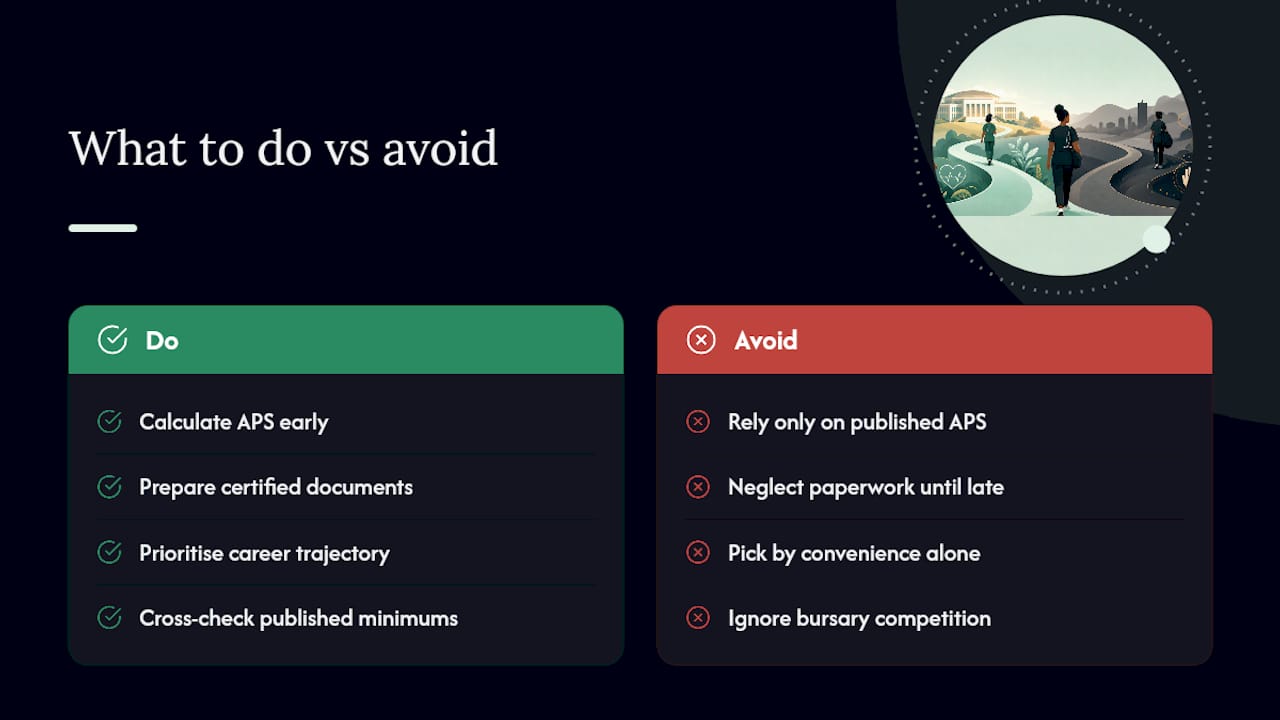
The bigger blind spot is documentation. Applicants spend months perfecting their APS and almost no time preparing certified paperwork, then lose a seat to a missing affidavit or an expired certification date, not an academic shortfall. That’s an avoidable, entirely administrative failure.
My honest read: pick your programme type (diploma versus BNurs) based on career trajectory first, subject strength second, and location convenience last. Too many applicants reverse that order and end up in a programme that limits their progression later. Run your actual marks through a proper APS calculation early, cross-check against real published minimums using Asksmarty’s requirements guide, and treat document preparation with the same urgency as your final exams.
— Nkosi
Check your nursing eligibility on Asksmarty before you apply anywhere
Asksmarty gets you a straight answer to “do I qualify?” in minutes instead of cross-referencing five separate PDFs. Enter your matric marks into the APS calculator, and it converts your results into an APS and shows which SANC-accredited nursing programmes you currently match, no email signup, no fee, and your marks never leave your device.
From there, use the programme search to browse nursing options across universities and colleges nationwide, with direct links through to each institution’s prospectus and application portal. If your APS falls short somewhere, the same tool flags nearby programmes and alternative pathways worth considering instead of leaving you guessing. Start with Asksmarty’s admission requirements page to see exactly where your marks stand today.
Sources
- Diploma in Nursing (Mediclinic prospectus)
- South African Nursing Council circular (Regulation reference)
- DUT nursing prospectus / leaflet
FAQ
Are nursing applications open for 2026?
Application windows vary by institution, with most provincial colleges and universities opening portals around mid-year for the following year’s intake. Check the specific college or university’s current prospectus or Asksmarty’s programme search for exact open and closing dates.
Can I study nursing with 17 points?
An APS below the minimum most diploma and degree nursing programmes publish, which commonly starts around 24, means you’d likely need to improve specific subjects, pursue an NCV bridging route, or explore Recognition of Prior Learning if you have relevant work experience.
Which TVET college can I study nursing at?
TVET colleges generally don’t offer direct nursing registration programmes accredited by SANC; instead, they help build subject competency in Maths, Science and English that feeds into a diploma or degree application later. Check Asksmarty’s colleges guide to compare TVET and private college options.
What APS score do I need for nursing?
Most diploma programmes ask for an APS of roughly 24 to 30, while university BNurs programmes and oversubscribed provincial colleges often expect the higher end of that range in practice. Confirm the exact figure with your target programme’s published prospectus, since minimums shift by institution and by year.
Recommended
Published 2026-08-25 · AskSmarty is an independent guide. Confirm anything time-sensitive on the official source.