Physiotherapy entry requirements for South African students
Discover the essential physiotherapy entry requirements for South African students. Ensure you meet the qualifications and deadlines.

To be considered for a South African Bachelor of Physiotherapy, you generally need a National Senior Certificate with strong passes in English, Mathematics, and Physical Science or Life Sciences, usually at Level 4 or Level 5. Most institutions also require the National Benchmark Test, and several, including Wits, will discard your application without a signed job-shadowing certificate. Deadlines are fixed and unforgiving.
Before you go any further, check these four things:
- Your NSC subject levels meet the minimum, not just “close enough”
- You have booked or written the NBT, since results take time to process
- You can access at least 16 hours of job-shadowing and get it signed off
- You know the closing date for each university, since Wits closes its 2027 intake applications on June 30, 2026
Key Takeaways
Meeting physiotherapy entry requirements in South Africa demands strong NSC marks, a completed NBT, a signed job-shadowing certificate, and strict attention to each university’s own deadlines.
| Point | Details |
|---|---|
| Core subjects, real thresholds | English, Mathematics, and Physical Science or Life Sciences typically need Level 4 or 5, but competitive applicants score higher. |
| NBT carries real weight | Wits weights NBT at 25% against a 75% matric average in its composite index for physiotherapy selection. |
| Job-shadowing is not optional | A minimum of 16 hours with a signed certificate is required at institutions like Wits, and missing it can void an application. |
| Deadlines are fixed and early | Wits closed 2027 intake applications on June 30, 2026, after opening them on March 1, 2026. |
| Check eligibility before applying | AskSmarty’s APS calculator and programme search let you test your marks privately against real program requirements. |
Table of Contents
- Physiotherapy entry requirements: subjects, levels, and APS
- NBT, job-shadowing, and selection tests explained
- How to check if you actually qualify
- Application deadlines and documents you need ready
- Strengthening your application beyond the marks
- What actually separates the applicants who get in
- Use AskSmarty to find out where you actually qualify
- Sources
- FAQ
Physiotherapy entry requirements: subjects, levels, and APS
The subject list is short, but the thresholds trip up more applicants than you’d expect. You need English, Mathematics, and either Physical Science or Life Sciences on your National Senior Certificate.
Here’s the honest part: meeting the minimum rarely gets you in. Physiotherapy programs are competitive, with limited places, and universities rank applicants using a composite index rather than a simple pass/fail cutoff. Your Academic Point Score matters, but so does how your specific subjects and NBT results feed into each faculty’s formula.
How the numbers actually combine:
- Your NSC results across your best subjects generate a raw academic score.
- Universities convert that into an APS or a faculty-specific composite index.
- NBT results get layered in, often with a fixed weighting rather than as a bonus.
- The final ranked list determines who gets an offer, not just who qualifies on paper.
Wits uses a composite index for its BSc Physiotherapy selection: a five-subject matric average weighted at 75%, combined with NBT results weighted at 25%. That means a strong NBT can meaningfully offset a slightly weaker matric average, but only if the NBT was written under the right conditions and within the right timeframe.
The exact formula differs across the University of the Witwatersrand, the University of Pretoria, the University of Cape Town, and Stellenbosch University, so check each program page rather than assuming they all calculate the same way. A Level 5 in Physical Science at one institution might sit comfortably above the cutline; at another, with a tougher composite index, the same mark leaves you outside the offer pool. Confirm your own subject combination against each university’s stated requirements before you build your shortlist around assumptions.
NBT, job-shadowing, and selection tests explained
Academic marks get you through the door, but three other requirements decide whether you actually get a seat.
The National Benchmark Test is required by most physiotherapy programs, and it isn’t a formality. Wits builds it into the composite index at a fixed weighting, and results must come from an in-person session using pencil and paper rather than an online sitting. NBT scores stay valid for three years, but many faculties only count your first attempt from the most recent testing cycle, so a “just in case I retake it” strategy can backfire.
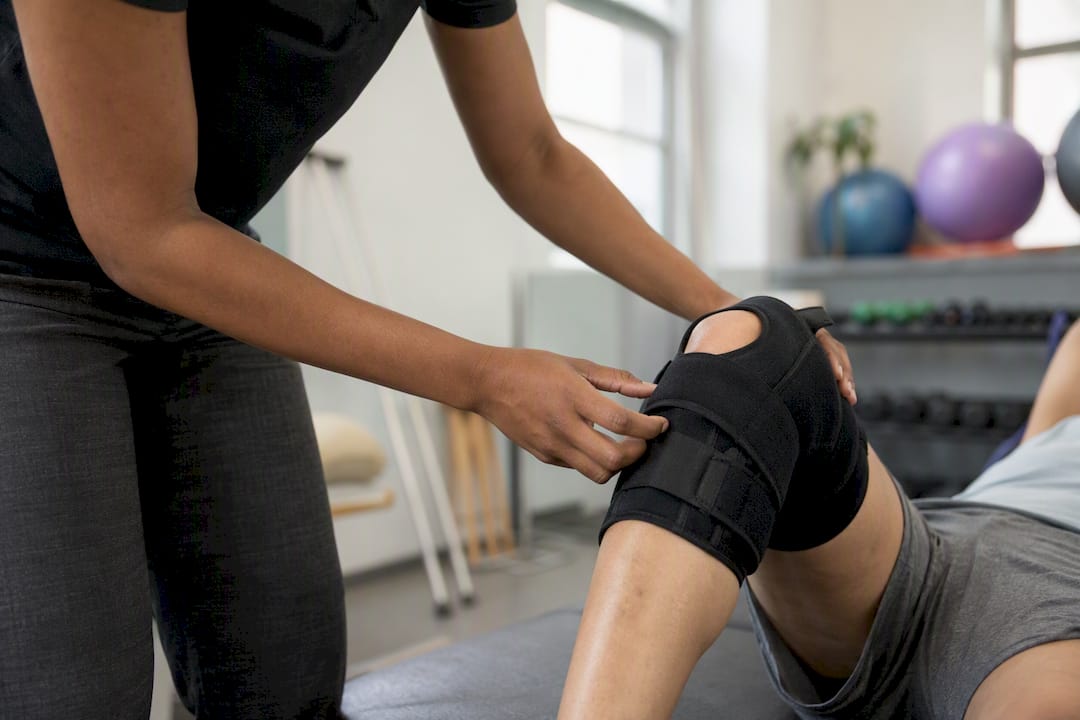
Job-shadowing is where good applicants get eliminated for administrative reasons, not academic ones. Wits requires a minimum of 16 hours of shadowing plus a signed certificate, and applications missing that document get excluded outright, regardless of matric performance.
Some entry routes add another layer. Applicants coming through alternative access programs, such as those requiring the Wits Access Programme Test (WAPT), face a separate selection test on top of standard requirements.
Pro Tip: Book your job-shadowing placement in Grade 11, not Grade 12. Physiotherapists get flooded with shadowing requests every October, and a signed certificate dated too close to the deadline raises red flags with admissions staff.
How to check if you actually qualify
You don’t need to guess your way through this, and you shouldn’t apply blind to five universities hoping one sticks.
- Calculate your APS honestly. Use AskSmarty’s APS calculator to run your actual or projected matric marks against real program thresholds, without your marks ever leaving your device.
- Search programs by your marks, not by name recognition. AskSmarty’s programme search filters physiotherapy programs by exact subject and NBT rules, so you see which ones you genuinely qualify for before you spend money applying.
- Register on each university’s self-service portal early. Wits, UP, UCT, and Stellenbosch all use separate systems, and account creation sometimes takes days to process during peak application weeks.
- Set calendar reminders for status checks. Portals rarely notify you proactively when a document is missing or an offer is issued.
Running scenarios before you commit to an application fee saves both time and money, particularly when testing different score combinations reduces the risk of applying somewhere you can’t realistically get in.
Application deadlines and documents you need ready
Physiotherapy intakes open early in the year and close months before the academic year starts, which surprises applicants used to thinking of “matric results in December” as the trigger point.
Wits offers a concrete example: its Graduate Entry Physiotheropy Programme opened applications on March 1, 2026, and closed on June 30, 2026, for the 2027 intake. That’s a six-month window, not a rolling deadline, and other universities run on similarly fixed calendars.
Before you start any application, gather:
- Certified copy of your matric certificate or latest school report
- Certified copy of your ID document
- Academic transcripts, especially if you’re applying through a graduate-entry route
- Completed bachelor’s degree certificate, only relevant for graduate-entry applicants like those applying through GEPP
- Signed job-shadowing certificate with dates and supervisor contact details
- Proof of application fee payment where required
Upload documents as soon as your portal account is active rather than waiting until the deadline week. Portals flag missing items, but they don’t always email you about it, so check your application status manually every few weeks. University application fees vary by institution, and unpaid fees are a common, avoidable reason applications stall.
Strengthening your application beyond the marks
Two applicants with identical APS scores can get very different outcomes, and the difference usually comes down to preparation admissions panels can actually see on paper.
- Get your job-shadowing certificate signed with real dates, the supervising physiotherapist’s contact details, and a specific location, since vague or undated certificates raise doubts.
- If you can’t access direct physiotherapy shadowing, related caring or public-facing roles can partially demonstrate commitment, though verified shadowing is still preferred where it’s required outright.
- Keep any personal statement focused on specific moments from your shadowing or caring experience rather than generic statements about “wanting to help people.”
- Ask referees to mention concrete observations, not just character praise, since specifics carry more weight in a panel review.
- If your first NBT attempt underperforms, weigh whether a retake fits your university’s rule on counting only the most recent year’s first sitting.
Pro Tip: A one-paragraph personal statement describing exactly what you observed during shadowing, a treatment technique, a patient interaction, a moment of clinical reasoning, tells admissions staff more than three paragraphs about your passion for helping people.
What actually separates the applicants who get in
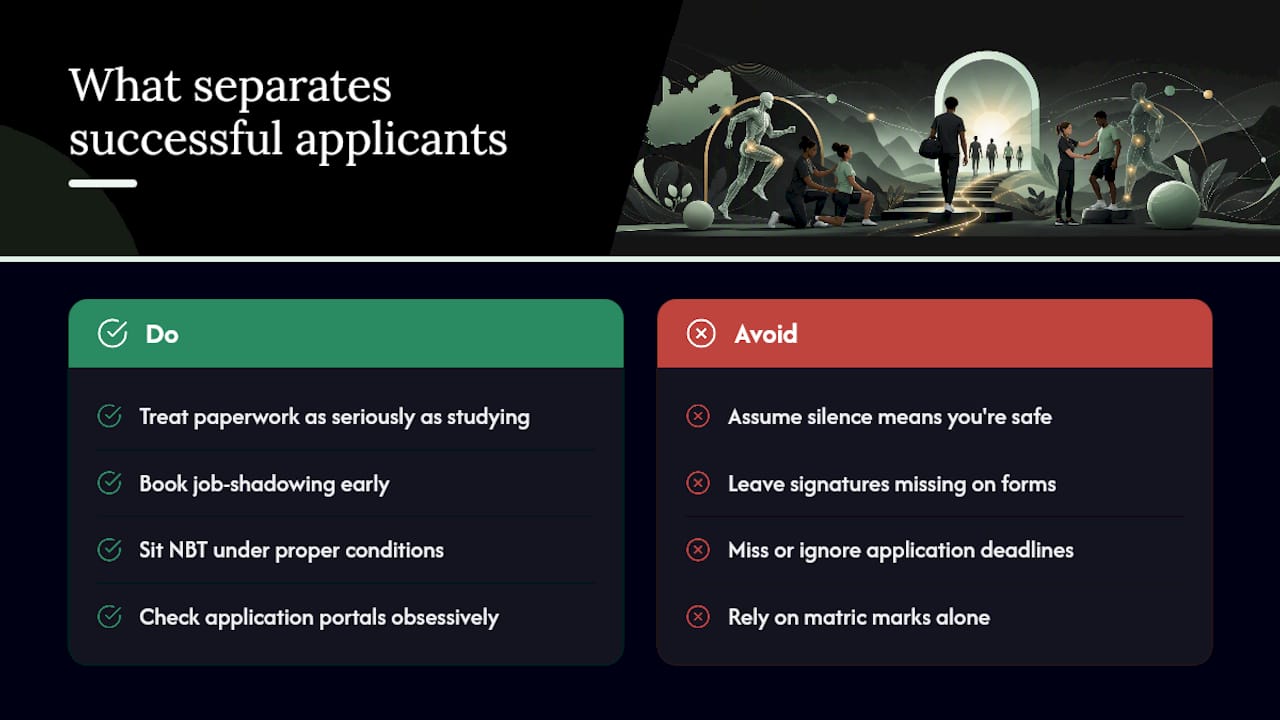
Most guidance on physiotherapy admissions focuses on marks, as if a high APS is the whole game. It isn’t. The applicants who get offers tend to be the ones who treated the administrative side of the process with the same seriousness as their studying, booking shadowing early, writing the NBT under proper conditions, and checking portals obsessively instead of assuming silence means good news.
The uncomfortable truth is that plenty of academically strong students lose their spot over a missing signature on a job-shadowing form or a missed deadline they didn’t track closely enough. That’s not a fairness argument, it’s just how selection with limited places works when NBT weighting and composite indices are involved. Plan for the paperwork as seriously as you plan for your exams, and use free tools to test your numbers before you commit money to an application. It’s a far better use of your energy than hoping your matric results alone will carry you.
— Nkosi
Use AskSmarty to find out where you actually qualify
Guessing which physiotherapy program fits your marks wastes application fees and time you don’t have during your final year of school. AskSmarty gives you a private way to run the numbers first: your marks stay on your device, there’s no fee to use the tool, and you get instant matches against a database of more than 1,700 South African university and college programs.
Start with the APS calculator to see exactly where your current or projected marks land against physiotherapy thresholds at Wits, UP, UCT, and Stellenbosch. From there, use AskSmarty’s programme search to filter by subject and NBT requirements so you only shortlist programs you can genuinely qualify for. If you want a deeper breakdown of how APS, NSC passes, and NBT scores interact across South African universities, AskSmarty’s requirements guide walks through the mechanics. Run your marks through the calculator today and build a shortlist you can actually act on before the next deadline closes.
Sources
- The Graduate Entry Physiotherapy Programme - GEPP - Wits University
- Choosing your path in rehabilitation: Physiotherapy vs Occupational Therapy - Careers4You
FAQ
What subjects do I need for physiotherapy in South Africa?
You typically need English, Mathematics, and Physical Science or Life Sciences on your NSC, usually at Level 4 or Level 5 depending on the university.
Is the NBT compulsory for physiotherapy applicants?
Most physiotherapy programs require the NBT, and some institutions, like Wits, weight it directly into their composite selection index alongside matric results.
How many job-shadowing hours does physiotherapy require?
Many South African institutions require a minimum of 16 hours of job-shadowing with a signed certificate, and applications without it can be excluded outright.
How do I know if my marks qualify me for a physiotherapy program?
Use AskSmarty’s APS calculator to test your actual or projected marks against real program thresholds before applying, without sharing your marks with anyone.
What happens if I miss the physiotherapy application deadline?
Missing the closing date, such as Wits’ June 30, 2026 deadline for its 2027 intake, generally means waiting for the next application cycle, since most physiotherapy programs don’t offer late or rolling admission.
Recommended
Published 2026-08-26 · AskSmarty is an independent guide. Confirm anything time-sensitive on the official source.