Public vs private universities: how to choose wisely
Navigating public vs private universities? Learn how to choose wisely based on net price after aid, graduation rates, and career outcomes.

For most in-state students, a public flagship or state university is the stronger financial default. A private university can be the smarter call when a high-need family qualifies for substantial institutional aid, or when a private school’s specific program and career outcomes clearly justify the higher sticker price. The real test is never the label. It’s the net price after aid.
Before you go further, check these four numbers for every school on your list:
- Net price after aid: run each school’s net price calculator, not the sticker price
- Graduation rate: find it on College Scorecard for your intended major
- Median early-career earnings: pull the program-level figure from College Scorecard, not the institutional average
- Student-to-faculty ratio: check the school’s published admissions or institutional research page
Sticker price is one of the most misleading numbers in higher education. A private school listing $55,000 per year may cost a qualifying family less than an in-state public after institutional grants. Run the calculator first, then form an opinion.
Table of Contents
- What actually separates a public from a private university?
- Cost: sticker price vs what you actually pay
- How financial aid actually works at each type
- Academic differences: majors, class size, and research access
- Campus life, size, and social fit
- How selective are public vs private universities?
- Graduation rates, career outcomes, and what College Scorecard tells you
- How to run the numbers: net price calculators and public data
- A practical checklist for making the final decision
- Key takeaways
- The prestige trap is costing families real money
- Useful sources for running your own research
- FAQ
What actually separates a public from a private university?
The difference comes down to funding and governance, not quality. Public universities receive state appropriations, which allows them to charge lower tuition to residents of that state. A board with state-appointed members typically governs them, and their mission usually includes broad access for in-state students across a wide range of fields.

Private nonprofit universities fund operations through tuition revenue, endowment returns, and donations. They charge one tuition rate regardless of where a student lives, but they often hold large endowments that fund substantial need-based grants. Harvard, for example, is private. So is MIT. So is a small liberal arts college with 1,200 students. The private label covers an enormous range.
Governance shapes more than tuition. State universities often respond to legislative priorities, which can mean strong funding for agriculture, engineering, or education programs tied to regional workforce needs. Private institutions set their own academic direction, which can mean faster pivots to new programs or a tighter focus on a particular educational philosophy.
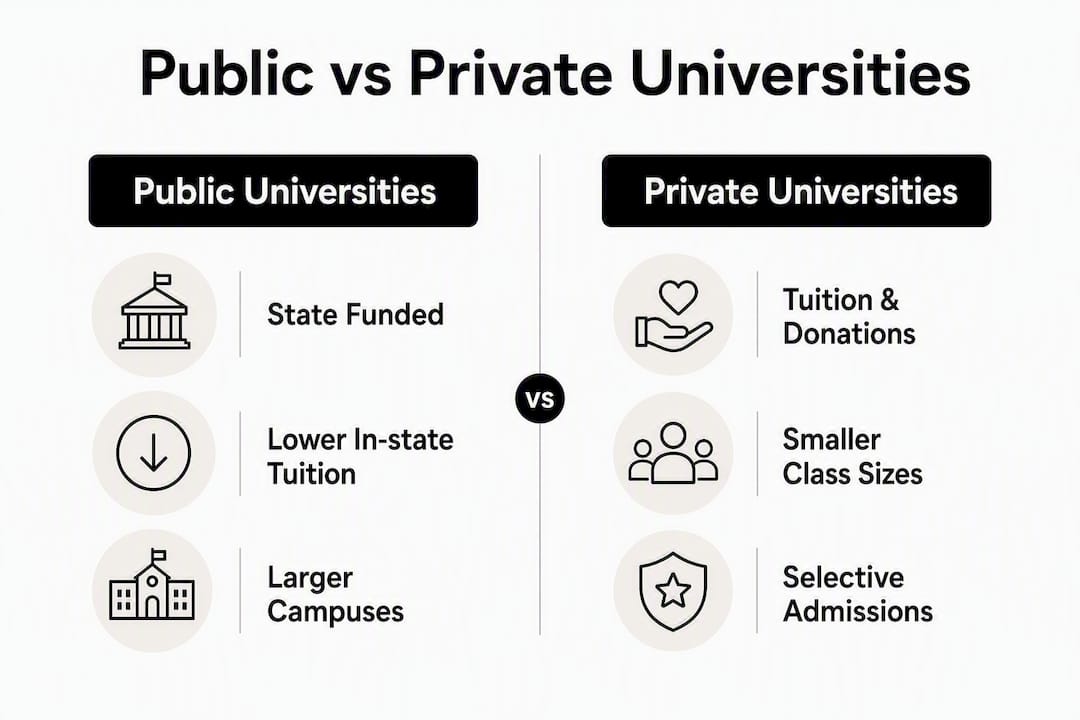
One thing the label does not determine: quality. A flagship public university can run world-class research labs and produce graduates who out-earn those from many private schools, depending on the program. The program and the school’s specific resources matter far more than whether the state funds it.
Cost: sticker price vs what you actually pay
Average in-state tuition at a public four-year institution runs about $9,750, compared to roughly $38,421 at a private nonprofit. That gap looks decisive until you factor in institutional aid. A private school with a large endowment can close much of that distance for families who qualify.
| Tuition type | Average sticker price | Typical net price after aid |
|---|---|---|
| Public, in-state | ~$9,750/yr | — |
| Public, out-of-state | ~$38,421/yr | Varies widely; limited institutional aid |
| Private nonprofit | ~$38,421/yr | — |
Sticker price figures from EducationData; net price averages from CampusROI.
Out-of-state public tuition deserves a specific warning. Out-of-state public tuition often approaches private tuition levels but rarely comes with the endowment-backed aid that makes some private schools genuinely affordable. Enrolling out-of-state at a public university is often the worst of both worlds financially, unless a merit scholarship or a program with no private equivalent justifies it.
Pro Tip: Every school on your list has a net price calculator on its website. Run it before you visit, before you fall in love with a campus, and before you compare financial aid letters. The number it produces is the only honest starting point for a cost comparison.
How financial aid actually works at each type
Public universities offer in-state students a built-in discount funded by taxpayers. Beyond that, their institutional aid budgets are typically smaller than those at well-endowed private schools. Federal aid, including Pell Grants and subsidized loans through FAFSA, is available at both types.
Private nonprofits with large endowments can offer need-based grants that dramatically reduce net price for qualifying families. Some elite private universities have adopted no-loan policies for families below certain income thresholds. That is not universal, but it is common enough to make dismissing private schools on sticker price alone a genuine mistake.
The single most common error families make is comparing a public school’s in-state sticker price to a private school’s sticker price and stopping there. The relevant comparison is always net price to net price, after each school’s aid offer is on the table.
When you receive award letters, check these items before accepting anything:
- Grants vs. loans: grants do not need to be repaid; loans do. Separate them clearly.
- Merit conditions: some scholarships require maintaining a GPA above 3.0 or a specific credit load. Miss the threshold once and the award disappears.
- Renewal terms: a one-year scholarship that is not guaranteed for years two through four is not a four-year offer.
- Work-study: this is earned income, not a grant. It reduces your bill only if you work the hours.
- Loan types: subsidized federal loans are cheaper than unsubsidized ones; both are cheaper than private loans.
Academic differences: majors, class size, and research access
Public universities generally offer a broader range of majors and more research infrastructure, particularly in STEM, agriculture, and professional fields. A flagship state university might house dozens of research centers, funded partly by federal grants and state appropriations. Public flagship STEM programs often yield earnings and employer pipelines comparable to elite private programs because of state-funded labs and strong regional employer relationships.
Private colleges, especially smaller liberal arts institutions, tend to offer smaller classes and closer faculty relationships. That structure suits students who learn better with direct mentorship, plan to attend graduate school, or are pursuing fields where writing, critical thinking, and one-on-one advising matter most.
Pro Tip: The public/private label is a weak predictor of program quality. Check the specific department’s accreditation, faculty research output, and undergraduate research participation rate for your intended major. A strong engineering program at a public flagship will often outperform a weaker one at a private school, regardless of prestige.
For each school you are considering, pull these data points:
- Number of majors and concentrations in your field
- Undergraduate research participation rate (ask the department directly)
- Published student-to-faculty ratio
- Percentage of courses taught by tenure-track faculty vs. adjuncts
- Lab and facility access for undergraduates specifically
Campus life, size, and social fit
Large public universities often enroll tens of thousands of students. That scale means hundreds of student organizations, Division I athletics, and niche communities for almost any interest. It also means you will need to be proactive. A student who does not seek out connections at a 40,000-person campus can feel invisible.
Smaller private colleges create a tighter social environment by default. You will see the same faces in class, at lunch, and at events. That closeness can be a strength or a constraint, depending on your personality.
Diversity looks different at each type. Large public universities tend to draw from across the state and increasingly from other states, producing geographic and socioeconomic variety. Some private schools have invested heavily in socioeconomic diversity through their aid programs; others remain less accessible to first-generation students.
Questions worth asking on any campus visit:
- What percentage of students live on campus after freshman year?
- How active are student organizations in your area of interest?
- What support exists for first-generation or low-income students?
- How does the school handle housing for students who cannot afford off-campus options?
How selective are public vs private universities?
Selectivity varies enormously within each category. Some public flagships, like UCLA and the University of Michigan, are highly selective. Many regional public universities admit the majority of applicants. Private schools span the same range, from open-access institutions to single-digit acceptance rates.
Test-optional policies, now common at both public and private schools, have shifted admissions toward holistic review at many institutions. That means essays, recommendations, and demonstrated interest carry more weight than they did a decade ago.
One pathway families often overlook: starting at an in-state community college and transferring to a public flagship. Many states have articulation agreements that guarantee admission to the flagship system for community college graduates who meet GPA requirements. This route can cut total four-year costs significantly while delivering the same degree from the same institution.
Key admissions points to track:
- Acceptance rate for your intended major (some programs are more competitive than the overall rate)
- Whether the school uses test-optional or test-blind policies
- Transfer articulation agreements with in-state community colleges
- Application deadlines and whether early decision or early action affects aid offers
Graduation rates, career outcomes, and what College Scorecard tells you
Families who focus on prestige often underweight graduation and completion rates, which are among the strongest predictors of whether a student actually benefits from enrolling. A school with a 55% six-year graduation rate is a different financial proposition than one with an 85% rate, regardless of its ranking.
College Scorecard lets you filter by field of study and see median earnings for graduates of specific programs, not just the institution as a whole. That distinction matters because a university’s average earnings figure blends engineering graduates with fine arts graduates. Pull the number for your major.
Career services quality also varies more within each category than between them. Ask directly: Which employers recruit on campus for your major? What is the placement rate for graduates in your field within six months? Does the school have alumni networks in the city or industry where you want to work?
Public universities average an ROI score of 57 versus 48 for private nonprofits when measured across large samples, with net price driving most of that gap. But that average conceals wide variation. A well-funded private school with strong career placement in your field can easily outperform a public school with weaker industry connections.
How to run the numbers: net price calculators and public data
This is the step most families skip, and it is the most important one. Here is how to do it properly:
- Record four numbers per school: — estimated net price per year, grants vs. loans breakdown, total four-year cost, and the graduation rate from College Scorecard.
| Metric | Where to find it | What to look for |
|---|---|---|
| Net price per year | School’s net price calculator | Compare across all schools, not vs. sticker |
| Graduation rate | College Scorecard | Aim for 70%+ for your major |
| Median earnings (your major) | College Scorecard program filter | Compare to loan total you would carry |
| Student-to-faculty ratio | School’s institutional research page | Lower is not always better; check class size data |
| Average public net price | — | CampusROI benchmark for comparison |
| Average private net price | — | CampusROI benchmark for comparison |
Pro Tip: If your four-year loan total at any school exceeds your expected first-year salary in your field, that is a warning sign worth taking seriously before you commit.
A practical checklist for making the final decision
Work through these steps in order. The earlier items carry more weight than the later ones.
- Compare program-level outcomes — for your intended major using College Scorecard. Look at median earnings and graduation rate, not the school’s overall ranking.
- Evaluate class size and academic support — Check the published student-to-faculty ratio, ask whether introductory courses are taught by faculty or teaching assistants, and confirm that undergraduate research opportunities exist in your department.
Decision rule: choose the school with the lower net price unless a more expensive option offers demonstrably better program outcomes, stronger career placement, or a scholarship that closes the gap. Prestige alone is not a program outcome.
Questions to ask the financial aid office: Is this aid renewable for four years? What conditions apply? What happens if my family’s financial situation changes?
Questions to ask the department: What percentage of graduates in this program find employment in the field within six months? Which employers recruit here?
Key takeaways
The single most important move any family can make is running each school’s net price calculator before comparing costs, because sticker price tells you almost nothing about what you will actually pay.
| Point | Details |
|---|---|
| Net price beats sticker price | Run each school’s net price calculator; a private school can cost less than an in-state public after aid. |
| Public flagships are the financial default | Average public net price (—) is lower than private (—); in-state enrollment is usually the safest financial starting point. |
| Program outcomes matter more than the label | Use College Scorecard to compare graduation rates and median earnings for your specific major, not the school’s overall average. |
| Out-of-state public is often the worst deal | Out-of-state public tuition averages ~$38,421/yr with limited institutional aid; weigh it carefully against private options. |
| Prestige is not a career outcome | Graduation rate and program-level placement data predict success better than rankings or the public/private label. |
The prestige trap is costing families real money
Most families walk into this decision with the same mental model: private equals better, public equals cheaper, and the goal is to get into the most prestigious school possible. That model is wrong in ways that matter.
The net price data tells a different story. A well-endowed private school can be genuinely affordable for a family earning under $75,000 a year. A flagship public can be the wrong call for an out-of-state student who pays near-private tuition without the institutional aid that makes some privates competitive. And a regional public with strong industry ties in your field can outperform a prestigious private on the metric that actually matters: whether you get a job in your field within six months of graduating.
The families who navigate this best treat it like a financial decision with academic inputs, not an academic decision with financial afterthoughts. They run the net price calculator before the campus visit. They pull College Scorecard data for their specific major before they fall for a school’s marketing. They ask career services hard questions about employer pipelines, not just about the career center’s hours.
One more thing: graduation rate is underrated as a selection criterion. A school where 40% of students do not finish is not just a statistic. It is a signal about advising quality, financial pressure on students, and whether the institution is set up for your success or just your enrollment.
Useful sources for running your own research
These are the tools that actually move the needle when you are comparing schools:
- College Scorecard: filter by field of study to find graduation rates and median earnings for your specific program, not just the institution.
- NCES IPEDS: the federal database behind most college data; use it to verify enrollment, faculty ratios, and completion rates.
- FAFSA (studentaid.gov): submit this first. Your Expected Family Contribution determines what aid you qualify for at every school.
If you are also exploring college and university options outside the U.S., Asksmarty’s university and college search covers South African institutions with program-level entry requirements, deadlines, and an APS calculator that matches your marks to qualifying programs privately, without your data leaving your device.
FAQ
What is the main difference between public and private universities?
Public universities are funded by state governments and charge lower tuition to in-state residents; private universities rely on tuition, endowments, and donations and charge one rate for all students, but often offer larger need-based grants.
Is a private university better than a public university?
Neither type is categorically better. The right choice depends on your net price after aid, your intended major’s program strength, and graduation outcomes at each specific school.
Is Harvard a public or private university?
Harvard is a private nonprofit university. It is not state-funded, though it receives federal research grants and offers substantial need-based aid that makes it free or near-free for families below certain income thresholds.
How do I compare the real cost of public vs private schools?
Run each school’s net price calculator with your actual family financial information, then compare four-year totals including living costs. Use College Scorecard to check graduation rates and median earnings for your specific major at each school.
Does out-of-state public tuition make sense financially?
Rarely, without a merit scholarship or a specialized program unavailable elsewhere. Out-of-state public tuition averages around $38,421 per year and typically comes with less institutional aid than comparable private schools offer qualifying students.
Recommended
Published 2026-08-02 · AskSmarty is an independent guide. Confirm anything time-sensitive on the official source.