How to reapply after rejection: South Africa guide
Facing a rejection? Discover how to effectively reapply after rejection in South Africa with practical tips and strategies to enhance your chances.

If your application was rejected, do this first: read the rejection letter today, note every deadline mentioned, and start parallel applications to alternatives immediately. Appeal only if you have a clear administrative error, missing documents you can now supply, or verified improved matric results. For everything else, treat this as a reapplication and move now.
Three actions for the next 48 hours:
- Read the rejection letter in full and note the exact reason given
- Confirm the appeal window or the next intake opening date by contacting admissions directly
- Begin applications to at least two realistic alternatives (TVET, distance learning, private college) while you decide on an appeal
Pro Tip: Create one physical folder and one timestamped email thread for all admission correspondence. If you appeal, that paper trail is your evidence.
Key takeaways
A rejection is not final: appeal only on narrow grounds (administrative error, missing documents, or improved results), and start a parallel reapplication immediately regardless of the outcome.
| Point | Details |
|---|---|
| Appeal grounds are narrow | Only appeal for administrative error, missing documents, or verified improved matric results. |
| Deadlines are strict | UNISA’s appeal window is typically 10 days; other institutions set faculty-specific dates. |
| One appeal per cycle | Many public universities allow only one appeal; a weak case wastes your only shot. |
| Strengthen before reapplying | Improve APS, update your personal statement, and get specific recommendation letters. |
| Asksmarty matches programmes | Use the free APS calculator at Asksmarty to find qualifying programmes instantly, with no data leaving your device. |
Table of Contents
- Should you appeal or reapply after rejection?
- What to do in the first 2–8 weeks: a deadline timeline
- How to strengthen your application before reapplying
- How Asksmarty helps you find programmes you actually qualify for
- What to include in an appeal letter and document checklist
- What are your realistic alternatives if reapplying this year isn’t possible?
- What most students and parents get wrong after a rejection
- Asksmarty: find programmes you qualify for right now
- Sources
- FAQ
Should you appeal or reapply after rejection?
This is the decision that shapes everything. Getting it wrong costs you weeks.
Appeals are appropriate mainly for administrative errors, missing documentation that can now be supplied, or verified improved matric results. An appeal asks the institution to review the same application on narrow grounds. It is not a second application, and admissions committees treat it that way.
Appeal if:
- Your results were captured incorrectly (administrative error with proof)
- A required document was missing and you can supply it now
- Your final matric results improved materially after a rewrite
Reapply instead if:
- You did not meet the APS threshold
- Your application was submitted late
- The programme was oversubscribed and you met the minimum but not the competitive cut-off
A fresh reapplication is usually the most effective route when rejection was due to not meeting academic criteria, late submission, or quota limits because it lets you address deficiencies and present a stronger file. Appeals for oversubscription almost never succeed. Contact your admissions office immediately to confirm whether your faculty allows appeals in this cycle and to get the exact procedure.
What to do in the first 2–8 weeks: a deadline timeline
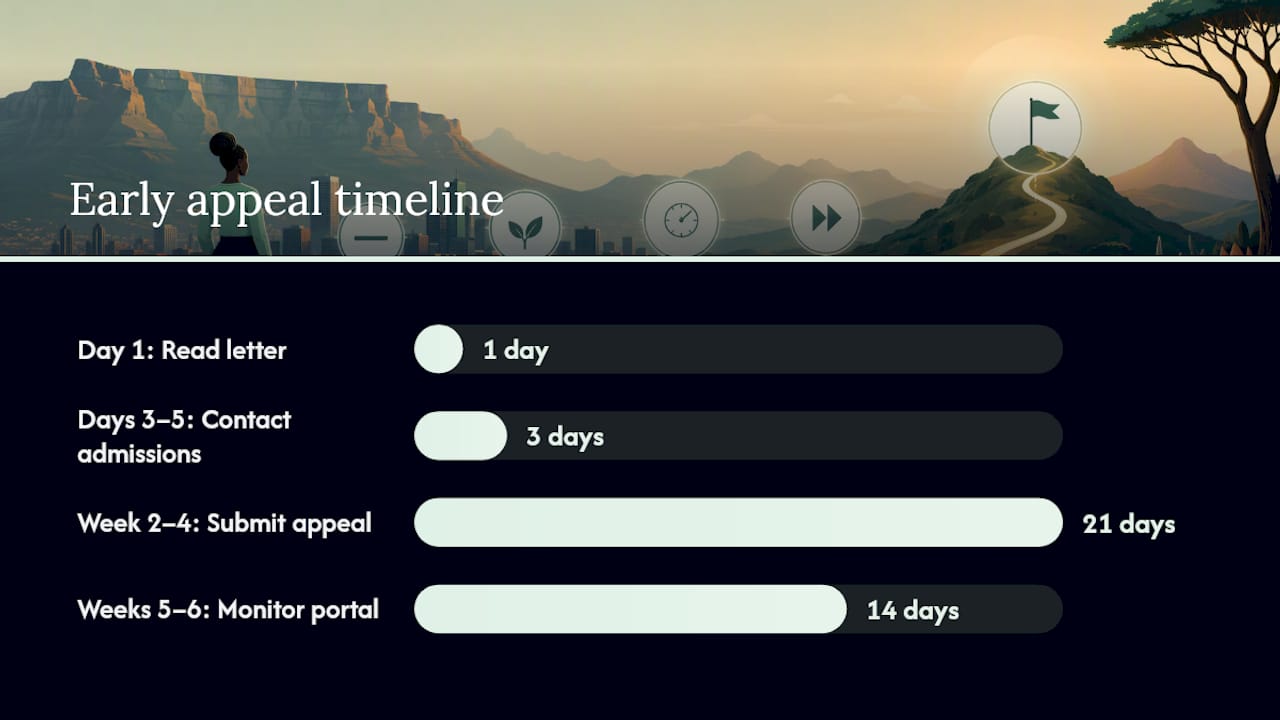
UNISA typically allows a 10-day window to submit an appeal after receiving the outcome. Other universities set faculty-specific dates, some as early as January. Missing the window by even one day usually ends your appeal rights for that cycle.

| Timeframe | Action | Notes |
|---|---|---|
| Day 1 | Read rejection letter; note reason and any deadline stated | Screenshot or print the letter immediately |
| Days 3–5 | Contact admissions in writing; request exact appeal deadline and reason if not stated | Use email so you have a record |
| Week 2–4 | Submit appeal with full evidence pack OR start next-intake application | Some institutions allow only one appeal per cycle |
| Weeks 5–6 | Monitor portal for appeal outcome; confirm alternative application deadlines | First-semester intakes typically open August–September the prior year; second-semester intakes open March–April |
Template email to admissions:
Set a calendar reminder the day you send it. Appeal windows are strictly enforced, and following up in writing increases the chance your appeal is processed correctly.
How to strengthen your application before reapplying
Advisors note that many rejections reflect oversubscription and competition rather than personal failure. The students who succeed on a second attempt treat the process strategically.
Academic fixes:
- Rewrite matric subjects to raise your APS. Use the APS calculator to see exactly which subjects to target for the programmes you want
- Enrol in a bridging or access programme. Several universities offer these for students who narrowly miss the threshold
- Take accredited short courses in your field. A National Certificate in a related area shows commitment and adds to your profile
Document and statement improvements:
- Rewrite your personal statement with specific examples of why you chose the programme and what you have done since your first application
- Get updated recommendation letters. Ask referees to speak to recent work, not the same generic praise from last year. Give them bullet points about what you want highlighted
Non-academic strengths:
- Volunteer work, community involvement, or part-time work in a related field all carry weight, especially for programmes in education, social work, and health sciences
- Portfolios matter for design, architecture, and fine arts. If yours was weak, rebuild it with new pieces before the next intake
Pro Tip: When asking for a recommendation letter, send the referee a one-page brief: the programme name, its entry requirements, and two or three specific things you want them to mention. Vague letters hurt more than they help.
Check university admission requirements for the exact APS, NBT, and subject prerequisites for your target programme before you reapply.
How Asksmarty helps you find programmes you actually qualify for
Asksmarty’s APS matching tool works differently from a standard programme search. You enter your subject marks directly in your browser, the tool matches them against over 1,700 programmes across South African universities and colleges, and your marks never leave your device. No account, no fee, no application processing.
Say your APS is 22 and your first-choice degree is out of reach this year. Enter your marks and Asksmarty immediately shows you TVET programmes, distance-learning options through UNISA, and private college diplomas that fit your current results. You can filter by study mode (full-time, part-time, distance), qualification type, and institution. That takes minutes, not days of searching individual prospectuses.
For a student with a stronger APS who simply applied too late, the tool surfaces mid-year intakes and second-semester openings at institutions like UKZN or UJ that are still accepting applications.
Pro Tip: Run the APS match before you appeal. If you find three realistic programmes you qualify for right now, you have a parallel plan. That reduces the pressure to win an appeal you might not win.
What to include in an appeal letter and document checklist
An appeal letter has one job: give the admissions committee a specific, evidence-backed reason to reconsider. Keep it short and factual.
Appeal letter structure:
- One sentence stating the ground for appeal (administrative error / missing document / improved results)
- A brief factual timeline (when you applied, when you received the outcome, what changed or was missed)
- A numbered list of attached evidence
- A respectful request for review and your contact details
Document checklist:
- Certified copy of your ID
- Certified final matric results or rewrite results
- Academic records from any post-school study
- Medical or legal documentation if exceptional circumstances apply
- Any document previously missing from your application, now certified
- Proof of administrative error (e.g., a screenshot of a portal error, a confirmation email)
A proper appeal must include certified certificates, academic records, or medical and legal documentation; incomplete or late appeals are commonly rejected. Submit everything in one complete package.
Follow-up cadence: Wait five working days after submission, then send one polite status-check email. Do not call daily. Some institutions take two to four weeks to respond. If an appeal fails, many universities do not allow a second appeal in the same cycle. If your grounds are weak, invest that energy in a stronger reapplication instead.
What are your realistic alternatives if reapplying this year isn’t possible?
Practical alternatives after rejection include TVET colleges, distance learning, private colleges, learnerships, and short skills courses, each with different trade-offs in time-to-start, cost, and final qualification.
- TVET colleges: Fastest entry, often no APS requirement, skills-focused National Certificates and diplomas. Good for trades, hospitality, IT, and business. Explore options at colleges in South Africa.
- UNISA (distance learning): Flexible, lower annual fees than contact universities, and multiple intake windows. Suits students who need to work while studying. Check the UNISA prospectus for 2027 programmes and deadlines.
- Private colleges: Faster intakes, smaller classes, and often more flexible entry requirements. Registered private colleges in South Africa must be DHET-registered, so check that status before enrolling.
- Learnerships: Employer-funded, NQF-accredited, and paid. A learnership in your field builds a CV while you prepare a stronger university application.
- Bridging or access programmes: Many universities run these specifically for students who narrowly miss the APS threshold. Completing one can qualify you for direct entry the following year.
Pro Tip: A three-year TVET diploma or a private college diploma can qualify you for advanced standing or a degree transfer at several South African universities. Ask the institution about their articulation agreements before you enrol.
What most students and parents get wrong after a rejection
The most damaging mistake is the reactive appeal: submitting one out of frustration, with no real grounds, because waiting feels better than doing nothing. At many public universities you get one appeal per cycle. Spending it on a weak case closes the door on a legitimate one.
Read the rejection letter fully before you do anything. The reason stated there tells you whether an appeal has any chance. If it says “programme full” or “APS below minimum,” that is not an appeal situation.
Parent handoff checklist:
- Help gather and certify documents (ID, results, academic records) but let the student write the appeal letter
- Set shared calendar reminders for every deadline mentioned in the rejection letter
- Contact the school counsellor for official guidance, not Facebook groups or WhatsApp forums
- Confirm application fees and payment methods in advance so a late payment doesn’t void a submission
The emotional weight of rejection is real. But students who start parallel applications immediately avoid long delays and keep their options open regardless of the appeal outcome. Plan for both paths at once.
Asksmarty: find programmes you qualify for right now
Rejection stings, but the next step is concrete: find out exactly which programmes match your current marks and start applying. Asksmarty’s free APS calculator and programme search does that in minutes, with no account and no fees. Your marks stay on your device.
Search over 1,700 programmes across South African universities and colleges, filter by study mode and qualification type, and get direct links to official application portals. Whether you are looking at a second-choice degree, a UNISA distance programme, or a private college diploma, find your programme and check deadlines before the next intake closes.
Sources
- How to Appeal a University Rejection in South Africa - EduFunds SA
- Studentroom
- UNISA Reapplication 2026: Your Guide After Rejection - Varsity Wise
Save your institution’s admissions email address and set a calendar reminder for every deadline in your rejection letter. Missing a window by one day is the most common and most avoidable reason appeals fail.
FAQ
When should you appeal vs. reapply after rejection?
Appeal only if there was an administrative error, a missing document you can now supply, or your matric results improved after a rewrite. For all other reasons, a fresh reapplication for the next intake is the stronger route.
How long does a university appeal take in South Africa?
Response times vary by institution, typically two to four weeks. UNISA’s appeal submission window is usually 10 days from the rejection date, and missing it ends your appeal rights for that cycle.
Can you reapply to the same programme after being rejected?
Yes. Most South African universities accept fresh applications for the next intake. Use the time to improve your APS, strengthen your personal statement, and submit earlier than you did the first time.
What documents do you need for a university appeal?
A certified ID, certified matric results, academic records, and any evidence specific to your grounds (medical certificates, legal documents, or proof of an administrative error). Incomplete submissions are routinely rejected.
How does Asksmarty help after a rejection?
Asksmarty’s free APS calculator matches your marks to over 1,700 South African programmes instantly, with your marks never leaving your device. It shows alternative programmes, mid-year intakes, and direct application portal links at no cost.
Recommended
Published 2026-08-12 · AskSmarty is an independent guide. Confirm anything time-sensitive on the official source.