Recognition of prior learning for South African applicants
Unlock your potential with recognition of prior learning in South Africa. Use your experience and skills for university access and credit.

Recognition of prior learning (RPL) lets you use formal, non-formal, or informal learning to gain university access, module credit, or advanced standing in South Africa. If you have years of workplace experience, short courses, or prior study but lack the exact qualifications a programme requires, RPL gives you a legitimate route in.
Three steps to start right now:
- Check SAQA guidance. The South African Qualifications Authority maintains national RPL policy and a list of current initiatives aligned to the National Qualifications Framework (NQF).
- Find your chosen university’s RPL office. Unisa has a dedicated RPL unit; the University of Johannesburg (UJ) publishes its RPL procedures on its official site. Both advise contacting the unit directly before applying.
- Gather your primary evidence. Start with a certified copy of your ID, an up-to-date CV, and signed employer reference letters. These three documents underpin almost every RPL submission.
Key takeaways
Recognition of prior learning in South Africa can grant university access, module credit, or advanced standing when your demonstrated competence maps to NQF-aligned outcomes at the institution you are applying to.
| Point | Details |
|---|---|
| RPL outcomes vary | You can gain access admission, module credit, advanced standing, or (rarely) a full qualification through RPL. |
| Evidence is everything | A certified ID, CV, employer letters, work samples, and a mapped portfolio are the core of any strong RPL submission. |
| Fees and timelines differ | A simple credit claim can resolve in six to eight weeks; a complex multi-module claim may take several months. |
| Start with SAQA and your institution | Contact SAQA for national policy guidance, then contact your chosen university’s RPL office for programme-specific rules. |
| Asksmarty for programme matching | After your RPL outcome, use Asksmarty’s programme database and APS calculator to find matching programmes and deadlines. |
Table of Contents
- How does recognition of prior learning work in South Africa?
- Who typically qualifies for RPL?
- What evidence and documents do you usually need?
- How do universities assess RPL claims?
- What do RPL fees and timelines typically look like?
- Step-by-step: how to apply for RPL at a South African university
- Where can you get help with RPL in South Africa?
- How Asksmarty helps you match programmes after RPL
- Why RPL deserves more credit than it gets
- Asksmarty helps you find the right programme after RPL
- Sources
- FAQ
How does recognition of prior learning work in South Africa?
RPL in South Africa is governed by the South African Qualifications Authority (SAQA) and anchored to the National Qualifications Framework (NQF). The NQF assigns every qualification a level from 1 to 10, and when an institution assesses your prior learning, it maps your demonstrated competencies against the outcomes required at the relevant NQF level. SAQA’s current RPL initiatives page sets out how institutions are expected to align assessments to those benchmarks.
The ILO’s RPL learning package makes a point worth holding onto: RPL assesses what you can do, not where you learned it. Whether your competence came from a formal classroom, a workplace, or self-directed study, the assessment measures outcomes. That framing matters because it means your informal experience is not automatically disqualified.
Possible outcomes from an RPL assessment include:
- Access admission — entry to a programme without the standard matric or prior qualification requirement
- Module credit or exemptions — recognition that you have already met the outcomes of specific modules, reducing your study load
- Advanced standing — entry at a higher year of study than the standard first year
- A full qualification (rare, and institution-dependent) — where the totality of your prior learning maps to all outcomes of a qualification
Institutions set their own benchmarks within the national NQF framework. Some use occupational standards; others use the specific module outcomes of the programme you are applying to. The OECD’s 2023 RPL booklet notes that when RPL is designed into modular programmes, it can meaningfully shorten the time to qualification by allowing learners to target only the gaps in their knowledge.
Pro Tip: Before you submit anything, ask the RPL office in writing whether a successful outcome will appear on your official academic transcript as NQF-aligned credits. Some institutions record the outcome; others do not. That distinction affects credit portability if you ever transfer.
Who typically qualifies for RPL?
There is no single eligibility test, but institutions generally look for three things: demonstrable competence in the relevant subject area, a clear link between your experience and the programme outcomes, and a gap between your formal qualifications and what the programme formally requires.
Common applicant scenarios:
- Mature learners without matric who have significant workplace experience in a field related to the programme they want to study
- Applicants seeking module exemptions based on prior formal study at another institution or a short course that covered equivalent content
- Vocational credential holders who want advanced entry into a degree programme, bypassing first-year modules they have effectively already completed
- Public sector employees covered by the DPSA’s RPL directive, which sets out a holistic approach to recognising competence in government roles
Two short examples illustrate the range. A 42-year-old site manager with 15 years of construction experience but no matric might apply for access to a built-environment diploma through RPL, submitting employer letters, project records, and a portfolio of completed work. A 28-year-old who completed a SETA-accredited short course in project management and wants to skip the introductory project management module in a business degree is a credit/exemption case — narrower in scope, faster to resolve, and often easier to document.
The honest caveat: not every institution offers RPL for every programme. Some faculties, particularly health sciences and law, restrict or exclude RPL for regulatory reasons. Always confirm with the specific faculty before investing time in a portfolio.
What evidence and documents do you usually need?
The strength of an RPL application lives almost entirely in the quality of the evidence. Assessors cannot award credit for competence they cannot verify, so your job is to make the connection between your experience and the module outcomes as explicit as possible.
Standard document checklist:
- Certified copy of your South African ID or passport
- Detailed CV (chronological, with specific duties and responsibilities, not just job titles)
- Signed employer reference letters on company letterhead, confirming your role and the nature of your work
- Copies of any certificates, diplomas, or transcripts from prior formal study
- Work samples: reports, designs, project plans, photographs of completed work, code repositories, or any tangible output you produced
- Records of continuing professional development (CPD): short courses, workshops, webinars, professional body membership
- Sworn affidavits where formal documents are missing or unavailable (for example, if a previous employer has closed)
Australia’s ASQA regulator draws a useful distinction: credit transfer requires documented proof that you completed a formal unit, while RPL requires evidence that you can demonstrate the outcomes of that unit. If you have a certificate, use it for credit transfer. If you have experience but no certificate, that is an RPL case, and the evidence you need is different.
Portfolio structure tips:
- Open with a clear index that lists every document and maps it to a specific module or learning outcome
- Present evidence chronologically within each section so the assessor can see how your competence developed
- Include both copies for submission and originals for verification
- Write a short reflective statement for each piece of evidence explaining what you did, what you learned, and how it relates to the outcome you are claiming
Pro Tip: Get every document certified before you submit, not after. Assessors routinely reject uncertified copies, which delays your application by weeks. Keep a master evidence map — a simple table with three columns: evidence item, module outcome it addresses, and document reference number.
How do universities assess RPL claims?
Assessment is not a single event. Most institutions use a combination of methods, and the mix depends on the complexity of your claim and the nature of the subject area.
Common assessment methods:
- Portfolio review — the assessor reads your submitted evidence and evaluates whether it demonstrates the required outcomes; the most common starting point
- Structured interview or professional conversation — a face-to-face or online discussion where the assessor probes your understanding and asks you to explain your experience in depth
- Practical demonstration — you perform a task or solve a problem in a controlled setting, common in technical, creative, or vocational fields
- Challenge or recognition test — a written or practical test that mirrors the module’s summative assessment; you pass it, you get the credit
- Workplace assessment — an assessor visits your workplace (or reviews documented workplace evidence) to observe competence in context
- Panel assessment — a group of assessors reviews your portfolio and interviews you, typically used for complex or high-stakes claims
The ILO learning package describes RPL as an outcomes-based process that can draw on any combination of these methods, with the choice driven by what the qualification standards require. New Zealand’s NZQA guidance similarly describes portfolio evidence, challenge tests, and interviews as standard tools, and notes that credit is formally recorded on the academic transcript when awarded.
The typical process flow looks like this: you submit your application and portfolio, the institution schedules an assessment (one or more methods), you receive feedback, and if gaps are identified, you may be offered bridging or gap training before a final decision. The outcome is then either credit awarded, partial credit with conditions, or a recommendation to complete the standard programme entry.
What do RPL fees and timelines typically look like?
Fees vary by institution and by the complexity of your claim. There is no national standard fee for RPL in South Africa. What drives the cost is the number of credits you are claiming, whether external assessors or a panel are required, and the administrative overhead of the intake process.
Factors that affect fees:
- Number of modules or credits being assessed
- Whether the institution uses internal or external assessors
- Whether a moderation panel is required
- Administrative and portfolio processing fees
Timeline factors:
- Administrative intake and eligibility screening (typically a few weeks)
- Assessment scheduling, which depends on assessor availability
- Gap training, if required before a final decision
- Moderation and quality assurance of the outcome
A straightforward credit exemption for one or two modules at an institution with a functioning RPL unit can sometimes be resolved within six to eight weeks. A complex claim involving multiple modules or access admission to a full programme can take several months, particularly if external assessors are needed or if the intake only runs once per semester.
Pro Tip: Before you pay any fee, ask for a written quote that specifies exactly what is covered and a realistic expected decision date. Some institutions charge a non-refundable assessment fee regardless of outcome. Know that before you commit.
Step-by-step: how to apply for RPL at a South African university
-
Identify the programme and confirm RPL is available. Not every programme accepts RPL. Check the faculty’s admissions page or contact the department directly. The Asksmarty university directory lists programmes and entry requirements across South African institutions, which helps you identify where to look first.
-
Contact the institution’s RPL office. Email or call before you submit anything. Ask whether RPL is open for your programme, what the current intake dates are, and what the fee structure looks like. For Unisa, the RPL unit handles this centrally. For UJ, the UJ programme page points you to the relevant faculty contact.
-
Map your evidence to module outcomes. Obtain the module outcomes or qualification outcomes for the programme. Work through each one and identify which pieces of your evidence address it. This mapping exercise is the core intellectual work of an RPL application.
-
Prepare and certify your documents. Assemble your portfolio using the checklist above. Certify every copy at a police station, commissioner of oaths, or post office. Write your reflective statements.
-
Submit your application and portfolio. Follow the institution’s submission instructions exactly. Some accept digital portfolios; others require physical submission. Keep a complete copy of everything you submit.
-
Attend assessments and follow up. Arrive prepared for an interview or practical assessment. After the assessment, follow up in writing to confirm the expected decision date. If gap training is recommended, ask for it in writing with a clear timeline.
Before you submit, confirm these three things with the RPL office:
- Will a successful outcome be recorded as NQF-aligned credits on your official academic transcript?
- Is there a specific intake deadline, or can you apply at any time?
- What happens if your claim is partially successful — can you complete gap training and resubmit?
Apply as early as possible relative to the normal admissions cycle. RPL decisions rarely arrive quickly, and missing an intake deadline because your RPL outcome was still pending is a frustrating and avoidable problem.
Where can you get help with RPL in South Africa?
Key contacts:
- SAQA — the primary national authority. Its RPL initiatives page explains national policy and lists current programmes. Start here for policy-level questions.
- Unisa RPL unit — Unisa has one of the more established RPL processes among South African universities. Contact the Unisa RPL office directly via the official Unisa website for programme-specific guidance.
- University of Johannesburg RPL unit — UJ’s RPL procedures are published on its official site. The Asksmarty UJ page gives you programme listings and contact entry points.
- DPSA — for public sector employees, the DPSA RPL directive sets out the framework that governs recognition in government departments.
Questions to ask when you contact an RPL office:
- What outcomes are possible for my specific programme (access, credit, advanced standing)?
- What evidence will you accept, and in what format?
- What are the current fees and expected timelines?
- How will the outcome be recorded on my academic transcript?
- Is there a limit on the number of credits I can claim through RPL?
Beyond the RPL office itself, student support units and career guidance services at many institutions can help you structure your portfolio and prepare for an interview assessment. If your experience is primarily vocational, TVET colleges may offer a more direct RPL pathway than a university, particularly for NQF levels 2 to 5.
How Asksmarty helps you match programmes after RPL
Once you have an RPL outcome, the next practical question is: which programmes will accept it, and what are the deadlines? Asksmarty’s programme database and admission requirements tool let you check entry requirements, NQF level expectations, and application deadlines across more than 1,700 programmes at South African universities and colleges.
A few things to keep in mind:
- Asksmarty provides matching and informational tools. It does not assess RPL claims, award credits, or make admissions decisions. Those decisions rest entirely with the institution.
- Use the APS calculator to test your effective entry standing once you know which credits or exemptions your RPL outcome includes.
- If your RPL outcome grants access admission to a programme, use the Asksmarty programme pages to confirm the application deadline and submission requirements for that specific intake.
The OECD’s RPL guidance points out that RPL works best when it connects to a clear modular pathway. Knowing which programme you are targeting before you start your RPL application makes the evidence-mapping process sharper and the outcome more useful.
Why RPL deserves more credit than it gets
Most people who could benefit from RPL never pursue it. The documentation feels daunting, the process seems opaque, and the cost-benefit calculation is unclear when you are not sure the institution will recognise your experience anyway.

Here is what that hesitation costs: years of additional study covering ground you have already covered, often at significant financial and personal expense. The ILO’s research on RPL notes that making previously invisible skills visible delivers psychological benefits alongside formal ones, including stronger self-esteem and better labour-market outcomes. That is not a soft finding. It reflects something real about what happens when people see their own competence formally acknowledged.
The practical advice is to start small. Do not begin by trying to claim a full qualification through RPL. Target one or two module exemptions where your evidence is strongest. A single successful exemption builds your confidence, gives you a sense of how the institution’s assessors work, and reduces your study load immediately. From there, you can decide whether a broader claim is worth pursuing.
The anxiety about documentation is real but manageable. Most of what you need already exists: your employment records, your CV, letters from managers who know your work. The portfolio is not about creating new evidence. It is about organising what you already have into a form that assessors can evaluate against specific outcomes.
Asksmarty helps you find the right programme after RPL
Getting an RPL outcome is only half the work. The other half is finding the right programme, at the right institution, before the application deadline closes.
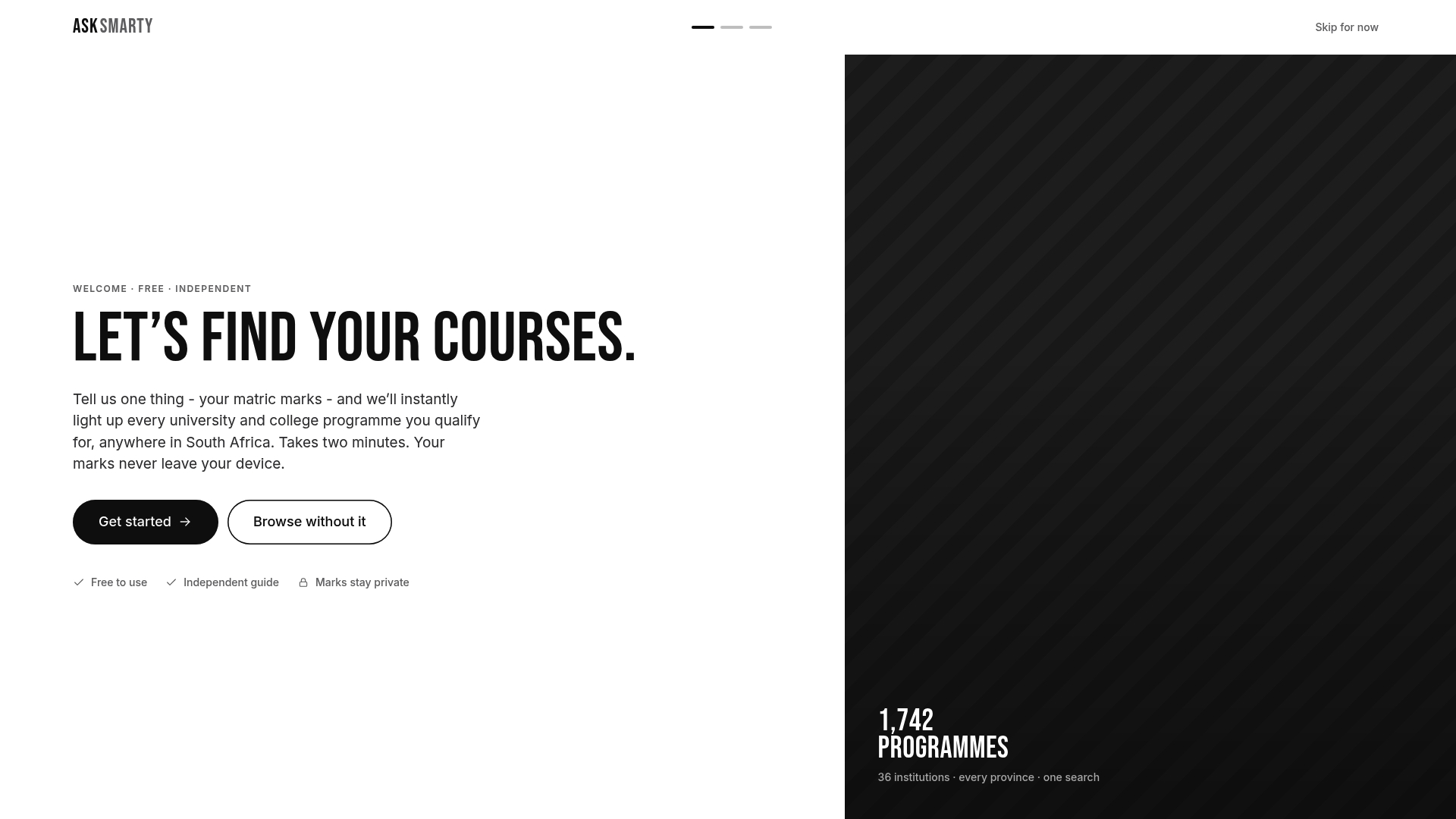
Asksmarty is a free, independent guide to South African higher education. It is not an RPL assessor and does not process applications. What it does is give you a searchable database of over 1,700 programmes with entry requirements, deadlines, and application fee details, so you can match your RPL outcome to a real programme and intake. Check UCT programme requirements or Stellenbosch deadlines in seconds, without sharing your marks with anyone. Use the APS calculator to see where your effective entry standing lands after RPL credits are factored in, then go straight to the institution’s application portal from the same page.
Sources
- Current Recognition of Prior Learning (RPL) initiatives in South Africa
- Recognition of Prior Learning (RPL) Learning Package (ILO PDF)
- Recognition of prior learning: OECD (RPL 2023 booklet)
- Credit transfer and recognition of prior learning (RPL) — ASQA
FAQ
Who qualifies for RPL in South Africa?
Anyone who can demonstrate competence against the outcomes of a qualification or module may qualify, regardless of where or how that competence was acquired. Common applicants include mature learners without matric, workers with significant industry experience, and people with prior study at another institution.
What documents are required for an RPL application?
Most institutions require a certified ID, a detailed CV, signed employer reference letters, copies of any prior certificates or transcripts, and work samples or a portfolio. Where formal documents are unavailable, a sworn affidavit may be accepted.
How much does RPL cost in South Africa?
Fees are set by each institution and vary based on the number of credits claimed and the assessment methods required. There is no national standard fee. Always request a written fee quote before paying, as some institutions charge non-refundable assessment fees regardless of outcome.
How do I know if I qualify for recognition of prior learning?
Contact the RPL office at your chosen institution with a summary of your experience and the programme you want to enter. They will screen your eligibility and advise whether a formal RPL application is worth pursuing. SAQA’s national guidance page is also a useful starting point for understanding the framework.
Can RPL affect my student funding or financial aid eligibility?
RPL outcomes that reduce your registered credit load may affect NSFAS or bursary calculations, since funding is often tied to full-time equivalent study. Confirm with your institution’s financial aid office how an RPL-based exemption will be treated before you finalise your registration.
Recommended
- AskSmarty - Find your course anywhere in South Africa, check if you qualify, apply
- University of South Africa - Programmes, Deadlines & How to Apply | AskSmarty
- University of the Witwatersrand - Programmes, Deadlines & How to Apply | AskSmarty
- University of Pretoria - Programmes, Deadlines & How to Apply | AskSmarty
Published 2026-08-10 · AskSmarty is an independent guide. Confirm anything time-sensitive on the official source.