Rolling Admissions in South Africa: Do They Exist?
South African universities rarely run true rolling admissions, but some courses fill first-come, first-served. See how it works and where late applications are possible.

Mostly, no. South African universities do not run rolling admissions the way some US colleges do, where applications are reviewed as they arrive until a class is full. Most set a closing date, rank applicants after that, and make offers in rounds. Still, some courses fill on a first-come basis, some institutions accept late applications, and many keep deciding for months after the deadline. This guide shows which is which, and how to find out if the course you want is still open.
TL;DR
- There is no national rolling-admissions system. Each university and college sets its own closing dates, and many programmes are number-limited.
- “Rolling decisions” are common: universities keep evaluating, waitlisting and issuing offers after the deadline, but late applications are often refused for competitive courses.
- Some institutions consider late applications, usually with a later cut-off and sometimes a higher fee. Medicine, pharmacy and radiography are the courses most likely to close hard.
- Meeting the minimum requirements or your APS never guarantees a place, so apply early and check your status on the institution’s portal.
- Check your marks against programme requirements before you spend money on applications.
Table of Contents
- What rolling admissions means, and what South Africa does instead
- How offers actually roll out
- Late applications: who may accept them
- Colleges and other routes
- Check what you qualify for before you apply
- Perspective: apply early, even when the door looks open
- How to apply, and which documents to have ready
- Is a course still open? How to check
- Find your course with AskSmarty
- FAQ
- Sources
What rolling admissions means, and what South Africa does instead
In a true rolling system, an institution opens applications, reviews each one as it comes in, and answers within weeks. Places run out as the class fills, so early applicants have the edge. There is no single deadline.
South Africa’s public universities mostly work differently. They publish a closing date, usually in the year before you start. They then take your results (preliminary first, final NSC later), calculate a score, and rank you against others applying for the same course. Two ideas often get mixed up:
- Rolling applications: you can apply at any time until the course is full.
- Rolling decisions: you must apply by the deadline, but the university keeps issuing offers, waitlist outcomes and status updates over many months.
South Africa is mostly the second. The University of Cape Town’s Faculty of Health Sciences is a clear example. Its undergraduate FAQ explains that selection continues after applications close on 31 July 2026 until January 2027, conditional offers go out in September for strong preliminary results, and late applications are not accepted. The decisions roll, but the door closes on a set date.
How offers actually roll out
UCT’s directions for 2027 applicants separate four outcomes: a conditional offer, a firm offer, a deferred decision and a waitlist. A waitlisted applicant gets a final decision only once the university knows more about the whole applicant pool. Other universities use similar labels.
The University of Johannesburg works in batches. According to Mail & Guardian, UJ ranks applicants after final Grade 12 results, admits the highest-ranked eligible applicants first, waitlists others, and may offer places to waitlisted applicants if admitted students do not register. That is why a waitlist spot in January or February is not a lost cause.
The University of the Free State admissions policy adds another layer. You may be conditionally admitted on final Grade 11 results, with final admission depending on Grade 12 results and programme requirements. Its general closing date can be extended to meet enrolment targets, while selection programmes keep their own dates.

Where first-come, first-served shows up
Some programmes do work close to a rolling model. Walter Sisulu University’s admission requirements for one mathematical sciences and computing programme describe selection as subject to enrolment limits and on a first-come, first-served basis. The University of Pretoria says its programmes are number-limited and encourages you to apply as soon as applications open. It also says meeting the minimum requirements does not guarantee admission.
Unisa is the closest to an open model. A 2019 report on its application model said applications were open and continuous through the year, but that did not guarantee registration for the next semester or year. Qualifications could close when full or shortly before registration. Unisa’s process has changed since then, so read its current application page before you rely on this.
Late applications: who may accept them
Late does not mean rolling, but it is the nearest thing most applicants will find. The rules differ by institution and by course.
| Institution type | What the published rules show | What to watch |
|---|---|---|
| Nelson Mandela University | Considers late applications on academic merit until its September closing date | MBChB, Pharmacy and Radiography are not considered after their own published closing dates |
| Mangosuthu University of Technology | Accepts applications until 30 September, late applications until 30 November | Late applications are handled with a different cut-off |
| MUT and private colleges via the CAO | For 2025 entry, late applications carried R470 for South African citizens and R580 for international applicants | Fees change each year, so check the current CAO page |
| UCT Health Sciences | No late applications | Decisions continue, but the application window does not |
These dates repeat each year in a similar pattern, but exact days move. Always confirm the current cycle on the institution’s own admissions page. Be careful with lists on other websites that claim a university is “still open”, because they go stale quickly.
The pattern most years
General closing dates for many universities fall between mid-year and the end of September, and some extend to October or later. Competitive courses close earlier. Health sciences, architecture, and anything with a selection test or portfolio usually close mid-year. After the main date, a few institutions reopen for a short late window, run a walk-in or mobile enquiry system, or fill remaining places in January once final results are in. If your matric results come out and you missed everything, that January window is where you should call and ask.
Colleges and other routes
If universities have closed, you still have options. In February 2026, PressPortal reported that many universities had closed general admissions for 2026 while some colleges were still accepting late applications. Public TVET colleges often take applications later and register students on a more open basis than universities. Minister Buti Manamela’s statement on readiness for the 2026 academic year presents TVET and community education colleges as important pathways alongside universities. That includes a route to a diploma and, later, to degree-level study. Contact the college directly for the programme and campus you want.
Private colleges and distance providers set their own intakes. Some register throughout the year. If you are comparing them, check accreditation and the registration terms before you pay anything.
Check what you qualify for before you apply
A late application wasted on a course you do not qualify for costs you a fee and a place in someone else’s queue. Start with the basics. A Bachelor’s pass requires, according to the Department of Basic Education, 40% in your Home Language, 50% in four other subjects excluding Life Orientation, 30% in the language of learning and teaching and one other subject, and six of seven subjects passed. That is the floor for a degree, not a ticket to any course.

Each university then sets its own APS (admission point score), subject requirements and levels. Our guide to the minimum subject percentages for university explains how they combine. If you are aiming at a specific institution, our breakdowns of UJ APS requirements and Wits APS scores show how a buffer of a point or two can matter. For high-demand fields, see medicine entry requirements.
Why aim for a buffer? Because universities rank eligible applicants in a pool, and, as the Mail & Guardian notes, provisional admission only confirms you meet the minimum, not that you hold a seat.
Perspective: apply early, even when the door looks open
We get the same question often: “If a place is still open, can I wait for my final marks?” Our answer is no. Where a course is capacity-limited, the safest assumption is that the number of seats is fixed and that time works against you. A late window is a second chance, not a plan.
What we have built at AskSmarty follows from that. Your marks stay on your device, so you can test any number of scenarios without handing over your data. You see which of over 1,700 programmes you qualify for, including where you are a point or two short, and you apply on the official portal. We are independent of any university, and we do not charge you or take your application. The point is to help you apply only where you have a real chance, and to do it before the deadline, not after.
— Nkosi
How to apply, and which documents to have ready
The government’s guidance on registering at a tertiary institution is simple: choose a course you qualify for, apply directly to the institution, complete its application form and submit it with all required documents. International applicants must also apply for a study permit and have foreign qualifications evaluated by SAQA.
Unisa’s application guidance is a good checklist of the typical documents:
- School qualifications and, where applicable, official tertiary academic records.
- An RSA ID or international passport.
- Marriage or divorce documents where applicable.
- Sworn translations for documents not in English or Afrikaans.
- The application fee, and complete, legible uploads.
Scan everything before you start. A blurry upload is a common reason for delay, and delay is costly when seats are limited.
Is a course still open? How to check
The order below saves the most time.
- Go to the programme page on the institution’s own site. It lists the closing date and whether the course is full.
- Check the CAO. The Central Applications Office has a centralised portal where applicants can see available programmes and monitor their application status. It covers participating institutions only.
- Phone or email admissions. Ask whether late applications are considered for your exact programme and what the fee is.
- Watch your status. Applicants are advised to regularly check their status on the university’s student portal, where updates such as Conditional Offer, Firm Offer or Waitlisted appear, as set out in the UCT directions.
- Keep a backup. Apply to a second institution or a related course with a lower APS, and consider a college route.
Find your course with AskSmarty
Our free tool lets you enter your matric marks and see which programmes you qualify for, with entry requirements, deadlines and application fees in one searchable database. Nothing is stored on our servers, and there is no account. When you find a fit, you get a link to the official portal to apply.
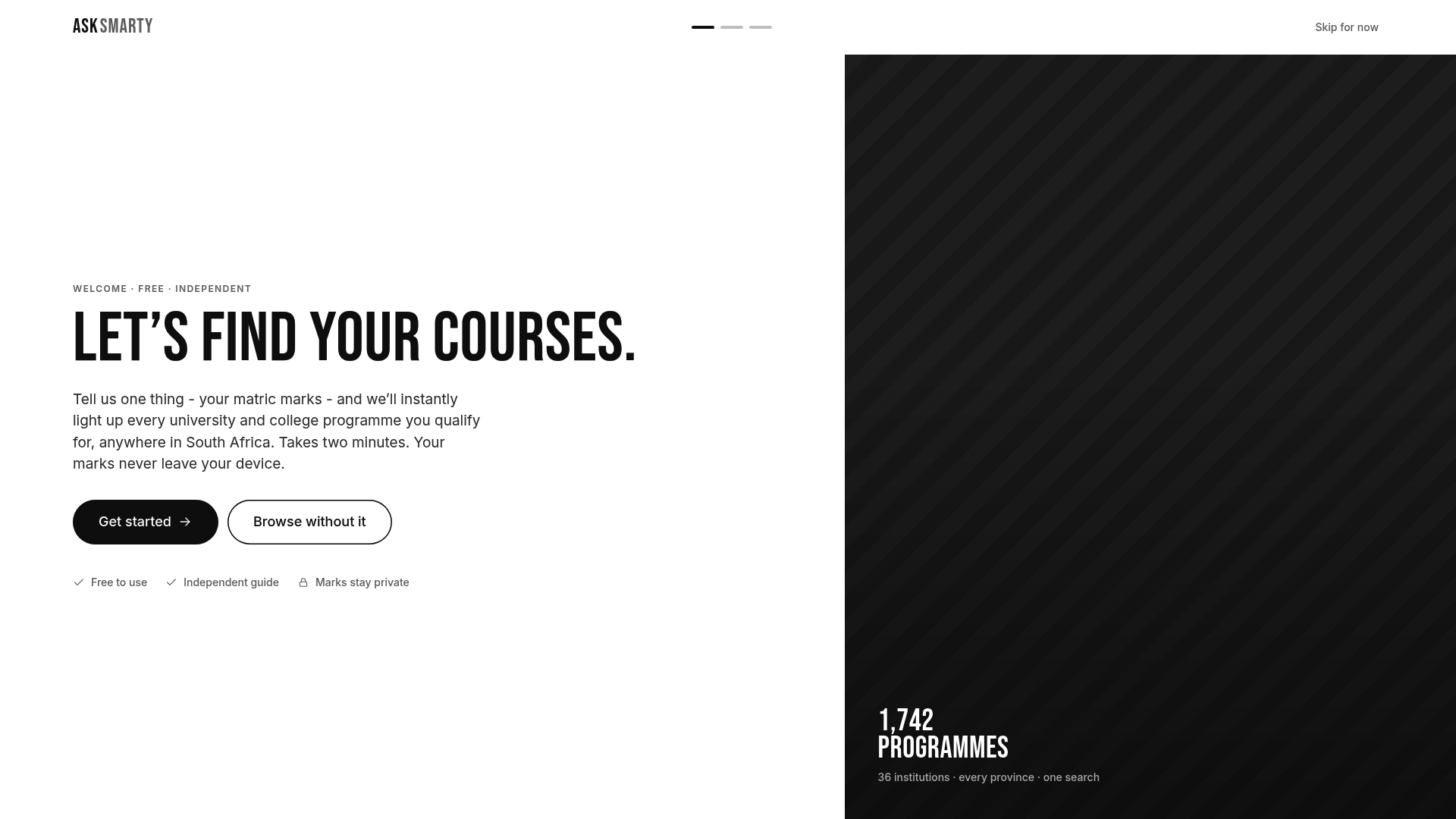
Start on the AskSmarty homepage and work through the list. If you are leaning toward a field, our guides on teaching entry requirements, psychology entry requirements and architecture entry requirements show where common marks land. Applying to UFS? See our UFS application guide.
FAQ
Do South African universities use rolling admissions?
Not in the strict sense. Most set a closing date and then keep issuing offers and waitlist decisions for months. A few programmes select first-come, first-served until places are full, and Unisa has used a continuous model, so check each institution.
Which universities are still accepting applications?
It changes every cycle, so no fixed list stays correct. Some institutions, such as Mangosuthu University of Technology, publish a late-application window, and Nelson Mandela University considers late applications until its September date for most courses. Check the current admissions page of each institution.
Can I apply late and still get in?
Sometimes. Late applications may be considered where places remain, but medicine, pharmacy, radiography and similar courses usually do not accept them. Expect a possible higher fee, and apply to a backup option at the same time.
Does meeting the APS guarantee a place?
No. The APS and subject levels make you eligible, but places are limited, and eligible applicants are ranked against each other. Final admission also depends on your final NSC results and available space.
What if all universities are closed?
Look at TVET and other colleges, private providers with accredited programmes, or a bridging or access programme. Contact them early, since many register students after the university cycle has ended.
Sources
- Undergraduate FAQ’s, UCT Faculty of Health Sciences
- Directions for undergraduate applicants 2027, UCT
- Important information for prospective students, University of Pretoria
- Admissions Policy, University of the Free State
- Admission requirements, Walter Sisulu University
- Why you are not guaranteed a place at university, Mail & Guardian
- UNISA modifies its application model, Gauteng News
- Study @ Mandela, Nelson Mandela University
- Apply, Mangosuthu University of Technology
- Available programmes and general queries, CAO
- 2027 Entry FAQs, CAO
- Announcement of 2024 NSC examination results, gov.za
- Minister Manamela: State of readiness for the 2026 academic year, gov.za
- Register at a tertiary institution, gov.za
- Apply for admission, Unisa
- Colleges offer late applications as universities close 2026 admissions, PressPortal
Recommended
Published 2026-10-30 · AskSmarty is an independent guide. Confirm anything time-sensitive on the official source.