Scarce skills in South Africa: how to pick a course
Explore scarce skills in South Africa across key sectors. Learn how to choose the right course for in-demand careers. Act now!

South Africa’s most critical scarce skills are concentrated in five sectors: **healthcare, IT and data, engineering and the built environment, finance and accounting, logistics and supply chain management, and renewable energy emerging fast as a sixth. The DHET’s 2024 National List of Occupations in High Demand is the official reference point, covering 350 occupations across the post-school education and training system and scheduled for its next update in 2026.
Here is a quick scan of the occupations that stand out across those sectors:
- Healthcare: Medical doctors, professional nurses, pharmacists, radiographers
- IT and data: Software developers, data analysts, cybersecurity specialists
- Engineering and built environment: Civil engineers, electrical engineers, quantity surveyors
- Finance and accounting: Chartered accountants, management accountants, internal auditors
- Logistics and supply chain: Supply chain managers, logistics coordinators
- Renewable energy: Solar PV technicians, energy efficiency engineers
The list is reviewed every two years, with updates expected on a regular schedule. Bookmark the Government Gazette publication and check back when you are ready to apply.
Table of Contents
- What does ‘scarce skills’ actually mean in South Africa?
- What is the DHET national list and how should you read it?
- Which sectors show the biggest skills shortages right now?
- What qualifications and training routes lead to these careers?
- How do you use scarce-skills signals to choose a course?
- How Asksmarty helps you match your marks to qualifying programmes
- Where to track scarce-skill demand and stay current
- Key takeaways
- Why matching official signals with realistic planning actually matters
- Asksmarty turns scarce-skills research into a real study plan
- Useful sources and links
- FAQ
What does ‘scarce skills’ actually mean in South Africa?
The term gets used loosely, so the distinction matters. A scarce skill refers to a situation where employers cannot find suitably qualified, experienced, or available people to fill a role. The shortage can be absolute (too few people trained) or relative (people are trained but not in the right location, or they have emigrated).
The Department of Employment and Labour uses this framing in its scarce skills publications, and it underpins the Critical Skills Visa category administered by the Department of Home Affairs.
The DHET’s Occupations in High Demand (OIHD) list is a related but distinct concept:
For a jobseeker or student, the practical difference is this: the OIHD list tells you which occupations the system is trying to produce more graduates for. That signals where bursaries, SETA funding, and learnership opportunities are likely to concentrate. The scarce-skills designation, by contrast, tells employers where they will struggle to hire and may need to pay a premium.
Both signals point in the same direction for career planning. If an occupation appears on both lists, the demand is real and the training pipeline has not caught up yet. That gap is where your opportunity sits.
What is the DHET national list and how should you read it?
The 2024 National List of Occupations in High Demand, published in the Government Gazette, contains 350 occupations and is the most comprehensive official signal South Africa has for post-school planning. DHET plans regular iterations of the list on a biennial basis.
How the list is compiled
The DHET uses a three-stage methodology that draws on multiple data sources rather than relying on any single indicator:
- Stage 1 — Quantitative indicators: — Data from the Quarterly Labour Force Survey (QLFS), the Labour Market Demand Survey (LMDS), and online job portal vacancy data are combined into a demand score for each occupation.
This multi-indicator approach reduces the distortion that any single data source would introduce. Job-portal data alone, for example, over-represents urban white-collar roles; the QLFS corrects for that.
What the list is — and what it is not
| Fact | Detail |
|---|---|
| Total occupations listed | 350 |
| Main data sources | QLFS, LMDS, job-portal vacancy data, employer mentions |
| Review frequency | Every two years |
| Next expected update | 2026 |
| Primary purpose | PSET enrolment and curriculum planning |
| Not intended for | Direct immigration or foreign-recruitment decisions |
One structural problem the list reflects: around 51.7% of South African workers are employed in occupations that do not match their education level — 23% are over-qualified and 28.7% are under-qualified for their current roles. That mismatch is precisely why the OIHD list exists. The system is trying to correct a long-standing misalignment between what gets taught and what employers actually need.
Some occupations on the list carry an asterisk. These are occupations where demand is particularly acute or where the shortage has persisted across multiple list iterations. Pay attention to those when you are shortlisting study options.
Which sectors show the biggest skills shortages right now?
The most in-demand sectors by the mid-2020s are healthcare, IT and data, engineering and the built environment, finance and accounting, and logistics and supply chain management. Here is what that looks like at occupation level, with qualification tiers included so you can find your entry point.

Healthcare
South Africa faces a persistent shortage of clinical professionals at every level.
- Professional level: Medical doctors (MBChB, 6 years), specialist physicians, pharmacists (BPharm, 4 years)
- Diploma/degree level: Professional nurses (4-year degree, registration with the South African Nursing Council), occupational therapists, physiotherapists
- TVET/technician level: Emergency care technicians, enrolled nurses, dental assistants
Registration with the Health Professions Council of South Africa (HPCSA) is mandatory for most clinical roles before you can practice.
IT and data
Demand here is broad and growing faster than any training pipeline can fill. Software developers, data analysts, and cybersecurity specialists are consistently flagged across employer surveys and media intelligence.
- Professional level: Software engineers (BSc Computer Science or Engineering), data scientists, cloud architects
- Diploma level: IT support specialists, network administrators, systems analysts
- Short-course/certification level: Cybersecurity analysts (CompTIA Security+, CISSP), data engineers (Google or AWS certifications)
The cybersecurity and data engineering niches deserve special attention. Both are growing rapidly, both have high entry barriers, and both reward candidates who combine a formal qualification with a recognized vendor certification.
Engineering and built environment
South Africa’s infrastructure backlog and energy transition are driving sustained demand. Professional engineers must register with the Engineering Council of South Africa (ECSA) before they can sign off on designs or supervise construction.
- Professional level: Civil engineers, electrical engineers, structural engineers (BEng/BSc Eng, 4 years + ECSA registration)
- Diploma level: Civil engineering technicians, electrical technicians (National Diploma, 3 years)
- TVET level: Electricians, plumbers, bricklayers (trade certificates via apprenticeship)
Finance and accounting
Chartered accountants (CA(SA)) remain one of the most consistently scarce designations in the country. Management accountants and internal auditors are close behind.
- Professional level: CA(SA) via SAICA (BCom Accounting + CTA + board exams, typically 6–7 years total)
- Diploma level: Financial accountants, bookkeepers (National Diploma in Financial Accounting)
- Technician level: Payroll administrators, credit analysts
Logistics and supply chain
E-commerce growth and the complexity of South Africa’s port and rail infrastructure have pushed supply chain skills up the demand curve.
- Professional level: Supply chain managers (BCom Logistics or Supply Chain Management)
- Diploma level: Logistics coordinators, procurement officers
- TVET level: Freight handlers, warehouse supervisors
Renewable energy and green skills
This is the fastest-growing niche. Solar PV installation, energy auditing, and environmental compliance are all generating new vacancies that the current training system has not caught up with. Employers report that environmental sustainability skills are among the weakest areas in the graduate pipeline — which means early movers into this space have a real advantage.
What qualifications and training routes lead to these careers?
The route into a scarce-skill career depends on the occupation, but the pattern is consistent: a formal qualification at the right NQF level, followed by professional registration where required, and increasingly supplemented by short industry certifications.
Degrees and diplomas (NQF levels 7–8)
Most professional-level roles (doctors, engineers, accountants, nurses) require a three- to six-year degree. For engineering, a four-year BEng or BSc Engineering leads to candidacy with ECSA; full professional registration typically follows two years of supervised work experience. For nursing, a four-year degree leads to registration with the South African Nursing Council (SANC). For accounting, the CA(SA) route through SAICA is the gold standard but takes six to seven years from matric to qualification.

TVET colleges and national diplomas (NQF levels 4–6)
TVET colleges offer a faster, more affordable entry into technical trades and technician roles. Electrical, civil, and mechanical engineering studies at NQF level 6 can lead directly to technician roles or serve as a stepping stone to a university of technology degree. The National Certificate Vocational (NCV) and NATED programmes are the main TVET pathways.
Learnerships and apprenticeships
SETAs fund learnerships that combine structured workplace learning with theoretical training. A learnership typically runs 12–24 months and results in an NQF-registered qualification. Apprenticeships for trades (electrician, plumber, boilermaker) follow a similar structure and end with a trade test. Both routes are particularly strong for engineering trades and logistics roles.
Academic research confirms that TVET and university curricula are struggling to keep pace with rapid technological change, which is why employer-led training through learnerships and apprenticeships is increasingly valuable alongside formal study.
Professional registration requirements
| Profession | Regulatory body | Typical registration timeline |
|---|---|---|
| Medical doctors | HPCSA | After MBChB + internship (2 years post-degree) |
| Nurses | SANC | After completing approved nursing degree |
| Engineers | ECSA | After BEng/BSc Eng + 2 years supervised experience |
| Accountants (CA) | SAICA | After BCom + CTA + board exams |
Pro Tip: Pair your formal degree or diploma with at least one recognized short-course certification before you graduate. For IT roles, a vendor certification (AWS, Google Cloud, CompTIA) can be the deciding factor in a competitive application. For sustainability roles, an ISO 14001 or energy auditing certificate signals practical readiness that most graduates lack.
How do you use scarce-skills signals to choose a course?
Knowing which sectors are in demand is only half the work. The other half is matching that signal to a study path you can actually complete and afford. Here is a practical sequence.
- Confirm the occupation appears on an official list or has clear demand signals. Check the DHET 2024 OIHD list and cross-reference with the Department of Employment and Labour’s scarce-skills publications. If the occupation appears on both, the signal is strong.
- Check entry requirements and any registration body. Use Asksmarty’s admission requirements guide to understand the APS score, subject requirements, and NQF level you need. Identify whether the profession requires HPCSA, ECSA, SANC, or SAICA registration — this affects your study route and timeline.
- Assess time-to-qualify and total cost. A six-year medical degree and a two-year TVET diploma are both valid routes into healthcare, but they have very different cost and time profiles. Factor in living costs, not just tuition.
- Do job shadowing and employer research. Even a single day of observation can prevent years of misaligned study. Contact employers directly, visit LinkedIn, and ask professionals in the field what a typical week looks like.
- Identify funding options. SETAs offer bursaries and learnership funding for occupations on the OIHD list. The National Student Financial Aid Scheme (NSFAS) covers tuition and living costs for qualifying students at public institutions. Many professional bodies (SAICA, ECSA) also administer bursary programmes.
- Build a back-up plan with transferable skills. If your first-choice programme is highly competitive, identify a related qualification at a lower entry threshold that builds transferable skills. A BSc in Mathematical Sciences, for example, opens doors into both data science and actuarial work.
Weighting personal fit against market demand is not a binary choice. The most durable careers sit at the intersection of what you are genuinely good at and what the market will pay for. Chasing a scarce-skill field you have no aptitude for is a poor strategy; ignoring demand signals entirely is equally risky.
Pro Tip: When approaching employers for job shadowing, email the HR department and the direct line manager separately. HR often handles formal requests slowly; a direct message to a practicing engineer or nurse explaining that you are a matric student considering the field gets a faster, more honest response.
How Asksmarty helps you match your marks to qualifying programmes
Knowing which occupations are in demand is the first step. The second is finding out whether you actually qualify for the programmes that lead there. That is exactly what Asksmarty is built for.
The workflow is straightforward:
- Enter your matric marks locally. Your marks are processed on your device and never sent to a server. No data leaves your phone or computer.
- Calculate your APS score. The APS calculator converts your subject marks into the admission point score that universities use to screen applicants.
- Search over 1,700 programmes. Filter by field of study, institution type, or NQF level to find programmes you qualify for right now.
- Shortlist and access prospectuses. Download prospectuses, check application deadlines, and follow official portal links to submit applications directly.
Common outcomes students get from this process: a clear list of programmes they qualify for, a realistic picture of which institutions are within reach, and direct links to application portals so there is no guesswork about where to apply. For students targeting scarce-skill careers, the programme search also surfaces education vacancies and course demand data that help confirm whether a field is genuinely growing.
Where to track scarce-skill demand and stay current
The official sources update on different cycles, so knowing where to look and when matters.
- DHET OIHD 2024 report and Government Gazette: — The primary source. Download the PDF and bookmark it. The next update is expected in 2026. When it publishes, compare the new list against the 2024 version to see which occupations have moved up or dropped off.
- Department of Employment and Labour: — Publishes scarce-skills reports and administers the Employment Services South Africa (ESSA) portal. ESSA lists active vacancies by occupation and region — useful for checking whether demand in your target field is concentrated in Gauteng, the Western Cape, or more broadly distributed.
For the DHET list specifically: occupations marked with an asterisk have been flagged as particularly acute shortages. When you are comparing two study options and one leads to an asterisked occupation, that is a meaningful differentiator.
Key takeaways
South Africa’s scarce skills are concentrated in healthcare, IT and data, engineering, finance, logistics, and renewable energy — and the DHET’s 2024 National List of Occupations in High Demand (350 occupations, next update 2026) is the most authoritative guide for turning those signals into a study plan.
| Point | Details |
|---|---|
| Official reference | The DHET 2024 OIHD list covers 350 occupations and is reviewed every two years; the next update is due in 2026. |
| Education mismatch | Around 51.7% of South African workers are in roles that do not match their education level, signalling a structural gap the OIHD list is designed to address. |
| Registration matters | Healthcare, engineering, and accounting roles require registration with HPCSA, ECSA, or SAICA before you can practise — factor this into your timeline. |
| Supplement your degree | Formal curricula lag behind industry change; adding a recognised short-course certification meaningfully improves employability, especially in IT and sustainability roles. |
| Asksmarty next step | Use Asksmarty’s free APS calculator and programme search to check which scarce-skill programmes you qualify for, with your marks processed privately on your device. |
Why matching official signals with realistic planning actually matters
The scarce-skills conversation in South Africa often gets stuck at the list level. People share the DHET document, highlight the top occupations, and stop there. What rarely gets said is that the list is a planning signal for the system, not a personal career guarantee. An occupation being on the OIHD list means the training pipeline has not caught up with demand — it does not mean every graduate in that field walks into a job.
What the data actually shows is more nuanced. The 51.7% education-job mismatch figure is striking not because it proves the system is broken, but because it shows how many people are studying into the wrong fields or at the wrong levels. The OIHD list, read carefully alongside the DHET technical report, tells you not just which occupations are in demand but at what qualification level demand is concentrated. A shortage of professional engineers is a different problem from a shortage of engineering technicians, and the study route is completely different.
The other thing worth saying plainly: the renewable energy and cybersecurity niches are genuinely early-stage in South Africa. The formal qualification pathways are still catching up. That means students who combine a solid technical foundation (an engineering or IT degree) with targeted short courses and practical certifications are positioning themselves ahead of a training pipeline that has not yet produced enough graduates. That is a real window, and it will not stay open indefinitely.
Asksmarty turns scarce-skills research into a real study plan
Reading the DHET list is the easy part. The harder question is: which of these 350 occupations can you actually qualify for, and which institutions offer the programmes that get you there?
Asksmarty answers that directly. Enter your matric marks, and the platform instantly matches you to programmes across South Africa’s universities and colleges, showing you exactly where you qualify based on APS score and subject requirements. No registration, no application fees, no data shared externally.
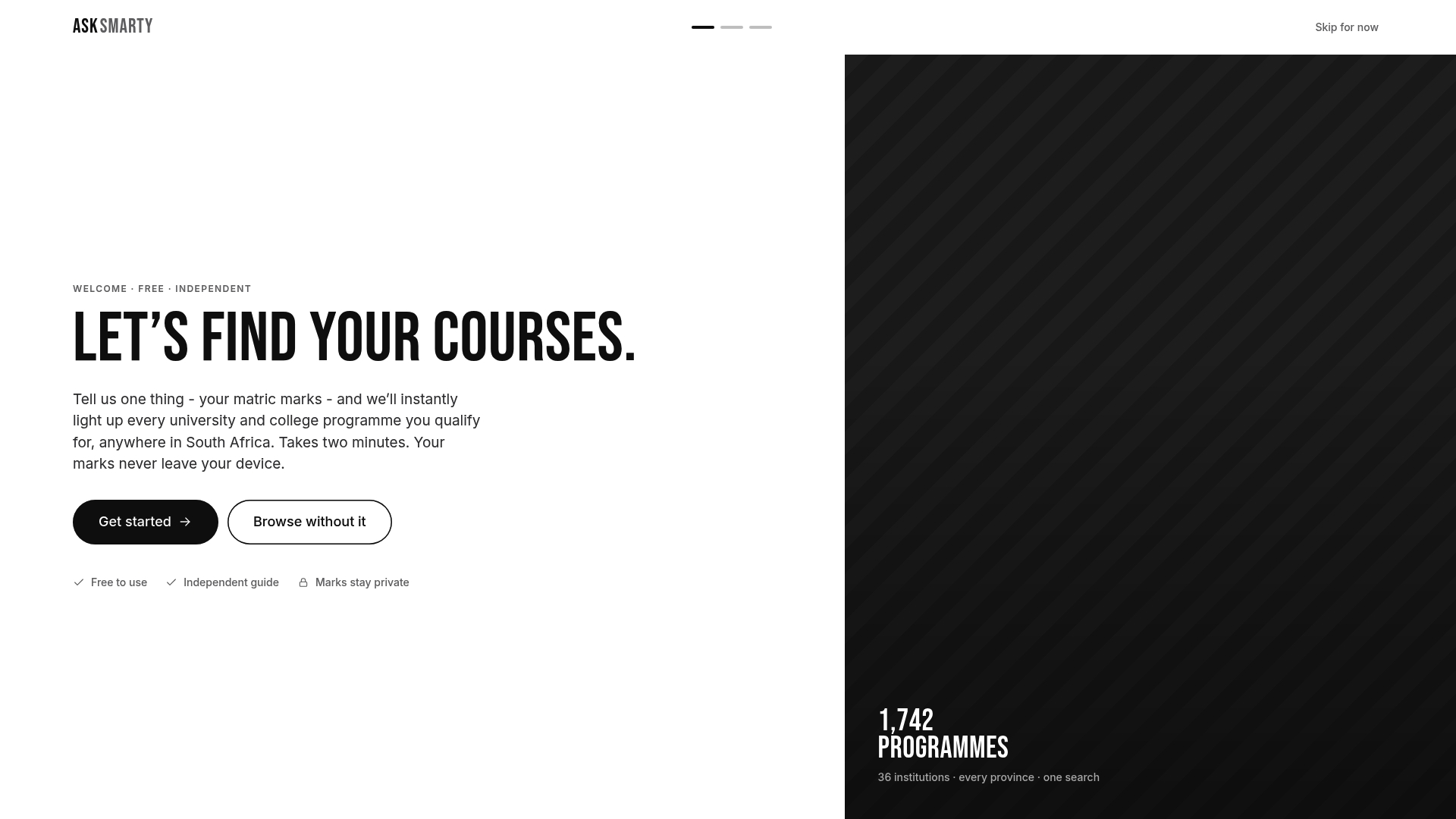
The tools are free: an APS calculator that converts your marks into an admission score, a searchable database of over 1,700 programmes filterable by field and institution, deadline and application fee details, and direct links to official application portals. If you are targeting a scarce-skill career in healthcare, engineering, IT, or finance, search programmes now to see which study routes are within reach based on your current marks.
Useful sources and links
- DHET 2024 National List of Occupations in High Demand (Government Gazette): — The primary official list of 350 occupations; use this to identify which fields the PSET system is prioritizing and to check minimum associated qualifications.
- Department of Employment and Labour — Scarce Skills: — Official scarce-skills publications and ESSA vacancy portal; use for employer-side demand signals and vacancy data by occupation.
- Asksmarty APS calculator: Free tool to convert your matric marks into an APS score and check programme eligibility.
- Asksmarty programme search: Search over 1,700 university and college programmes by field, institution, and entry requirements.
FAQ
What are the top scarce skills in South Africa?
The most consistently scarce skills fall across healthcare (doctors, nurses, pharmacists), IT and data (software developers, cybersecurity specialists, data analysts), engineering (civil, electrical, structural), finance (chartered accountants, management accountants), and logistics. The DHET 2024 National List of Occupations in High Demand covers 350 occupations and is the official reference for post-school planning.
What skill is most in demand in South Africa right now?
Healthcare professionals and software developers consistently top demand rankings, but cybersecurity and data engineering are growing fastest. Renewable energy skills are emerging as a high-priority gap as South Africa’s energy transition accelerates.
What are scarce skills, and how are they different from occupations in high demand?
A scarce skill is an occupation where employers cannot find suitably qualified or experienced people to fill vacancies. The DHET’s Occupations in High Demand (OIHD) list is a related but distinct concept: it is a planning tool for the post-school education system, not a direct recruitment or immigration list. Both signals are useful for career planning, but they serve different purposes.
How can I find out which scarce-skill programmes I qualify for?
Use Asksmarty’s free APS calculator to convert your matric marks into an admission score, then search the programme database to see which scarce-skill study routes are within reach. Your marks are processed on your device and never shared externally.
Does appearing on the DHET list guarantee a job after graduation?
No. The OIHD list signals that the training pipeline has not kept up with employer demand, but it is not a job guarantee. Graduates still need the right qualification level, practical experience, and in many cases professional registration (HPCSA, ECSA, SANC) before they can practise. Use the list as a demand signal, not a promise.
Recommended
Published 2026-08-01 · AskSmarty is an independent guide. Confirm anything time-sensitive on the official source.