Second semester applications in South Africa: 2026 guide
Discover vital details about second semester applications in South Africa for 2026, including deadlines, eligible programs, and step-by-step guides.

Second semester applications are open at several South African institutions right now, but availability varies by institution and programme. Your first move is to visit your chosen institution’s official admissions portal and confirm whether your specific programme has a mid-year intake. Some universities only open a handful of qualifications in Semester 2, and a few require you to resolve an academic appeal before you can even access the application link.
Here is what this guide covers: which universities and TVET colleges accept mid-year applicants, exact 2026 deadlines, how to apply step by step, eligibility traps to avoid, and what to do if you have already missed a deadline.
Quick orientation:
- Second semester applications are open at selected institutions, including UNISA, CUT, and some TVET colleges.
- Not all programmes run a mid-year intake. Check at programme level, not just institution level.
- Academic exclusion or a pending appeal can block your application link entirely until resolved.
- Use official portals or Asksmarty’s live deadline search to confirm current status before you prepare documents.
Table of Contents
- Which South African institutions accept mid-year applicants?
- How to apply for Semester 2, step by step
- Who can apply, and what blocks an application?
- What to do if you missed the deadline
- What happens after you submit an application?
- How Asksmarty verifies deadlines and keeps this guide current
- Key takeaways
- The mid-year window is shorter than most students expect
- Asksmarty makes finding open Semester 2 places faster
- Useful sources
- FAQ
Which South African institutions accept mid-year applicants?
Mid-year intake is not universal. Most South African universities run a single annual intake in Semester 1, but a meaningful group does open selected programmes for Semester 2 entry. The institutions below are the ones most commonly associated with second-term enrollment.
Comprehensive universities and universities of technology:
- UNISA is the most flexible option for mid-year applicants. As a distance-learning institution, UNISA accepts applications for selected programmes across multiple registration periods. Faculty-level availability still varies, so check the portal for your specific qualification.
- UCT publishes an annual undergraduate prospectus that details which programmes allow mid-year or late entry. Most full-degree programmes start in Semester 1 only; short learning programmes and some postgraduate routes are the exceptions.
- UJ lists programme-specific intake notes in its undergraduate prospectus. Mid-year entry is limited to selected diploma streams and continuing students.
- UFS includes mid-year intake notes in its 2027 prospectus. As with most contact universities, full-degree programmes predominantly start in Semester 1.
- CUT explicitly opens continued-studies applications for Semester 2 for returning students. The application window ran from early May to early July. See Asksmarty’s CUT page for current status.
- TUT accepts mid-year applications for selected programmes. Check the TUT admissions page on Asksmarty for the current portal link and open dates.
- UP (University of Pretoria) — runs a structured admissions calendar with programme-specific intake notes. Most undergraduate programmes are Semester 1 only; confirm via the UP admissions portal.
- DUT (Durban University of Technology) offers selected programmes with mid-year entry. Asksmarty’s DUT page lists current programme availability and portal links.
TVET colleges:
TVET colleges are often more flexible than universities on mid-year intake. Ikhala TVET College, for example, has publicly announced Semester 2 applications open for 2026. Many other TVET colleges follow a similar pattern. Check the full colleges directory on Asksmarty to find TVET options near you.
Key point: Programme availability for mid-year entry is frequently limited to selected qualifications — skills-short courses, selected diploma streams, or specific modules. Do not assume the full programme list is open in Semester 2.
How to apply for Semester 2, step by step
Before you open any portal, decide which applicant type you are. Returning students who previously enrolled at the institution use a continued-studies application. First-time applicants use the new applicant route. These are separate systems with separate eligibility checks and, often, separate deadlines. Applying through the wrong portal is one of the most common reasons applications stall.
Step-by-step process:
- Find your programme and confirm mid-year availability. Use Asksmarty’s programme search to filter by institution and check whether Semester 2 intake is listed.
- Go to the official admissions portal. Each institution has its own URL. Never apply through a third-party site that is not the institution itself or a verified guide like Asksmarty.
- Create an account or log in. Returning students at most institutions authenticate with their student number. New applicants register with their ID number.
- Select the Semester 2 or mid-year intake option. This is a specific field in the application form. If you do not see it, the programme may not be open for mid-year entry.
- Upload your documents. See the table below for what you need and where to get each item.
- Pay the application fee or claim a waiver. Check Asksmarty’s application fees page for a current list of which institutions charge and which waive fees.
- Submit and save your confirmation. Screenshot the confirmation screen and save the reference number. Email confirmations sometimes land in spam.
Required documents:
| Document | Notes |
|---|---|
| South African ID or passport | Certified copy required at most institutions |
| Matric certificate or statement of results | NSC original or certified copy; Grade 11 results if matric not yet complete |
| Academic transcripts | All post-school study; certified copies |
| Proof of application fee payment | Bank-stamped receipt or portal payment confirmation |
| Proof of address | Some institutions require this for new applicants |
| Supporting documents (if applicable) | Medical reports, affidavits, or appeal outcomes for special cases |
Practical tips:
- Name your files clearly before uploading (e.g., “Surname_ID_Certified.pdf”). Unnamed files get lost in bulk processing.
- Apply to more than one institution if you qualify. Semester 2 places fill quickly.
- For UNISA, the application portal is separate from the student portal. New and returning applicants both use the admissions portal, but the programme selection screen differs.
Pro Tip: Returning students at institutions like CUT authenticate via student number, which auto-populates their academic record. This means the system can immediately flag whether an appeal is pending and block the application link. If your link is inactive, check your appeal status first, not your login credentials.
Who can apply, and what blocks an application?
Standard eligibility for Semester 2 entry follows the same rules as Semester 1: your Admission Points Score (APS) must meet the programme minimum, you need the required NSC subject passes, and some programmes require National Benchmark Test (NBT) results. Use Asksmarty’s APS calculator to check your score before you apply, and review the full entry requirements guide for what each metric means.
Common eligibility checks:
- APS score meets the programme minimum (varies by institution and faculty).
- Required NSC subjects passed at the correct level (e.g., Mathematics vs. Mathematical Literacy).
- NBT results submitted where the programme requires them (mainly UCT, UP, and SU).
- No outstanding academic exclusion or unresolved appeal.
Academic exclusion and appeals:
This is the eligibility trap most students do not anticipate. If you were academically excluded at the end of Semester 1, many institutions block your continued-studies application link until your appeal is resolved. CUT’s 2026 procedure is explicit: academically excluded students must submit their appeal between 1 July and 17 July 2026 before the continued-studies link becomes accessible. Appeals typically require supporting evidence — a medical report, an affidavit, or a counsellor’s letter — and the outcome is not guaranteed.
Special applicant categories:
- Mature students (23 or older without a matric) can apply under mature-age exemption rules, but programme availability for this category in Semester 2 is limited. Confirm with the admissions office directly.
- Transfer students moving from one institution to another need their full academic transcript and, in some cases, a letter of good standing from their previous institution.
- Short learning programme (SLP) applicants often face fewer eligibility barriers. SLPs at UNISA and other institutions sometimes run on their own intake schedule, separate from the main semester cycle.
Red flags that delay or block applications:
- Outstanding appeal with no outcome posted.
- Missing certified documents (uncertified copies are rejected at submission).
- Applying as a “new applicant” when the system has you on record as a returning student.
- NBT results not yet submitted for programmes that require them.
What to do if you missed the deadline
Missing a Semester 2 deadline is not the end. The Department of Higher Education and Training (DHET) advises applicants who missed first-round admissions to consider second-semester entry, TVET colleges, and distance learning as realistic next steps.
Immediate actions:
- Check the institution’s late-application policy on its admissions page. Some institutions accept late applications selectively.
- Contact the admissions office by phone and email. Be brief: state your name, ID number, programme of interest, and reason for the late submission.
- Ask specifically about a waitlist or whether any places remain.
- Enquire about short learning programmes or bridging courses that run outside the main semester cycle.
What to include in a late-application request:
- Your full name and ID number.
- The programme and institution you are applying to.
- A clear, honest reason for the late submission with supporting evidence (medical certificate, death certificate, affidavit).
- Your full academic record.
- Contact details and a preferred callback time.
Fallback options:
- TVET colleges: Many run flexible intake schedules. Ikhala TVET is one example of a college that publicly opens Semester 2 applications. Check Asksmarty’s colleges directory for options near you.
- UNISA: Distance learning means UNISA’s intake schedule is more forgiving than contact universities. Check the UNISA late-application page on Asksmarty for current status.
- Private colleges: Registered private colleges often have rolling or quarterly intakes. See Asksmarty’s private colleges list for accredited options.
- Defer to Semester 1, 2027: If no mid-year option works, use the remaining months to strengthen your application, improve your APS, and apply early for the next main intake.
What happens after you submit an application?
Most institutions issue offers in two stages. A conditional offer arrives first and means the institution wants to admit you, subject to verifying your final documents (certified matric certificate, final transcripts, NBT results). A final offer follows once those documents are confirmed. Do not assume a conditional offer is a guaranteed place.
How to monitor your application status:
- Log into the institution’s admissions portal and check the status field. Most portals update within five to ten business days of submission.
- Watch your email, including your spam folder. Offer letters and requests for additional documents come by email at most institutions.
- Use Asksmarty’s application status checker to track status across multiple institutions from one place.
Steps from offer to registration:
- Accept the offer by the deadline stated in the offer letter. Missing the acceptance deadline releases your place to the next applicant.
- Pay the registration or tuition deposit. The amount and payment method vary by institution.
- Sign up for your modules through the student portal. For Semester 2, module registration windows are short, sometimes only a few days.
- Attend orientation if the institution runs one. Semester 2 orientations are often condensed or online.
Post-application calendar items to save:
- Conditional offer response deadline.
- Final document submission deadline.
- Registration open and close dates.
- First day of Semester 2 lectures.
- NSFAS or bursary confirmation deadline (mid-year applicants should check funder policy separately, as not all bursaries cover Semester 2 entry).
How Asksmarty verifies deadlines and keeps this guide current
Asksmarty checks official institution admission notices, published prospectuses, and admissions portal announcements directly. Cross-checks are done against DHET guidance and institutional communications. This page was last verified in May 2026.
Verification approach:
- Live checks of official admissions portals and published prospectuses for each named institution
- Institutional announcement pages (such as CUT’s announcements section) are monitored for date changes
Asksmarty maintains dedicated late-application and status pages for multiple South African universities, including Stellenbosch and UCT. These pages reflect the most recently confirmed open or closed status for late and mid-year applications.
Pro Tip: Save the direct URL to your institution’s admissions portal and take a screenshot of the “applications open” notice with the date visible. If a dispute arises about your submission timing, that screenshot is your evidence.
When in doubt about whether a page is current, look for an explicit “applications open” or “applications closed” notice with a date, a published prospectus year, or a “last updated” stamp. A page without any date reference should be verified by calling the admissions office directly.
Key takeaways
Second semester applications in South Africa are open at selected institutions right now, but programme-level availability, appeal status, and applicant type determine whether you can actually submit.
| Point | Details |
|---|---|
| Check programme availability first | Not all programmes run a Semester 2 intake; confirm at programme level, not just institution level. |
| CUT’s 2026 window as a benchmark | CUT’s application period ran from 11 May to 10 July 2026, with the appeal period from 1 July to 17 July 2026. |
| Appeals block application access | Academically excluded students cannot access the continued-studies link until their appeal is resolved. |
| UNISA offers the most flexibility | As a distance provider, UNISA accepts mid-year applications for selected programmes across faculties. |
| Asksmarty for live deadline checks | Use Asksmarty’s programme search and status checker to compare open windows across institutions. |
The mid-year window is shorter than most students expect
The compressed timeline of a Semester 2 application is what catches most students off guard. You are not just racing a deadline. You are racing a deadline while gathering certified documents, waiting on appeal outcomes, and competing for a smaller pool of available places than Semester 1 offers.
What I find students consistently underestimate is the appeal dependency. If you were excluded at the end of Semester 1, the assumption is often that you can appeal and apply simultaneously. At many institutions, that is simply not how the system works. The appeal outcome is the gateway. Until it posts, the application link stays locked. That can cost you two to three weeks of a ten-week window.
The other thing worth saying plainly: mid-year intake is genuinely useful, but it is not a soft option. Programmes that do open in Semester 2 carry the same academic load and the same exit requirements as their Semester 1 equivalents. The only difference is the starting point. If you are using Semester 2 as a reset after a difficult Semester 1, go in with a realistic plan for the workload, not just relief at getting a place.
Apply early within the window. Prepare your documents before the portal opens. And if your first-choice institution is not offering your programme mid-year, use that time to strengthen your application for Semester 1, 2027 rather than settling for a programme that does not fit.
Asksmarty makes finding open Semester 2 places faster
Checking each institution’s portal individually takes hours, and dates change without notice. Asksmarty’s free university and programme directory pulls together live deadline information, application fee details, and official portal links for over 1,700 programmes across South Africa, so you can compare mid-year intake options in one place.
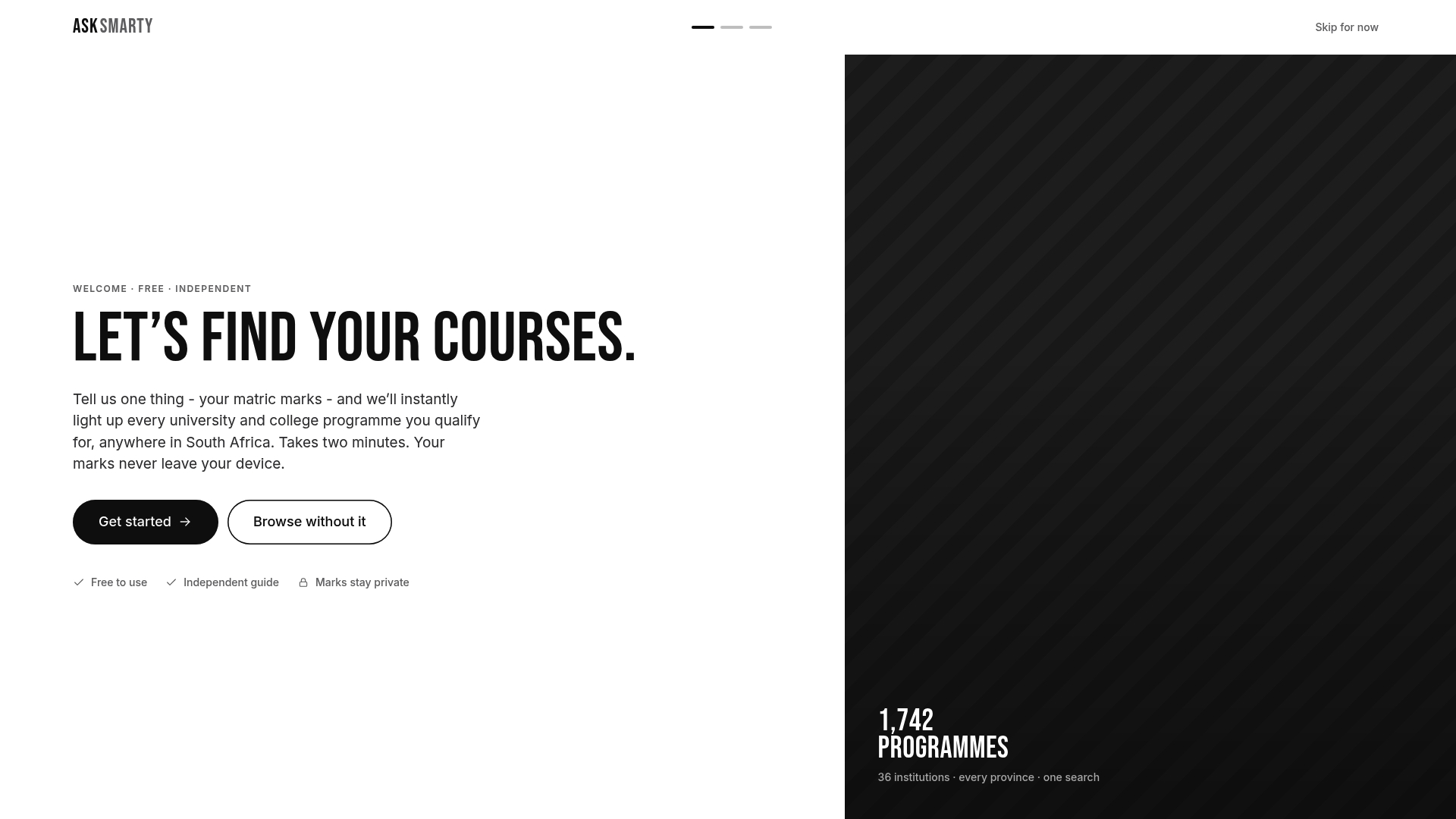
Your matric marks never leave your device. The APS calculator checks your eligibility instantly, the programme search filters by intake period, and the application status tool tracks submissions across multiple institutions. No fees, no data sharing, and no waiting for a callback.
Start by searching for open Semester 2 programmes at asksmarty.co.za/programmes and confirm your APS score against programme minimums before you apply.
Useful sources
Official sources used to verify the information in this guide:
- CUT | 2026 Continued Studies Applications are Open for the Second Semester
- Apply for admission
- Semester 2 Applications Open
- what next? 1. Apply for second semester entry at a university
- University of Cape Town undergraduate prospectus 2027
- University of Johannesburg undergraduate prospectus 2027
- University of the Free State prospectus 2027
- AskSmarty - Stellenbosch late application page
To verify that any admissions page is current, look for an explicit “applications open” or “applications closed” notice with a visible date, or a prospectus year. If no date is shown, call the admissions office to confirm.
FAQ
Are second semester applications open right now?
At several South African institutions, yes. UNISA, CUT, and selected TVET colleges have confirmed Semester 2 applications open for 2026. Availability at other universities depends on the specific programme, so check the official admissions portal for your chosen course.
Is UNISA open for second semester in 2026?
UNISA accepts applications for selected programmes across multiple registration periods, including mid-year. Visit the UNISA admissions portal to confirm which programmes are currently open for Semester 2 enrollment.
Which TVET colleges are open for second semester in 2026?
Ikhala TVET College has publicly announced Semester 2 applications open for 2026. Many other TVET colleges follow a similar pattern. Check Asksmarty’s colleges directory for a current list of colleges with open mid-year intake.
Which applications are still open for 2026?
Programme-level availability changes weekly during the application window. Use Asksmarty’s programme search tool to filter by intake period and see which institutions currently have open applications for 2026 Semester 2 entry.
What should I do if I missed the Semester 2 deadline?
Contact the admissions office directly with your ID number, programme of interest, and a reason for the late submission. If no late place is available, consider UNISA, TVET colleges, or registered private colleges, which often have more flexible intake schedules.
Recommended
Published 2026-08-04 · AskSmarty is an independent guide. Confirm anything time-sensitive on the official source.