Student loans South Africa: what to try first in 2026
Explore the best options for student loans in South Africa for 2026, from NSFAS to commercial banks. Secure your education funding now!

If your household income falls between R350,001 and R600,000 a year and you have a place at a public university or TVET college, check the NSFAS Missing‑Middle Loan Scheme before you look anywhere else. It charges no interest, needs no guarantor, and covers the same costs a bank loan would. If your income sits above that band, or you need funding for a private institution, a commercial bank loan from FNB, Standard Bank, Nedbank, or Capitec is usually the next stop, provided you can line up a guarantor with a clean credit record.
Here’s the shortlist, in the order most families should work through it:
- NSFAS Missing‑Middle Loan Scheme — no interest, no guarantor, but strict income and institution rules.
- Commercial bank student loan — flexible, covers up to roughly R450,000–R500,000, but depends entirely on your guarantor’s creditworthiness.
- Bursaries, scholarships, and non‑profit funds — worth chasing in parallel, because free money always beats borrowed money.
Before you apply anywhere, run through this:
- Confirm your admission and get your exact programme costs sorted using a tool like AskSmarty’s admission calculator.
- Gather guarantor documents (ID, three months of payslips or bank statements, proof of residence) while you wait on your acceptance letter.
- Start the application that matches your income band, either through myNSFAS or your chosen bank’s student loan portal.
Key takeaways
Most South African students should check NSFAS Missing‑Middle eligibility first, secure a strong guarantor as backup, and confirm admission before submitting any loan application.
| Point | Details |
|---|---|
| Check income band first | NSFAS Missing‑Middle applies to households earning R350,001–R600,000 studying at public institutions. |
| Guarantor strength decides bank loans | Banks assess the guarantor’s credit and income, not the student’s, so line this up early. |
| Confirm admission before funding | Lenders require proof of registration and official cost invoices before releasing money. |
| Budget for life after the grace period | Capital repayments start six to twelve months after study, regardless of employment status. |
| Chase alternatives in parallel | Bursaries and non‑profit funds reduce how much you need to borrow, and deadlines close early. |
Table of Contents
- What loan routes actually exist in South Africa?
- Who actually qualifies for a student loan in South Africa?
- How do you apply for a student loan step by step?
- What does a student loan actually cost you?
- How do you choose the right loan for your situation?
- What alternatives should you try before borrowing?
- Confirm your admission before you apply for any funding
- Where to check the official terms and portals
- What to try first: an honest read on student loans in South Africa
- Sources
- FAQ
What loan routes actually exist in South Africa?
South African students have three broad funding categories to choose from, and each one works on a completely different logic. Understanding which logic applies to your household is the fastest way to stop wasting time on applications you were never going to qualify for.
NSFAS and the Missing‑Middle Loan Scheme sit at one end. This is a means‑tested government loan aimed squarely at households that earn too much for a full NSFAS bursary but not enough to comfortably self‑fund a degree. It’s open to South African citizens and permanent residents with combined household income between R350,001 and R600,001, studying at a public university or TVET college.
Commercial bank student loans sit at the other end. FNB, Standard Bank, Nedbank, and Capitec all run credit‑based products that don’t care what your parents earn. What they care about is whether your guarantor can service the debt. These loans typically cover tuition, accommodation, books, and study equipment, with limits in the R450,000 to R500,000 range depending on the bank and the guarantor’s profile.
Private lenders and non‑profit loan funds fill the gaps left by the first two. Organisations like Helpmekaarfonds blend bursary and loan features for students who can’t meet a bank’s guarantor requirements or NSFAS’s income and institution rules.
The real dividing line isn’t NSFAS versus banks. It’s means‑tested versus credit‑based. One route judges your household income; the other judges your guarantor’s bank statements. Knowing which test you’re facing changes everything about how you prepare.
A quick map of what to expect from each route:
- NSFAS Missing‑Middle: interest‑free, income‑tested, restricted to public institutions.
- FNB, Standard Bank, Nedbank, Capitec: credit‑tested through a guarantor, usable at most accredited institutions, personalised interest rates.
- Non‑profit and private funds: smaller pool of money, often hybrid bursary/loan terms, worth exploring if the first two doors are closed.
Who actually qualifies for a student loan in South Africa?
Eligibility splits cleanly along the same means‑tested versus credit‑based line, and getting this wrong wastes weeks.
For NSFAS Missing‑Middle, the rules are specific. You need to be a South African citizen or permanent resident, your combined household income must fall between R350,001 and R600,000 a year, and you must be accepted or registered at a public university or TVET college. NSFAS treats the application almost identically to its standard bursary process, right down to the consent forms and loan agreement you’ll sign through myNSFAS.
Bank loans work differently. The bank barely looks at your credit history as a student, because you probably don’t have one yet. Instead, it assesses your guarantor’s ability to repay the loan, meaning their income, existing debt, and credit record carry the weight of the application. A parent, older sibling, or family friend with steady income and a clean credit record will get you approved faster than a family with a higher household income but no bankable guarantor.
A significant portion of South African households earning in that missing‑middle band still don’t qualify for full bursary support, which is a key gap this loan scheme aims to address.
Documents you’ll need regardless of route:
- Your ID and your guarantor’s ID.
- Proof of acceptance or registration from your institution.
- Three months of your guarantor’s payslips or bank statements.
- Proof of residence for the guarantor.
- An official invoice or proof of costs from your university or college.
Part‑time students face tighter rules almost everywhere. NSFAS Missing‑Middle is built primarily around full‑time study, and most banks reserve their best rates and the full interest‑only period for full‑time enrolment too.
How do you apply for a student loan step by step?
The mechanics differ sharply between NSFAS and the banks, so treat them as two separate workflows rather than one generic “student loan application.”
For NSFAS Missing‑Middle, the process runs through the myNSFAS portal. You create or log into your profile, submit your household income documents and ID, and NSFAS checks your income band against your institution’s acceptance status. Once verified, you sign the consent form and loan agreement online. Funds get released once your registration is confirmed with your institution, following the same disbursement pattern as a standard NSFAS bursary.
For bank loans, you typically start by requesting an online quote, then move to full application once you have a guarantor lined up. FNB, Standard Bank, and Nedbank all ask for your institution’s official invoice or proof of costs before they’ll release funds, and most banks pay tuition and accommodation fees directly to the institution or landlord rather than into your personal account. Books and equipment may be paid separately once you show proof of what you’re buying.
| Stage | NSFAS Missing‑Middle | Bank student loan |
|---|---|---|
| Apply | Submit via myNSFAS portal | Request online quote or visit branch |
| Pre‑check | Income and institution verification | Guarantor credit assessment |
| Document verification | Consent form, loan agreement, registration proof | ID, payslips, proof of residence, invoice |
| Funds disbursed | After registration confirmed with institution | Paid directly to institution or landlord |
Pro Tip: Get your guarantor’s payslips, bank statements, and proof of residence organised before you touch the application form. Verification delays, not approval decisions, are what stretch bank loan timelines from days into weeks.
What does a student loan actually cost you?
This is where most families underestimate the real burden of borrowing, because the sticker price during your studies looks nothing like the sticker price after graduation.
Banks charge a personalised interest rate based on your guarantor’s credit profile, not a flat published number. During your studies, most banks let you pay interest only, deferring the full capital repayment until after you finish. FNB offers up to R450,000 with a typical 12‑month interest‑only window; Nedbank and Standard Bank run similar structures, usually with a grace period of six to twelve months after your studies end before full repayments, capital and interest combined, kick in.
Here’s what that actually looks like in numbers. On a R100,000 loan at a mid‑range personalised interest rate spread over a five‑year repayment term after your grace period ends, you’re looking at a monthly instalment in the region of R2,000 to R2,200, depending on the exact rate the bank offers your guarantor. That’s before any initiation fee or monthly service fee gets added.

The financial education organisation Atleha‑edu makes a point worth repeating here: interest‑only repayment during study is a deferral, not free money. The capital doesn’t shrink while you’re at university. It just waits.
Watch for these red flags before you sign anything: a grace period noticeably shorter than six months, unusually high initiation fees stacked on top of the interest rate, or a lender that can’t clearly explain how it pays your institution directly. A legitimate lender will always want your registration proof and an official invoice before releasing a cent.
How do you choose the right loan for your situation?
Run through these questions before you commit to any application, because the answers point you straight to the route that fits.
- Does your household income sit between R350,001 and R600,000, and are you at a public university or TVET? If yes, apply for NSFAS Missing‑Middle first. It costs you nothing in interest.
- Do you have access to a guarantor with steady income and a clean credit record? Without one, most bank applications stall regardless of how strong your own academic record is.
- How is the loan actually paid out? Confirm whether tuition goes directly to your institution and whether accommodation gets paid to a landlord or into your own account.
- What does the loan cover, and does that match what you actually need? Tuition‑only loans won’t help if your biggest gap is accommodation or a laptop.
- What happens after the grace period ends? Ask for the exact monthly repayment figure once capital repayments start, not just the interest‑only figure during study.
Quick comparison for common student profiles:
- Missing‑middle household, public university acceptance: NSFAS wins on cost every time. No interest beats any bank rate.
- Higher household income, private institution: A bank loan is often your only borrowing option, so guarantor strength becomes the deciding factor.
- No guarantor available, income above NSFAS threshold: Look hard at bursaries and non‑profit funds before signing a bank agreement at all.
What alternatives should you try before borrowing?
Every rand you get from a bursary is a rand you never have to repay with interest, which makes this section worth more time than most students give it.
- Institutional bursaries offered directly by your university or college, often tied to academic merit or financial need, and worth checking even after you’ve been accepted.
- National scholarship funds and sector bursaries, particularly in fields like engineering, accounting, and health sciences, where employers sponsor students in exchange for post‑study work commitments.
- Private bursaries run by corporates and foundations, usually with earlier deadlines than you’d expect. Some close before the academic year even starts.
- Non‑profit loan funds like Helpmekaarfonds, which blend bursary and loan terms for students who fall through the NSFAS and bank cracks.
- Part‑time work and work‑study arrangements, which won’t cover full tuition but can meaningfully reduce how much you need to borrow for books, transport, or accommodation top‑ups.
Prioritise this route hardest if you’ve already received partial funding from one source, if your academic record makes you a strong bursary candidate, or if you simply don’t have anyone who can act as a credible guarantor. Bursary deadlines routinely fall six to nine months before the academic year starts, so chase these in parallel with your loan research, not after it.
Confirm your admission before you apply for any funding
Here’s the mistake that costs students the most time: applying for a loan before confirming exactly where you’ve been accepted and what it will actually cost.
Every lender in this guide, NSFAS included, wants proof of acceptance or registration and an official invoice before releasing funds. Nedbank and Standard Bank both require documented proof of costs from the institution itself, not an estimate you’ve worked out yourself.
This is exactly the gap Asksmarty closes. Its admission calculator lets you enter your marks privately, on your own device, and instantly see which programmes across South African universities and colleges you actually qualify for, without submitting anything to anyone.
The sequence that saves the most wasted effort looks like this:
- Enter your matric marks into the AskSmarty admission calculator to see which programmes you qualify for.
- Use the results to shortlist realistic institutions and confirm entry requirements through resources like AskSmarty’s requirements guide.
- Once you’re accepted, secure your official acceptance or registration letter, which nearly every lender treats as a non‑negotiable document.
- Only then start your NSFAS or bank loan application, armed with the exact institution, programme, and cost figures the lender will ask for.
Skipping straight to a loan application without this step is how students end up submitting paperwork for a loan tied to a programme they were never going to be admitted to.
Where to check the official terms and portals
- NSFAS student loan information covers eligibility, the consent process, and how the loan agreement works.
- myNSFAS portal is where you actually submit your Missing‑Middle application.
- FNB’s student loan page lists current limits, interest‑only periods, and how to request a quote.
- Standard Bank’s student loan portal explains disbursement, grace periods, and how to apply online.
- Nedbank’s study loan page details required documents and payout rules for tuition and accommodation.
- AskSmarty’s admission calculator helps you confirm what you qualify to study before you approach any lender.
What to try first: an honest read on student loans in South Africa
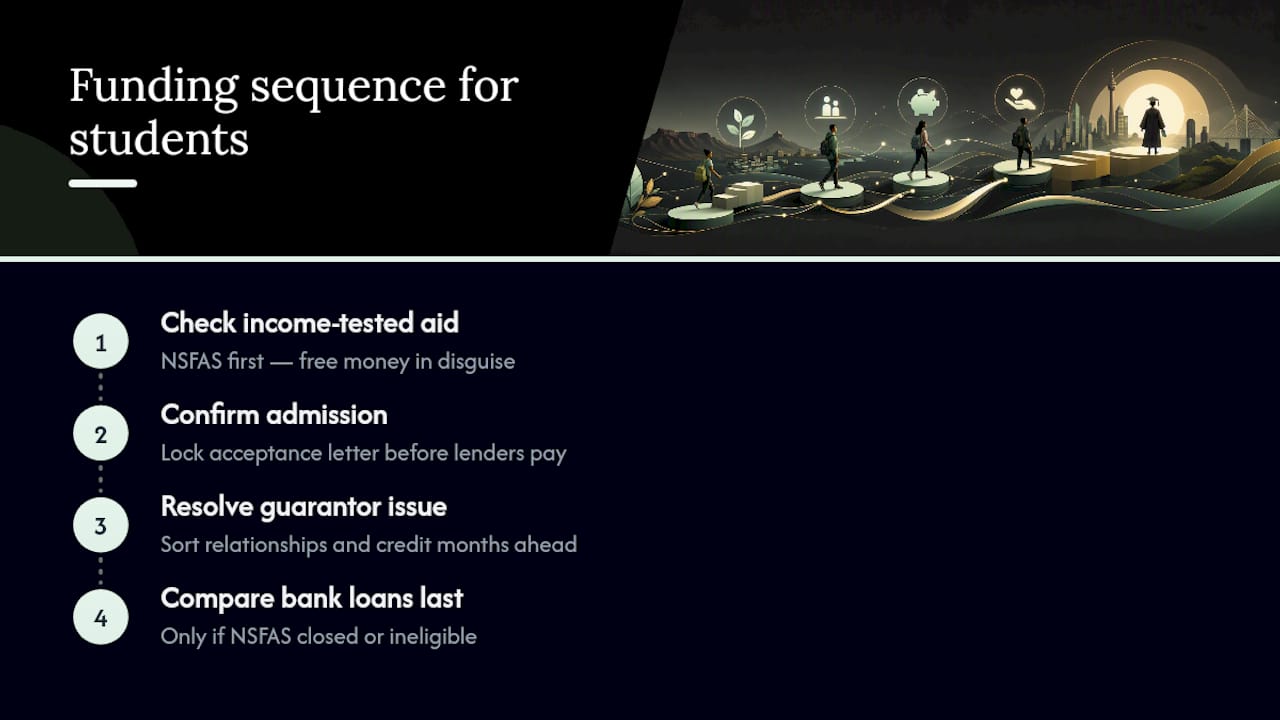
The conventional advice on funding your degree treats NSFAS and bank loans as competing options you weigh against each other. That framing is wrong for most families. They’re not competitors. They’re a sequence. Check the income‑tested door first, because it’s free money in disguise, and only walk toward a bank once that door is closed to you.
What gets underestimated constantly is the guarantor problem. Students spend weeks polishing personal statements and comparing interest rates between FNB and Nedbank, then discover at the final hurdle that nobody in their circle has the credit profile a bank wants to see. That’s not a paperwork issue you fix in a weekend. It’s a relationship and financial‑planning issue that needs sorting months before you apply, not days.
The other gap in most guides is sequencing admission and funding correctly. Loan guides talk about interest rates and grace periods at length, then treat “get accepted” as an afterthought, when in practice it’s the document every single lender demands before they’ll pay out a rand. Confirm where you actually qualify, get that acceptance letter locked down, and only then start comparing what NSFAS and the banks can offer you. Skip that order and you risk building an entire loan application around a programme you were never going to get into.
This article is general information, not a substitute for advice from a qualified financial advisor. Consult a qualified financial professional about your own circumstances before acting on anything here.
Sources
- NSFAS student loan information
- Student Loan - Apply or increase your limit | Standard Bank
- Student Loans: Fund Your Education | FNB
- Prepare for your dream career with our study loans | Nedbank
- Loan scheme missing‑middle explained
FAQ
Which bank is best for student loans in South Africa?
There’s no single best bank. FNB, Standard Bank, Nedbank, and Capitec all offer similar limits around R450,000 to R500,000, so the deciding factor is usually which bank your guarantor already banks with, since existing relationships can smooth approval.
How do I qualify for a student loan in South Africa?
For NSFAS Missing‑Middle, your household income must fall between R350,001 and R600,000 and you must be accepted at a public university or TVET college. For bank loans, qualification depends mainly on your guarantor’s income and credit record rather than your own.
What’s the easiest student loan to get?
NSFAS Missing‑Middle is generally the most accessible if your household income fits the band, since it requires no guarantor and no interest. Outside that income range, approval speed with a bank depends almost entirely on how strong your guarantor’s credit profile is.
What is the monthly repayment on a R100,000 loan?
On a R100,000 loan at a mid‑range personalised interest rate over a five‑year term after the grace period, expect a monthly instalment in the region of R2,000 to R2,200, depending on the exact rate your guarantor qualifies for.
Recommended
Published 2026-08-17 · AskSmarty is an independent guide. Confirm anything time-sensitive on the official source.