Can you transfer between universities in South Africa?
Wondering how to transfer between universities in South Africa? Discover the requirements and steps to make your academic move smooth and successful.

Yes, you can usually transfer between South African universities, but acceptance and credit both depend on your academic record, how well your modules match the new programme, and whether there’s actually space. Faculties commonly want a cumulative average of 60% to 65%, and competitive programmes push that closer to 70%. Two things to do today:
- Pull up your target university’s faculty rules on transfers and CAT (Credit Accumulation and Transfer), since every faculty sets its own bar.
- Request certified transcripts and full module outlines from your current institution now. They take longer to arrange than most students expect.
Key Takeaways
Transferring between South African universities works when your academic average clears the faculty’s threshold and your module outlines prove genuine syllabus overlap with the target programme.
| Point | Details |
|---|---|
| Check the real threshold | Most faculties want 60 to 65%, but competitive programmes often require a higher academic average. |
| Gather module outlines early | Departments need NQF level, credit value, outcomes, and assessment methods for every module. |
| Know the CAT limits | Expect an 80% syllabus overlap guideline and a common 50% credit cap on completed qualifications. |
| Apply and submit CAT together | Submitting credit evidence after admission is often rejected outright. |
| Protect your funding | NSFAS and private bursaries require separate confirmation with the new institution before you register. |
Table of Contents
- How to transfer between universities: who actually qualifies
- What documents do you need to transfer universities?
- How does credit transfer actually work between universities?
- When should you apply and what’s the process?
- What happens after you submit a transfer application?
- How does transferring affect NSFAS and bursary funding?
- Common mistakes students make when transferring universities
- How Asksmarty helps you plan a transfer with confidence
- Where to verify transfer policies directly
- An editorial take on what actually gets transfers approved
- Sources
- FAQ
How to transfer between universities: who actually qualifies
There are two kinds of moves here, and people mix them up constantly. An internal transfer shifts you between faculties or programmes at the same institution. An external transfer, the one most people mean when they talk about transferring between universities, moves you to a different institution entirely, with a fresh application and a separate credit evaluation.
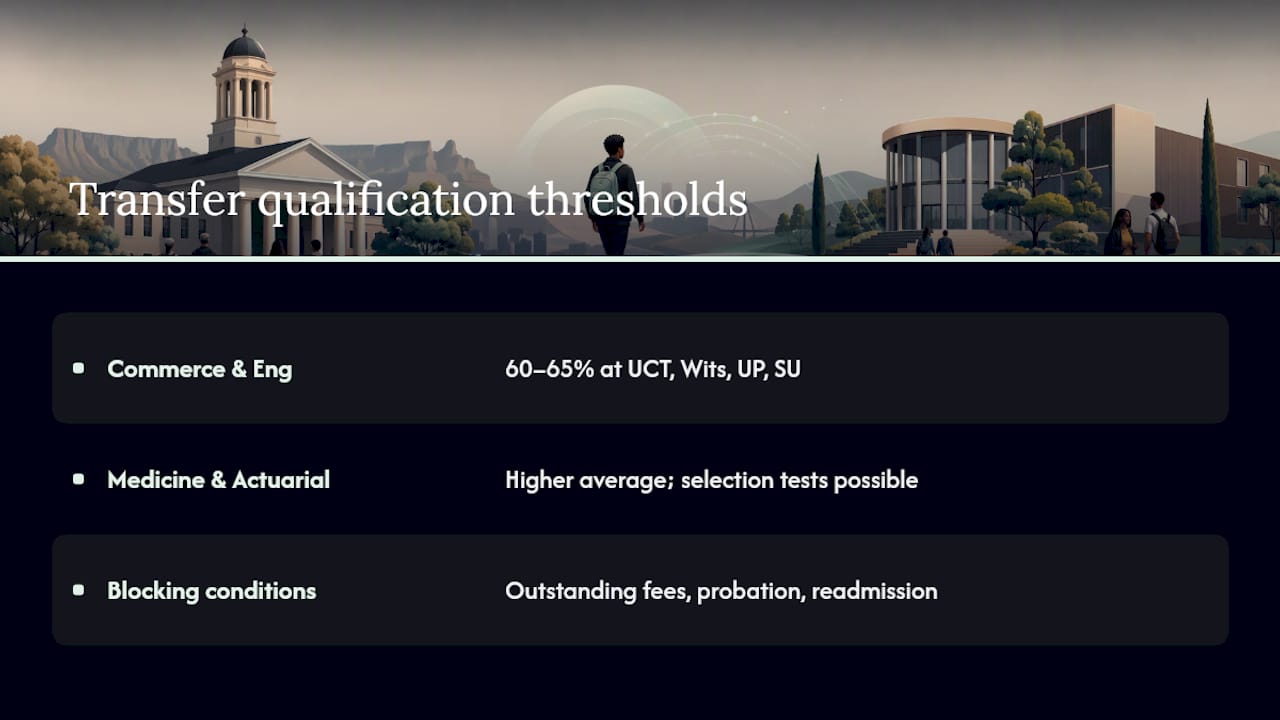
Numeric thresholds vary by faculty rather than by university as a whole. Commerce and engineering faculties at UCT, Wits, UP, and SU often expect 60 to 65%, but medicine, actuarial science, and other capacity-limited programmes routinely demand a higher academic average, sometimes with additional selection tests. Academic average is only half the battle. Outstanding fees at your current university, academic probation, or an active readmission condition can all block a transfer application before it even reaches the CAT office.
Pro Tip: Call the faculty’s undergraduate office before you apply, not the general admissions line. Admissions can confirm you meet the minimum average, but they usually can’t tell you whether your specific modules will map onto the new curriculum.
What documents do you need to transfer universities?
Admissions offices and CAT reviewers work off a fixed checklist, and missing one item is the single most common reason applications stall.
- Certified official academic transcript from every institution you’ve attended, no exceptions for a single semester.
- Certified copy of your ID and matric certificate or NSC results.
- A certificate of good conduct or letter of good standing from your current university.
- Full module syllabi for every module you want credited: NQF level, credit value, learning outcomes, and assessment methods for each one.
- Degree certificate (if you’ve completed a qualification) and proof of current registration.
- Any existing exemption or RPL documentation from a prior credit evaluation.
Universities including UWC list this exact combination as standard, and departments won’t start a credit comparison without the module outlines specifically. A transcript alone tells them what mark you got. It says nothing about what you actually learned.
How does credit transfer actually work between universities?
This is where most transfer plans succeed or fail. Departments don’t take your word for equivalence. They compare your old module against the new one, line by line, using CAT (Credit Accumulation and Transfer) for completed coursework and RPL (Recognition of Prior Learning) for experience or informal learning that doesn’t sit neatly in a transcript.
Two limits show up across almost every institution’s policy:
- An 80% syllabus overlap guideline: if your old module covered less than roughly 80% of what the new module teaches, it typically won’t be recognized as a direct equivalent.
- A 50% credit cap: institutions commonly cap how much of a completed qualification’s credits they’ll recognize toward a new one, often around half, regardless of how strong your marks were.
Stellenbosch University’s RPL and CAT procedures reflect this pattern, and it’s echoed across the sector: CAT and RPL exist to support mobility, but the receiving institution keeps final say over what counts.
NQF level matters too. A module pitched at NQF level 6 generally won’t substitute for one at level 7, even if the content overlaps. The head of department, or a delegated credit committee, signs off on the final mapping, and this review typically takes 4 to 12 weeks once your documents are complete. Postgraduate RPL applications often need additional Senate approval, which adds time you should build into your planning from the start.

When should you apply and what’s the process?
Apply for admission and submit your CAT or RPL evidence in the same application. Submitting credit evidence after you’ve already been admitted is a common mistake, and it’s often rejected outright because registration and timetabling get locked in around students who applied with complete files.
- Research target programmes and faculty transfer rules between April and July.
- Submit your admission application and full CAT/RPL package together, typically August through September for the following academic year. Some institutions run a mid-year intake around July, but confirm this per university since it’s not universal.
- Wait for departmental review: the faculty maps your modules against theirs, checking NQF level, content overlap, and credit value.
- Receive a conditional offer specifying which modules you’ve been credited or exempted from.
- Register, once fees, funding, and any outstanding administrative holds from your previous institution are cleared.
Total turnaround usually runs 4 to 12 weeks from a complete application, though it stretches longer if documents arrive piecemeal.
Pro Tip: Don’t wait for the admissions office to chase your module outlines. Email the receiving department directly and ask what format they want the syllabi in, some prefer a specific template, and finding that out in week one saves a month later.
What happens after you submit a transfer application?
Two outcomes carry different labels, and it’s worth knowing the difference. A CX result means you’ve been granted credit for a module, and it comes off your remaining course load entirely. An EX result means exemption, you don’t have to repeat the content, but it may not count toward your total credits the same way.
- Request the formal, written credit comparison, not just a verbal summary from an academic advisor.
- If you disagree with the outcome, contact the department or HoD directly to appeal or submit additional module evidence, since admissions staff usually can’t resolve detailed CAT disputes on their own.
- Once outcomes are confirmed, finalize registration, pick your modules for the year, and ask whether any bridging reading is recommended before term starts.
How does transferring affect NSFAS and bursary funding?
Funding doesn’t follow you automatically, and this catches students off guard every year.
- If you’re NSFAS funded, you need a formal acceptance letter from the new university and must update your myNSFAS record yourself. Confirm directly with the new institution’s financial aid office before you start attending classes, not after.
- Private bursaries sometimes restrict transfers or need written permission from the funder. Check your contract terms and notify the bursary provider early, since some can suspend or claw back funding for an unapproved move.
- Outstanding fee holds at your current institution can block the release of your transcript entirely. Clear any balance before requesting documents, or your whole timeline slips.
Pro Tip: Email your NSFAS or bursary contact the same week you submit your transfer application, not after you’re accepted. Funding decisions often take weeks to process on their end too.
Common mistakes students make when transferring universities
- Requesting a generic transcript instead of full module outlines, then wondering why the department can’t confirm equivalence.
- Waiting until after admission to submit CAT evidence, which many faculties treat as a late and often rejected request.
- Emailing only the general admissions inbox instead of following up with the specific receiving department.
- Having no backup option if the transfer falls through, whether that’s an internal faculty move or a different institution altogether.
Pro Tip: Keep a dated email trail of every exchange with the department. If a mapping decision gets disputed later, that record is often what resolves it in your favor.
How Asksmarty helps you plan a transfer with confidence
Before you invest weeks gathering transcripts, check whether you’d actually meet the new programme’s entry score using Asksmarty’s APS calculator. It flags whether you clear the minimum admission threshold before you commit to a full CAT application.
- Search the programme database for exact deadlines and official application portals across every major South African university.
- Use the admission requirements guide to understand APS and NQF terms before you contact a faculty.
- Keep your own marks private throughout, since Asksmarty’s tools run the calculation on your device rather than storing your results.
Students often lose weeks chasing the wrong faculty contact simply because they didn’t confirm the programme’s entry score first. A five minute calculation upfront avoids that entirely.
Where to verify transfer policies directly
Confirm current rules on your target university’s own transfer or CAT page, since faculty-specific requirements shift year to year and override general guidance like this. Check SAQA or CHE for the national framework behind NQF levels and credit recognition.
An editorial take on what actually gets transfers approved
Most transfer advice treats this as a paperwork exercise, but understanding the difference between a letter of intent vs interest can help better position your transfer application for programme fit. It isn’t. The applications that succeed are the ones where a student did the department’s mapping work for them, matching module outcomes side by side, before anyone in admissions asked for it.
The conventional wisdom fixates on your average, and yes, clearing 60 to 65% matters. But I’d argue the syllabus overlap question decides more outcomes than the mark itself.
If you take one thing from this guide, prioritize the module outlines over everything else, and get them months before your deadline, not weeks. Everything downstream, the CAT decision, your registration, your funding confirmation, depends on that evidence existing in the first place. Treat the APS calculator as your filter for realistic targets, not your final answer. It tells you where you qualify. It won’t tell you whether your third year stats module maps onto theirs. Only a department can do that.
Sources
- Transferring students | University of Cape Town
- Supplement to RPL and CAT Procedures (Stellenbosch University)
- Uni24
FAQ
Can you transfer from one university to another in South Africa?
Yes. You apply for admission at the new university and submit a separate CAT or RPL request for credit recognition, and both academic average and module overlap determine the outcome.
Does UCT accept transfer students?
UCT does accept transfer applications, with faculty-specific academic thresholds commonly around 60 to 65% and higher for competitive programmes; check the specific faculty’s transfer page before applying.
Can you apply to another university while still enrolled at one?
Yes, applying to a new university while currently registered elsewhere is standard practice for transfer students, though you should confirm your current institution’s fees are settled before requesting transcripts.
How long does credit transfer evaluation take?
Processing typically takes 4 to 12 weeks once your documents are complete, so apply as early as possible in the intake cycle.
What is the difference between CAT and RPL?
CAT (Credit Accumulation and Transfer) evaluates formal coursework you’ve already completed, while RPL (Recognition of Prior Learning) recognizes experience or informal learning that doesn’t appear on a standard transcript.
Will my NSFAS funding automatically move with me?
No. You must secure formal acceptance at the new university and update your myNSFAS record yourself, confirming directly with the new institution’s financial aid office.
What happens if my modules don’t fully match the new programme?
You may receive partial credit, an exemption without full credit, or a requirement to complete bridging modules, depending on how closely your old syllabus overlaps with the new one.
Which documents do universities require most often for a transfer?
Certified transcripts, matric certificate, certificate of good conduct, and detailed module outlines showing NQF level and learning outcomes are required by nearly every South African university, including UWC.
Recommended
- University of South Africa - Programmes, Deadlines & How to Apply | AskSmarty
- How to Apply to a South African University or College | AskSmarty
- University of Johannesburg - Programmes, Deadlines & How to Apply | AskSmarty
- CAO vs Direct Application - When to Use the CAO and When to Apply Direct | AskSmarty
Published 2026-08-23 · AskSmarty is an independent guide. Confirm anything time-sensitive on the official source.