University application fees in South Africa: 2027 guide
Discover university application fees in South Africa for 2027. Get details on costs, exemptions, and tips for local and international applicants.

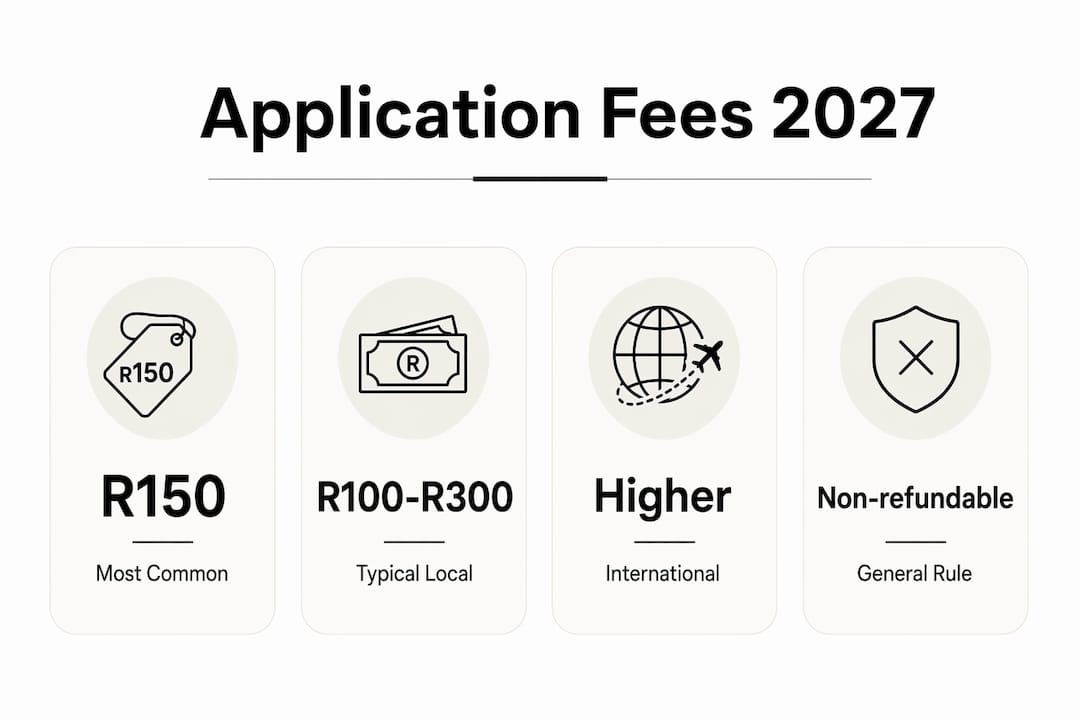
Most South African universities charge between free and several hundred rand to process an application, with a moderate range being most common for local applicants. Many institutions set a standard fee in the mid-to-high hundreds of rand. International applicants from outside the SADC region typically pay more. Paying the fee is a processing requirement only. As UCT explicitly states, paying does not mean a place will be offered, and fees are non-refundable.
Common exemptions apply to current students, recent graduates, and in some cases applicants from households earning below a stated income threshold often cited by universities. Always check the specific university’s policy before paying.
Table of Contents
- How much do university application fees actually cost?
- Per-university application fees for 2027 (South Africa)
- Which universities have no application fee?
- Who qualifies for a fee waiver and how to request one
- How to pay your application fee without problems
- Application deadlines and late-fee policies
- How many universities should you apply to, and what will it cost?
- How we checked these fees
- Key takeaways
- The thing most students get wrong about application fees
- Asksmarty makes it easier to apply where you qualify
- Official sources used to verify fees
- FAQ
How much do university application fees actually cost?
For local South African applicants, fees generally fall between R100 and R300 per application, with R100 the most commonly listed rate for UCT and R200 for Wits postgraduate applications. Here is a quick breakdown:
- Local/South African applicants: Institutions like UCT charge R100 per application for local and SADC applicants, Wits lists R200 for postgraduate applications, and other universities are within this range.
- SADC applicants: Charged the same rate as local applicants at universities such as UCT (R100).
- Outside-SADC international applicants: Generally pay higher fees. UCT charges R300 for outside-SADC applicants and significantly more for Graduate School of Business (GSB) programmes (R1,000 or USD 100 for outside Africa).
- Postgraduate applicants: For example, Wits lists R200 per application for postgraduates, with some exemptions for current students applying online.
- GSB and specialist programmes: Fees are often substantially higher than standard undergraduate rates (e.g., UCT GSB R1,000 or USD 100 for outside Africa applicants).
One thing worth knowing: universities process far more applications than they can ever admit. Wits reportedly received a very large number of undergraduate applications in a single cycle compared to the number of available places. The fee funds that processing operation. It has no bearing on your chances.
Per-university application fees for 2027 (South Africa)
Fees verified from official university portals and admissions documents. Last checked: June 2026. Fees are subject to change — always confirm on the official portal before paying.
| University | Local fee | International fee | Common exemptions | Payment methods | Official portal |
|---|---|---|---|---|---|
| UCT | Moderate fee | Higher fee for outside SADC applicants; higher for GSB programmes | Current UCT students and graduates (excl. GSB); Semester Study Abroad applicants | Online credit card, EFT, direct deposit | uct.ac.za |
| Wits | Moderate fee for undergraduates | Higher rate — check portal | Current Wits students applying online may be exempt | Self-service portal, EFT (FNB account) | wits.ac.za |
| Wits (postgrad) | Moderate fee for postgraduates | Higher rate — check portal | Current students applying online | Self-service portal, EFT | wits.ac.za/postgraduate |
| UP | Typical fee amount | Higher rate — check portal | Check portal for income-based waivers | Online portal, EFT | up.ac.za |
| UKZN | Typical fee amount | Higher rate — check portal | Check portal | Online portal, EFT | ukzn.ac.za |
| Stellenbosch | Typical fee amount | Higher rate — check portal | Check portal | Online portal, EFT | sun.ac.za |
| UJ | Typical fee amount | Higher rate — check portal | Check portal | Online portal, EFT | uj.ac.za |
| NMU | Typical fee amount | Higher rate — check portal | Check portal | Online portal, EFT | mandela.ac.za |
| UFS | Typical fee amount | Higher rate — check portal | Check portal | Online portal, EFT | ufs.ac.za |
| UNISA | Typical fee amount | Same or higher — check portal | Check portal | Online portal, EFT | unisa.ac.za |
Note: Fees for UP, UKZN, Stellenbosch, UJ, NMU, UFS, and UNISA are sourced from publicly available admissions guidance and may have been updated since this check. Confirm the current figure on each university’s official portal before submitting payment.
Which universities have no application fee?
Free applications are less common than many students expect, but they do exist in specific circumstances:
- Wits (current students): Students already enrolled at Wits who apply online for a further qualification may not be required to pay an application fee
- UCT (graduates and current students): UCT exempts current students and graduates from the application fee for most qualifications, with the GSB as a notable exception
- Some online-only application windows: Certain institutions have offered free online application periods during specific windows — these are announced on the official portal and are not permanent
- University of the Western Cape (UWC): Has offered free online applications during certain periods; check the UWC application page for current policy
- University of Mpumalanga (UMP): Has historically offered free applications; confirm on the UMP application page
Never assume a free application window is still open. Policies change between cycles. Always go directly to the official portal before submitting.
Who qualifies for a fee waiver and how to request one
Common exemption criteria
Most South African universities base exemptions on one or more of the following:
- Household income: A commonly cited threshold is a combined household income below R150,000 per year. Some institutions set their own figures — check the specific policy
- Current students: Enrolled students at the same institution often apply at no cost, particularly through the online portal
- Graduates: Recent graduates of the same institution are frequently exempt (UCT is a clear example)
- Sponsored applicants: Some bursary holders or government-sponsored applicants may qualify
- SADC vs. non-SADC: Some universities charge SADC applicants the same rate as locals, which effectively reduces the fee burden for regional students
Step-by-step: how to request a waiver
- Check the official policy first. Go to the university’s admissions or fees page and search for “application fee exemption” or “fee waiver.” Do this before starting your application.
- Gather your documents. You will typically need: a certified copy of your South African ID (or passport), proof of household income (payslips, SASSA grant letter, or a sworn affidavit if income is informal), and proof of current student or graduate status if applicable.
- Submit the waiver request before or during the application. Some portals let you flag exemption status during the online application process. Others require a separate email to admissions.
- Wait for confirmation. Processing times vary. Follow up after five working days if you have not received a response.
- Do not submit payment until the waiver is confirmed. If the waiver is denied, you will still need to pay before the closing date.
Pro Tip: Write a short, clear email when requesting a waiver. Something like: “Dear Admissions, I am applying for [programme] for the 2027 intake. I would like to request an application fee exemption on the basis of [household income below R150,000 / current student status]. I have attached [ID copy / income proof / student card]. Please confirm whether I qualify before I submit payment.” Keep it factual and attach everything in one email.
How to pay your application fee without problems
The fastest and the safest method is always the university’s own self-service portal. Wits instructs applicants to log in to the Student Self-Service Portal at self-service.wits.ac.za using their person number and date of birth, navigate to Campus Finances, select “Application Fee,” and proceed. The payment links to the application automatically.

UCT accepts payment in three ways: online by credit card through the UCT payments portal, by EFT, or by direct deposit into the UCT bank account.
Common pitfalls and how to avoid them
- Wrong payment reference: Always use your unique applicant or person number as the EFT reference. Wits is explicit that only the person/student number should appear in the reference field. A wrong reference means the payment cannot be matched to your application.
- Bank processing delays: EFTs can take 2–3 business days to reflect. Do not leave payment to the last day before a deadline.
- Proof of payment not submitted: After an EFT, email your proof of payment to the admissions office immediately. Do not wait for the system to update automatically.
- Paying to the wrong account: Use only the bank details published on the official university website. Never use details from a third-party site or social media post.
Pro Tip: If your EFT has not linked to your application after three business days, email admissions with the subject line: “EFT payment not linked — [Your Name] — [Person/Applicant Number].” Attach your proof of payment and state the date, amount, and reference used. Most admissions offices resolve this within a few days when you give them everything upfront.
Application deadlines and late-fee policies
South African university applications for the 2027 academic year typically open between April and July 2026, with most closing dates falling between August and September 2026 for competitive programmes. Some institutions accept late applications into October or November, but limited-intake programmes are often closed well before the official deadline.
UCT’s 2027 undergraduate directions list specific dates by programme and faculty — download the PDF directly from the UCT admissions site for the most current figures.
A few practical points on timing:
- Pay your application fee when you submit your application, as some portals only confirm processing once payment is received.
- Late applications, where accepted, may incur additional fees. Check the specific university’s policy.
- If you miss a deadline, contact admissions directly to ask about possible grace periods. Accommodations vary and are not guaranteed for competitive programmes.
How many universities should you apply to, and what will it cost?
A balanced shortlist typically includes one or two reach institutions (where your marks are at the lower end of the entry requirement), two match institutions (where you comfortably qualify), and one safety option. That usually means four to five applications.
Here is what that looks like in practice:
- 4 applications at R100 each (UCT/local): R400 total
- 4 applications at R200 each (Wits postgrad, other): R800 total
- Mixed shortlist (2 × R100 + 2 × R200): R600 total
Those figures assume no exemptions apply. If you qualify for a waiver at one institution, your total drops accordingly.
- Prioritise applications to programmes with limited intake first. These fill up fastest and tend to have earlier effective deadlines even when the official date is later.
- Apply to any free-application routes before paying elsewhere. It costs nothing to try.
- Use the Asksmarty APS calculator to confirm you meet the entry requirements before paying a fee for a programme you are unlikely to be considered for.
Pro Tip: Keep a simple spreadsheet: university name, programme, application fee, deadline, payment method, date paid, and proof-of-payment file name. When you are managing four or five applications simultaneously, this prevents the most common mistake — missing a payment deadline for one institution while focused on another.
How we checked these fees
Every fee in this guide was verified against official university admissions pages, downloadable admissions PDFs (including UCT’s 2027 undergraduate directions and the 2026 postgraduate applicants guide), and university self-service portal instructions. Where a fee was listed on a university’s own admissions or payments page, that figure was used. Where only a range or approximate figure was available from secondary sources, the table notes that the reader should confirm on the official portal.
Asksmarty refreshes fee data at the start of each application cycle and again when universities publish updated admissions guides, typically between March and June each year. If you spot a discrepancy between what is listed here and what a university’s portal currently shows, please report it to us via the contact form on Asksmarty so we can update the table promptly.
Key takeaways
Most South African universities charge R100–R300 per application for local students, fees are non-refundable regardless of outcome, and paying through the official self-service portal is the fastest and safest method.
| Point | Details |
|---|---|
| Typical fee range | Local applicants pay R100–R300 per application; R100 is most common for UCT and R200 for Wits postgraduates. |
| Fees are non-refundable | Paying does not guarantee admission; treat each fee as a cost of applying, not a deposit. |
| Exemptions exist | Current students, graduates, and low-income households (often below R150,000) may qualify for a waiver. |
| Portal payment is safest | Self-service portal payments link automatically; EFTs require proof submission and can take 2–3 days. |
| Asksmarty tools | Use the Asksmarty APS calculator and programme search to confirm eligibility before paying any fee. |
The thing most students get wrong about application fees
The conventional wisdom is that applying to more universities improves your chances. That is true, up to a point. But the part students underestimate is how quickly R300 per application adds up when you are applying to five or six institutions without first checking whether you actually meet the entry requirements.

The more useful question is not “how many should I apply to?” but “which of these am I genuinely competitive for?” A student who applies to four programmes where they comfortably qualify will almost always have a better outcome than one who applies to eight programmes, half of which are long shots, and spends R2,400 in the process.
The other thing worth saying plainly: the non-refundable nature of these fees is not incidental. Universities collect significant revenue from application fees, and the vast majority of applicants are not admitted. That is not an argument against applying. It is an argument for being deliberate about where you spend the money.
Check your APS score, match it against published entry requirements, and apply where the numbers actually work in your favour.
Asksmarty makes it easier to apply where you qualify
Before you pay a single application fee, it is worth knowing whether you actually meet the entry requirements. Asksmarty’s free APS calculator lets you check your score instantly, and the programme search tool matches your marks against over 1,700 programmes across South African universities and colleges. Your marks never leave your device.
Once you know where you qualify, the how-to-apply guide walks you through the full application process for each institution, including payment steps and portal links. No fees, no sign-up required. Check where you qualify, then apply with confidence.
Official sources used to verify fees
All fees and policies in this guide were checked against the following official sources in June 2026:
- UCT application procedure and fee table — UCT Admissions
- UCT 2027 undergraduate directions PDF — UCT Admissions
- UCT 2026 postgraduate directions PDF — UCT Admissions
- UCT payments portal — UCT Finance
- Wits undergraduate application page — Wits Admissions
- Wits postgraduate applications page — Wits Admissions
- Wits self-service portal payment guide (PDF) — Wits Admissions
- Wits Vuvuzela: universities and application fees — Wits Vuvuzela (May 2025)
Fees for UP, UKZN, Stellenbosch, UJ, NMU, UFS, and UNISA were sourced from each institution’s publicly available admissions guidance. Asksmarty updates this data at the start of each application cycle. If a figure has changed, report it via the Asksmarty fees page and we will verify and update promptly.
This guide provides general information for planning purposes. Confirm all fees, deadlines, and exemption criteria directly with the relevant university before submitting your application.
FAQ
How much is the UNISA application fee?
UNISA charges a typical application fee for local applicants, though this figure should be confirmed on the official UNISA application portal before submitting payment, as fees are updated each cycle.
Which universities have no application fee in South Africa?
No South African university offers universally free applications, but UCT exempts current students and graduates (excluding GSB applicants), and Wits may exempt current students applying online. Some institutions have offered free application windows during specific periods — check each official portal.
Are university application fees refundable if I am not accepted?
No. As UCT states explicitly, application fees are non-refundable regardless of whether an offer of admission is made.
What happens if my EFT payment does not link to my application?
Email the admissions office immediately with your proof of payment, your applicant/person number, the payment date, and the amount. Wits guidance stresses using your person number as the EFT reference to prevent this from happening in the first place.
How much are university fees per year in South Africa?
Annual tuition fees vary widely by institution and programme. Application fees generally range between R100 and R300 and are a separate, one-time cost paid before enrolment and are not part of tuition.
Recommended
Published 2026-07-27 · AskSmarty is an independent guide. Confirm anything time-sensitive on the official source.