Applying to university in South Africa: what to do first
Navigate your university application in South Africa with step-by-step guidance, ensuring you meet crucial requirements and deadlines.

Apply through each university’s own online portal unless your chosen institution is one of the pilot participants in the Central Application Service, which opens from 1 April for the following year’s intake. Start now with your Grade 11 or mid-year Grade 12 results rather than waiting for final marks. Check whether your programme requires the National Benchmark Test, run your marks through Asksmarty’s APS calculator to see what you already qualify for, and if you’ll need financial help, note that NSFAS applications open later in the year and depend on having a university reference number first.
TL;DR:
- Applying early with Grade 11 or mid-year results improves your chances for programs that fill quickly, especially before June deadlines.
- Most rejections occur due to application routing errors or missing documents, not low marks, so careful preparation reduces mistakes.
- Use Asksmarty’s APS calculator to identify programs you qualify for based on your marks and avoid guessing faculty ranges.
- Submit certified copies of ID, results, and proof of residence within three months of certification to prevent rejection due to outdated documents.
- Complete your university, residence, and NSFAS applications in the proper order, ensuring you have reference numbers for each step to avoid delays.
Table of Contents
- How to choose programmes and submit your application
- When should you apply for the 2026 university intake?
- What is the Admission Point Score and how does it work?
- What documents do you need and what trips people up?
- Do you need to write the National Benchmark Test?
- How do residence and NSFAS applications fit together?
- What happens after you submit your application?
- Nkosi’s perspective: cut the guesswork out of applying
- Check your APS and find your programmes on Asksmarty right now
- Where to check deadlines and requirements yourself
- Sources
- FAQ
How to choose programmes and submit your application
Most rejections at this stage have nothing to do with marks. They happen because a student applied to the wrong programme, missed a required document, or used the wrong application route entirely. Fix the routing question first, then work through the mechanics.
- Shortlist three to five programmes using university prospectuses and a programme search tool like Asksmarty’s database, which filters by entry requirements so you’re not guessing.
- Check whether the university uses CAS or its own portal. CAS is still a pilot, so confirm participation directly. Institutions that don’t participate, including most of the larger universities, require applications through their own websites.
- Create your applicant account on the relevant portal (or CAS) using your ID number and a working email address you check often.
- Select your qualifications carefully. Listing the wrong programme code is one of the most common and most avoidable mistakes.
- Upload documents and pay the application fee, or confirm your fee exemption if you qualify for one under the university’s own policy.
- Save every confirmation number, screenshot and email. You’ll need these reference numbers again when you apply for NSFAS or check your application status later.
Applying to a specific university, such as UCT or UNIZULU, looks slightly different depending on whether that institution runs its own system or leans on a shared portal. Read the specific instructions before you start filling in fields.
When should you apply for the 2026 university intake?
Applications for next year’s intake typically open on 1 April, and Stellenbosch University is a useful benchmark: undergraduate applications open that day and many close by the end of July. Other universities stretch their windows into September, but competitive programmes such as medicine, engineering and law often close months before the general deadline.
- April: Applications open. Apply immediately with Grade 11 or mid-year results.
- April to June: Register for the NBT if your programme requires it. Slots fill quickly and late booking is one of the most preventable delays applicants face.
- June to September: General university deadlines fall in this window, though popular programmes close earlier.
- September to November: NSFAS applications typically open, but you need a confirmed university application reference number before you apply.
- January: Final NSC results are released and conditional offers get confirmed or withdrawn.
Applying with Grade 11 results rather than waiting for your final NSC marks moves you toward the front of the queue for programmes that fill before the general closing date, a pattern FundiConnect’s application guidance confirms across multiple institutions.
What is the Admission Point Score and how does it work?
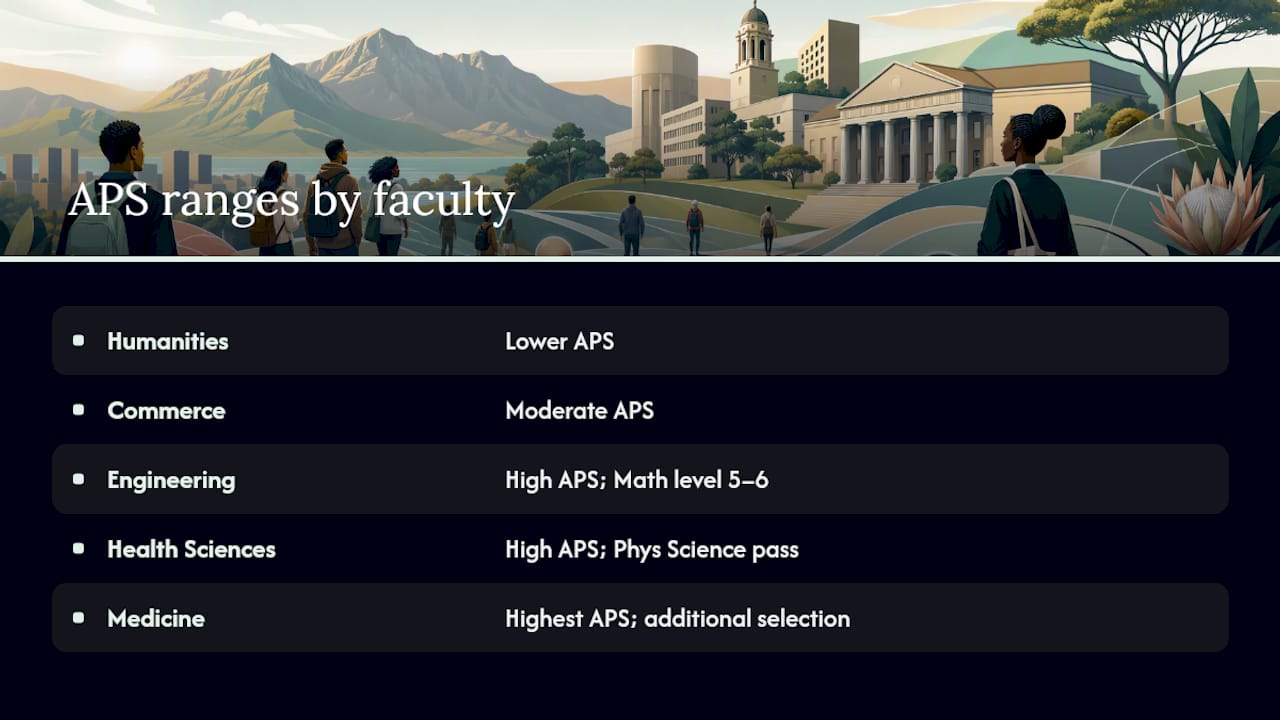
Your Admission Point Score, or APS, is the number universities calculate from your best six subjects (usually excluding Life Orientation) to decide whether you meet a programme’s minimum threshold. Every institution weights subjects slightly differently, so the same set of marks can produce different APS figures depending on where you apply.
Rough faculty ranges give you a sense of where you stand, though they shift year to year and by institution:
Universities set different Admission Point Score ranges by faculty, with Humanities and social sciences requiring lower scores than Commerce, Engineering, Health Sciences, and Medicine, which also often require additional selection criteria.
Beyond APS, most programmes set subject-specific minimums. Engineering degrees commonly demand a Mathematics level of 5 or 6, while health science programmes often require a specific pass in Physical Science on top of Mathematics. Universities issue conditional offers based on your Grade 11 or mid-year Grade 12 marks, then confirm the place once your final NSC results land in January, a process the University of Pretoria outlines clearly for prospective students.
If you completed school outside South Africa, you’ll need a SAQA evaluation to convert your qualification into an equivalent NQF level, and that process commonly takes four to eight weeks. Start it well before the application window closes.
Pro Tip: Run your actual marks through Asksmarty’s APS calculator before you apply anywhere. It shows you which programmes you already qualify for, so you stop guessing at faculty ranges and start applying to places you can genuinely get into.
What documents do you need and what trips people up?
Universities ask for a fairly standard document set, but the details around certification cause more rejections than weak marks ever do.
- Certified copy of your ID or passport
- Recent Grade 11 or Grade 12 results (whichever the university requests)
- Proof of residence
- Certified translations, if any document isn’t in English or Afrikaans
- Passport photos, where the specific programme requires them
The certification rule catches out more applicants than any other requirement. Certified copies are generally only accepted if they’re stamped within the last three months by a Commissioner of Oaths, a Notary Public, or a police station. A certified ID copy from two years ago, even if nothing on it has changed, gets rejected on age alone.
Upload files as PDF or JPEG/PNG, keep file sizes within the portal’s stated limit, and keep a backup copy on a USB drive or in cloud storage. Before you submit, check that your name is spelled identically to how it appears on your exam registration. A mismatched middle name or a missing hyphen has held up more applications than it should.

Pro Tip: Get your documents certified the week you plan to apply, not months in advance. A certified copy that’s fine in April can be too old by the time you actually submit in July.
Do you need to write the National Benchmark Test?
The NBT measures academic and quantitative literacy and it’s a separate requirement from your NSC subjects. Several universities, including UCT, Stellenbosch, Wits and the University of Pretoria, require it for specific faculties, particularly engineering, commerce and health sciences, according to guidance from FundiConnect.
- Register directly at nbt.ac.za, not through your university’s own portal.
- Sessions run online and remotely in many cases, but slots fill fast around peak application months.
- Book as soon as you know your target programme requires it. Waiting until the deadline often means no slots left in your area.
- Universities combine your NBT score with your APS during selection, so a strong APS doesn’t automatically offset a weak NBT result.
How do residence and NSFAS applications fit together?
Residence applications and NSFAS funding are two entirely separate processes, and treating them as one is where a lot of students lose time.
- Apply to your university first and secure your official application reference number. Everything else depends on this.
- Apply for residence around the same time as your academic application. Universities weigh academic merit, financial need and distance from home, and residence spaces are limited enough that early applications matter.
- Apply to NSFAS once you have that university reference number in hand. NSFAS windows commonly open in September and close in November for the following academic year, and a confirmed reference number is a hard requirement before your funding application can be finalised.
- Keep every reference number from both processes somewhere you won’t lose it. NSFAS and university systems will ask you to quote them repeatedly.
What happens after you submit your application?
Once you’ve applied, check your status regularly through the university’s own portal rather than waiting for an email that might land in spam. Status updates usually move from “received” to “under review” to “conditional offer” or “unsuccessful.”
- If you accept an offer, note the deposit deadline. Missing it can mean losing the place to someone on the waiting list.
- Accepting multiple offers at once is legal but risky. Universities expect a final decision, and holding several spots can delay other applicants.
- Submit your final NSC results as soon as they’re released in January so your conditional offer can be confirmed and registration completed in January or February.
- If you missed a deadline entirely, ask about late or supplementary application windows, formal appeals processes, or apply to a TVET college as a backup route.
Nkosi’s perspective: cut the guesswork out of applying
Most application stress isn’t about the marks. It’s about not knowing which portal to use, whether a programme is realistic, or whether a document will get bounced back for being a week too old. Having guided South African applicants through this process for years, I’ve found the students who struggle least aren’t the ones with the highest marks. They’re the ones who checked their numbers early and applied with a plan.
Run your marks through Asksmarty’s APS calculator before you touch a single application form. Your marks stay on your device, nothing gets uploaded or processed, and you walk away with a realistic list of programmes instead of a guess based on a faculty range you read somewhere. Save that list. It becomes your application roadmap for the next few months.
— Nkosi
Check your APS and find your programmes on Asksmarty right now
Asksmarty is the free route to a clear application plan, not another portal you have to register on. You get an APS calculator that works off your actual marks, a searchable database of over 1,700 programmes across South African universities and colleges with current entry requirements and deadlines, and direct links to each institution’s own application portal so you’re never guessing where to click next.
Your marks never leave your device, there’s no processing fee attached to a programme match, and you don’t need to create an account just to see what you qualify for. Start with the APS calculator to see your realistic options, then browse the programme database to shortlist where to apply, and check admission requirements for the specific NBT and subject rules that apply to your target course before you submit anything.
Where to check deadlines and requirements yourself
Verify details directly at the CAS learner guide for central applications, nbt.ac.za to book your test, the official NSFAS site for funding, and each university’s own admissions page for programme-specific rules.
Sources
- Gov
- How to apply undergraduate studies — Stellenbosch University
- Important information for prospective students — University of Pretoria
FAQ
When should I apply to university in South Africa for 2026?
Applications for the following year’s intake typically open from 1 April, and you should apply with your Grade 11 or mid-year Grade 12 results rather than waiting for final marks.
What is the Central Application Service and do I have to use it?
CAS is a DHET pilot portal letting you apply to participating institutions from one application, but many universities still require direct applications through their own websites, so confirm participation first.
How do I check my APS before applying?
Use a tool like Asksmarty’s APS calculator, which converts your actual subject marks into an APS score and shows programmes you already qualify for without uploading your results anywhere.
Do all universities require the National Benchmark Test?
No. Requirements vary by faculty and institution, with programmes in engineering, commerce and health sciences at universities like UCT, Stellenbosch and the University of Pretoria commonly requiring it.
When should I apply for NSFAS funding?
NSFAS applications typically open in September and close in November, but you need a confirmed university application reference number before you can complete that application.
Recommended
Published 2026-08-28 · AskSmarty is an independent guide. Confirm anything time-sensitive on the official source.