South African university open days 2026: dates and next steps
Discover the 2026 university open days in South Africa, including dates and how to engage with faculties for your future studies.
South African universities ran scheduled open days throughout 2026, with many of the largest events falling in the middle of the year. UCT’s main open day took place on Saturday 25 April 2026, running from 10:00 to 15:00. If that date has passed for your target university, you still have options: virtual sessions, recorded faculty talks, and direct departmental contact can all keep your application moving.
Your three immediate next steps:
- Check the official admissions or open-day page for each university you are considering (links in the sources section below).
- Look at faculty-specific pages separately — some faculties require their own registration, independent of the main event.
- Use the Asksmarty APS calculator to confirm which programmes you qualify for before you attend or follow up.
Pro Tip: Register for faculty sessions as soon as dates are announced. Health Sciences, Medicine, and Engineering sessions fill up fast and sometimes close weeks before the main open day.
Key takeaways
South African university open days in 2026 followed a Q2 pattern, with UCT’s main event on 25 April setting the template — but missed dates are recoverable through virtual sessions, recorded talks, and direct faculty contact.
| Point | Details |
|---|---|
| UCT open day date | UCT’s 2026 main open day ran on 25 April 2026, 10:00–15:00, with concurrent faculty sessions. |
| Faculty registration | Some faculties (e.g., Health Sciences) require separate registration — check faculty pages weeks ahead. |
| Deadline variation | Application deadlines vary by institution and faculty; health-related programmes often close earliest. |
| Missed open day | Recorded sessions, virtual Q&As, and direct faculty e-mail are all viable alternatives. |
| Asksmarty tools | The free APS calculator and programme finder at asksmarty.co.za help you match marks to programmes immediately. |
Table of Contents
- Where can you find 2026 open-day dates and register?
- Key 2026 open-day timing and the deadlines you must watch
- What should you and your family actually do on the day?
- What UCT’s 2026 open day looked like — and what it means for other universities
- What to do if you missed an in-person open day
- Tools that help you act after an open day
- What students actually get wrong at open days
- Asksmarty makes the post-open-day step straightforward
- Sources
- FAQ
Where can you find 2026 open-day dates and register?
The most reliable source is always the university’s own admissions or open-day landing page, not a third-party summary. Universities publish event pages, registration forms, and faculty schedules there first. Check the timestamp on any page you find — an undated post from a previous year can look current and mislead you.
Where to look, in order of reliability:
- Official admissions page: search “[university name] open day 2026” and go directly to the .ac.za domain result.
- Faculty pages: faculties like Health Sciences often publish their own event pages with separate registration forms. UCT’s Health Sciences faculty did exactly this in 2026.
- University news and announcements: UCT News, UJ’s events page, and NWU’s open-days portal all carry confirmed dates and schedules.
- Official social channels: universities post reminders and last-minute changes on their verified Facebook and Instagram accounts.
- Mailing lists: signing up via the admissions page usually gets you a registration confirmation and a reminder closer to the date.
If registration for a session is already closed, e-mail the faculty office directly and ask whether a waitlist exists or whether a virtual equivalent is scheduled. Most admissions offices respond within a few working days during application season.
For recorded sessions, check the university’s official YouTube channel. UCT, UJ, and Stellenbosch have all published faculty talks and campus tour footage that remain accessible after the live event.
Key 2026 open-day timing and the deadlines you must watch
Most major South African universities scheduled their main open days in Q2 2026, typically between March and June. UCT’s 25 April date fits that pattern squarely. The University of Fort Hare ran postgraduate open-day events later in the year, in July and August, showing that the calendar extends well beyond mid-year for some applicant groups.
The timing of the open day, however, is not the same as the application deadline, and confusing the two is one of the most common mistakes learners make.
| Event type | Typical 2026 window | Notes |
|---|---|---|
| Main university open days | March–June | Most large universities; concurrent faculty sessions |
| Faculty-specific sessions | Same day, separate sign-up | Health Sciences, Engineering, Law often require own registration |
| Postgraduate open days | July–August | Fort Hare and others; separate from undergraduate events |
| Application deadlines | Varies widely by institution and faculty | Some programmes closed as early as April; others accept late applications |
| NBT registration | Linked to application deadlines | Check faculty requirements — some programmes require NBT scores |
Deadlines vary by institution and by faculty, and many health-related programmes close earlier than the general university deadline. Missing a faculty-specific deadline for Medicine or Health Sciences is not recoverable the way a general late application sometimes is.
Deadline checklist:
- Confirm the faculty application deadline on the faculty page, not just the university homepage.
- Check whether your target programme requires an NBT score and when the next sitting is.
- Note residence and financial aid deadlines — these are often earlier than the academic application deadline.
- Search for late-application windows if the main deadline has passed.
What should you and your family actually do on the day?
Arrive early. At multi-faculty events, sessions run concurrently, and missing the 10:00 start at a popular faculty can mean missing a mandatory admissions Q&A that does not repeat.
Priority tasks for the day:
- Attend the faculty session for your target course first, before general campus tours.
- Visit the student funding and bursary stand — NSFAS, university bursaries, and external funders often have representatives on site.
- Stop at the residence information stand, especially if you are coming from outside the city.
- Join a library or lab tour if your target faculty offers one; it gives you a realistic picture of the study environment.
- Attend an admissions clinic if one is running — these are the best place to ask about APS requirements, late applications, and recognition of prior learning.
Questions worth preparing in advance:
Ask deans and heads of department about assessment methods (exams vs. continuous assessment), typical class sizes, and graduate employment or placement rates. Ask student representatives what the workload genuinely looks like in first year. Ask the residence office about application timelines and costs.

Logistics: bring your ID, a printed copy of your latest school report or transcript, a notebook, and comfortable shoes. Campus shuttles run between sites at large universities, but peak times between popular faculties and residences get crowded. Plan your route before you arrive.
Pro Tip: Download the campus map the night before and mark the three sessions you cannot miss. Treat those as fixed appointments and fit everything else around them.
What UCT’s 2026 open day looked like — and what it means for other universities
UCT’s 2026 Open Day ran on 25 April from 10:00 to 15:00 and included dean presentations, concurrent faculty Q&A sessions, admissions clinics, NBT information sessions, and organised tours of residences and the library. The Health Sciences faculty ran its own programme simultaneously, with demonstrations and facility access available only on specific guided tours.
This structure is common across large South African universities. Wits, Stellenbosch, and the University of Pretoria all run similar multi-faculty formats where sessions overlap and some require advance booking. The practical implication: you cannot attend everything, so prioritise the faculty session for your first-choice programme and treat everything else as secondary.
What to do if you missed an in-person open day
Missing the main event is not a dead end. Most universities offer at least one of the following, and often several.
Immediate alternatives:
- Watch recorded faculty sessions on the university’s YouTube channel.
- Register for a virtual open day or online Q&A — many universities schedule these after the main event.
- Book an individual campus tour through the admissions office.
- Download the prospectus and faculty handbook from the university’s website.
- Contact the faculty office directly by e-mail to ask specific questions about entry requirements and application status.
Step-by-step for the week after a missed open day:
- Identify the two or three programmes you are most seriously considering.
- Download the relevant prospectus or programme guide from each university’s site.
- E-mail the faculty admissions contact with your specific questions (APS requirements, NBT, portfolio requirements if applicable).
- Register for the next virtual session or webinar if one is listed.
- Check whether a late application window is still open for your target institution.
If your target faculty is Medicine, Health Sciences, or Engineering and the deadline has passed, contact admissions immediately. Ask directly whether any places remain, whether a waiting list exists, and what the process is. Do not assume the answer is no without asking.
Tools that help you act after an open day
An open day generates a lot of information quickly. The practical challenge is turning that into a concrete application plan before the momentum fades.
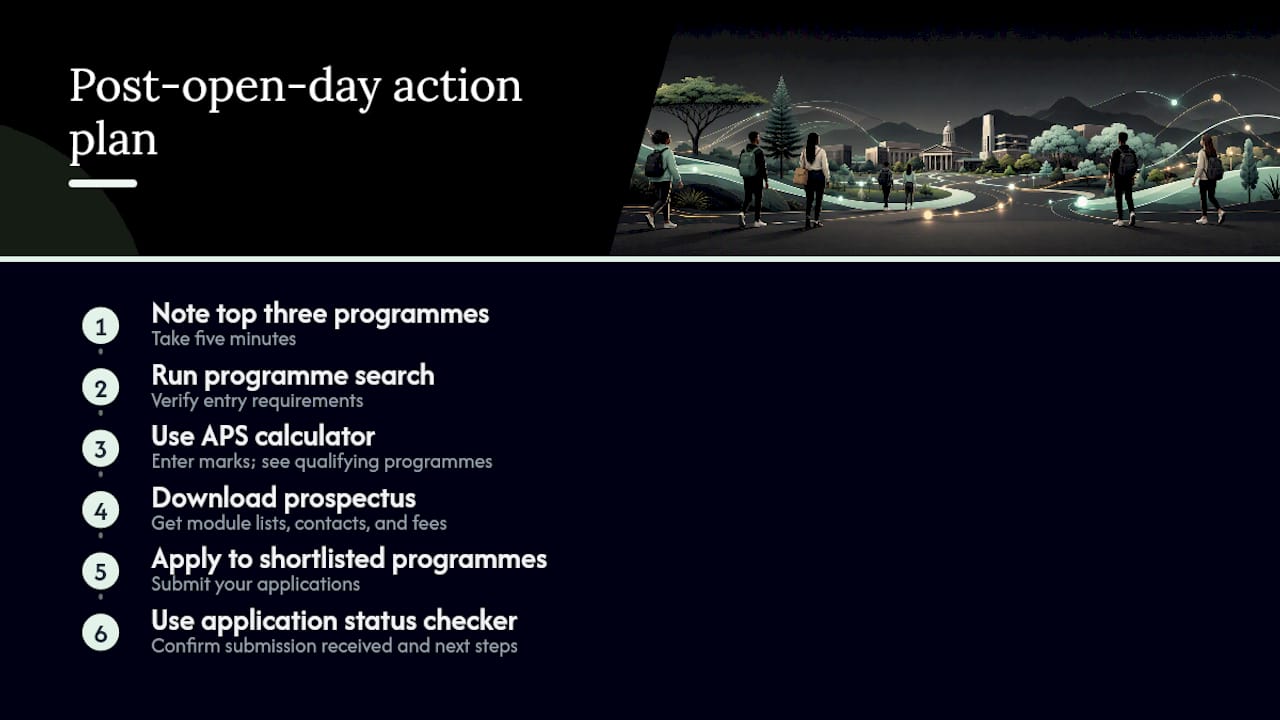
The Asksmarty APS calculator lets you enter your current or projected marks and immediately see which programmes across South Africa you qualify for. That single step replaces hours of cross-referencing faculty handbooks. The programme search tool lets you filter by field of study, institution, and entry requirements, so you can shortlist programmes that match what you learned at the open day.
Prospectus downloads on Asksmarty give you module lists, contact details for faculty offices, and application fee information in one place. After you have applied, the application status checker lets you confirm whether your submission was received and what the next step is.
Pro Tip: Right after an open day, take five minutes to note the three programmes that interested you most. Then run each through the Asksmarty programme search to verify entry requirements while the details are still fresh.
What students actually get wrong at open days
Most learners spend too much time at the general admissions stand and not enough time in faculty sessions. The general stand tells you how to apply. The faculty session tells you whether you actually want to study there.
The second common mistake is ignoring residence and funding information. For many students, the question of whether they can afford to live on campus is as important as whether they qualify academically. Both answers are available on the day, but only if you go looking.
Students who do those three things leave an open day with a clear shortlist. Students who do not leave with a brochure and no plan.
Save every piece of information you collect — event programmes, faculty contact cards, and any notes from Q&A sessions. You will need those details when you sit down to complete your application.
Asksmarty makes the post-open-day step straightforward
After a day of campus tours and faculty sessions, the next move is checking where your marks actually qualify you. Asksmarty’s free APS calculator does that instantly, without storing your marks or charging anything. The programme finder then lets you search over 1,700 programmes across South African universities and colleges, filtered by your results and field of interest.
For students researching specific universities, Asksmarty’s institution pages cover entry requirements, deadlines, and application fees in one place — including the University of Pretoria, Stellenbosch, UNISA, and others. No registration required. Check your eligibility and download a prospectus at Asksmarty.
Sources
- UCT Open Day 2026 | University of Cape Town
- UCT Open Day 2026 – Faculty of Health Sciences | Faculty of Health Sciences
FAQ
Which SA universities are still open for 2026 applications?
Deadlines vary by institution and faculty, and some programmes have already closed. Check the official admissions page for each university you are considering, as late-application windows differ and some faculties accept applications on a rolling basis.
When was the UCT open day in 2026?
UCT’s main open day ran on Saturday 25 April 2026, from 10:00 to 15:00, with concurrent faculty sessions, admissions clinics, and NBT information available on the day.
Do I need to register separately for faculty sessions?
Yes, for some faculties. UCT’s Health Sciences faculty required its own registration for 2026 sessions, separate from the general open-day sign-up. Always check the faculty page directly, not just the main university open-day page.
Which SA universities are open for 2027 applications?
Most universities open their application portals in the second half of the year, typically between April and September. Check each university’s admissions page directly, or use the Asksmarty universities overview to find institution-specific deadlines and application links in one place.
Recommended
Published 2026-08-11 · AskSmarty is an independent guide. Confirm anything time-sensitive on the official source.